
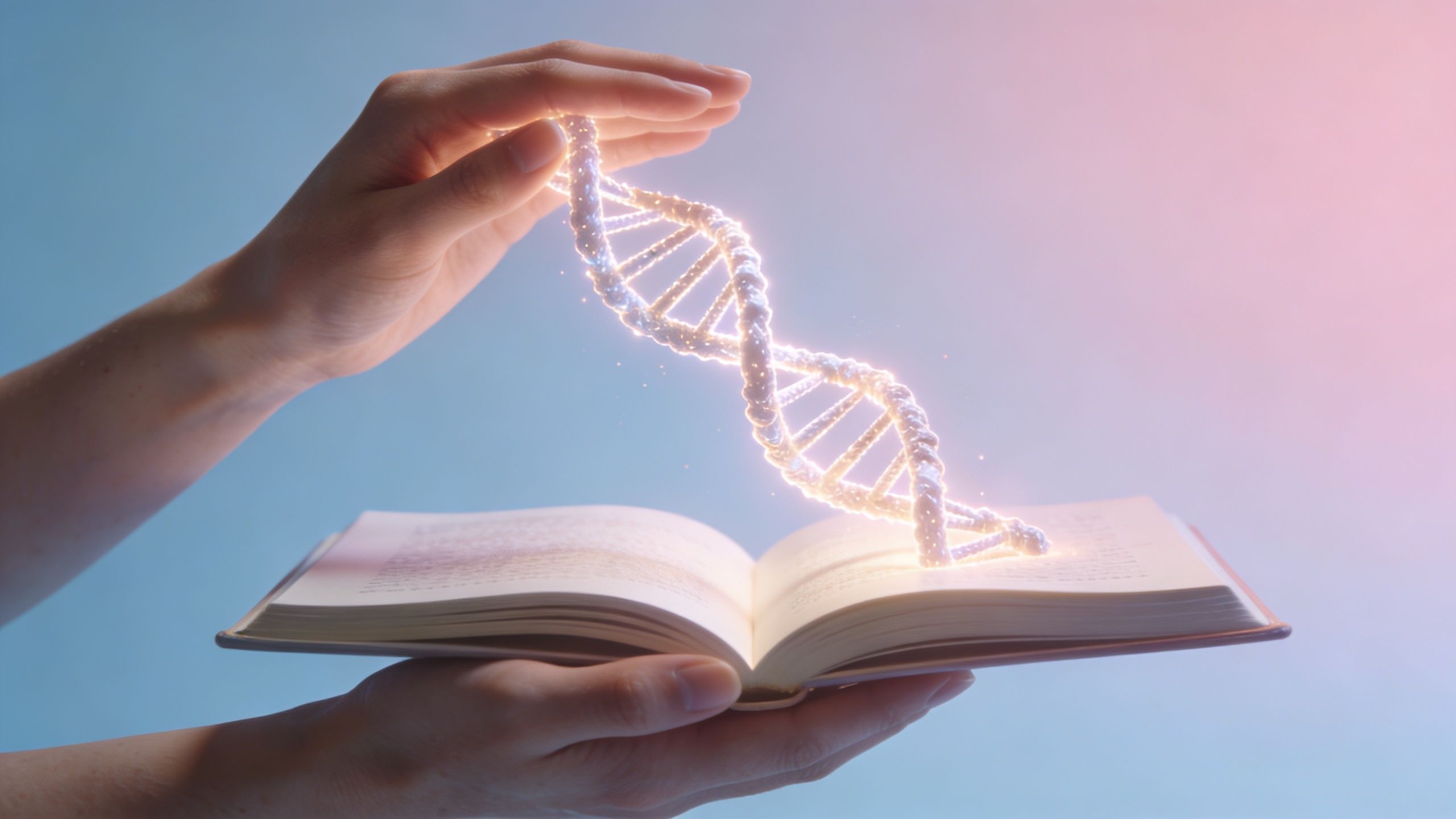
What is DNA? Your genetic blueprint explained simply
You pay attention to your diet and may try less sugar, more protein, or longer breaks between meals. Even so, your body sometimes seems not to respond to standard advice the way you expect. This is exactly where the question becomes interesting: What exactly is DNA, and what does it have to do with your everyday life?
The short answer is: DNA is your body's biological blueprint. The longer answer is much more interesting because it explains why two people can respond very differently to the same diet. Once you understand how DNA works, abstract biology suddenly becomes something very practical.
Why your DNA is the key to your health
Many people recognize this pattern. One person loses weight quickly during a classic low-carb phase, while another feels permanently tired and experiences intense cravings. Someone feels great eating lots of oats and fruit, while someone else does not stay full for long on the same foods. It is easy to conclude that your body is complicated or that you are doing something wrong.
Often, however, the problem is much more straightforward. One-size-fits-all solutions do not take your biological starting point into account. In Germany, around 54% of adults are overweight, and 67% of Germans who have tried to lose weight report feeling frustrated. The linked explanation cites the fact that standard diets often overlook genetic differences as a possible reason; this is discussed by DocCheck in its article on DNA and personalized nutrition.
Why standard advice is often not enough
Your body processes food based on more than just a calorie table. It uses enzymes, hormones, transport pathways, and regulatory mechanisms. Some of these are influenced by your genes. This does not mean that your genes determine everything. But it does mean that they set the framework in which diet, exercise, sleep, and stress have an effect.
Practical rule: If a nutrition plan sounds good in theory but consistently feels wrong for you, it may be worth looking at your individual biology instead of criticizing yourself even more.
What your DNA can influence in everyday life
DNA is particularly relevant when it comes to metabolism. In other words, questions such as:
- Carbohydrates: How well do you cope with eating lots of starchy foods?
- Fats: Do you feel stable or rather sluggish on a high-fat diet?
- Satiety: Do you eat “reasonably well” and still not feel properly full?
- Response to routines: Do you benefit more from structured meals or more flexible patterns?
That is precisely why “what is DNA” is not merely a school question. It is a health question. Once you understand that DNA is more than a term from biology class, you can start thinking about nutrition in a more personal and realistic way.
The blueprint of life: How DNA is structured
If you want to truly understand DNA for the first time, a simple image can help. Imagine that your body has a huge cookbook. This cookbook contains not recipes for pasta or soup, but instructions for skin, muscles, digestion, hormones, and many other functions. This cookbook is your DNA.
DNA has a characteristic shape often described as a double helix. You can think of it as a twisted ladder or a spiral staircase. The sides of this ladder consist of a stable backbone. The rungs carry the actual information.

The four letters of DNA
Genetic information is written using just four bases:
- Adenine
- Thymine
- Guanine
- Cytosine
These four building blocks function like the letters of an alphabet. Every DNA strand consists of these four bases, and they connect in fixed pairs. A pairs with T, and G pairs with C. According to the Wikipedia article on deoxyribonucleic acid, human DNA contains approximately 3 billion base pairs.
That sounds enormous. It is. And yet this complete blueprint fits inside the tiny cell nucleus of your cells.
What a nucleotide is
If you want to take a closer look, DNA consists of small units called nucleotides. Each nucleotide has three parts:
| Component | Simple explanation |
|---|---|
| Phosphate | Part of the outer backbone |
| Deoxyribose | A sugar building block in the backbone |
| Base | The letter A, T, G, or C |
This repetition is what makes DNA so clever. The same basic building blocks create a code capable of storing extremely complex information.
If you would like to understand the structural organization in even more detail and visually, you will find an additional explanation in the article on DNA structure at mybody-x.
The genius of DNA lies not in having many different building blocks, but in a simple language with clear rules.
Where readers often get confused
Many people confuse DNA, genes, and chromosomes. The simplest way to put it is:
- DNA is the material that genetic information consists of.
- A gene is a specific section of this DNA containing a particular set of instructions.
- A chromosome is tightly packaged DNA.
Once you clearly distinguish these concepts, genetics immediately becomes easier to understand. DNA is not simply “something in the cells,” but a precisely structured information system.
From code to trait: The function of DNA
A blueprint is useful only if someone reads it. The same is true of DNA. It not only stores information; it also provides the template for what your body produces. Above all, this involves proteins. These proteins perform countless tasks in the body. They build tissue, regulate reactions, and help process nutrients.

How DNA becomes a function
The cookbook analogy helps here too. A gene is like a single recipe. When the cell needs something specific, it does not use the whole book. It accesses only the relevant recipe.
The process can be simplified as follows:
- Step 1: A specific section of DNA is read.
- Step 2: The information is transferred into a usable working copy.
- Step 3: The cell builds a protein from this template.
It sounds technical, but it is essentially a translation process. A code is turned into a specific effect in the body.
Why so much information fits into so little space
DNA is an astonishingly dense storage medium. Theoretically, 1 gram of DNA could store up to 215 petabytes of data, as explained in the article about DNA as a data storage medium. That is why an organism's complete blueprint can fit inside a tiny cell nucleus.
The most important thing for your understanding is this: Your body does not work with rough instructions, but with enormously detailed information. That is why even small differences in the code can be noticeable in everyday life.
What this means for eye color, energy, and metabolism
Proteins influence visible traits such as hair or eye color. But they are just as important for invisible processes, including digestion, inflammatory responses, hormone balance, and energy production.
When people say, “My body simply reacts differently,” it is often not their imagination but biology.
Things become interesting where genes do not act in isolation. Your lifestyle also plays a role. Sleep, exercise, stress, and the environment influence how genetic information is used. If this interplay interests you, it is worth taking a look at epigenetics and the effects of the environment on genes.
Unique Like You: Inheritance, Mutations, and Individuality
The basic structure of DNA is the same in all humans. Nevertheless, no two people are alike. This is because the exact sequence of bases differs at many small points. These differences arise through inheritance and natural changes in the genetic code.
You receive genetic information from each of your parents. This creates a new combination that did not exist before. In addition, there are small variants and changes that often go unnoticed but can nevertheless play a role in metabolism or in how stimuli are processed.
Why Differences Are Nothing Unusual
Many people hear the word mutation and immediately think of something dangerous. In reality, genetic changes are first and foremost a normal part of biological diversity. Some have no noticeable effect. Others alter small details in the body.
In everyday life, the term genetic variant is often more helpful. It neutrally describes that your body is “coded” slightly differently in some places than another person’s.
How this became personalized analysis
The fact that we can systematically study such differences at all today has a scientific history. Nutrigenetics only became possible after James Watson and Francis Crick discovered the double-helix structure of DNA in 1953. In 1984, the first genetic fingerprint was developed. This development is described in Feragen’s overview of the history of DNA research.
That was more than just a milestone in the laboratory. It laid the foundation for genetic information to be relevant today not only to research or forensics, but also to everyday questions about nutrition and metabolism.
Small differences in DNA do not make you “defective.” They make you unique.
Your Genes on the Plate: DNA, Nutrition, and Metabolism
This is where DNA becomes truly tangible for many people for the first time. Food is part of everyday life. If genes influence how your body processes nutrients, that explains why two people can react very differently to the same meal.
Not every body handles carbohydrates, fats, or feelings of hunger in the same way. Some people do well with a higher-carbohydrate diet and remain stable. Others feel more balanced with more protein and a different meal structure. Such differences may be related to genetic variants that help shape metabolism.
What nutrigenetics means in everyday life
Nutrigenetics examines how genetic differences influence the body's response to nutrition. This is neither magic nor a fixed destiny. It is an additional layer that can help tailor nutrition more precisely to your own body.
Typical questions include:
- Carbohydrate tolerance: Do you tend to respond steadily or with significant fluctuations?
- Fat metabolism: How efficiently does your body use fat as an energy source?
- Satiety and appetite: Why is portion control easy for some people but hardly possible for others?
- Individual implementation: Which dietary approach feels manageable for you in the long term?
Anyone who wants to explore the concept in greater depth can find a good introduction in the article What Is Nutrigenetics and How Does It Shape Our Lives.
Why personalized plans often work better
Perhaps the most important point is not perfection, but practicality. A nutrition plan is of no use if you abandon it after a short time because it does not suit your body's sensations, your hunger, or your everyday life.
This is exactly where personalized nutrition becomes interesting. The information provided refers to studies showing that genetically tailored diets achieve 35% better adherence. This suggests that individualized plans are not only theoretically useful but often easier to stick to in everyday life.
What a DNA test can be useful for in nutrition
A DNA test for nutrition does not provide a magic formula. But it can organize questions that would otherwise remain unclear:
| Question | What genetic clues can contribute |
|---|---|
| Why do I struggle to stick to diets? | They can explain which eating structure suits you better |
| Why don't some meals make me feel full? | They can provide clues about appetite and metabolic patterns |
| Why don't standard plans work for me? | They help interpret general rules in a more personalized way. |
The goal is not to make eating more complicated. The goal is to make it more suitable.
Your personal nutrition code: the mybody® DNA Test
If you not only want to know what DNA is but also what my DNA means for me, you need a translation from the genetic code into everyday life. That is exactly where DNA nutrition tests come in.

How a DNA nutrition analysis works in practice
The process is usually much simpler than many people think. Instead of complicated doctor’s appointments, the sample is collected at home using a saliva sample. The sample is then analyzed in a laboratory and presented in an easy-to-understand report.
What matters here is not only data collection but also translating the results into concrete decisions. Questions such as: Which food structure might suit you better? Where should you take a closer look? And how can you put this into practice without juggling nutritional values every day?
What matters in a test designed for everyday use
A useful test should not stop at abstract genetic terms. It only becomes helpful when genetic insights are turned into practical recommendations for everyday life.
Pay attention to these points:
- Simple sample collection: The at-home process should be clear and accessible.
- Understandable analysis: Results must be worded so that you can use them without studying biology.
- Practical nutrition guidance: Recommendations that can be directly incorporated into meals and routines are particularly valuable.
- Data protection: For sensitive health data, pseudonymized processing and sample destruction are important criteria.
One example of this approach is the mybody-x DNA Nutrition Test with an individual cookbook and recipe book. The saliva sample is collected at home, analyzed in a laboratory, and translated into a report with personalized nutrition guidance. The practical component with a cookbook and recipe book is particularly relevant because it brings the results directly into everyday life. The article on DNA analysis at mybody-x also explains how such evaluations generally work.
Genetic knowledge is most valuable when it does not remain in a PDF but ends up on your plate.
Why the recipe book is more than an extra
Many people do not fail because of a lack of knowledge, but because of implementation. They understand in theory that they should eat in a way that suits them better, but they do not know what exactly to buy, cook, or prepare.
An individualized cookbook and recipe book fills this exact gap. It turns analysis into real action. Instead of general nutrition advice, you get dishes and structures that may better suit your metabolic profile.
Frequently asked questions about DNA analyses
Many people are curious about DNA tests while also being cautious. That makes sense. You should look closely, especially when it comes to health and data. Here are the questions that come up most often.

Can my DNA change
Your basic DNA remains the same. What can change is not the blueprint itself, but how your body uses individual pieces of information. That is precisely why DNA tests remain relevant as a baseline analysis, even if you improve your lifestyle later.
Does a DNA test tell me whether I will definitely become ill
No. A DNA test for nutrition is not a prediction of illness or a diagnosis. Rather, it shows genetic tendencies that should be considered together with lifestyle, sleep, exercise, and the environment.
What do I do with the result
The result is most useful when you derive specific habits from it—for example, your meal structure, food choices, or balance of carbohydrates, fats, and protein. A good report helps you set priorities instead of overwhelming you with details.
How secure is my data
Data protection is central when it comes to DNA data. Providers who transparently explain how samples are processed, whether they are pseudonymized, and what happens to the material after the analysis are a sensible choice. For many people, destroying the sample after evaluation is an important factor in building trust.
Good DNA analyses do not answer every health question. But they help you finally ask the right questions about your body more precisely.
If you no longer want to manage your body according to general nutrition rules, taking a personalized look at your genetics may be worthwhile. MYBODY Lab GmbH offers health analyses for DNA, metabolism, and nutrition that can be completed from home and translate genetic results into practical recommendations for everyday life.



Share now:
What are genes? Your blueprint for health & nutrition
L-Glutamine for Leaky Gut: Science & Effects 2026