
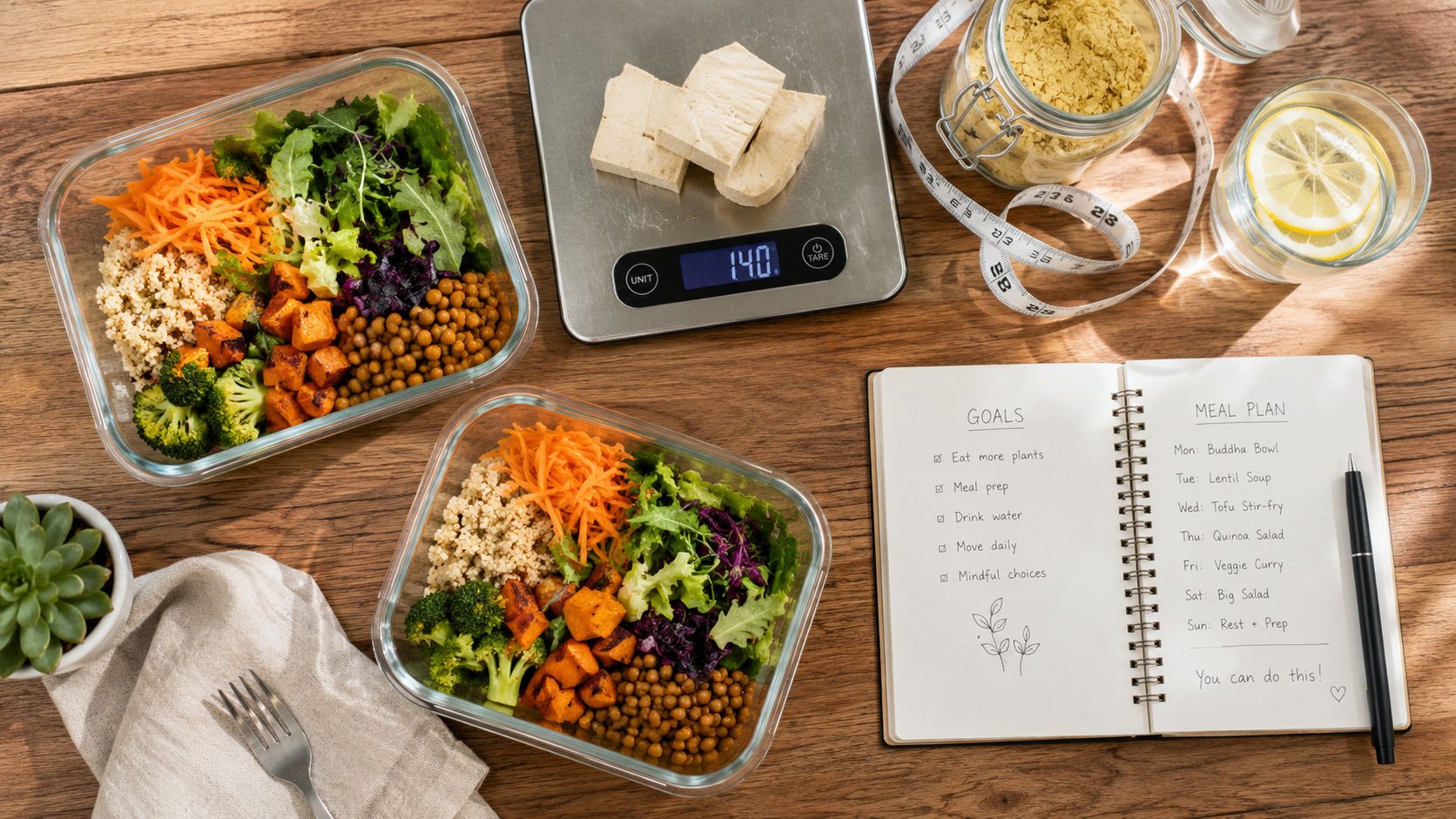
Vegan weight loss: Your step-by-step plan for 2026
You eat plenty of vegetables, cook fresh meals, shop plant-based, and make an effort. Yet your weight stays the same. This is exactly what many people experience when they want to use a vegan diet for weight loss and eventually realize, frustrated, that “healthy” does not automatically mean “effective for losing fat.”
The problem is often not a lack of discipline. What is frequently missing is a clear strategy. And with a vegan diet, there is another factor: Your body can function very well on a well-planned plant-based diet, but it reacts noticeably when important building blocks are missing. Then a sound eating style can quickly turn into a persistent plateau.
Why vegan weight loss often works differently than expected
Vegan weight loss sounds simple at first glance. More vegetables, more fiber, less fast food—surely the weight should come down. In practice, this often works only at the beginning.
Many vegan eating plans fail not because of the idea, but because of the implementation. If you mainly eat bread, pasta, plant-based spreads, smoothies, snacks, and processed foods, you may be vegan, but not necessarily eating in a way that encourages your body to release its fat reserves. In addition, some people are mindful of calories but eat too little protein, too one-sidedly, or with undetected nutrient deficiencies.
Healthy does not automatically mean effective
A plate can look very healthy and still be impractical for your goal. A large bowl of muesli with nut butter, banana, oat milk, and seeds provides valuable nutrients. But it may also contain little filling protein and be fairly energy-dense. Then you quickly get hungry again and eat more over the course of the day than you realize.
Anyone who wants to delve deeper will find a good foundation in the article about healthy vegan nutrition. However, “vegan and healthy” alone is often not enough for weight loss.
Vegan weight loss works best when you do not just replace foods, but also take your metabolism into account.
The metabolic blind spots
I often call these metabolic blind spots in consultations. They are things that are easy to overlook in everyday life:
- Too little protein. You get hungry more quickly and lose muscle more easily while in a calorie deficit.
- Too many liquid or soft calories. Smoothies, juices, latte drinks, and nut butters are often less filling than real meals.
- Undetected deficiencies. When B12, iron, zinc, iodine, or vitamin D levels are low, metabolism often does not function properly.
- Constant snacking. Even small vegan snacks add up.
Counting calories can help. But it is only a tool. If your plan works in theory but you feel tired, are constantly hungry, or are barely making progress despite your discipline, it is worth taking a closer look at the biochemistry.
What works better in practice
Not everyone needs a complicated system. What usually works better is a clear framework:
| Category | What often does not work | What is more likely to work |
|---|---|---|
| meals | snack constantly | a few filling main meals |
| protein | keep in mind on the side | consciously include with each meal |
| calories | just estimate | check briefly at first |
| nutrients | guess | check specifically if progress stalls |
When you approach vegan weight loss strategically, you work with your body rather than against it.
Laying the foundation: calories, needs, and goals
Without an energy deficit, no one reliably loses weight. This also applies to a perfectly planned vegan diet. Even so, you do not have to turn it into a mathematics project. Above all, you need a sensible starting value, a realistic goal, and the willingness to adjust later.

Understand your needs instead of reducing blindly
Your daily expenditure roughly consists of two parts:
- Basal metabolic rate. This is the energy your body needs at rest.
- Activity expenditure. This is everything added by daily life, steps, training, and movement.
For starters, a practical approach is enough. Use a calculator, determine your approximate needs, and then work with a moderate deficit. When you calculate your calorie needs, the goal is not to be accurate to the last calorie. It is about not starting too high or too aggressively.
How to set a realistic target
Many people make the mistake of cutting back drastically right away. It sounds determined, but often ends in intense cravings, fatigue, and loss of control. A gentle start is more sustainable.
In practice, this means:
- Start with your estimated maintenance requirement.
- Subtract a moderate deficit.
- Follow this consistently for a set observation period.
- Only then assess your weight, hunger, energy, and satiety.
Practical rule: Your calorie target is a starting point, not a prison. If your sleep, satiety, or daily life suffer because of it, the plan was too strict.
Goals that remain sustainable in everyday life
A good goal is not just “weighing less.” It also means feeling fuller, snacking less, maintaining muscle, and preserving your performance in everyday life. That is why a vegan weight-loss strategy is about more than simply eating less.
For people who want to take a highly individualized approach, a genetic perspective may also be interesting. The NutriCare | INFINITY DNA Test analyzes genetic nutrient utilization, food intolerances, micronutrient requirements, and metabolic type. It is not a substitute for a nutrition plan, but it can provide additional insights into how your body responds to food.
A simple weekly check-in
Instead of driving yourself crazy every day, evaluate your plan using a few questions:
- Are you constantly hungry? Then the calorie deficit is often too large, or the meals are not very filling.
- Do you feel drained? Then your calorie intake, protein, sleep, or nutrient status often needs adjusting.
- Are you sticking with it in everyday life? A plan that works for only three days is not a good plan.
- Is your eating behavior changing? Less intense cravings are often a better sign than simply looking at the scale.
That provides the foundation. Without this foundation, losing weight on a vegan diet quickly becomes chaotic.
The vegan protein and macro strategy
The most common obstacle when losing weight on a vegan diet is not a lack of willpower, but too little protein. Many people consume enough carbohydrates and often enough fat too, but their protein intake falls well short of what would be beneficial for satiety, muscle retention, and a calm appetite.

Why protein makes such a big difference when losing weight
Protein serves several purposes when losing weight. It is noticeably more filling than many quickly digested snacks. It helps protect muscle mass while in a calorie deficit. And it gives meals more structure because you plan more consciously instead of eating only side dishes.
Knowing your daily protein requirement automatically helps you plan meals more purposefully. In practice, this often reduces the constant urge to look for something sweet or “just one more little thing.”
Good vegan protein sources for everyday life
Not every plant-based meal is automatically high in protein. Salad, vegetable stir-fry, or porridge can be healthy, but without smart additions they often provide too little.
Particularly helpful are:
- Tofu and tempeh. Practical, versatile, and easy to portion.
- Lentils and beans. Filling and ideal for bowls, stews, or curries.
- Chickpeas. Work well in hot dishes, salads, and spreads.
- Plain soy yogurt. Useful as a breakfast base or snack.
- Edamame. Quick, uncomplicated, and rich in protein.
- Whole grains plus legumes. A simple combination with good nutritional value.
How to combine macros sensibly
Many vegan plates consist of a large carbohydrate source, some vegetables, and a small protein side. For weight loss, the opposite approach is often better: Plan the protein first, then the vegetables, and finally add an appropriate energy source.
A simple meal-building framework:
| Building block | Good choices |
|---|---|
| Protein base | Tofu, tempeh, lentils, beans, soy yogurt, edamame |
| Volume | Broccoli, zucchini, mushrooms, cucumber, tomato, leafy greens, cabbage |
| Filling carbohydrates | Potatoes, brown rice, quinoa, oats, whole-grain bread |
| Use fats deliberately | Nuts, seeds, tahini, avocado, oil |
If a vegan meal leaves you hungry again after two hours, it was often not just because of the carbohydrates, but because it contained too little protein and lacked structure.
Concrete meals that work in practice
Rather than staying abstract, here are dishes that work well for many people:
- Lentil dal with brown rice and spinach. Warming, filling, and easy to prepare in advance.
- Tofu scramble with black beans and vegetables. Works in the morning, at lunchtime, or in the evening.
- Bowl with quinoa, edamame, cucumber, red cabbage, and baked tofu. Highly filling and easy to plan.
- Chili made with beans, tomatoes, and textured soy protein. Practical for several days.
- Soy yogurt with berries, oats, and hemp seeds. Quick and much more sensible than a sweet standard breakfast.
If a B deficiency is detected in tests, a targeted product may be useful. Vitamin B Complex | Energize provides all 7 B vitamins in an optimal dosage for energy, the nervous system, and metabolism and is particularly recommended when a B deficiency has been confirmed by a blood or DNA test.
The most common mistakes and how to avoid them
Many people fail to lose weight on a vegan diet not because they lack motivation, but because of three recurring thinking errors. The diet looks clean, intentional, and plant-based. Yet the overall approach is off.
The good news: These errors can usually be clearly identified and corrected directly.

Mistake one when trying to lose weight on a vegan diet
The first stumbling block is the processing trap. Vegan substitutes are not inherently bad. But many people rely too heavily on burgers, nuggets, desserts, bars, spreads, and ready-made meals. This saves time, but often makes losing weight more difficult.
These products are often energy-dense while also being less filling. You eat vegan, but not automatically in a way that supports your calorie deficit.
This principle is more useful:
- Build meals around whole foods. Vegetables, legumes, potatoes, whole grains, tofu, tempeh.
- Use convenience products as a supplement. Not as a daily main strategy.
- Choose simple dishes. The clearer a meal is structured, the easier it is to stay in control.
Mistake two when trying to lose weight on a vegan diet
The protein gap is deceptive because it is barely noticeable at first. Many people appear to eat lightly and healthily during the day, but end up snacking repeatedly or eating large portions in the evening. Carbohydrates are often blamed, even though the real problem was a lack of satiety.
Typical signs include:
| Note | What is often behind it |
|---|---|
| constant appetite | low-protein meals |
| fatigue after eating | unbalanced meal composition |
| late-night cravings | eating too little during the day |
| inconsistent control over eating | lack of structure instead of lack of discipline |
Mistake three when trying to lose weight on a vegan diet
The third and most underestimated point is nutrient blindness. Many people do everything right, but no one ever checks whether the body actually has the necessary conditions for an active metabolism.
With vegan diets in particular, I repeatedly see the same critical areas: B12, iron, zinc, iodine, and vitamin D. When these levels are low, many people report fatigue, reduced stamina, poorer recovery, or a lack of progress despite a calorie deficit.
Anyone who controls only calories but overlooks nutrient deficiencies is often working against an invisible brake.
A clear example from practice: A vegan client in her early thirties had been eating plant-based for several years but was making little progress despite a healthy diet. The test revealed a B12 deficiency, low iron, and inadequate protein intake. After following an individually tailored vegan plan with targeted supplementation, she lost 5 kg within ten weeks. Without going hungry.
This isn’t a free pass for every plateau. But it shows how often it’s not a lack of willpower, but the right diagnosis that’s missing.
When your metabolism needs a check-up
There comes a point when being even more disciplined no longer helps. If you have your meals under control, maintain a clear calorie deficit, and are still stuck, a check-up is worthwhile.
Not as a lifestyle gimmick, but as a strategic tool.

The five markers I take especially seriously when losing weight on a vegan diet
For people trying to lose weight on a vegan diet, I pay particular attention to these five micronutrients:
- Vitamin B12. Important for energy metabolism and performance.
- Iron. Low iron status is often associated with fatigue and reduced resilience.
- Zinc. Relevant to many metabolic processes.
- Iodine. Plays a role in thyroid function.
- Vitamin D. A low level often only becomes apparent at a late stage.
When these areas are not in balance, people often report feeling “like they’re being held back.” That’s exactly why a metabolism test and check-up can make sense if no progress occurs despite good adherence.
What tests can and cannot do
Lab tests aren’t a shortcut that replaces bad habits. Nor do they solve a weight problem on their own. But they eliminate the guesswork.
That is the real benefit:
- You test instead of assuming.
- You supplement strategically instead of guessing.
- You recognize why a plan is theoretically sound but doesn’t work in practice.
Especially with recurring plateaus, this is often the difference between continued frustration and a well-founded course correction.
If you want to take an even more personalized approach
In addition to traditional blood markers, the genetic perspective can also be interesting. Some people noticeably respond differently in everyday life to carbohydrate amounts, fat distribution, appetite regulation, or nutrient requirements. This doesn’t explain everything, but it can provide additional guidance.
This is where a provider such as MYBODY Lab GmbH can be one piece of the puzzle. The company offers at-home health analyses for DNA, metabolism, and nutrient status. For people who want to take a data-driven approach to vegan weight loss, such an analysis can help them build a more precise plan.
A good test doesn’t tell you what to eat. It shows you what you should take a closer look at.
How to tell that testing makes more sense than dieting even harder
In practice, these situations often indicate that a check-up may be worthwhile:
- You follow your plan, but nothing changes.
- You become exhausted quickly or often feel cold.
- You train, but you recover poorly.
- You have been vegan for some time but have never had your nutrient status checked.
- Your hunger is difficult to control, even though you eat in a structured way.
Then the next app or the next diet rule is no longer what matters; clarity is.
Measure success and adjust the plan
A good vegan weight-loss plan does not end with the scale. It also shows in how you feel in everyday life, how stable your eating habits have become, and whether you can maintain your routine over the long term.
So measure progress more broadly. Do your clothes fit more loosely? Do you stay full longer after meals? Do you feel more at ease mentally because food is no longer constantly on your mind? These are often signs that your plan is truly working.
Adaptation matters more than perfection
Your body does not stay the same. When you lose weight, your energy needs usually change as well. What worked well at first may later be too much or too little.
In practice, this means:
- Reassess your calorie intake regularly instead of sticking to outdated values for months
- Review your meals when hunger or cravings for snacks return
- Maintain your protein intake and daily structure, even when your weight is already dropping
- Review your nutrient status when your energy and progress suddenly decline
What realistic expectations look like
Not every body responds at the same speed. In practice, an individualized plan with targeted nutrient optimization often results in an average loss of 4 to 6 kg of body fat in three months when followed consistently. More importantly, this change is much more stable when the plan is based on test results rather than assumptions.
That is exactly what vegan weight loss is about. Not deprivation at all costs, but a system that suits your body. First, establish a sensible calorie deficit, then develop a good protein strategy, and finally look at possible nutrient-related obstacles. That is how frustration turns back into direction.
If you no longer want to approach vegan weight loss by guesswork but instead based on real measurements, a data-driven approach may be worthwhile. MYBODY Lab GmbH offers analyses of nutrient status, metabolism, and DNA that can help you assess plateaus more precisely and tailor your nutrition plan more individually.



Share now:
The 7 Metabolic Types: What’s Really Behind Them
Vitamin D and magnesium: They only work together