
Is it healthy to drink electrolytes every day?
Electrolyte powders and drinks have become a trend—many people now drink them every day, assuming they are doing something good for their health. But is that really true?
For most healthy people with a balanced diet, it is not necessary to drink electrolytes every day—and it may even be unfavorable. The body regulates its electrolyte balance itself, and a normal diet generally provides enough. Daily consumption can lead to an unnecessarily high sodium intake in particular; many products also contain plenty of sugar. Daily intake is useful only for certain groups—for example, during intensive endurance training or in cases of heavy, regular sweating.
It is best to read this article as an overview: First, you will get the clear answer, then you will learn why daily electrolytes are unnecessary for most people, what risks excess intake carries—and for whom daily consumption may nevertheless be useful.
What to expect in this article
Where Does the Electrolyte Hype Come From?
Why Daily Electrolytes Are Unnecessary for Most People
What are the risks of daily consumption?
Who might benefit from daily electrolytes?
What to look for in electrolyte products
Electrolytes from food instead of from a bottle
Know your mineral status
Context: What a test can—and cannot—do
Conclusion
Frequently asked questions (FAQ)
Sources
Whether daily electrolytes are useful for you depends greatly on your situation. This overview covers the most common cases—as an initial guide, not individualized advice:
| Who you are | Useful every day? | Note |
|---|---|---|
| Healthy, normally active | Usually no | Diet meets the need; water is sufficient |
| Recreational exercise (moderate) | Usually no | Only useful for long or hot sessions |
| Intense endurance exercise | Often yes | High loss of sweat and sodium |
| Physical work in hot conditions | Often yes | Regular heavy sweating |
| Medical condition / medication | Only under medical supervision | Clarify individually; do not determine the dosage yourself |
Anyone who consumes electrolytes every day without needing them is primarily risking these four issues:
Too much salt
Many people already consume too much sodium—more every day is more likely to raise blood pressure.
Hidden calories
Many processed products contain sugar that you do not need in everyday life.
Too much of a good thing
An excess of individual minerals can disrupt the balance—especially if you have pre-existing conditions.
Unnecessary intake
Healthy kidneys regulate the balance themselves—additional intake offers no benefit.
The short answer: healthy or not?
For healthy people with a balanced diet, drinking electrolytes every day is neither necessary nor particularly healthy. In small amounts, it is usually harmless, but offers no additional benefit—and may even be disadvantageous because of the sodium and sugar.
The reason is simple: Your body regulates its electrolyte balance very precisely, especially through the kidneys. What you take in too much of is generally excreted again. There is no “stockpiling” of electrolytes—the body maintains the balance itself as long as you eat a normal diet.
The important distinction is between “essential to life” and “additionally necessary”: The fact that electrolytes are indispensable to the body does not mean you need to consume extra amounts of them. Just as you do not need oxygen from a bottle as long as you can breathe normally, you do not need electrolytes from powder as long as your diet provides them.
Key message: Daily electrolytes are not a health booster for everyone, but a tool for special situations. For most people, water and a balanced diet are entirely sufficient.
Where Does the Electrolyte Hype Come From?
In recent years, electrolytes have evolved from a niche sports topic into a lifestyle product. On social media, in fitness and keto circles, and in advertising, they are marketed as a daily wellness drink—often with promises of more energy, better hydration, and greater well-being.
The underlying truth is undisputed: Electrolytes are vital, and replenishing them is crucial in certain situations. But that does not mean everyone needs to supplement them daily. This is exactly where marketing steps in, turning a sensible niche application into an everyday product for everyone.
For you, that means: Do not let the ubiquity of these products unsettle you. The key question is not “How many additional electrolytes can I drink?” but “Do I actually have an increased need?”—and in everyday life, only a small proportion of people do.
This also explains why electrolyte products are advertised so aggressively: They can be sold to a very large target audience, even though only a small proportion of them actually need them. A healthy, critical perspective is worthwhile here—as it is with many dietary supplements.
Why Daily Electrolytes Are Unnecessary for Most People
Electrolytes such as sodium, potassium, magnesium, and calcium are abundant in ordinary foods. Vegetables, fruit, potatoes, and legumes provide potassium; nuts and whole grains provide magnesium; dairy products and green vegetables provide calcium—and you generally get more than enough sodium from salt anyway.
As long as you do not have unusually high losses—such as from sweating for hours or a gastrointestinal illness—your body easily compensates for minor fluctuations. So a daily electrolyte drink usually replenishes something that is not depleted in the first place.
In other words: For healthy people, intake is not the bottleneck; at most, losses in exceptional situations are. If you do not experience such losses, you simply do not benefit from daily electrolytes—the body just excretes the excess again.
A comparison helps: Drinking electrolytes “in reserve” is about as useful as adding more fuel to an already full tank—the excess simply spills over. Your body cannot store electrolytes; it keeps their levels constant and excretes any excess in the urine. Therefore, routinely replenishing electrolytes every day without a genuine loss provides no benefit.
What are the risks of daily consumption?
An electrolyte drink taken occasionally and in a carefully measured amount is not a problem. However, anyone who drinks electrolytes every day over the long term without actually needing them should keep a few points in mind.
Too much sodium and blood pressure
The biggest issue is sodium. Most people in industrialized countries already consume too much salt through processed foods—additional electrolytes containing sodium are more likely to make this worse than help.
The World Health Organization (WHO) recommends that adults consume less than 5 grams of salt per day—around 2 grams of sodium; in reality, most people consume significantly more. Consistently high salt intake is associated with elevated blood pressure.
So anyone who adds a sodium-containing electrolyte drink every day to an already salt-rich diet is not doing their blood pressure any favors—especially if they are prone to high blood pressure.
This does not mean that sodium is bad—quite the opposite, it is essential for life. But most people already get enough or too much of it in their daily diet. Additional sodium is therefore only useful if you have actually lost it, for example through heavy sweating during exercise or in hot weather.
Hidden sugar and calories
Many ready-made electrolyte drinks and powders contain sugar, sometimes in considerable amounts. During prolonged exercise, some sugar can be useful because it supports the absorption of sodium and water. In everyday life, however, it only provides additional calories you do not need—and contributes to blood sugar spikes.
A calculation makes this clear: Anyone who drinks a sugary electrolyte beverage every day may unknowingly consume several additional teaspoons of sugar. Over weeks and months, this adds up to a considerable amount—without providing any health benefit as long as there is no increased need. If you use electrolytes in everyday life, you should therefore consciously choose sugar-free options.
Overdosing on individual minerals
Excessive amounts of individual minerals can also cause problems. High doses of magnesium often lead to diarrhea and gastrointestinal discomfort. Too much potassium can affect heart rhythm—especially when kidney function is impaired—and can then be dangerous. With healthy kidneys, excess potassium is usually excreted, but you should not rely on that.
That is why taking individual minerals in high doses over the long term is not a good idea without an established deficiency and medical supervision. “More is better” does not apply to electrolytes.
Too much fluid: the dilution trap
An often-overlooked risk concerns not the electrolytes themselves but the drinking behavior surrounding them. Drinking very large amounts of plain water can dilute your sodium level—especially during prolonged, sweaty exertion.
Drinking too much while consuming too little sodium during prolonged endurance exercise can lead to dangerous dilutional hyponatremia (an abnormally low sodium level) (Hew-Butler et al., 2017).
For normal everyday life, this risk is low. But for serious endurance athletes, it is real—and another reason to base fluid and electrolyte intake on actual needs rather than the principle of “as much as possible.”
Who might benefit from daily electrolytes?
There are certainly people for whom daily or regular electrolyte intake can be useful—namely whenever losses remain consistently high or there is a specific need.
Regular electrolyte intake may be useful for …
- ✓ Intensive endurance training with long daily sessions and heavy sweating
- ✓ Physically demanding work in hot conditions (e.g., on construction sites or in kitchens)
- ✓ A very low-carbohydrate diet such as keto, which causes more sodium to be excreted
- ✓ Certain medical conditions or medications – but only after consulting a doctor
For these groups, the goal is not “more is better” but rather to compensate for a genuine need. People who train intensively should adjust their intake to the duration and intensity of their exercise; anyone taking medications such as diuretics or who has kidney or heart disease should always coordinate their electrolyte intake with a doctor.
Illness is an important special case: In cases of diarrhea or vomiting, oral rehydration solutions are very useful in the short term to replace fluids and electrolytes. However, this is a temporary measure, not something to consume continuously.
Moderation is important here too: Even people with increased needs should adjust their intake to their actual losses rather than routinely consuming as much as possible. If you are unsure whether you really belong to a group with increased needs, it is best to seek medical advice or have your own levels assessed instead of simply assuming you do.
What to look for in electrolyte products
When choosing an electrolyte product, it is worth checking the ingredients list. Pay attention to the sugar content: For everyday use, sugar-free or low-sugar options are the better choice, while some carbohydrates can be useful during long endurance exercise.
Also check the sodium content and factor it into your total salt intake for the day. And be cautious with products that contain very high doses of individual minerals—especially with potassium and magnesium, more is not better.
A simple, inexpensive alternative for occasional use is to mix it yourself: water with a pinch of salt and a little fruit juice provides sodium, fluid, and some carbohydrates—without unnecessary additives and with full control over the amount.
Caution is also advised with products that advertise very high dosages or healing claims. Reputable providers transparently state their sodium, sugar, and mineral content and do not exaggerate the dosages. If a product suggests that it is essential for everyone every day, skepticism is warranted—because that is not the case for most people.
Electrolytes from food instead of from a bottle
The most sustainable way to maintain a healthy electrolyte balance is through your diet, not powder. A varied, whole-food diet reliably covers most people's needs—without any additional products.
Key takeaway: Instead of drinking electrolytes every day, most people are better off drinking enough fluids and eating a balanced diet—vegetables, fruit, nuts, whole grains, and moderate salt use provide everything you need.
In practical terms: a banana or potatoes for potassium, a handful of nuts for magnesium, dairy products or green vegetables for calcium—and water as your standard drink. This way, you stay supplied without having to think about dosages, while also saving sugar and money.
There is also a simple rule when it comes to drinking: listen to your thirst. In healthy people, it is a reliable regulator of fluid needs. Only in extreme heat, during prolonged exertion, or when ill is it worth managing your intake more consciously and then paying targeted attention to electrolytes as well.
Know your mineral status
Instead of drinking electrolytes every day as a precaution, it makes more sense to check your actual status if you have symptoms or are unsure. That way, you do not supplement on suspicion but know where you stand.
The Nährstoff | VitalCheck Complete from mybody® (MYBODY Lab GmbH) measures 15 values from a home capillary blood sample—including the minerals sodium, calcium, and magnesium, as well as vitamin D, B12, iron (ferritin), zinc, and selenium. The analysis is performed in an ISO-certified laboratory in compliance with the GDPR. To be clear: potassium is not included in this test, and a self-test does not replace a medical diagnosis.
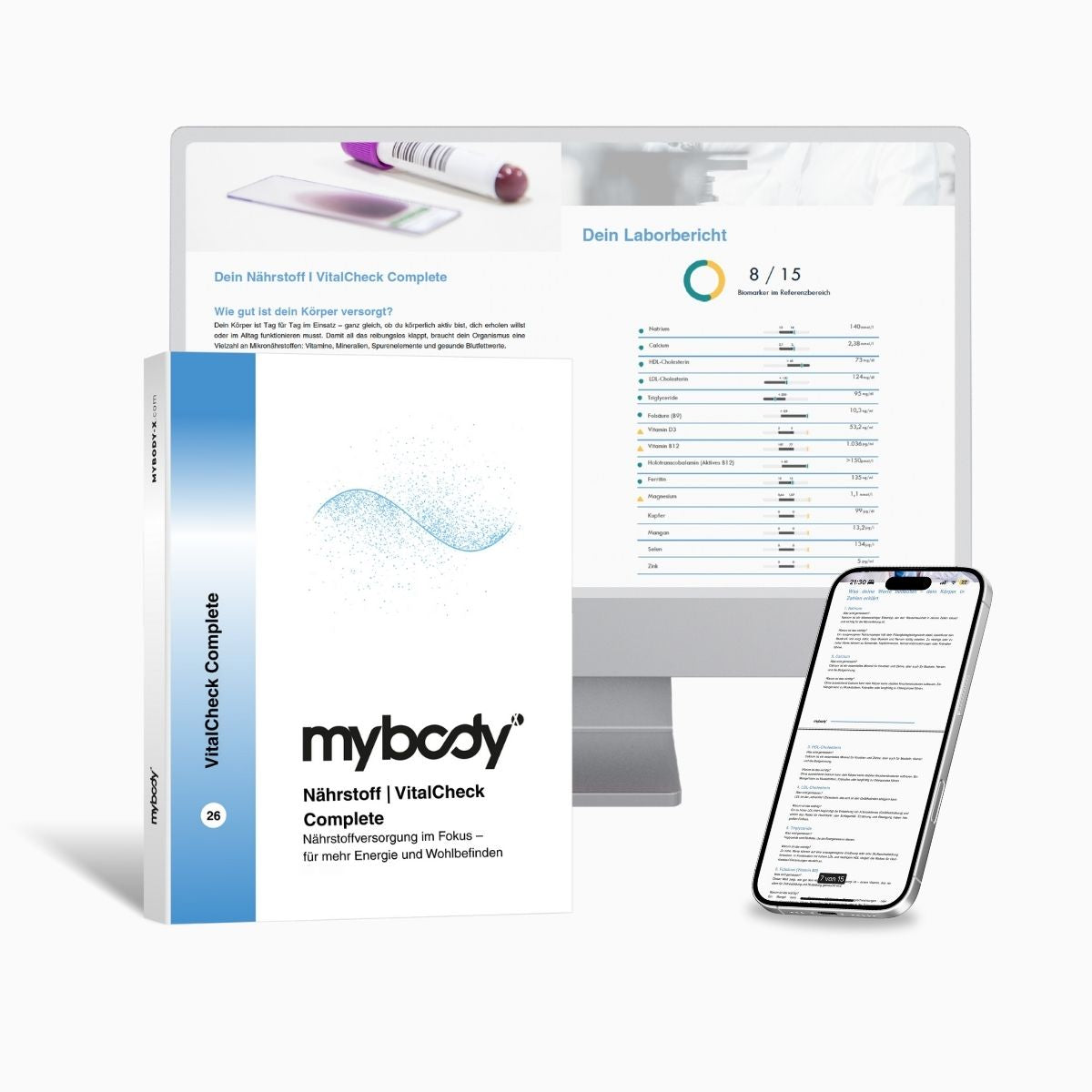
Nutrient | VitalCheck Complete
Comprehensive at-home blood analysis—including the minerals sodium, calcium, and magnesium, as well as important vitamins and trace elements. For a well-founded overview instead of taking supplements on suspicion.
Price: €169.00 (instead of €199.00) · Sample type: Capillary blood (at home) · Processing time: approx. 10–15 business days · Laboratory: ISO-certified, GDPR-compliant
View Nutrient CheckInformation on price, sample type, processing time, and markers comes from the mybody® product page (as of July 2026) and may change. A self-test does not replace a medical diagnosis.
Context: What a test can—and cannot—do
A blood test can reveal individual mineral levels and help you avoid taking supplements blindly. It is therefore a useful tool, but it does not replace a medical diagnosis.
In addition, the electrolyte level in the blood is a snapshot that the body regulates closely. A routine test does not always capture an acute imbalance. Abnormal results or persistent symptoms—for example, palpitations, severe fatigue, or frequent cramps—should therefore always be medically evaluated.
Use a test as a status check and as preparation for a medical consultation—not as a free pass to then take supplements permanently and without supervision.
In short: A test answers the question “Where do I stand right now?”, but not automatically the question “Should I take supplements long term?” Make this decision together with medical advice—depending on your specific levels, lifestyle, and any pre-existing conditions. Especially with kidney or heart disease, taking supplements long term without medical guidance is risky and should be avoided.
Conclusion
Drinking electrolytes every day is neither necessary nor particularly healthy for most healthy people. The body regulates its electrolyte balance itself, and a balanced diet reliably covers the need. Daily consumption can do more harm than good, especially because of the sodium and hidden sugar.
Regular intake makes sense only when there is a genuine need: intensive endurance exercise, physically demanding work in hot conditions, a very low-carbohydrate diet, or certain medical situations—the latter always in consultation with a doctor. For everyone else, the rule is: drink water, eat a balanced diet, and if symptoms persist, have your levels checked and seek medical advice rather than taking supplements as a precaution.
Ultimately, daily electrolytes are less a question of being “healthy or unhealthy” than of meeting your needs: Those with increased needs benefit from targeted replenishment; those without them are, at best, wasting money and, at worst, risking unnecessarily high sodium and sugar intake. Listen to your body—and, when in doubt, seek medical advice.
Frequently asked questions (FAQ)
Test instead of guessing
Instead of drinking electrolytes every day as a precaution: The nutrient | VitalCheck Complete shows your mineral status (including sodium, calcium, and magnesium) from an at-home blood sample – ISO-certified and GDPR-compliant.
Explore nutrient testsYou might also be interested in this
→ Electrolytes: When should you take them?
In which situations additional electrolytes are genuinely useful.
→ Test for nutrient deficiencies: Recognize symptoms and address them specifically
What signs indicate a deficiency and what really helps.
Sources
- World Health Organization (WHO): “Sodium reduction" – recommendation of less than 5 g of salt (2 g of sodium) per day for adults. who.int
- World Health Organization (WHO): “Oral rehydration salts" – use of oral rehydration solutions in cases of fluid and electrolyte loss. who.int
- Hew-Butler, T. et al. (2017): “Exercise-Associated Hyponatremia: 2017 Update" (Frontiers in Medicine) – risk of dilutional hyponatremia. frontiersin.org
- German Nutrition Society (DGE) – Reference values and recommendations for minerals and a wholesome diet. dge.de
The statements on salt/sodium intake are based on [1], those on oral rehydration during illness on [2], and the warning about dilutional hyponatremia on [3]; general recommendations are based on [4]. Product-related information from mybody® (price, sample type, processing time, markers) comes from the respective product page on mybody-x.com and may change.

mybody® Editorial & Specialist Team
This article was created by the mybody® editorial and specialist team, which brings together expertise in nutritional science, blood analysis interpretation, laboratory diagnostics, and sports and metabolic science. Learn more about our team on our editorial and author page.
Published on July 24, 2026 · Last updated on July 24, 2026
Medical notice: This article is for general information only and does not replace medical advice, diagnosis, or treatment. If you have persistent symptoms, pre-existing conditions (e.g., affecting the heart or kidneys), high blood pressure, or are taking medication, please consult a doctor.




Share now:
Recognizing alcohol intolerance: ALDH2, symptoms, and when a genetic test is truly helpful
How do you notice an electrolyte deficiency?