
Gut health at a glance: Your at-home stool test explained
An at-home stool test is a brilliant and, above all, discreet way to gain important insights into your gut health—all without having to go directly to a doctor’s office. You can conveniently collect a small stool sample in the comfort of your own home and then send it to a specialized laboratory for analysis.
What an at-home stool test really is

You may be wondering exactly what an at-home stool test involves and whether it is right for you. Honestly, the idea of dealing with your own digestion can feel a little strange at first. Many people hesitate to see a doctor right away for symptoms such as bloating or stomach rumbling—whether because of a lack of time, uncertainty, or because the symptoms are not always present.
This is exactly where an at-home test comes in. It bridges the gap between your gut feeling and a concrete, scientifically based assessment. Think of it simply as an initial, confidential health check that you take into your own hands. Instead of sitting in a waiting room, you order a kit that provides everything you need for hygienic and truly uncomplicated sample collection.
A look behind the scenes of your body
An at-home stool test is much more than just a sample in a tube. It is a valuable tool that can tell you a great deal about various aspects of your health. Depending on which test you choose, different things are analyzed:
- Hidden (occult) blood: A very common test looks for tiny amounts of blood in the stool that you would not be able to see with the naked eye. This is a key component of the early detection of colorectal cancer.
- Gut microbiota composition: Other analyses, often referred to as microbiome tests, provide a detailed picture of your personal community of bacteria in the gut. Trillions of tiny helpers live there and have a major impact on your health.
- Inflammatory markers: Certain values may indicate inflammation in the gut, which could be the cause of your abdominal pain or other symptoms.
These tests are designed to give you an initial, well-founded assessment. They bring gut health out of the taboo zone and make it a completely normal part of your healthcare.
Overview: When an at-home stool test makes sense
You may be unsure whether such a test is the right step for you in your current situation. This table will help you quickly identify the situations in which an at-home test could be a good idea for you.
| Situation or symptom | Why a test can help | Possible next step |
|---|---|---|
| General digestive problems (bloating, diarrhea, constipation) | Provides initial indications of whether an impaired gut microbiome or inflammation could be the cause. | Discuss the results with a doctor or nutritionist to adjust your diet. |
| Colorectal cancer screening (especially from age 40/50) | Detects hidden blood in the stool, an early warning sign of colorectal cancer or polyps. | If the result is positive, medical evaluation (colonoscopy) is essential. |
| Unexplained fatigue or skin problems | An imbalanced gut microbiome (dysbiosis) can affect the entire body. | Analyzing the gut microbiome can provide starting points for changing your diet or taking probiotics. |
| After antibiotic therapy | Antibiotics often also attack the "good" gut bacteria. The test shows their condition afterward. | Targeted restoration of the gut microbiome with probiotic and prebiotic foods. |
Of course, a test can never replace a visit to the doctor, but it provides valuable information and a basis for deciding what to do next.
Why preventive care is so important
It cannot be emphasized enough: early detection is incredibly important. Around 54,000 people in Germany develop colorectal cancer every year, and it is noticeable that increasingly younger people are also affected. This is precisely why some health insurance providers, such as KKH (Kaufmännische Krankenkasse), already offer their policyholders an at-home stool test for early detection from the age of 40. The huge advantage is obvious: it is easy and discreet, and you can proactively keep an eye on your health without having to make an appointment.
An at-home stool test is not a substitute for a medical diagnosis, but it is an important first step. It gives you the control and information you need to take targeted further action if necessary.
What types of stool tests are available
If you choose an at-home stool test, you quickly realize that not all tests are the same. There are a whole range of different options, each of which can reveal completely different secrets about your gut. Think of it as a well-organized toolbox for your gut health—there is a suitable instrument for every concern.
The term “stool test” is really just a general term for various analytical methods. Depending on what exactly you want to find out—whether you are interested in routine screening, want to investigate the causes of certain symptoms, or simply want to take stock of your gut flora—a different type of test may be appropriate. Let’s take a look together at the most common options. This will give you a sense of which test might be right for you.
The iFOBT for colorectal cancer screening
The best-known stool test is the immunological test for occult blood, which many people know by the abbreviation iFOBT. The word “occult” means something like “hidden” here, and that is exactly what the test does: It detects tiny amounts of blood in the stool that are invisible to the naked eye. This is extremely important because intestinal polyps or colorectal cancer in its early stages can bleed long before causing any other symptoms.
This test is a central pillar of Germany’s statutory colorectal cancer screening program. It is quite clever because it specifically reacts to human hemoglobin (the red pigment in blood) and is not affected by foods such as red meat. This makes it very reliable. By the way, a positive result is no reason to panic. Rather, it is a clear signal that medical evaluation with a colonoscopy is advisable to determine the cause.
Microbiome analysis to assess your gut flora
Microbiome analysis takes a completely different approach. It is not about blood, but about your countless tiny inhabitants. Your gut is home to trillions of bacteria that together form your gut flora, also known as the microbiome. This complex ecosystem is absolutely essential for your digestion, immune system, and even your mood.
Think of microbiome analysis as a detailed census of your gut. It shows you not only how many different types of bacteria are present (the diversity), but also whether certain strains may be overrepresented or underrepresented (a condition known as dysbiosis).
This kind of imbalance can be associated with all kinds of symptoms—from bloating and irritable bowel symptoms to skin problems or constant fatigue. The results then provide you with specific starting points for restoring balance to your gut flora through a tailored diet, probiotics, or prebiotics.
Tests for specific health markers
In addition to these two major categories, there are a whole range of other, more specialized tests. They specifically look for certain markers and are often used to investigate a particular suspicion or assess the health of the gut in even greater detail.
Here are some important examples:
- Calprotectin test: Calprotectin is an inflammatory marker. If the level in stool is elevated, this may indicate inflammatory processes in the intestines, such as those occurring in chronic inflammatory bowel diseases (Crohn’s disease and ulcerative colitis).
- Pancreatic elastase test: This value provides an indication of how well your pancreas is functioning. If there is too little of this important digestive enzyme, it may be the cause of fatty stools and nutrient deficiencies.
- Zonulin test: Zonulin is a protein that has recently been repeatedly associated with intestinal permeability (the so-called “leaky gut”).
- Tests for pathogens: Sometimes it is also useful to test stool specifically for certain bacteria (e.g., Helicobacter pylori), viruses, or parasites that can cause acute gastrointestinal problems.
Various symptoms are often also related to how your body reacts to certain foods. While a stool test analyzes the gut microbiome, if food intolerances are suspected, it may make sense to supplement this with other methods. If you suspect that your problems are related to your diet, a test for IgG-mediated food intolerances may also provide useful insights, as it works through a blood analysis. This gives you an even more comprehensive picture of your individual health situation.
Your at-home stool test: Here’s how easy it is, step by step
Let’s be honest: The thought of having to collect a stool sample yourself may sound strange at first, perhaps even a little off-putting. And that is completely understandable. But we want to show you that the entire process behind an at-home stool test is much easier, cleaner, and more discreet than you probably imagine.
Our goal is to eliminate any uncertainty for you. That is why we guide you through every step in detail—from ordering your test kit and collecting your sample hygienically to shipping it safely. You will see: You can handle this important step for your health calmly and confidently.
From ordering to your mailbox: The exact process
The entire process is designed to be as convenient and simple for you as possible. You do not need any medical knowledge and can complete everything in the familiar surroundings of your own home.
- Ordering: Choose the right test online and order it. The test kit will then arrive at your home in completely neutral packaging. No one but you needs to know what is inside.
- Preparation: Your kit contains everything you need: clear, illustrated instructions, a sample tube, a stool collection aid, and a prepaid return envelope. Take a moment to read through the instructions carefully before you begin.
- Collecting the sample: This is the part most people feel a little apprehensive about, but it is really straightforward. Simply attach the included paper stool collection aid to your toilet. It ensures that the sample does not come into contact with the toilet water or cleaning products.
- Securing the sample: Use the small stick already attached to the lid of the sample tube to collect a tiny amount of stool. It is usually sufficient to briefly dip it in three different places. Then screw the lid on tightly—and the sample is safely and hygienically sealed in the tube.
- Shipping: Now place the sealed tube in the sturdy return envelope provided. Simply seal it and drop it in the nearest mailbox. Postage has already been paid, so you do not need to do anything else.
This overview shows you once again how simple the preparation is in three steps to get your stool test ready to go.
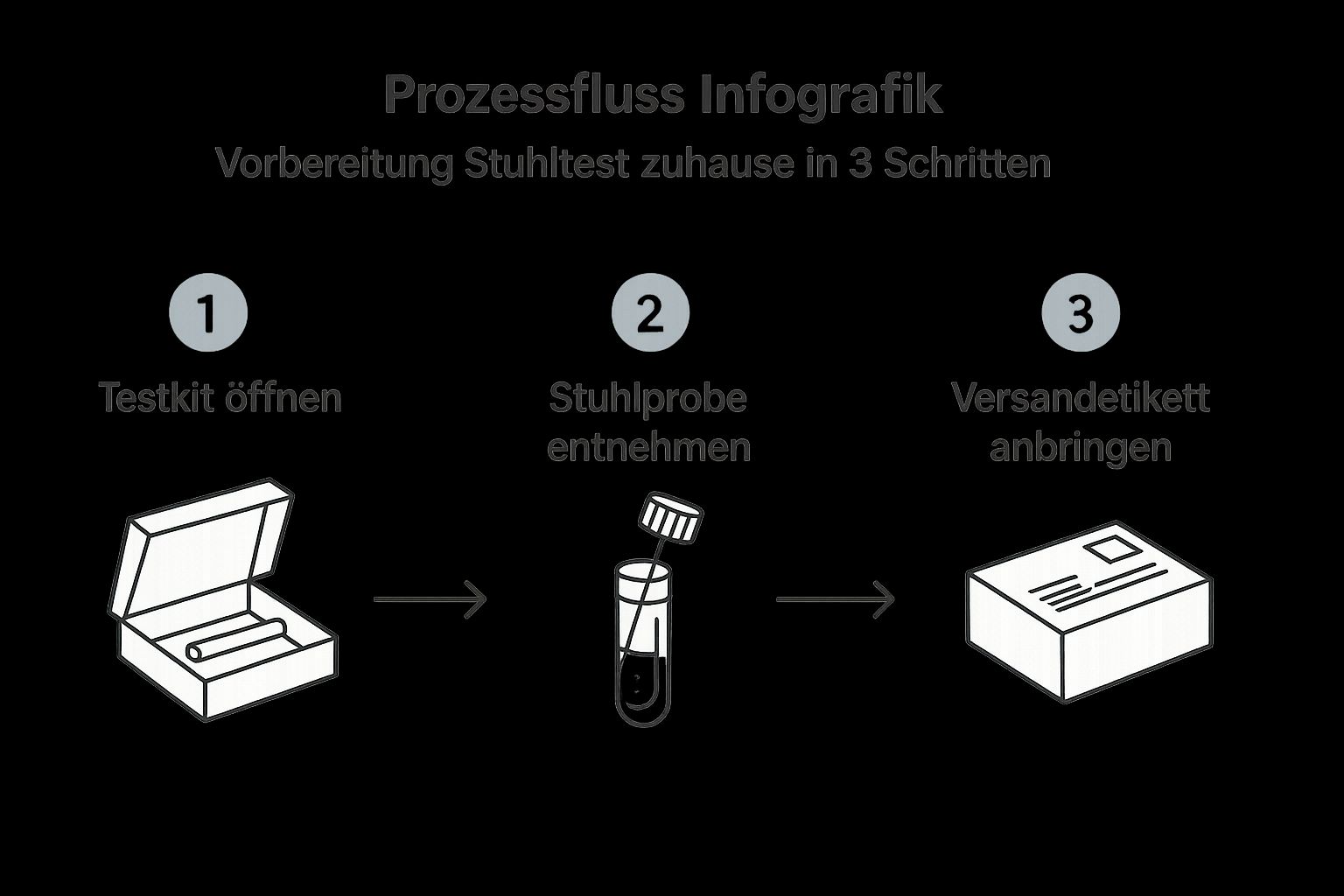
As you can see, the entire process is designed to remove every obstacle and give you peace of mind from start to finish.
And what happens in the laboratory?
As soon as your sample arrives at the certified partner laboratory, the actual work begins. Medical professionals analyze your sample there using state-of-the-art laboratory technology. First, it is anonymized, meaning it is assigned a unique code that can only be linked to you. Your personal data is therefore strictly protected at all times and is stored completely separately from the sample.
Depending on the test you choose, different analysis methods are then used. This may involve looking for hidden blood (a so-called iFOBT) or even elaborate sequencing to decode the composition of your gut microbiome.
The entire process, from sample collection to laboratory analysis, is standardized and quality-assured. The laboratories that reputable providers work with are generally certified according to strict standards such as DIN EN ISO 15189—the same quality standard that medical practices and clinics must also meet.
A simple test with a major impact on your preventive healthcare
The fact that such tests are so readily available is a huge step forward for personal preventive healthcare. A great example of how effective these home tests can be comes from the Siemens Company Health Insurance Fund (SBK): Since November 2023, it has offered its members a free at-home stool test. During the program’s pilot phase, the positivity rate was already around 10 percent. This means that an initial important indication was found in one out of every ten people, which could then be medically investigated—all before a doctor’s appointment was even necessary. Learn more here about how home tests complement standard healthcare.
This example impressively demonstrates how straightforward and effective a home test can be for taking responsibility for your own intestinal health. It bridges the gap between an initial suspicion and visiting a doctor, providing you with valuable, concrete information.
How to properly understand your results

You did it: You ordered the at-home stool test, collected the sample, and now you’re holding the results in your hands. What now? This feeling of uncertainty when looking at the results is completely normal. But don’t worry—we won’t leave you alone with it.
We’ll help you decipher the results so that you understand what your body is trying to tell you. Don’t view the finding as a final verdict, but rather as a valuable piece of the puzzle. It helps you better understand your health and take the right next steps.
When the stool blood test is positive
A “positive” result on a test for hidden blood in the stool (a so-called iFOBT) can be quite frightening at first. The most important thing first: Take a deep breath and don’t panic. A positive result does not automatically mean that you have a serious condition such as colorectal cancer.
Above all, it is an important signal from your body that minimal bleeding has occurred somewhere in your digestive tract. The causes can be varied and often harmless.
Possible reasons for a positive result include:
- Hemorrhoids: These enlarged vascular cushions at the anus are a very common and usually harmless cause of traces of blood.
- Anal fissures: Small tears in the lining of the anal canal can also bleed slightly and often heal quickly.
- Stomach or intestinal ulcers: Inflammation or ulcers located higher up in the digestive system can also cause minor bleeding.
- Intestinal polyps: These are benign growths of the intestinal lining that can bleed. They are considered precursors to colorectal cancer and should therefore be evaluated.
A positive result is not a reason to panic, but a clear call to action. It is a signal that medical evaluation is the next logical and absolutely right step to identify the cause and safely rule out serious illnesses.
It is best to schedule an appointment with your primary care doctor or a gastroenterologist soon and bring your report with you. They will interpret the results and discuss the next steps with you, usually a colonoscopy.
Interpreting the results of a microbiome analysis
If you have opted for a comprehensive microbiome analysis, you are essentially holding a map of your gut flora in your hands. This is not about being “positive” or “negative,” but about the composition of your very own ecosystem. Your report provides insights into several fascinating aspects:
- Bacterial diversity: This is one of the most important values of all. High diversity, meaning many different bacterial species, is considered a sign of a healthy and resilient microbiome. If diversity is low, the gut may be more susceptible to disruptions.
- Dysbiosis index: This value summarizes whether your microbiome is balanced or whether dysbiosis—an imbalance—is present. This may mean that certain “good” bacterial strains are too rare and “bad” ones too common.
- Distribution of bacterial strains: The report shows which major bacterial groups (e.g., Firmicutes, Bacteroidetes) dominate in your gut and what their ratio is. This ratio can provide fascinating insights into your diet and metabolism.
- Short-chain fatty acid production: The test can also show how effectively your gut bacteria produce important substances such as butyrate. Butyrate is essentially super fuel for your intestinal lining.
These results help you understand the often invisible connection between your diet, lifestyle, and any symptoms you may be experiencing.
If you want to delve even deeper into the fascinating world of your gut inhabitants, a detailed microbiome test provides an excellent foundation for targeted improvements. The findings are usually presented in a way that gives you very specific recommendations for your diet and lifestyle.
Finding the right provider for your at-home test

The market for at-home stool tests is growing, and so is the number of providers. That is initially good news, because you have a wide range of options. However, this variety can quickly become confusing and raise one question: Who can I really trust here?
Choosing a provider is ultimately a very personal decision. It concerns your sensitive health data and ensuring that you ultimately have truly reliable results in your hands. We want to help you separate the wheat from the chaff and find a reputable partner for your gut health.
Important characteristics of a trustworthy provider
A good provider impresses not only with a stylish website, but above all with transparency and quality. Think of the search simply as a quick check in which you tick off a few key criteria to make sure you are in good hands.
Pay particular attention to these points:
- Certified partner laboratory: This is essential. Reputable providers work with accredited medical laboratories. An important certification here is DIN EN ISO 15189. This is the same quality standard that medical practices and hospitals must also meet—your guarantee of a professional analysis.
- Crystal-clear data protection: Your health data is extremely sensitive. The provider must clearly and understandably explain how they protect your data. Pseudonymized processing of samples and strict compliance with the GDPR are absolutely non-negotiable here.
- Understandable results: What good are the best lab results if you do not understand them? A good provider does not simply give you a list of numbers, but presents the results in a way you can follow—often with graphics, clear explanations, and a personal interpretation.
A reputable provider does not leave you alone with your results. They see themselves as a partner who helps you interpret the results and draw the right conclusions from them.
More than just a lab result: what the service should include
A low price is naturally tempting, but it is often worth taking a second look at what the service package actually includes. A standalone lab result without any context is usually only of limited help. A high-quality service offers you significantly more support on your journey toward better gut health.
So also take a close look at what goes beyond the analysis itself:
- Specific recommendations for action: Based on your results, do you receive individual tips for your diet and lifestyle? More importantly, are these recommendations practical and feasible in everyday life?
- Consultation options: Does the company offer follow-up consultation, perhaps with nutrition experts or naturopaths? Sometimes a few clarifying words in a personal conversation are worth their weight in gold.
- Scope of the analysis: Compare exactly which parameters are included in the test. Especially with microbiome analyses, there are huge differences in how in-depth the examination really is.
For example, if you suspect that your symptoms are related to certain foods, it is essential to take a more comprehensive look. In that case, also learn about the various at-home intolerance tests, which can provide you with further important pieces of the puzzle for the bigger picture.
Checklist for choosing a provider
To make your decision easier, we have created a short checklist for you. Use these criteria to find a trustworthy and suitable provider for your stool test.
| Evaluation criterion | What you should look out for | Why it matters |
|---|---|---|
| Laboratory quality | Is the laboratory certified according to DIN EN ISO 15189? | Guarantees medical standards and reliable analysis results. |
| Data protection | Is the sample pseudonymized? Is the privacy policy clear and GDPR-compliant? | Protects your highly sensitive health data from unauthorized access. |
| Results presentation | Is the results report easy to understand, presented graphically, and accompanied by explanations? | Ensures that you understand your values and can interpret them correctly. |
| Service & consultation | Are there specific recommendations for action? Is personal consultation available? | Provides practical help and support in putting the results into practice. |
By carefully reviewing these points, you can make an informed and confident decision. This will help ensure that your at-home stool test becomes a truly valuable step for your health.
Frequently asked questions about at-home stool tests
Finally, we want to address the questions we keep receiving about at-home stool tests. With these quick answers, we want to dispel any remaining uncertainties and ensure that you feel fully informed.
How reliable is a test like this really?
Modern immunological home tests (iFOBT) are based on the same precise laboratory technology that you know from a doctor's office. They are highly reliable because they react specifically only to human blood in stool.
It is important to understand that a home stool test is a valuable initial indicator that helps you better assess your personal risk. However, it does not replace a medical diagnosis or a colonoscopy—which remains the gold standard in diagnostics for reliably determining the cause.
What should I do if I receive an abnormal result?
An abnormal result is initially just an indication and absolutely no reason to panic. It simply means that a deviation was found that a doctor should investigate. The most important next step is therefore to make an appointment with your family doctor or a gastroenterologist.
Simply take your results with you and discuss the next steps calmly. Harmless causes, such as hemorrhoids, are often responsible, but it is essential to reliably rule out serious conditions.
Studies also show just how effective regular testing is. According to the Cancer Information Service, consistent participation over ten years results in one fewer out of every 1,000 women dying from colorectal cancer. This underscores how valuable these tests are as a preventive tool. You can read more about the details of early detection here.
Does health insurance cover the costs?
That depends entirely on the test. Statutory health insurance providers generally cover the cost of the iFOBT for colorectal cancer screening for all insured persons aged 50 and over. Some providers are even more generous and offer it at an earlier age.
More comprehensive analyses, such as a detailed examination of the microbiome, are generally considered individual healthcare services (known as IGeL) that you pay for yourself. A quick inquiry with your health insurance provider will always clarify the situation so you know exactly where you stand.
If you have any further questions that we were unable to answer here, take a look at our detailed FAQ section. There you will find additional information about our tests and the entire process.
Are you ready to take proactive control of your gut health? Discover the scientifically validated tests from MYBODY Lab GmbH and gain valuable insights to help you improve your well-being in a targeted way. Find the right test for you now at https://mybody-x.com.



Share now:
Celiac disease test: The path to clarity regarding gluten intolerance
Improve gut health for greater well-being