

Genetics explained simply for beginners
Imagine holding the personal blueprint of your life in your hands—a kind of secret guide that explains why you are the way you are. That is essentially what genetics is all about. In this guide, we’ll take you on a journey through this fascinating subject, without any complicated technical jargon.
What your genes really reveal about you
Have you ever wondered why you have green eyes while your siblings have blue ones? Or why you absolutely love certain foods but simply can’t stomach others? The answers lie deep within your genes—the unique code hidden in every single cell of your body.
Genetics is the science that deciphers this code. It is essentially your body’s instruction manual. It explains not only what you look like, but also influences how your metabolism works, how your immune system responds to invaders, and which hidden talents or health predispositions lie dormant within you. But don’t worry: Your genes are not your unchangeable destiny.
Modern science shows that only about 25% of your life expectancy is determined by your genes. You control the remaining 75% yourself—through your lifestyle, diet, and environment. Your genes provide the foundation, but you are in the driver’s seat.

Your personal blueprint thanks to genetic testing
Nowadays, you don’t have to be a scientist to get a glimpse into your genetic blueprint. Modern genetic tests that allow you to test your genetic predisposition make it possible—and you can do it conveniently from home. A simple saliva sample is all it takes to gain fascinating insights into your very own predispositions.
Tests like these analyze your DNA and can show you, for example:
- Your metabolic type: Do you process carbohydrates better, or are you a fat burner?
- Your personal nutrient profile: Do you have a genetically determined higher need for certain vitamins or minerals?
- Your response to food: Could your aversion to broccoli actually be in your genes?
A test like this is, of course, not a crystal ball. Rather, it is a valuable tool. It provides you with data-based insights into how you can optimize your diet and lifestyle so that you can achieve your health goals and reach your full potential. If you want to dive deeper and learn how to use your genes for your health, you’ll find valuable information in our follow-up article.
Ultimately, it’s about understanding yourself better. Genetics, explained simply, is the key to learning the language of your own body and making conscious decisions for a healthier and more vibrant life.
The Building Blocks of Life Explained Clearly
To understand how a genetic test can reveal your personal predispositions, we first need to take a look at the basics. Imagine your body as a gigantic library. Every single one of your trillions of cells contains a complete edition of this library—the entire blueprint for you—so it always knows what its job is.
If you want genetics explained simply, this analogy is a great starting point.

Your Personal Library of Life
This library has different levels that all work together perfectly. To make the whole thing easier to understand, let’s summarize the most important terms in a brief overview.
| Term | Analogy | Function |
|---|---|---|
| Chromosome | A bookshelf | Contains and organizes genetic information. You have 46 of them (23 pairs). |
| Gene | A single sentence in a book | A specific instruction, e.g. for your eye color or metabolism. |
| DNA | The letters that make up the sentence | The actual code, consisting of the four bases A, T, C, and G, that forms all the instructions. |
| SNP | A “typo” in a letter | A tiny but important variation in the code that makes you unique. |
This table gives you a quick overview. Now let’s take a deeper dive and examine the individual building blocks more closely.
What do these terms mean in detail?
Okay, let’s take a closer look at the individual parts of your genetic library:
-
Chromosomes – The Bookshelves: In each of your cells, you have 46 chromosomes, neatly arranged in 23 pairs. You received one set of 23 chromosomes from your mother and the other set of 23 from your father. They are like enormous bookshelves that safely store all the important information.
-
Gene – The Sentences in the Books: Each of these shelves (chromosomes) is packed with thousands of genes. A gene is like a single, clear instruction sentence in a book. This sentence might read: “Eye color is blue” or “Process caffeine quickly.” So there are instructions for all sorts of things, from your appearance to your nutritional needs.
-
DNA – The Letters of Life: So what are these sentences made of? Letters. These letters are your DNA (deoxyribonucleic acid). The entire code of our bodies is astonishingly written using just four chemical bases: adenine (A), thymine (T), cytosine (C), and guanine (G). The sequence of these four letters alone determines everything that happens in your body.
Just imagine printing out a person's entire genetic code. You would need a book series filling about 1,000 books, each with 1,000 pages. A single small “typo” in this gigantic work can already make a noticeable difference.
How tiny differences make you unique
Now comes the really exciting part: This vast amount of genetic information is approximately the same in all people 99,9 % identical. That is why we all have two arms, two legs, and one nose.
But it is the remaining 0.1% that makes you the unique person you are. Experts call these exact tiny variations in your DNA code SNPs (Single Nucleotide Polymorphisms).
An SNP is essentially a small substitution of a single letter in your genetic code—a tiny “typo.” Such a typo can cause your body to produce a particular protein slightly differently from other people. And these SNPs are precisely what a modern genetic test targets, allowing you to test your genetic predispositions. It scans your code for these specific variations to draw conclusions about your personal predispositions—from your metabolic type to your individual vitamin requirements.
How a genetic test reveals your personal predispositions
You may wonder how a simple saliva sample can reveal so much about you—from your ancestry to your health predispositions. The key lies in analyzing tiny but crucial variations in your genetic code. They are called SNPs (Single Nucleotide Polymorphisms).
Imagine your DNA as a huge, universal cookbook. Most recipes are nearly identical in everyone. SNPs are like small variations in these recipes—honey is used instead of sugar, or spelt flour instead of wheat flour. These tiny changes can noticeably affect the end result: your body and how it functions.
Modern at-home genetic tests, designed to assess your genetic predisposition, specialize in finding these SNPs. They scan your DNA and compare it with huge scientific databases. These databases are used to determine which SNPs are statistically associated with certain traits, such as fast caffeine metabolism or lactose intolerance.
From sample to result
The entire process is easier than you might think and usually takes place in three steps. Once you have collected your sample and sent it to the laboratory, the actual analysis begins there.
- DNA extraction: First, your DNA is carefully isolated from the cells in your saliva sample. It is purified to prepare it for analysis.
- Genotyping: Next, a so-called microarray chip is used. This chip is equipped with hundreds of thousands of tiny probes, each matching a specific SNP in your genome. Your DNA is applied to the chip, and a signal lights up wherever it binds. This makes your unique SNP pattern visible.
- Analysis and evaluation: Specialized software reads these signals and compares your pattern with the available research data. Based on this, your personal report is created, presenting your genetic predispositions in an understandable way.
An “elevated risk” in your genetic test report is not a diagnosis, let alone an unavoidable fate. It is a statistical probability—and valuable information that gives you the opportunity to take proactive steps and take control of your health.
What types of genetic tests are there?
The range of tests available for assessing your genetic predisposition is now enormous. It spans from purely lifestyle-based analyses to medically relevant screenings. The most common categories are:
- Lifestyle and nutrition tests: These provide insight into how your body responds to certain nutrients. For example, they can show whether you are genetically predisposed to vitamin D deficiency or how your body metabolizes fats and carbohydrates. If you want to learn how a DNA test can improve your diet, you can find deeper insights here.
- Ancestry tests: They analyze your DNA to determine your ethnic origins and identify potential relatives in global databases.
- Medical genetic tests: These are generally ordered by a doctor and specifically look for gene mutations associated with hereditary diseases such as cystic fibrosis or an increased risk of cancer (e.g., due to the BRCA genes).
The following infographic provides a simplified illustration of how DNA replication works—a central process that occurs during every cell division and forms the basis for passing on our genetic information.
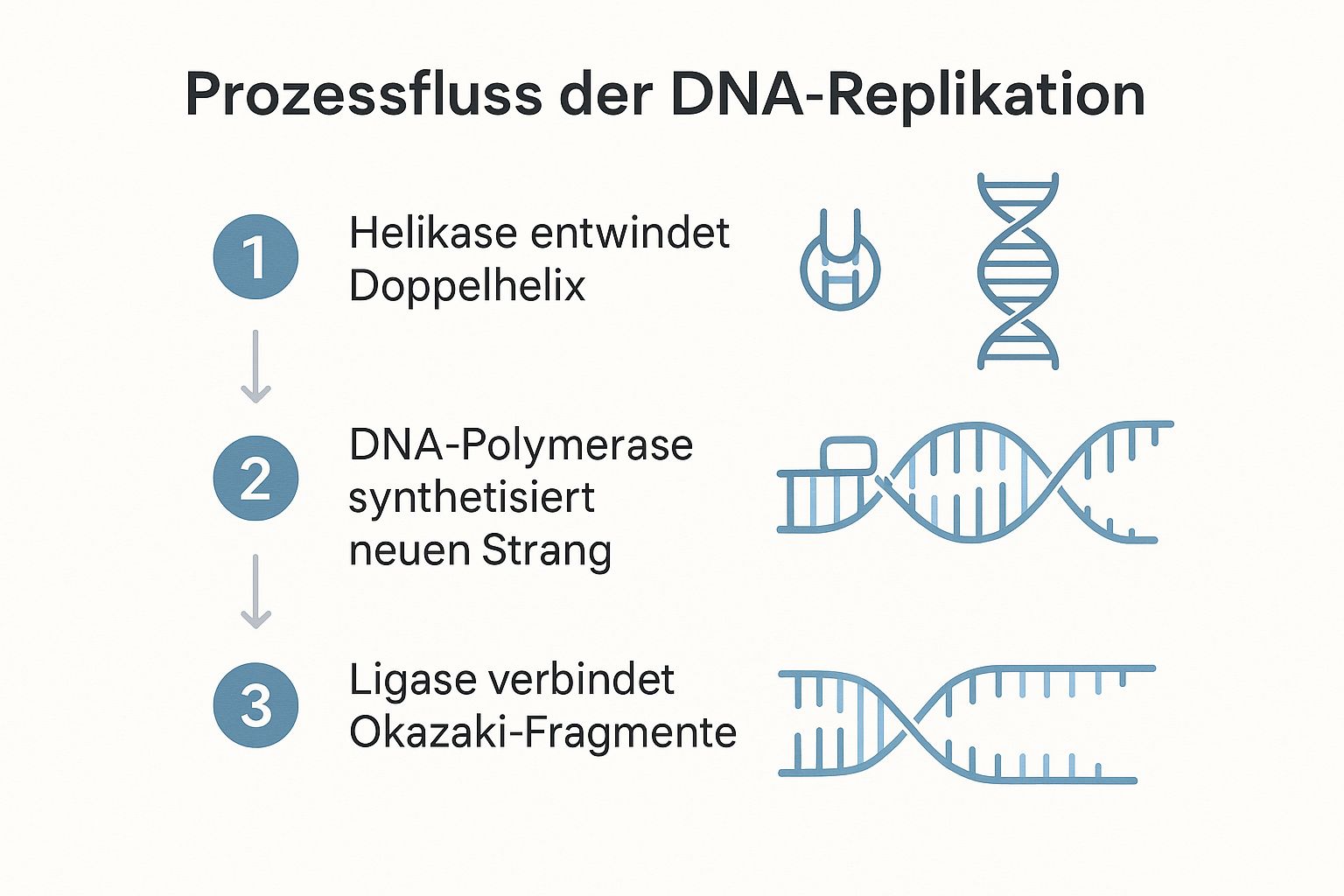
This process illustrates how precisely and complexly your body copies its genetic code. In the laboratory, a similar process is used to replicate your DNA and make it readable for analysis.
The practical benefits of genetic testing for cancer and hereditary diseases
The true value of genetic testing is particularly evident today in modern medicine, especially when it comes to the early detection and prevention of serious diseases. Genetic tests are now much more than just a tool for exploring your ancestry—they are a crucial component of a proactive healthcare strategy. If you know your genetic predisposition, you can not only understand risks but also actively and specifically address them.

Genetic predispositions can massively influence your personal risk, particularly for certain types of cancer. A well-known example is a mutation in the BRCA1 or BRCA2 genes. If such a change is present, the risk of breast and ovarian cancer increases significantly. A genetic test that allows you to test for this genetic predisposition provides clarity and gives you and your doctor the opportunity to take highly targeted preventive measures.
Knowing that you have a genetic predisposition is not a diagnosis but an opportunity. It transforms vague anxiety into a concrete action plan that may include more frequent checkups or preventive measures.
Targeted screening and personalized therapies
Hereditary factors also often play a major role in colorectal cancer. Mutations in certain genes can increase the risk of so-called Lynch syndrome, which is associated with colorectal cancer occurring at a significantly younger age. A positive test result often leads to a clear recommendation: to undergo colonoscopies much earlier and more regularly than is usual for the general population.
Statistics demonstrate the relevance: In 2022 alone, an estimated 504,000 new cancer diagnoses were recorded in Germany. A significant proportion of these, particularly breast, prostate, and colorectal cancers, have a genetic component. You can find more information about the latest figures in the cancer statistics for Germany on krebsdaten.de. These figures underscore how important it is to identify high-risk groups early in order to take effective preventive measures.
However, the use of genetic tests goes far beyond simply assessing risk:
- Personalized cancer treatment: If cancer is already present, analyzing the tumor’s genetic material can help identify the most effective treatment. Some medications work only for very specific genetic mutations in the tumor.
- Family planning: If hereditary diseases such as cystic fibrosis or Huntington’s disease are known in your family, a genetic test before or during pregnancy can provide valuable clarity.
- Other health risks: Genetic analyses can also provide information about predispositions to heart disease or metabolic disorders. Similarly, a test can help explain how intolerances can be uncovered and a genetic test can detect hidden food allergies.
Understanding genetic counseling
A genetic test is only as valuable as the understanding of its results. That is precisely why professional genetic counseling is essential when you have your genetic predisposition tested.
Here, an expert will calmly explain what your individual result means, what consequences it may have for you and perhaps your family, and which next steps make sense. It is a protected space where you can ask all your questions and make informed decisions about your life and healthcare planning.
How genomic medicine is revolutionizing your preventive healthcare
Imagine your doctor knowing not only your current symptoms but your complete genetic blueprint. On this basis, they can find the perfect therapy for you—not just one that somehow fits. What sounded like science fiction until recently is becoming increasingly tangible through genomic medicine.
This branch of medicine represents a genuine paradigm shift. Instead of looking at individual genes בלבד, the goal is to understand the entire genome and use this information to prevent diseases more effectively, diagnose them more precisely, and treat them more successfully.
From research to practice
In Germany, this development is being driven forward significantly by the genomDE initiative. It is part of the European “1+ Million Genomes” strategy, whose goal is to connect genetic data and thereby gain a better understanding of rare and complex diseases in particular. For the more than 6,000 known genetic disorders, such as cystic fibrosis or sickle cell disease, this could soon enable much more precise diagnosis and treatment. Learn more about this nationwide strategy for genomic medicine at bundesgesundheitsministerium.de.
By analyzing vast amounts of data, researchers identify patterns that were previously invisible. They decipher why some people respond differently to medications or which genetic factors trigger certain diseases in the first place. The result is a form of medicine that no longer takes a one-size-fits-all approach, but responds specifically to your unique DNA.
The vision of genomic medicine is to tailor treatments so precisely to your individual genetic profile that side effects are drastically reduced and the chances of recovery increase.
Personalized medicine in everyday life
So what does this mean for you specifically? Genomic medicine opens the door to an entirely new approach to preventive healthcare. Instead of waiting for symptoms to appear, you can take proactive action and take your health into your own hands.
This is how genomic medicine can help you in practical ways:
- More precise medication choices: Your genetic profile can predict which medication will work best for you and cause the fewest side effects. No more “trial-and-error” approach.
- Targeted prevention: An analysis of your genome can indicate risks for certain diseases at an early stage—long before they even develop.
- Personalized nutrition strategies: Your genetic blueprint reveals which nutrients your body processes particularly well or poorly. This is the perfect basis for a diet that truly suits you.
These personalized approaches are precisely the heart of nutrigenetics. If you would like to delve deeper and understand what nutrigenetics is and how it shapes our lives, we have some fascinating insights for you.
With all these opportunities, protecting your highly sensitive data is, of course, extremely important. Strict data protection laws and ethical guidelines ensure that your genetic information is handled securely and confidentially.
Your most important questions about genetics and genetic tests
Genetics often raises questions, especially when it comes to tests you can simply take at home. You may be curious but also a little uncertain. That’s completely normal.
Here you’ll find clear answers to the most frequently asked questions, so you can get a better sense of what your genes can—and cannot—tell you.
Is a genetic test actually useful for me?
Whether a genetic test that lets you test your genetic predisposition is right for you personally depends entirely on what you hope to gain from it. It’s like any tool: You need to know what you want to use it for.
- Out of pure curiosity: If you simply want to learn more about your roots or certain predispositions, such as your metabolic type, a lifestyle genetic test can be truly fascinating.
- For your health strategy: Tests that show you how your body processes nutrients or whether you are prone to intolerances are incredibly valuable. They give you specific guidance on how to optimize your diet and lifestyle.
- If you have health concerns: This is very important: If hereditary diseases run in your family or you are experiencing unexplained symptoms, your first point of contact should always be a doctor. They can assess whether a medical genetic test is necessary and refer you to a specialized counseling center.
Ultimately, a genetic test is a source of information. It gives you data you can use to take proactive control of your well-being.
What does an “elevated risk” mean in the results?
This point often causes confusion and sometimes unnecessary fear. Let’s clarify it: An “elevated risk” in your report is not a diagnosis. It does not mean that you will definitely develop a disease.
Think of it this way instead: You are driving on a road where accidents statistically occur somewhat more often. That does not mean you will have an accident. But it is wise to drive a little more attentively and buckle up properly.
An increased risk is not a prediction, but a probability. It is valuable information showing that your lifestyle—meaning your diet and physical activity—has an even greater impact in your case. It is your opportunity to actively counteract it.
So this information is not bad news, but a clear call to action. You can use this knowledge to pay closer attention to risk factors, adjust your preventive care, and establish healthy habits. It transforms vague concern into a concrete plan.
Are my genetic data safe with providers?
An entirely justified and important question. After all, your genetic information is the most personal data there is about you. There are significant differences between providers here.
Reputable providers in Germany are subject to extremely strict laws. These include the General Data Protection Regulation (GDPR) and the Genetic Diagnostics Act (GenDG), which rank among the strictest in the world.
Specifically, this means:
- Pseudonymization: Your sample is linked to a code in the laboratory, not to your name. No one there knows that it is your sample.
- Secure storage: Your data must be stored in encrypted form and protected against unauthorized access.
- Purpose limitation: Your data may be used exclusively for the analysis you commissioned. Nothing else.
- Your right to erasure: You can request at any time that your data be deleted and your sample destroyed.
Especially when dealing with providers based abroad, you should read the privacy policy very carefully. Make sure you know whom you are giving your consent to and whether your data may be shared with third parties. When in doubt, always choose a provider that is transparent about its data protection practices and whose standards comply with European guidelines.
Are you ready to unlock the secrets of your body and put your health on a scientifically sound foundation? At MYBODY Lab GmbH, we offer ISO-certified genetic tests that allow you to test your genetic predisposition. Discover how you can specifically optimize your diet, metabolism, and well-being. Start your journey to a healthier you now at mybody-x.com.



Share now:
Your nutrition genetic test for optimal results
Nutrigenetics for your personalized nutrition