
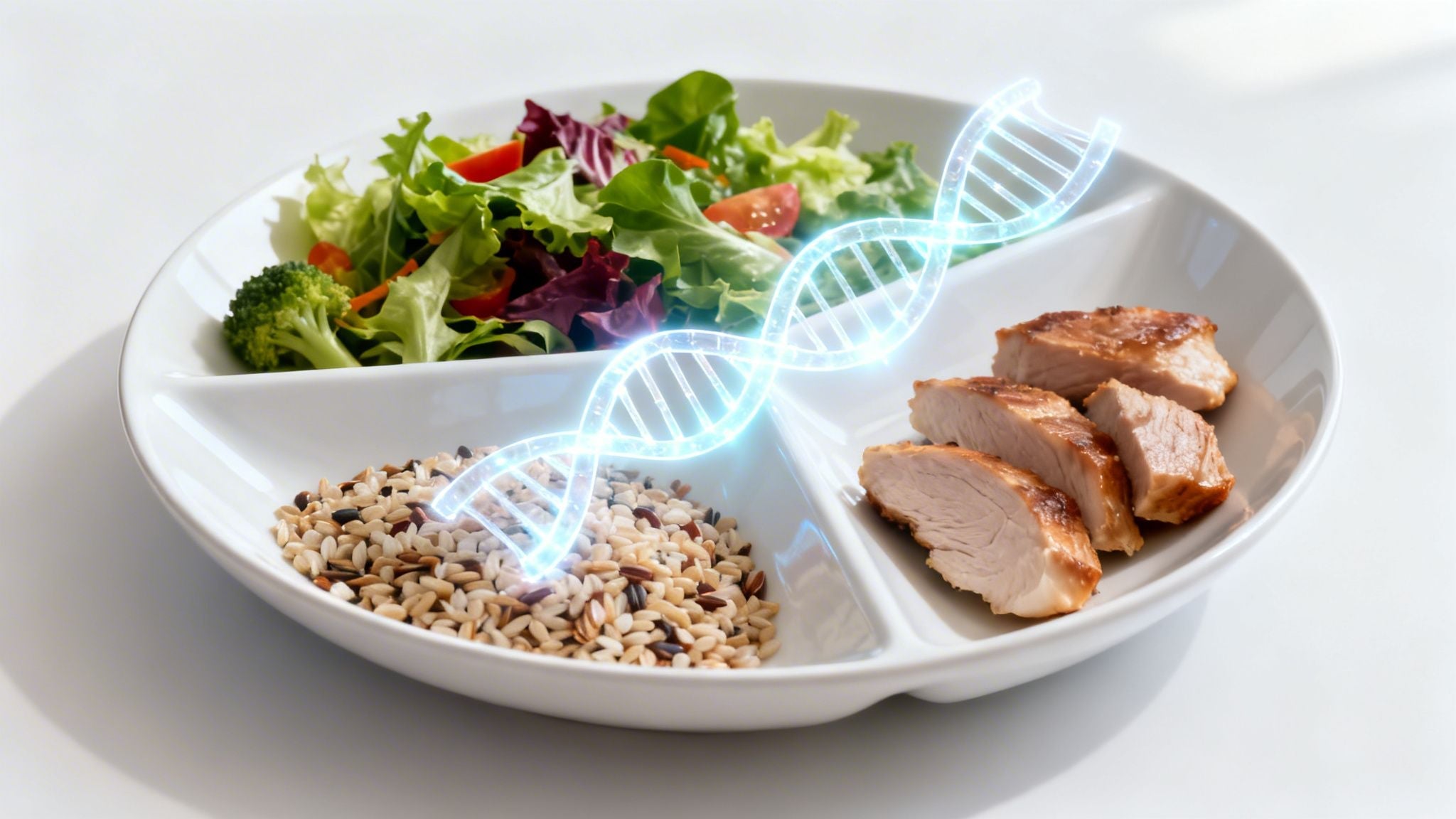
Understanding and successfully using the DNA diet
Imagine your diet wasn't an endless search anymore, but a clear, personalized guide. That's precisely the idea behind a DNA diet : a nutritional approach built on insights into your own genetics. Instead of following generic rules, you receive a kind of personal user manual for your body.
Why a DNA diet is more than just a trend
Have you ever wondered why your friend can effortlessly eat pasta, while the mere thought of it makes you gain weight? Or why a low-carb diet works wonders for some, but only makes you grumpy? The answer often lies not in willpower, but simply in our genes.
Each of us is unique – and this is especially true for our metabolism. A classic diet is often like a standard key that only fits a few doors. Most of the time, you're left standing there frustrated.
Your body's genetic blueprint
A DNA diet, also called nutrigenetic nutrition, is different. It's your very own personal key that fits perfectly into the lock of your metabolism. Through a simple analysis, such as the one offered by mybody-x.com, your individual genetic blueprint is unlocked.
The goal behind this? To find out how your body reacts to the three main nutrients :
- Carbohydrates: Do you use them quickly as energy, or does your body tend to store them more easily as fat?
- Fats: How efficiently does your fat metabolism work? Do you particularly benefit from healthy fats, or should you use them more consciously?
- Protein: What is your personal protein requirement to build muscle and achieve a good feeling of satiety?
The insights gained from your DNA provide you with concrete answers to precisely these questions. You'll learn what your metabolic type is and which nutrient distribution works best for you personally.
You can think of it this way: Your genes dictate what and how much your body really needs. A DNA diet translates this genetic language into a clear, practical nutrition plan.
This personalization is the key lever that sets it apart from conventional methods. It's not about strictly prohibiting food groups. It's about choosing the right foods in the right amounts for your unique body. This makes dietary changes not only more effective, but above all, more sustainable.
Traditional diet compared to personalized DNA diet
To clarify the differences, here is a brief comparison. This table illustrates the key differences between a general dietary approach and the personalized strategy of a DNA diet.
| feature | Classic diet | DNA Diet |
|---|---|---|
| Approach | One-size-fits-all, blanket rules | Individualized, based on genetic data |
| basis | General recommendations, trends | Personal metabolic type, genetic analysis |
| Nutrients | Often strict guidelines (e.g., low carb, low fat) | Optimal distribution of fats, carbohydrates, and proteins |
| Success | Often short-term, high potential for frustration | Sustainable, as it is tailored to the body |
| motivation | Discipline and sacrifice are the focus | Understanding and targeted selection instead of prohibition |
| sustainability | Low, as often not suitable for everyday use | High, because it is a long-term strategy |
As you can see, the DNA diet is not just another short-term solution, but a fundamentally different, data-driven path to your goals.
The science that makes all of this possible is called nutrigenetics. If you'd like to delve deeper into this fascinating topic, you can learn more about what nutrigenetics is and how it influences our lives in our article.
Ultimately, a DNA diet puts an end to the endless guesswork. You no longer have to jump from one diet to the next, but instead receive a sound strategy based on facts – the facts about your own body. This allows you to achieve your goals without frustration and strengthen your well-being from within.
Discover your genetic metabolic type
Every body is unique. While your friend might be able to eat endless amounts of pasta without gaining weight, you feel sluggish and bloated after just a small portion. Why is that? The answer lies in your DNA – it's essentially the instruction manual for your metabolism. A DNA-based diet helps you read and understand this manual.
Imagine your genes as personal regulators for your body. These regulators determine how efficiently you convert fats, carbohydrates, and proteins into energy. In some people, the regulators for fat metabolism are set to "full throttle," while in others, the body is more sensitive to carbohydrates.
These genetic nuances are perfectly normal and make us unique. But they're also the reason why a standard diet simply doesn't work for so many people. Your body plays by its own rules – and a DNA analysis like the one from mybody-x.com puts the rulebook in your hands.
The idea behind it is simple: With genetic analysis, you crack the code of your metabolism and can finally achieve your health and weight goals.

So it's not about guessing, but about a logical process tailored to you.
The most important metabolic markers in your DNA
When we talk about DNA analysis for nutritional purposes, we zoom in on very specific gene variants, known as SNPs (Single Nucleotide Polymorphisms). These are tiny variations in your genetic code, but they can have a huge impact on your metabolism.
A prominent example is the FTO gene , often referred to in the media as the "weight control gene." Certain variants of this gene can suppress your feeling of satiety and cause you to unconsciously reach for high-calorie foods. If you know you have this predisposition, there's no need to panic. On the contrary, you can counteract this by eating protein- and fiber-rich meals to feel full and satisfied for longer.
Other crucial markers are:
- APOE gene: Plays a key role in fat metabolism and reveals how your body reacts to saturated fats.
- PPARG gene: Involved in fat storage and insulin sensitivity. It gives you an indication of whether a lower-fat diet would be beneficial for you personally.
- TCF7L2 gene: Variants of this gene are closely related to carbohydrate metabolism and the risk of type 2 diabetes.
Your genes are not a destiny set in stone. They are valuable information that helps you make the right choices for your body.
Genetics often plays a crucial role, especially in metabolic disorders. In Germany, the prevalence of type 2 diabetes is around 11.9% among adults. Since our genes can influence up to 80% of our metabolism, it becomes clear why standard diets so often fail. Personalized nutrition, based on the analysis of relevant genes for fats, carbohydrates, and proteins—as offered by mybody-x.com—can demonstrably increase the chances of successful weight loss by 30–50% . You can find more detailed figures and facts in the German Health Report .
What is your metabolic type?
Based on the analysis of these and other genes, your personal metabolic type can be determined. Although reality is of course much more complex, for the sake of simplicity, three basic types can be distinguished:
- The carbohydrate type (“carb type”): Your body is a master at converting carbohydrates into energy. A diet rich in complex carbohydrates such as whole grains, potatoes, or legumes often provides you with the best fuel.
- The Fat Type: Your metabolism functions best when it uses fats as its primary energy source. You benefit from healthy fats, such as those found in avocados, nuts, and high-quality oils.
- The mixed type: You're an all-rounder and can process both carbohydrates and fats well. For you, a balanced distribution of macronutrients is the ideal way to feel energized and manage your weight.
This classification is the first, but crucial, step away from common diet myths and toward a strategy that truly suits you. Want to know exactly how to find your type? Read our guide on determining your DNA metabolic type . Ultimately, a DNA analysis will provide you with a scientifically sound shortcut to your personal success.
How your at-home DNA test works exactly
Are you wondering how to get your own personalized, genetically tailored diet? You're probably thinking of a complicated medical process. But it's quite the opposite. The entire mybody-x.com DNA test process is designed so you can complete it comfortably and stress-free from the comfort of your own home.
It all starts with your test kit, which arrives discreetly at your door. No doctor's visit, no needles – just you and the chance to finally get to know your body properly.

Your path to analysis: Explained step by step
The process is really simple and only takes a few minutes. We'll walk you through it here so you know exactly what to expect.
- Order & receive: Simply order your mybody-x.com DNA test kit online. We'll send it directly to your home – in discreet packaging, of course.
- Taking a sample: The kit contains everything you need, including very easy-to-follow instructions. You then use a special cotton swab to take a painless saliva sample from the inside of your cheek.
- Activate & return: Next, register your kit online using a unique code. Then, pack the sample in the enclosed return envelope and send it to our laboratory free of charge.
That's all you need to do! From this moment on, our experts will take over while you sit back and relax. If you'd like more details on the procedure, check out our guide, which explains exactly how a saliva test works .
What happens in the lab and how we protect your data
As soon as your sample arrives at our laboratory, the real scientific work begins. Here, we combine the highest precision with maximum security, so that you can fully rely on your results.
First and foremost, your sample is pseudonymized . This means your name and personal data are replaced with an anonymous code. From this point on, no one in the lab can directly link your sample to you. This is a fundamental step to protect your privacy and a key requirement of the General Data Protection Regulation (GDPR) , which we strictly adhere to.
Afterwards, the DNA is isolated from your cells and analyzed in our ISO-certified partner laboratory . Specialized equipment specifically examines only the gene variants that are relevant to your metabolism. We don't analyze your entire genome, but only the scientifically established markers that provide information about your aptitude for the DNA diet.
Your trust is our most valuable asset: Your genetic data will be used exclusively for the creation of your report. It will never be shared with third parties, sold, or misused for any other purpose. After the analysis, your biological sample will be professionally destroyed.
From lab results to a clear roadmap
After the analysis, we translate the raw scientific data into a comprehensive, yet above all, easily understandable report. Our goal is to provide you with concrete insights that you can implement immediately, not complicated diagrams or medical jargon.
Your results report shows you in black and white:
- Your personal metabolic type: You will find out whether your body processes carbohydrates, fats or a mixture of both more efficiently.
- Individual nutrient recommendations: You will receive clear information on how best to distribute your macronutrients (proteins, fats, carbohydrates).
- Suitable sports recommendations: Discover which sports best suit your genetic predisposition for endurance or strength.
This report is your personal roadmap to a healthier lifestyle. It takes the guesswork out of it and gives you a scientifically sound foundation on which you can confidently build.
Putting your genetic insights into practice in everyday life
You're holding your DNA analysis report in your hands – a kind of personal treasure map for your body. But knowledge alone doesn't change anything. The real key to success lies in translating these valuable insights into your everyday life.
Forget rigid rules and complicated plans. It's about cleverly leveraging your genetic advantages and elegantly circumventing your personal "stumbling blocks." This way, you transform scientific data into a new routine that feels good and gets you to your goal without frustration.

From knowledge to action: How to implement your results
Your report tells you the "what" and "why"—now it's time for the "how." Implementing your DNA diet can be easily divided into three areas: nutrition, exercise, and smart habits. Think of the following tips as building blocks from which you can create your own personal path.
1. Personalize your meals. The core of your analysis is your optimal macronutrient distribution. Your body has a clear preference for whether it derives energy best from carbohydrates, fats, or proteins. This distribution is the basis for every plate you put together.
2. Optimize your training. Your athletic predisposition is also in your genes. Does your body find endurance training particularly effective, or does it respond better to strength training? Adjust your activities accordingly to achieve maximum results and keep your motivation high.
3. Understand your behavior patterns. Some gene variants influence our feeling of satiety or our tendency to snack. If you know that your satiety signal is genetically somewhat weaker, you can consciously counteract this with protein- and fiber-rich meals.
The key advantage of your DNA analysis is that you stop working against your body. Instead, you start working with it – this makes the entire process easier and more sustainable.
The following table gives you a sense of how different the recommended nutrient distribution can look.
Example nutrient distribution by metabolic type
| Metabolic type | Recommended carbohydrates | Recommended proteins | Recommended fats |
|---|---|---|---|
| Carbohydrate type | 50-60% | 15-20% | 25-30% |
| Protein type | 30-40% | 30-35% | 30-35% |
| Fat type | 20-25% | 20-25% | 50-60% |
| Mixed type | 40-50% | 20-30% | 30-40% |
These figures are of course only guidelines, but they clearly show that there is no one perfect diet for everyone.
Practical examples for your everyday life
Theory is good, practice is better. What does this look like in everyday life? Here are two concrete examples of how you can implement the recommendations for different metabolic types.
Example 1: The Carbohydrate Type . Your genes show that you metabolize carbohydrates efficiently. You get the most energy from them, but quality is crucial.
- Breakfast: Oatmeal with berries and a few nuts. The complex carbohydrates will give you long-lasting energy.
- Lunch: Quinoa salad with lots of vegetables and chicken breast.
- Dinner: Wholemeal pasta with a light tomato sauce and lentils.
- Sports: Endurance activities like running, cycling or swimming are a perfect match for your genetic predisposition.
Example 2: The Fat and Protein Type. Your body uses fats and proteins particularly well as energy sources. A low-carbohydrate diet gives you energy and supports your weight management.
- Breakfast: Scrambled eggs with avocado and spinach. Healthy fats and proteins ensure long-lasting satiety.
- Lunch: Large mixed salad with grilled salmon and an olive oil dressing.
- Dinner: Fried chicken or tomato fillet with broccoli and almonds.
- Exercise: Strength training, HIIT sessions or functional training help you build muscle and keep your metabolism active.
To make getting started even easier, we've put together a comprehensive guide. There you'll learn in even more detail how to optimize your diet based on your test results .
The future of nutrition is personal.
Implementing a DNA diet is more than just a short-term plan – it's a step towards smarter, personalized healthcare. DNA-based approaches, like those offered by mybody-x.com , are groundbreaking in this regard. For example, the analysis explains why approximately 29% of Germans have difficulty processing carbohydrates.
Studies suggest that a genetically tailored diet can increase weight loss effectiveness by up to 35% compared to standard diets. That's a huge difference.
Ultimately, it's about letting science work for you. With insights from your genes and these practical tips, you have everything you need to sustainably improve your diet – in a way that perfectly suits you.
How your DNA helps you stay healthy in the long term
Your genes can do so much more than just help you lose weight. They're like an internal compass for your health – a real tool for staying active and fit well into old age. A DNA diet isn't just a short-term plan, but an investment in your future.
Once you understand how your body reacts to certain nutrients, you can take targeted countermeasures. You strengthen your body from the inside out and protect it against the typical pitfalls of our modern life.
Preventing illness through proper nutrition
Lifestyle diseases like type 2 diabetes or cardiovascular problems don't develop overnight. They are usually the result of years of interplay between lifestyle and genetic predisposition. This is precisely where a diet tailored to your DNA can make all the difference: you act proactively instead of just reacting to symptoms.
By adapting your diet to your genetic metabolism, you help your body to smooth out blood sugar spikes and keep inflammation levels low.
- Keeping blood sugar under control: Are you genetically predisposed to your cells not responding well to insulin? Then consciously reducing your intake of rapidly digestible carbohydrates can significantly lower your risk of developing type 2 diabetes.
- A strong cardiovascular system: Certain genes, such as the APOE gene, reveal how your body processes saturated fats. With this knowledge, you can specifically choose the right fats to positively influence your blood lipid levels and thus your heart health.
Silent inflammation and cell health
Ever heard of "silent inflammation"? These are chronic, low-grade processes in the body that often go unnoticed. They are considered a contributing factor to many age-related diseases and can noticeably accelerate the aging process. The good news: Proper nutrition is one of the most powerful weapons against these silent threats.
Your DNA analysis reveals which nutrients your body urgently needs to keep inflammation in check. Omega-3 fatty acids, antioxidants from colorful vegetables, and certain B vitamins are crucial here. A personalized diet ensures you receive precisely the protective substances that keep your cells healthy and resilient.
Think of a DNA-based diet as a targeted investment in your cellular future. You're giving your body exactly the building blocks it needs to slow down aging processes and repair itself.
Especially in the area of prevention, such personalized approaches are becoming increasingly important. In Germany alone, over 500,000 people are newly diagnosed with cancer every year. Personalized nutritional strategies, such as those based on the analyses from mybody-x.com , can be a valuable component of preventative care. DNA tests, for example, show that up to 70% of the population has genetic variants that indicate suboptimal carbohydrate utilization. Studies suggest that personalized DNA diets can increase the success of health goals by up to 40% . You can find more information on this topic in this insightful article about metabolic optimization .
Metabolic flexibility for a long, active life
Metabolic flexibility – it sounds complicated, but it's quite simple: It's your body's ability to efficiently switch between different energy sources, burning carbohydrates one time and fats the next. People with high metabolic flexibility often have more energy, a more stable mood, and a lower risk of metabolic disorders.
A rigid diet that doesn't suit you can block this important ability. A personalized DNA diet, on the other hand, trains it specifically. By learning to give your body the right fuel, you teach your metabolism to remain adaptable and efficient – a key factor for healthy aging and vitality.
Ultimately, knowing your genes means one thing above all: you take back control. You end the endless guesswork and make informed decisions for your health. An investment that pays off for a lifetime.
Your most important questions, our honest answers
A diet based on your genes? That sounds like something from the future – and naturally raises questions. Understandably so! We've compiled the most frequently asked questions for you and provide clear, honest answers so you feel confident and well-informed.
Is the result of a DNA diet truly scientific?
Absolutely – and this isn't magic, but solid science. The recommendations you receive are based on nutrigenetics . This is an established branch of research that precisely examines how our genes and our diet interact.
Analyses like those offered by mybody-x.com are conducted in highly specialized, ISO-certified laboratories. This means it's not about a vague assessment, but rather the evaluation of very specific gene variants whose influence on metabolism has been proven in numerous studies. You receive a well-founded translation of your genetic predisposition into practical tips for your everyday life. Science never sleeps, and reputable providers continuously adapt their analyses to new, established findings.
How secure is my genetic data?
The protection of your data is non-negotiable for us – it is the foundation of our trust. The entire process is designed from start to finish to ensure your privacy is protected at all times.
- Anonymization in the lab: As soon as your sample arrives at the lab, it is pseudonymized. This means your name is replaced by a unique code. From this moment on, no one in the lab can directly link the sample to you.
- Strict GDPR rules: The processing and storage of your data adheres strictly to the guidelines of the European General Data Protection Regulation (GDPR).
- No disclosure to third parties: Your genetic data will be used exclusively for the creation of your personal report. Under no circumstances will it be sold or shared with insurance companies, employers, or other third parties.
- Disposal of your sample: After analysis, your biological sample will be disposed of professionally and safely.
You can therefore be absolutely certain: your data is in the best hands with us. We treat it with the same care and confidentiality as medical records.
Will my genes change? Do I need to repeat the test?
No, and that's precisely one of the biggest advantages. Your genes are the fixed blueprint of your body – they remain unchanged throughout your life. That's why a DNA metabolic test is a unique investment in your health.
The results are valid for life. They provide you with a reliable foundation on which you can continually adjust your diet and lifestyle. Whether your goal shifts from weight loss to increased energy or healthy aging – the information from your genes remains your personal compass.
Isn't such a DNA diet very complicated and expensive?
This is a common concern, but the reality is quite different today. DNA analysis is much more accessible and easier to perform than most people think. The cost is a one-time investment in knowledge that lasts a lifetime – unlike recurring expenses for diet programs that ultimately don't suit you.
The implementation is also perfectly practical for everyday life. You don't need to buy exotic superfoods or expensive specialty products. It's about eating ordinary foods in the proportions that are optimal for your metabolism. Your mybody-x.com results report gives you clear, simple recommendations that you can start using immediately.
Are you ready to stop the guesswork and finally find out what your body really needs? mybody-x.com guides you with scientifically sound analyses and results you can truly understand.
Discover the DNA metabolism test that's perfect for you now , and take the first step towards a diet that works for you – not against you.

Share:
Genetic diet explained: Personalized weight loss with your DNA
DNA Diet Test 2026: Your guide to personalized weight loss