

Improving your VO2 max value made easy
You want to improve your VO2 max value, but still have questions about what this number actually means? It's simple: It is the gold standard for your endurance fitness. The value shows how well your body can absorb oxygen, pump it through your body, and use it in your muscles to produce energy.
In short: The higher your VO2 max, the fitter and more capable your cardiovascular system is.
What your VO2 max value really means
Imagine your body as the engine of a sports car. Your VO2 max value is essentially the horsepower rating of this engine—it indicates how much power you can call upon at full throttle. It is measured in milliliters of oxygen per kilogram of body weight per minute (ml/kg/min).
A high value helps you sustain intense exertion for longer. This applies to sprinting for the bus just as much as to the final sprint in a competition. But this value is far more than just a metric for athletes; it is a strong indicator of your overall health and fitness.
Of course, we all have a personal upper limit that depends on various factors:
- Your genes: Genetics gives you a certain amount of potential to work with.
- Your age: Maximum oxygen uptake naturally declines somewhat over the years.
- Your sex: On average, men have a slightly higher VO2 max value than women.
- Your training: And here comes the best news—this is the factor you can influence yourself!
Why a good VO2 max value is so important in everyday life
Solid endurance fitness pays off not only in sports but also makes your entire life easier. Studies repeatedly show that VO2 max declines steadily in many people from the age of 40.
Even a simple everyday task like climbing stairs requires a value of around 32 ml/kg/min. Alarming but true: Many people fall below this value as early as age 60, which can noticeably limit their independence and quality of life.
Your VO2 max value is more than just a number on your watch. It is a direct indicator of the health of your engine—your heart—and largely determines how much energy and vitality you have available each day.
Understanding and interpreting your personal value
Don't worry—you don't have to reach values like a professional cyclist, who often exceeds 70 ml/kg/min. Everyone is different, and completely different standards apply to health-conscious recreational athletes. The great thing is that almost anyone can noticeably increase their value with the right training.
To get a sense of where you stand, take a look at our VO2 max table. There you’ll find a clear overview for different age groups and fitness levels.
Effective training methods for greater endurance
If you want to improve your VO2 max, simply piling up kilometers won’t get you very far. If you always train at the same steady pace, you’ll quickly hit a performance plateau. The real key is to apply targeted, intense stimuli that challenge your cardiovascular system and force it to adapt and become stronger.
The goal is to push your body out of its comfort zone—but in a smart, well-structured way. Two training approaches have proven particularly effective: high-intensity interval training (HIIT) and polarized training.
High-intensity interval training (HIIT) as a booster
HIIT is probably the most efficient way to create maximum training stimulus in a short time. The principle is remarkably simple: You alternate between extremely demanding exertion phases and short recovery periods. These intense peaks drive your heart rate up and force your heart to pump more oxygen-rich blood to your muscles.
One proven protocol that you can incorporate into your training plan right away is the 4 x 4-minute intervals:
- Warm-up: Start easy with 10 to 15 minutes of relaxed running or cycling.
- Intervals: Now things get serious. Complete 4 rounds of 4 minutes each at very high intensity (approximately 90–95% of your maximum heart rate). Between intervals, take a 3-minute active recovery period, during which you continue jogging or cycling at an easy pace.
- Cool-down: To finish, roll or jog easily for another 10 minutes.
There’s no doubt that these sessions are tough, but they’re worth it. They not only improve your stroke volume but also train your muscles to absorb and use the available oxygen more efficiently.
However, your body adapts not only to the training itself but also depends on fundamental factors such as your genetics and age. This infographic clearly shows which factors influence your VO2 max.
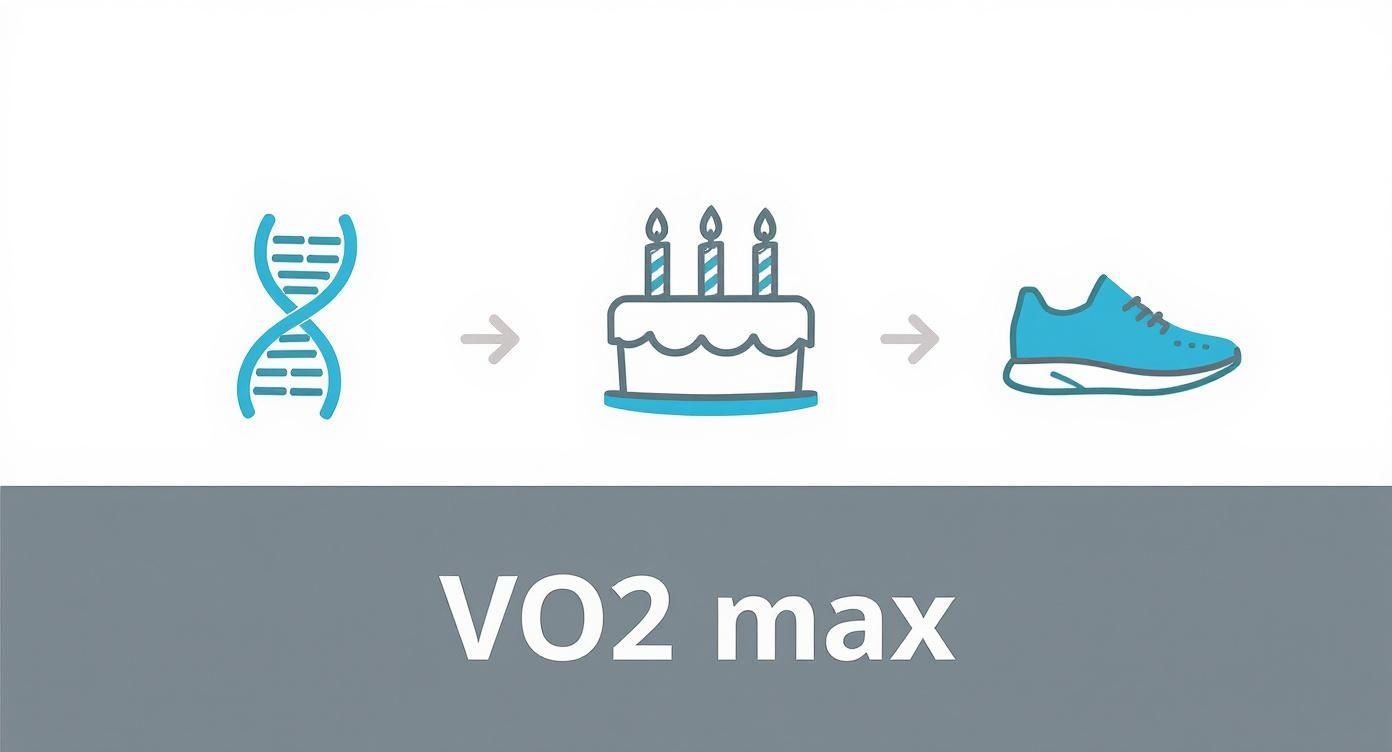
As you can see: Genetics and age are fixed factors, but training is the key variable you can adjust yourself to reach your full potential.
Polarized Training: The 80/20 Rule
Another extremely successful strategy is polarized training, often also known as the 80/20 rule. The idea is that you complete around 80% of your training sessions at very low intensity (that is, purely in the basic endurance zone) and only the remaining 20% at very high intensity (for example, with HIIT sessions). Training in the strenuous but submaximal “middle” zone is deliberately avoided here.
This approach has a huge advantage: it builds a broad aerobic base and protects you from overtraining, while the short, sharp sessions provide the necessary performance peaks. If you are preparing for truly demanding goals, such as an 800-kilometer pilgrimage, this method is worth its weight in gold. You can find more tips on physical preparation for a pilgrimage here.
Comparison of the top training methods for increasing VO2 max
Are you unsure whether to choose short, hard intervals or the 80/20 rule? This table compares high-intensity interval training (HIIT) and polarized training to help you decide which method best suits your goals and time budget.
| Feature | High-intensity interval training (HIIT) | Polarized training (80/20 rule) |
|---|---|---|
| Time required | Low (approx. 20–30 min. per session) | Higher (long, easy sessions + short, intense ones) |
| Intensity | Very high (90–95% max HR) | Extremely polarized (very easy or very intense) |
| Focus | Maximum stimuli in a short time | Building a broad aerobic base + targeted peaks |
| Ideal for | Athletes with limited time | Endurance athletes with more training time |
| Risk of overtraining | Higher with overly frequent use | Lower due to the high proportion of recovery training |
Both methods are extremely effective for increasing your VO2 max. While HIIT is the perfect turbo boost for anyone short on time, polarized training builds a more robust and deeper endurance base over the long term. Ultimately, your daily routine and personal preference decide.
It is important to always listen to your body. Your genetic predisposition also plays a role in how quickly you make progress. If you would like to make your training even more individualized, take a look at our article on the DNA-based training plan.
By the way, how effective structured training is can be seen impressively in elite sports. A German longitudinal study of professional footballers showed that their maximal oxygen uptake increased over six years from an average of 53.2 ml/kg/min to an impressive 64.9 ml/kg/min. That is a substantial increase of 21.67%
The right diet for your oxygen transport
Your training is only one side of the coin. A smart diet is the crucial fuel that enables your body to absorb oxygen efficiently and utilize it in your muscles in the first place. So, to improve your VO2 max value, you also need to take a close look at your diet.
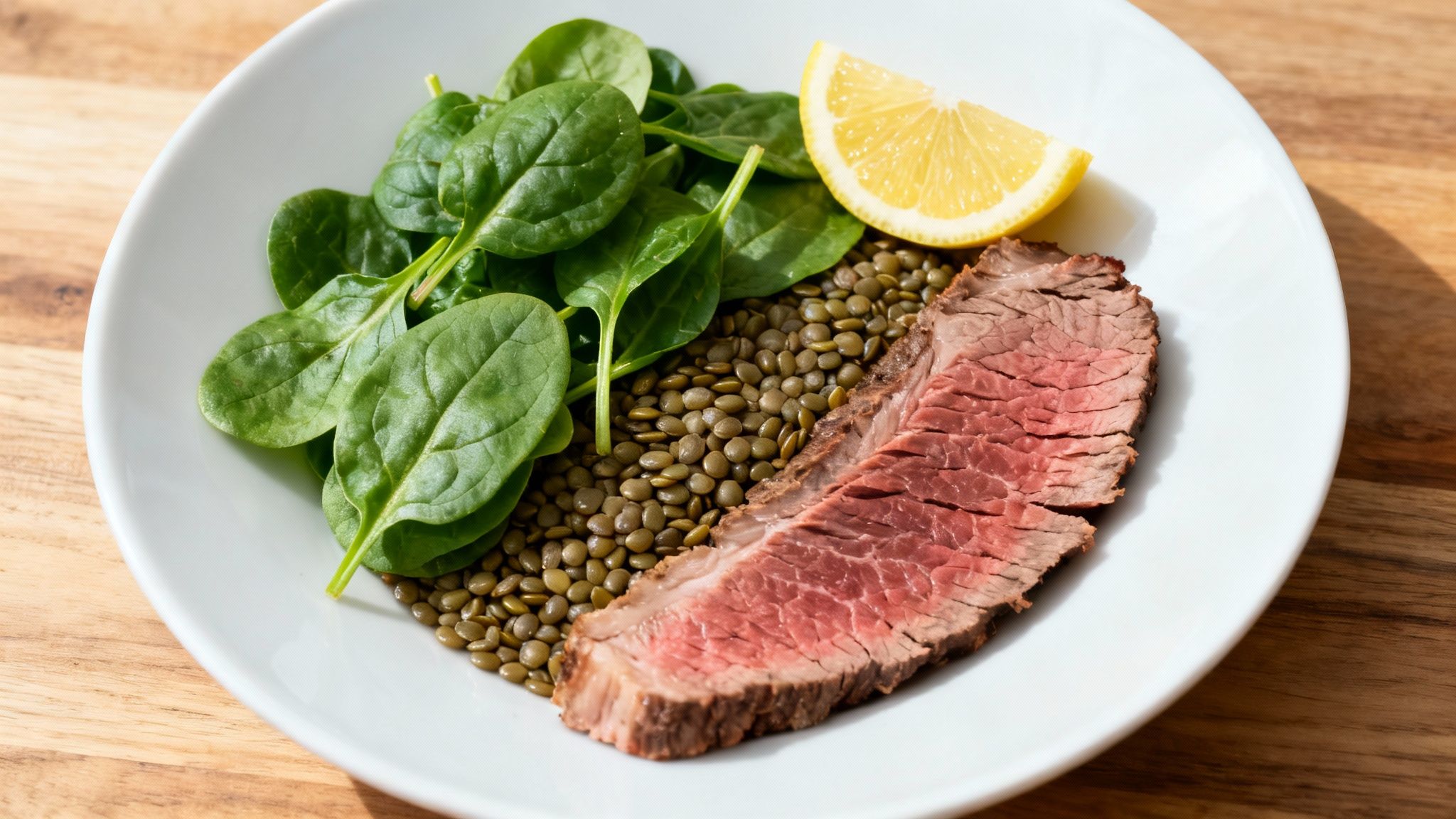
The absolute key player in transporting oxygen through your blood is iron. Think of it this way: This trace element is the central building block of hemoglobin, the protein in red blood cells. Hemoglobin grabs oxygen in the lungs and carries it, so to speak, piggyback to the working muscles.
Iron and vitamin C as a power duo
Iron deficiency simply means less hemoglobin. This slows oxygen transport, and your endurance performance noticeably declines. You feel fatigued more quickly, and your VO2 max value stagnates, no matter how hard you train.
To optimally replenish your iron stores, you should rely on a combination of animal- and plant-based sources:
- Animal-based iron (heme iron): Red meat, liver, and shellfish are the top sources here. Your body can absorb and utilize this form particularly well.
- Plant-based iron (non-heme iron): Lentils, chickpeas, spinach, and oats are also excellent alternatives.
But this is where an important partner comes into play: Vitamin C. It boosts the absorption of plant-based iron in the intestines many times over. A small trick with a big impact: Always combine your lentil soup with a glass of orange juice, or add fresh bell peppers to your salad. If you want to delve deeper, read our article on what to eat if you have iron deficiency.
The role of B vitamins in your energy production
In addition to iron, certain B vitamins are also essential for your energy production and the formation of red blood cells. Without them, virtually nothing happens in your cells' energy metabolism.
Vitamin B12 and folic acid (vitamin B9) are particularly important here. They are directly involved in cell division and the maturation of red blood cells. A deficiency can lead to a form of anemia that limits your performance just as much as iron deficiency.
Your diet lays the biochemical foundation for your athletic performance. Well-stocked iron and vitamin stores are not a minor detail but the prerequisite for your hard training to bear fruit at all.
A balanced, nutrient-rich diet is simply the foundation. If you would like to deepen your knowledge of a holistic approach, you can find valuable information on how to get fit and optimally support your body through healthy eating.
But remember: Every body is different. If, despite good training and a mindful diet, you feel like you are treading water, a nutrient deficiency could be the invisible brake. A simple nutrient test from mybody-x.com can give you clarity. It shows you precisely whether your stores of iron, vitamin B12, and other important micronutrients are truly at optimal levels. This allows you to take targeted action and unlock your full potential.
Uncover hidden performance inhibitors with blood tests
You give your all in training and follow your plan consistently, but that big leap in performance simply will not come? Your VO2 max value is barely improving, even though you feel like you are doing everything right. Do not worry—many ambitious athletes know this frustration all too well. The cause often lies deeper than you might think—namely, in your blood.
Sometimes invisible brakes at the cellular level are blocking your full potential. Your body is an incredibly complex system. When important building blocks for energy production or oxygen transport are missing, even the hardest training cannot have its full effect. This is exactly where our at-home blood tests come in. They finally give you clarity instead of leaving you in the dark.
Nutrients as the key to your energy supply
Imagine you want to start a fire. You have plenty of wood (your training), but you lack oxygen (essential nutrients). What happens? The fire will barely burn. Your body works much the same way. A simple nutrient test from mybody-x.com can show you precisely whether your “oxygen supply” at the cellular level is truly optimal.
This is primarily about three crucial values for your endurance performance:
- Iron (ferritin): As we have already discussed, iron is the heart of hemoglobin, which transports oxygen throughout your body. Your ferritin level tells you how full your iron stores are. A low level is one of the most common causes of unexplained fatigue and stalled performance.
- Vitamin B12: This vitamin is an indispensable co-pilot in the formation of red blood cells and for overall energy metabolism. A deficiency can quickly lead to anemia and a noticeable energy slump.
- Vitamin D: The “sunshine vitamin” is about much more than just being good for your bones. It plays a central role in muscle function and your overall performance. A deficiency can noticeably impair your muscle strength and, above all, your recovery.
Such a test provides you with facts, in black and white. Instead of blindly taking random supplements, you can specifically fill the gaps your body actually has. If you want to take a deeper dive into which other values are relevant, take a look at our guide, which explains what is tested in a complete blood count.
Keep an eye on stress and recovery
Training is stress for the body—but beneficial stress that prompts it to adapt and become stronger. However, if too much everyday stress is added and recovery falls by the wayside, the entire system can become destabilized. Chronic stress leads to the continuous release of the hormone cortisol.
A persistently elevated cortisol level can sabotage your recovery, hinder muscle growth, and even lead to weight gain. It acts like a handbrake pulled on your athletic progress.
A hormone test from mybody-x.com that measures your cortisol level gives you valuable insights into your personal stress level and ability to recover. If it reveals an imbalance, that’s a clear signal: You shouldn’t train harder, but smarter, and should deliberately focus on recovery, sleep, and active stress management.
By knowing your internal values, you turn mere assumptions into solid certainty. You no longer structure your training and nutrition based only on how you feel, but on hard data from your own body. This helps you uncover hidden performance barriers and finally unlock your true potential.
Recovery and everyday tips for sustainable success
The hardest training won’t get you anywhere if the crucial adaptations don’t take place. They don’t happen during exertion, but only in the hours and days afterward. So you make true progress toward improving your VO2 max between your training sessions.
Your body needs time to process the stimuli created by training, repair itself, and become stronger. Anyone who ignores these phases risks overtraining, stagnation, and, in the worst case, even injuries. That’s why recovery and smart everyday habits are just as important as your training plan itself.
Sleep as your most important ally
You can confidently consider sleep your most important recovery tool. While you sleep, crucial repair and rebuilding processes take place in your body. Growth hormones, which are essential for muscle repair, are released.
At the same time, the stress hormone cortisol is regulated. Chronic sleep deprivation leads to consistently elevated cortisol levels, sabotaging your recovery and slowing your progress. Aim for a consistent 7 to 9 hours of quality sleep per night—that’s the only way to support your hormonal balance and give your body the chance to recover fully.
Good sleep isn’t a luxury but a biological necessity. It is the foundation on which every athletic improvement is built—especially when it comes to sustainably increasing your VO2 max.
Active recovery instead of complete rest
Simply lying on the couch on a rest day isn’t always the best strategy. Active recovery can even speed up regeneration. Light movement promotes blood flow, supporting the removal of metabolic by-products such as lactate from the muscles.
Here are a few simple, tried-and-tested methods for active recovery:
- Easy cooldown jog or cycling: A short, very relaxed session of 20–30 minutes at the lowest heart rate.
- Stretching or yoga: Improves flexibility and can relieve muscle tension that has built up during the week.
- Foam roller (foam rolling): Helps loosen stuck fascia and relax your muscles. It can hurt sometimes, but it works wonders.
These gentle activities keep your system moving without creating additional stress.
Breathe your way to better performance
Your lungs are a central part of the oxygen transport system we want to improve. With targeted breathing exercises, you can noticeably improve your lung function and breathing efficiency. One simple but highly effective technique is box breathing:
- Inhale through your nose for 4 seconds.
- Hold your breath for 4 seconds.
- Exhale through your mouth for 4 seconds.
- Hold your breath for 4 seconds.
Repeat this cycle for a few minutes, for example in the evening before bed. This exercise not only strengthens your diaphragm but also helps calm your nervous system and reduce stress. It’s the perfect addition for building a well-rounded foundation for a better VO2 max.
Your most frequently asked questions about VO2 max
Finally, we want to answer a few questions we receive time and again. Here are the answers, short and to the point, so you know exactly how to improve your VO2 max.
How quickly can I improve my VO2 max?
That is probably the million-dollar question—and the answer depends heavily on where you are right now. If you’re new to training, you’ll make the biggest and fastest gains. Your starting point is everything.
An average recreational athlete in Germany usually has a value between 35 and 40 ml/kg/min if male, while for women it is more likely to be between 25 and 35 ml/kg/min. However, studies clearly show that someone who starts untrained at 35 ml/kg/min can reach 45–50 ml/kg/min within a few months through targeted training. You can read more fascinating details about maximal oxygen uptake here.
Your body adapts rapidly to new stimuli at first. But the fitter you become, the more targeted and harder you have to work for each further improvement—the classic principle of diminishing returns.
Is training hard enough on its own?
No, absolutely not. Focusing solely on high-intensity sessions is a typical beginner’s mistake. Without a solid aerobic base built through long, easy runs, you simply lack the foundation. The right mix is what matters.
Polarized training (approximately 80% easy and 20% hard) has proven to be the most sustainable method. This allows you to provide strong stimuli without slipping into overtraining. And don’t forget: recovery, sleep, and a good diet are just as important as the training itself.
Does age play a role?
Yes, age is a factor, but it’s not an excuse. Biologically, it’s normal for VO2 max to gradually decline from the age of 30 onward. But—and this is the good news—regular training can significantly slow this process or even partially reverse it.
It’s truly never too late to start. Even at an advanced age, you can still improve your endurance fitness impressively, thereby strengthening your health and quality of life in the long term.
Are blood tests really necessary?
Not necessary, but extremely smart. Especially if you feel stuck on a performance plateau, the at-home blood tests from mybody-x.com can provide the crucial insights. They uncover hidden obstacles, such as an iron or vitamin B12 deficiency that may be quietly sabotaging your oxygen supply.
Instead of fumbling in the dark and guessing what your body might be lacking, you get clear facts. This allows you to take targeted action and ensure that your hard training really pays off.
Are you ready to better understand your body and unlock your full potential? The blood tests from mybody-x.com provide the data-driven foundation you need to optimize your training and nutrition with precision. Discover the right tests for you now at https://mybody-x.com and take your performance to the next level.



Share now:
VO2max Score for Women: How to Quickly Improve Your Endurance
Proper nutrition for more energy and well-being