
VO2max value in women: How to improve your endurance quickly
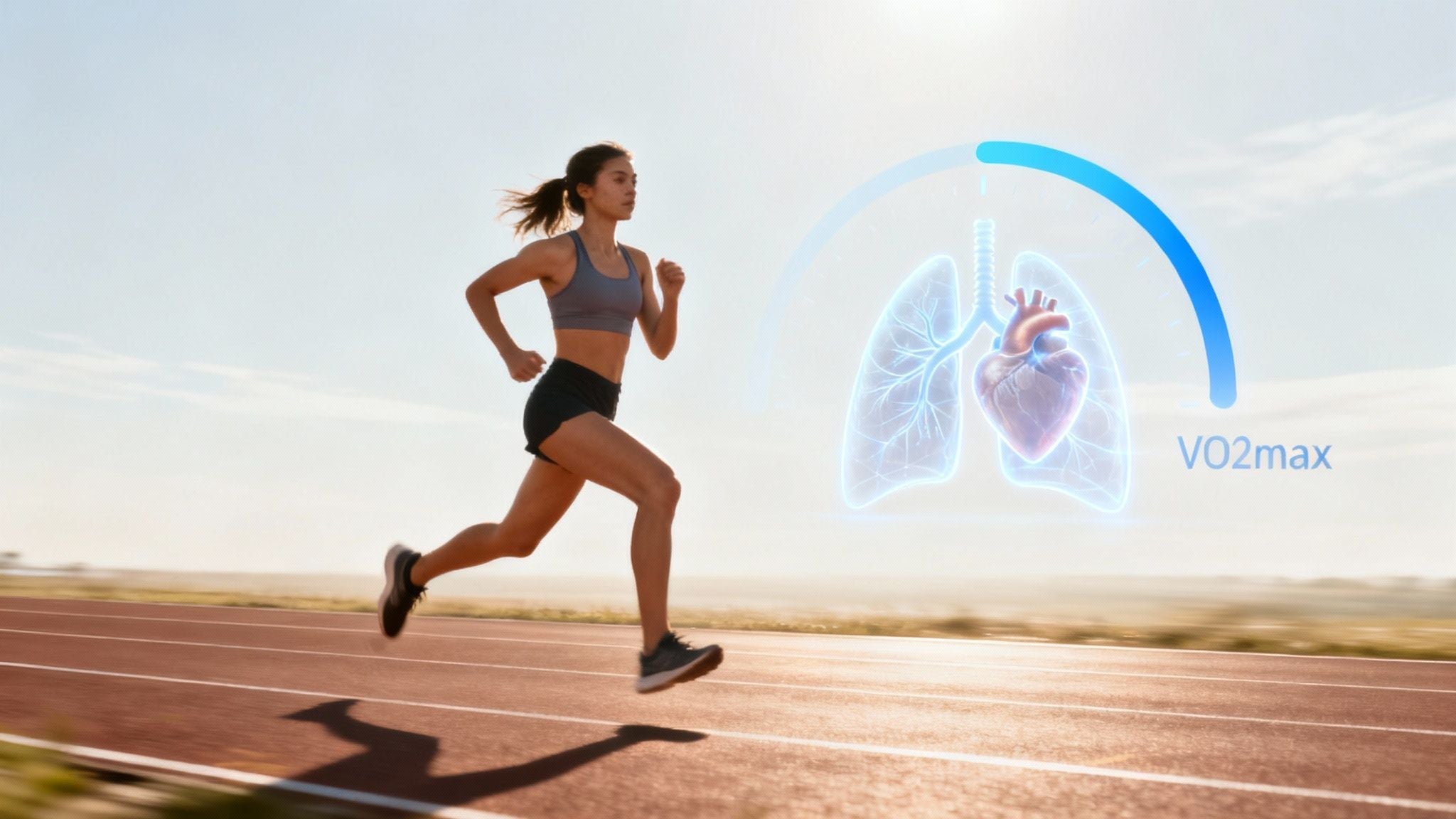
The VO2max value in women is one of the most important indicators of endurance fitness. It tells you how well your body can use the oxygen you breathe in to generate energy for movement. Very roughly speaking, typical values for untrained women range between 27 and 30 ml/kg/min, while physically active women often reach values of 35 to 45 ml/kg/min.
What your VO2max value really means as a woman
Are you wondering what this number actually tells you and why it is so important for your fitness? Imagine your body as a high-performance engine. The better this engine can use oxygen as fuel, the more power it puts on the road. That is exactly what VO2max measures.
For you as a woman, this value is a great indicator of your cardiovascular health and overall stamina. It shows how smoothly your heart, lungs, and circulatory system work together to supply your muscles with the vital oxygen they need during exertion.
Why women's values are different
You may have already noticed that women's VO2max values are slightly lower on average than men's. Don't worry, this is completely normal and has purely biological reasons. The differences can usually be attributed to a few simple factors:
- Heart size and blood volume: Women naturally have a slightly smaller heart and lower blood volume. As a result, slightly less oxygen-rich blood is pumped through the body with each heartbeat.
- Muscle mass: Men tend to have more muscle mass, and muscles are the main consumers of oxygen during exercise.
- Hemoglobin level: Hemoglobin is the protein in red blood cells that essentially carries oxygen on its back. Women naturally have slightly less of it.
However, these physiological differences do not mean that you are less fit. They simply mean that the benchmark is different. That is why it is so important to always compare your value with women in your age group.
Your VO2max value is not a fixed verdict but rather a guide. It shows you where you currently stand and how you can get even more out of yourself through targeted training and a healthy lifestyle.
The range among women in Germany is quite broad: Untrained women generally fall in the range of 27 to 30 ml/kg/min. Ambitious amateur athletes can easily reach values above 45 ml/kg/min, while exceptional elite athletes can even break the 70 mark. Since the value tends to decline with age, regular training becomes all the more important. If you want to delve deeper into the subject, you can find more background on VO2max at triathlon.de from the experts.
Knowing your individual value is therefore extremely helpful. It enables you to make your training smarter and support your health without getting lost in complicated technical jargon.
Understanding VO2max values for women by age and fitness level
Okay, so you’ve determined your VO2max value and are probably wondering: “Great, but what am I supposed to do with this number? Is my value good?” That’s exactly the key point! This value is your very own starting point for realistically assessing your fitness and setting goals that truly suit you.
Your VO2max is not a number set in stone. Rather, it is a dynamic value that depends heavily on your age and, of course, your training status. It is perfectly normal for the cardiovascular system’s maximum performance to decline somewhat over the years, with the value tending to decrease. But here’s the good news: You can not only slow down this process, but actively reverse it!
How to interpret your value correctly
To give you an idea of where you stand, there are some very helpful reference tables. But please don’t view them as a ranking; think of them as your personal fitness navigation system. They help you put your VO2max value as a woman into the right context and make your progress visible.
This infographic does a great job of showing just how significant the differences are between the typical VO2max values of untrained women, dedicated recreational athletes, and true professionals.
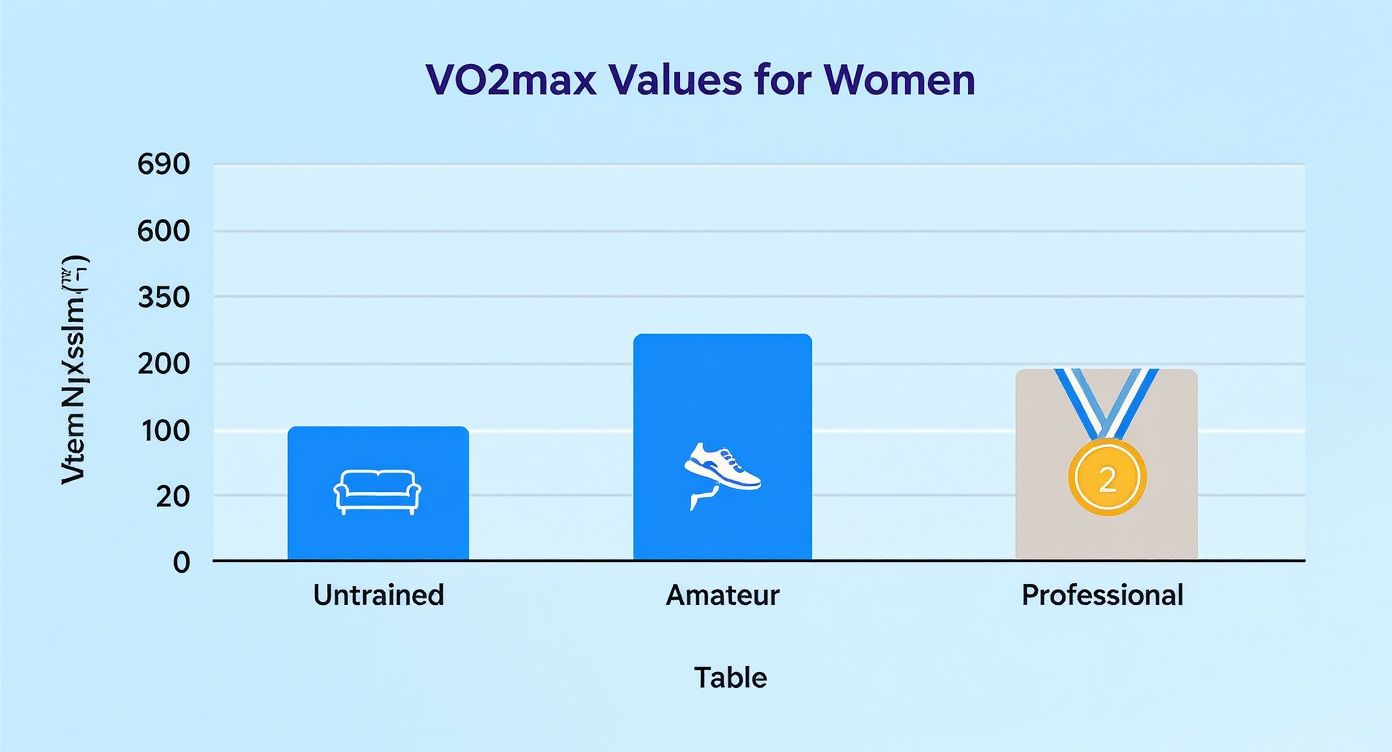
You can see it immediately: The step from “untrained” to “regular recreational training” catapults your aerobic fitness into a whole different league. Now that’s motivation, right?
Let’s take a closer look: For women between 20 and 29, a value below 29 ml/kg/min is considered rather poor. On the other hand, if you’re between 34 and 39 ml/kg/min, that’s already very good. Anything above 45 ml/kg/min in this age group is considered excellent. If you’re between 40 and 44, the scale shifts somewhat—here, values above 43 ml/kg/min are already excellent. If you’d like to dive deeper into the data, you’ll find more details on how to interpret it from the Laufcampus experts.
Your personal fitness compass
These figures are far more than just data on your sports watch. They are a direct reflection of your cardiovascular health. A high value means that your body is highly efficient at delivering oxygen where it is needed—in your muscles. This is the absolute foundation for greater endurance, everyday energy, and your overall well-being.
Is your value not as high as you hoped? Perfect! Don’t see it as a verdict, but as a starting signal. It shows you the huge potential still within you, just waiting to be awakened through the right training.
VO2max reference values for women by age
The following table provides a more detailed overview of how to interpret your value in relation to your age and different fitness levels. This allows you to see at a glance where you currently stand.
| Age group | Poor | Average | Good | Excellent |
|---|---|---|---|---|
| 20-29 | under 29 | 30-33 | 34-39 | over 40 |
| 30-39 | under 28 | 29-32 | 33-37 | over 38 |
| 40-49 | under 26 | 27-30 | 31-35 | over 36 |
| 50-59 | under 24 | 25-28 | 29-32 | over 33 |
| 60+ | under 22 | 23-26 | 27-30 | over 31 |
Always keep in mind that these are reference values. Every body is different and unique. For an even more detailed breakdown, we’ve put together a comprehensive VO2max value table for you in another article, providing further valuable insights. Use this information as your personal motivation—you can do it!
Accurately determine your VO2max value
Now that you know how to interpret your value, you’re probably eager to finally find out what it is. There are several different ways to determine your personal VO2max value as a woman—some are more precise, while others are more affordable and easier to carry out.
This way, you can decide which method best suits your goals and budget. In the end, you’ll have a reliable starting point for your training.
The gold standard in the laboratory
If you want to know exactly, there's no way around spiroergometry in a sports medicine laboratory. Picture it like this: You run on a treadmill or pedal an ergometer while wearing a special breathing mask. The workload is gradually increased until you reach your absolute performance limit.
This mask is the centerpiece of the test. It measures exactly how much oxygen you inhale and how much carbon dioxide you exhale. Your maximum oxygen uptake can be calculated from this difference. It doesn't get more precise than that! Of course, this method is complex and comes at a cost, but it delivers the most accurate value and is the absolute standard in competitive sports.
Estimates from Your Fitness Watch
For most of us, going to a lab isn't necessary at all. Modern fitness watches from Garmin and others are a highly practical alternative, as they estimate your VO2max directly from your wrist.
And these estimates have become surprisingly accurate! But how do they do it? Your watch uses a clever algorithm that gathers and analyzes various data from your workouts:
- Your heart rate: How high is your pulse at a particular running speed?
- Your pace or performance: How fast are you moving, or how many watts are you putting out on the bike?
- Your heart rate variability (HRV): The tiny variations between your heartbeats reveal a lot about your recovery status.
Basically, your watch looks at how hard your cardiovascular system has to work to produce a certain level of performance. The less your heart has to work at a high pace, the fitter you are—and the higher your watch estimates your VO2max to be.
Your watch readings are an excellent guide for keeping track of your progress. The lab is unbeatable when it comes to absolute accuracy, but the estimated values are more than sufficient for managing your everyday training.
Field Tests You Can Do Yourself
Want a quick, free assessment without expensive equipment? Then so-called field tests are a brilliant option. They may not give you a millimeter-perfect figure, but they provide a really good approximation of your aerobic fitness.
The best-known test of this kind is the Cooper Test. The task is incredibly simple: Run as far as you can in exactly 12 minutes. The distance covered is then entered into a formula that produces an estimate of your VO2max.
Another simple option, which is especially interesting for female cyclists, is based on your best 5-minute performance. There’s also a simple formula for calculating a good estimate of your value.
If you’d like to dive deeper into the various measurement methods and the calculations behind them, take a look at our detailed article about the VO2max value. Regardless of which method you choose, the measured value is your personal starting point on the path to greater endurance.
Time to get serious: How to whip your VO2max into shape
Okay, you know your number, know where you stand, and are motivated to get more out of yourself? Fantastic! A solid VO2max value for women is a great starting point, but the real potential lies in deliberately pushing that number higher. Now let’s get practical—I’ll show you the smartest training strategies to take your body to the next level.
We’re focusing on two proven approaches that will really get your endurance engine running. And don’t worry, you don’t have to turn your entire life upside down. It’s about applying smart, intense stimuli that force your cardiovascular system to become more efficient.
High-intensity interval training (HIIT) for a turbo boost
If you want to see noticeable results in a short time, high-intensity interval training (HIIT) is your ultimate secret weapon. The principle is brilliantly simple: you alternate between very short, brutal exertion phases and brief recovery periods. These intense peaks force your heart and lungs to absorb more oxygen and transport it to your muscles faster.
Your body hates this stress—and that’s exactly why it adapts, so you’ll be better prepared next time. Studies in Germany show that women can increase their VO2max by up to 20–30% through targeted training such as HIIT. Workouts in which you give it your all for 15–30 seconds and repeat the process 10–20 times are particularly effective.
Beginner workout for female runners – it could look like this:
- Warm-up: 10 minutes of very easy jogging.
- Intervals: 8 rounds of: 60 seconds of fast running (effort 8 out of 10), followed by 90 seconds of walking or easy jogging.
- Cool-down: 10 minutes of easy jogging and gentle stretching.
Polarized training: The smart 80/20 rule
Another extremely effective method is polarized training. The idea behind it is simple but extremely clever: You complete about 80% of your training sessions at an easy pace and low intensity. The remaining 20% are all-out and high intensity. You consciously leave out the zone in between—the demanding “moderately fast” pace.
Why does this work so well? The long, easy sessions build your aerobic base and train your body to burn fat without exhausting you. The short, hard sessions then provide exactly the stimulus you need for a higher VO2max.
This method is perfect for avoiding overtraining while still achieving maximum progress. You give your body plenty of time to recover while also providing the key stimuli for improving performance.
A training week could be structured as follows:
- Session 1 (80%): 60 minutes of easy-paced running (slow enough that you can still hold a good conversation).
- Session 2 (20%): A brisk HIIT session (as described above).
- Session 3 (80%): 45 minutes of relaxed cycling or swimming.
- Session 4 (80%): A 75-minute slow run on the weekend.
The be-all and end-all: Don’t forget recovery!
Whatever strategy you choose, always remember: Growth happens during rest. Intense training only provides the stimulus. Your body becomes stronger only when it has time to recover and adapt. Sufficient sleep, good nutrition, and intentional rest days are just as important as the training itself.
Every body is unique, and your genes also play a significant role in how well you respond to certain training stimuli. A personalized approach can make all the difference here. If you want to know what type of training and recovery profile you have from a genetic perspective, a DNA training plan can provide valuable insights to help you make your training even more targeted and effective.
How nutrition and lifestyle support your endurance
Do you train hard, but somehow aren’t making progress? Do you feel stuck on a performance plateau? A high VO2max value in women depends not only on sweat and miles. What you give your body as fuel is at least as important.
Imagine having a race car engine but filling it only with low-quality fuel. That is exactly what happens to your body when it lacks important nutrients for endurance performance. Training is only half the battle; your diet and lifestyle are the foundation on which everything is built.
Your oxygen express needs the right building blocks
The key to endurance is oxygen. Your blood is the transport system, and red blood cells are the delivery vehicles. The hemoglobin in them grabs oxygen in the lungs and delivers it to the muscles that are working hardest.
For this “oxygen express” to run smoothly, your body needs certain building blocks. Two of them are absolutely critical:
- Iron: This trace element is the heart of hemoglobin. Without enough iron, your body cannot build enough oxygen carriers. The result? You become short of breath more quickly, feel sluggish, and your performance drops.
- B vitamins: In particular, vitamin B12 and folic acid (B9) are essential for producing healthy, high-performing red blood cells. If they are lacking, this can also severely restrict oxygen transport.
A deficiency in any of these areas acts like a handbrake on your endurance. Women in particular have a higher risk of iron deficiency due to menstruation— a factor that can directly affect athletic performance. If you would like to learn more about how to replenish your iron stores, take a look at our guide on what to eat if you have an iron deficiency.
A nutrient deficiency is like running with the handbrake on. You can step on the gas as much as you like—but as long as the brake remains engaged, you will never reach your full potential.
But how do you know whether your nutritional status is truly optimal? Fatigue and a dip in performance are often the first signs, but unfortunately they are also very nonspecific. Instead of fumbling in the dark, a simple nutrient test from mybody-x.com can provide clarity. With a small blood sample that you can conveniently collect at home, you can check your iron and vitamin B12 status. This way, you know exactly where to start to give your body the building blocks it needs for peak performance.
The following table provides a quick overview of the most important nutrients that get your oxygen transport up to speed.
Nutrients for optimal oxygen transport
This table summarizes which nutrients are essential for blood formation and oxygen transport, which foods contain them, and how a mybody-x test can help assess them.
| Nutrient | Function for VO2max | Top food sources | Suitable mybody-x test |
|---|---|---|---|
| Iron | A central component of hemoglobin; binds and transports oxygen | Red meat, lentils, spinach, pumpkin seeds, rolled oats | Iron ferritin self-test, NUTRI CHECK blood test |
| Vitamin B12 | Necessary for the formation of red blood cells | Meat, fish, eggs, dairy products | Nutrient | VitalCheck Basic, NUTRI CHECK blood test |
| Folic acid (B9) | Supports the maturation and development of red blood cells | Leafy green vegetables, legumes, whole-grain products | NUTRI CHECK blood test |
| Vitamin C | Improves the absorption of iron from plant sources | Bell peppers, broccoli, citrus fruits, berries | Assessed as part of the NUTRI CHECK blood test |
As you can see, targeted nutrient intake plays a crucial role. By keeping these key nutrients in mind, you ensure that your engine is optimally fueled.
More Than Just Food: Your Holistic Approach
Optimal nutrient intake is the foundation. But achieving a noticeable increase in your VO2max requires a holistic view of your lifestyle.
- Sleep: Recovery doesn’t happen on the sofa but during sleep. This is when your body repairs muscle damage and adapts to training stimuli. Chronic sleep deprivation is a real progress killer. Aim for seven to nine hours per night.
- Stress management: Constant stress floods your body with the hormone cortisol. This not only slows recovery but also inhibits muscle growth. Find your balance—whether through yoga, meditation, or a simple walk in the woods.
- Hydration: Even mild dehydration makes your blood more viscous. Your heart then has to pump significantly harder to deliver oxygen to your muscles. That costs valuable energy! Make sure you drink enough throughout the day, especially around your workouts.
When you bring these three pillars—nutrition, recovery, and training—into balance, you create the perfect conditions for your hard work to finally pay off and your VO2max to rise sustainably.
Your path to better fitness and greater well-being
Now you know what the VO2max value for women is all about, how to interpret it for yourself, and above all, how to improve it. This number is so much more than just a value on your fitness watch—it’s a living indicator of your cardiovascular health.
See your VO2max value as your personal driving force. It shows you in black and white how your training directly affects your endurance and well-being. Every small improvement is proof that your body is getting stronger and your engine more efficient.
The key to better endurance lies in a smart mix of three important building blocks:
- Smart training: Whether HIIT or polarized training, targeted and intense stimuli are what really move you forward.
- The right nutrition: Your body needs the right fuel. Good nutrition, especially an adequate supply of iron and B vitamins, is the foundation for every improvement in performance.
- A mindful lifestyle: Good sleep, smart stress management, and sufficient water are often underestimated helpers that make your recovery—and therefore your progress—possible in the first place.
Your VO2max is like a compass that shows you the way to more energy and enjoyment of life. Use it to set your goals, celebrate your progress, and stay on track.
It’s not about chasing arbitrary records, but about discovering the fittest and healthiest version of yourself. If you notice that you’re not making progress despite all your efforts, taking a closer look at your nutrients could provide the crucial clue. A simple nutrient test from mybody-x.com can quickly show you whether an undetected deficiency may be holding you back.
Listen to your body, celebrate your successes—no matter how small they may seem—and be proud of your journey. With your new knowledge, you now have everything you need to take your endurance, health, and well-being to a whole new level. Your journey to greater fitness starts right here.
Your questions about VO2max, answered briefly
You probably still have a few questions buzzing around in your head. That’s great, because it shows that you’re genuinely taking an interest in your fitness! Here, I’ve collected the most common questions about the VO2max value in women and answered them briefly and clearly.
How quickly can I increase my VO2max value as a woman?
It depends heavily on your starting level. If you’re just beginning to run or cycle, you’ll probably see the fastest results—often, increases of 10 to 20% are possible after just six to eight weeks. That’s a huge motivational boost!
If you’ve been at it for a while and are well trained, your progress will be smaller, and you’ll need to train more specifically to continue improving your performance. No matter where you start, consistency is key.
Does my cycle affect my VO2max value?
Yes, definitely! This is a really important point that many women notice in themselves. Hormonal fluctuations during your cycle can affect how you feel on a given day and therefore also influence your watch’s measurements.
For example, many women feel particularly strong and energized during the first half of their cycle, known as the follicular phase. To compare your progress as fairly as possible, it’s best to try to perform your performance tests during the same phase of your cycle each time.
Does strength training help improve my VO2max?
Absolutely! Although endurance training is the most direct way to increase your VO2max, strength training plays an important supporting role.
Think of it this way: Stronger muscles simply work more efficiently. They use less oxygen at the same level of exertion. This improves your running economy, puts less strain on your cardiovascular system, and ultimately has a positive effect on your endurance.
Why is my VO2max value lower than men’s?
This is completely normal and has simple biological reasons. On average, women naturally have slightly less muscle mass, a smaller heart, and less hemoglobin in their blood, which is responsible for transporting oxygen.
All of this means that women’s maximum oxygen uptake is somewhat lower to begin with. That’s why it’s so important never to compare your value with men, but only with women in your age and fitness group.
Are you ready to take not only your training, but also your nutrient intake to the next level? Taking a close look at your blood values can be the crucial step. Discover with the blood tests from mybody-x.com how you can support your endurance from the inside out. Find the right test for you now at mybody-x.com



Share now:
Matcha tea: How healthy is the green powder really?
Improving your VO2 max made easy