

Your food allergy test as a clear guide for your diet
A food allergy test is a diagnostic procedure that detects specific IgE antibodies in your blood to determine whether your immune system is overreacting to certain foods. It helps you distinguish between a true allergy and a simple intolerance, allowing you to identify the cause of your symptoms.
An allergy, or just an intolerance?
Stomach pain after eating, tingling in your mouth, or a sudden rash – when your body reacts to certain foods, the first thought is often: "I have an allergy." But before you consider a food allergy test, we need to clarify one crucial question. Is it really an allergy, or is it an intolerance?
The two terms are often lumped together in everyday use, but they describe two completely different processes in your body. Understanding this difference is the first and most important step toward correctly identifying your symptoms and taking the appropriate measures.
The crucial difference lies in the immune system
A true food allergy is always a reaction of your immune system. Your body mistakenly classifies an otherwise harmless substance, such as a protein in peanuts or milk, as a dangerous intruder. It then produces specific antibodies of the type immunoglobulin E (IgE).
Every time you come into contact with this allergen again, your immune system immediately sounds the alarm. It triggers a chain reaction that can range from mild skin redness to life-threatening symptoms.
Imagine your immune system as an overzealous security guard. With an allergy, it mistakes a harmless visitor (the food) for a burglar and immediately triggers a general alarm.
A food intolerance, also called an intolerance, has nothing to do with the immune system. The problem almost always lies in the digestive system. For example, your body may lack a specific enzyme needed to properly break down and process a food component such as lactose (milk sugar). The symptoms are often very unpleasant, but generally not life-threatening.
If you would like to understand the differences in more detail, you can find detailed information on distinguishing between allergies and intolerances in our article.
Interpreting symptoms correctly – what you should look out for
The type of symptoms and how quickly they appear often provide important initial clues about what you may be dealing with:
- Typical allergy symptoms: These usually appear very quickly—often within just a few minutes and no more than two hours after consumption. They can affect the skin (hives, swelling), the airways (shortness of breath, wheezing), and even the circulatory system (dizziness, collapse). Tingling in the mouth or swollen lips are also classic signs.
- Typical intolerance symptoms: Digestive problems such as bloating, abdominal pain, diarrhea, or constipation are usually the main symptoms. They often occur with a delay, sometimes not until hours after eating.
It is truly remarkable how much personal perception can differ from an actual medical diagnosis. While around 30 percent of Germans report in surveys that they suffer from a food allergy, scientific studies paint a completely different picture.
A comprehensive study found that the actual rate among adults is only 3.7 percent. You can read more about these interesting study results on the prevalence of food allergies here.
This knowledge will help you better categorize your symptoms and understand why a targeted test is the next logical step toward finally gaining clarity.
The most common testing methods in direct comparison
If you are finally looking for clarity about your body's reactions, you face an important question: Which food allergy test is right for you? The world of diagnostics offers various ways to get to the bottom of the causes of your symptoms. Each method has its own strengths and weaknesses.
To make it easier for you to get started, we present the most important testing methods. This gives you a solid foundation for making an informed decision about a self-test such as the one from mybody®x.
This graphic helps you categorize your symptoms and decide whether an allergy or an intolerance is more likely.
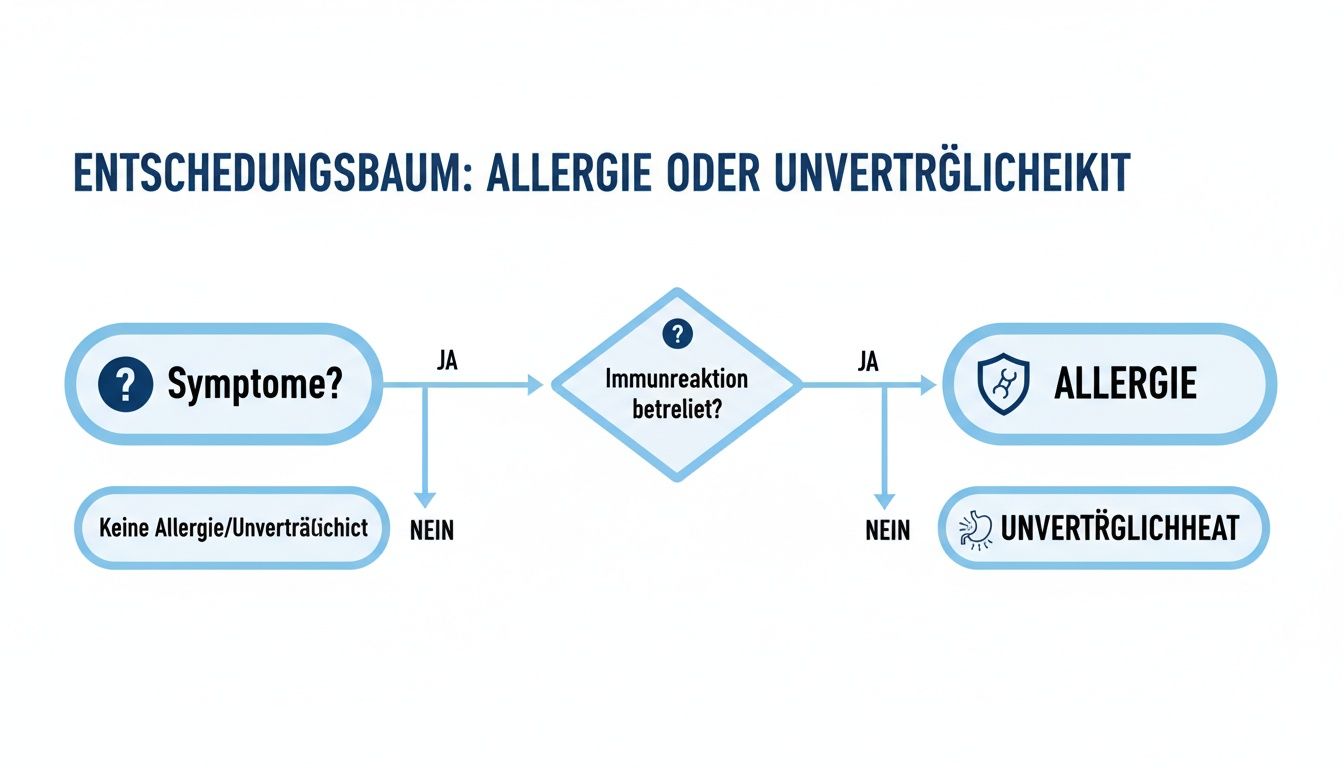
The decision tree makes it clear: A true allergy is always an immune system reaction, whereas intolerances are usually attributable to digestive problems.
The skin prick test at an allergist's office
The skin prick test is a true classic in allergy diagnostics and is performed directly in a doctor's office. Small drops containing various allergen extracts are applied to your forearm. The skin is then lightly scratched at these points so that the substances can penetrate the uppermost layer of skin.
When your body reacts to an allergen, a small, itchy swelling develops within 15 to 20 minutes—much like a mosquito bite. This procedure is quick and provides immediately visible results, but it also has its drawbacks. Certain medications, such as antihistamines, must be discontinued beforehand, and the test is often not feasible if you have severe skin conditions.
Specific IgE blood test
A modern and highly accurate alternative is the specific IgE blood test. A small blood sample is taken and analyzed in a laboratory for IgE antibodies against a wide range of foods. This is exactly the technology used in the mybody®x home tests.
The major advantage is that you do not need to stop taking any medication, and the test is completely independent of the condition of your skin. It measures your immune system's sensitization at virtually the molecular level and provides a detailed overview of potential triggers.
An IgE blood test is like looking into your immune system's memory. It shows you which foods have been marked as “enemies,” even if your last contact with them was some time ago.
The results provide valuable information that you can then compare with your symptoms. While this test detects sensitization, our guide explains how to test for a food intolerance that is not mediated by the immune system.
The oral food challenge as the gold standard
The oral food challenge is considered the most reliable method for confirming or ruling out an allergy conclusively. Under strict medical supervision, you consume gradually increasing amounts of the suspected food.
This test is usually carried out in a hospital, as immediate medical assistance must be available in the event of a severe reaction. It is often used when other tests have not provided a clear result.
Elimination diet and food diary
An elimination diet is less a test than a diagnostic method used in everyday life. You consistently avoid all suspected foods for several weeks. If your symptoms noticeably improve during this time, that is a strong indication of a connection.
You then reintroduce the foods one at a time, with a time interval between them, to identify the exact trigger. An accompanying food diary is essential here for accurately documenting reactions and meals and recognizing patterns.
It is remarkable how many people are affected by allergies. Among the German-speaking population aged 14 and over, around 12.49 million people consider themselves allergy sufferers. Women are affected significantly more often than men, at 14 percent compared with 6 percent.
How an IgE blood test detects your sensitizations
The specific IgE blood test is one of the most advanced methods for obtaining meaningful results from a food allergy test. It is also the technology we rely on at mybody®x to give you clear insights into your body’s reactions. But how exactly does it work, and what actually happens to your small blood sample when it arrives at the laboratory?
Let’s take a look behind the scenes of your immune system together. We’ll explain in simple terms how this test works and what the results ultimately mean for you.
Your IgE antibodies take center stage
Immunoglobulin E antibodies, or IgE for short, are at the heart of every genuine allergy. The best way to think of them is as a kind of special operations unit within your immune system. Normally, their job is to detect and neutralize genuine threats such as parasites.
With an allergy, however, a serious case of mistaken identity occurs. Your body mistakenly classifies a completely harmless protein—such as one from a hazelnut—as a dangerous intruder. It then specifically produces IgE antibodies that fit this hazelnut protein exactly, like a key in a lock.
These antibodies attach themselves to specific cells called mast cells, which are found throughout your body. From this moment on, your body is “sensitized.” If you eat a hazelnut again, the antibodies immediately recognize the allergen, bind to it, and trigger a chain reaction. The mast cells suddenly release messenger substances such as histamine, which then cause typical allergic symptoms such as itching, skin rashes, or shortness of breath.
What happens to your blood sample in the laboratory
When you take a food allergy test like the one from mybody®x, you only need a few drops of blood from your fingertip. You then send this sample directly to our certified partner laboratory, where the real detective work begins.
First, the blood serum—that is, the liquid part of your blood without the blood cells—is prepared, because this is exactly where your IgE antibodies are found. In an automated process, your serum is then brought together with extracts from dozens of different foods.
- Step 1: Your blood serum is placed on a special test plate containing tiny amounts of various food allergens (e.g., from peanuts, wheat, and milk).
- Step 2: If your blood contains specific IgE antibodies against one of these allergens, they bind firmly to the corresponding sites on the plate.
- Step 3: The plate is then thoroughly washed to remove all antibodies that did not find a partner.
- Step 4: Finally, a solution is added that triggers a color reaction as soon as it encounters bound IgE antibodies. The more intense the color, the higher the concentration of antibodies.
This allows the laboratory to measure precisely how many specific IgE antibodies are present in your blood for each individual food.
A positive test result indicates sensitization. This means that your immune system has, so to speak, created “wanted posters” in the form of IgE antibodies for a particular food. It is a crucial indication, but not yet the definitive diagnosis of an allergy.
Sensitization is not the same as an allergy
This point is incredibly important for interpreting your test result correctly. An IgE blood test measures sensitization, meaning the general tendency of your immune system to react to a food. However, it does not automatically mean that you will actually experience symptoms every time you come into contact with it.
In fact, there are people who have a confirmed sensitization but can eat the corresponding food without any problems. A true allergy is only present when both sensitization can be detected and typical symptoms occur after consumption. Your test result is therefore an extremely valuable piece of information that shows you where you need to take a closer look. The mybody®x at-home IgE allergy blood test provides you with exactly this sound basis to finally uncover connections between your diet and your well-being.
How your at-home allergy test works
Do you finally want to take action yourself and take the first step toward clarifying your symptoms? A mybody®x home test is a straightforward and completely reliable way to gain valuable initial insights. We will guide you through the entire process—from ordering and the child’s-play sample collection to your personal results report, which is genuinely easy to understand.
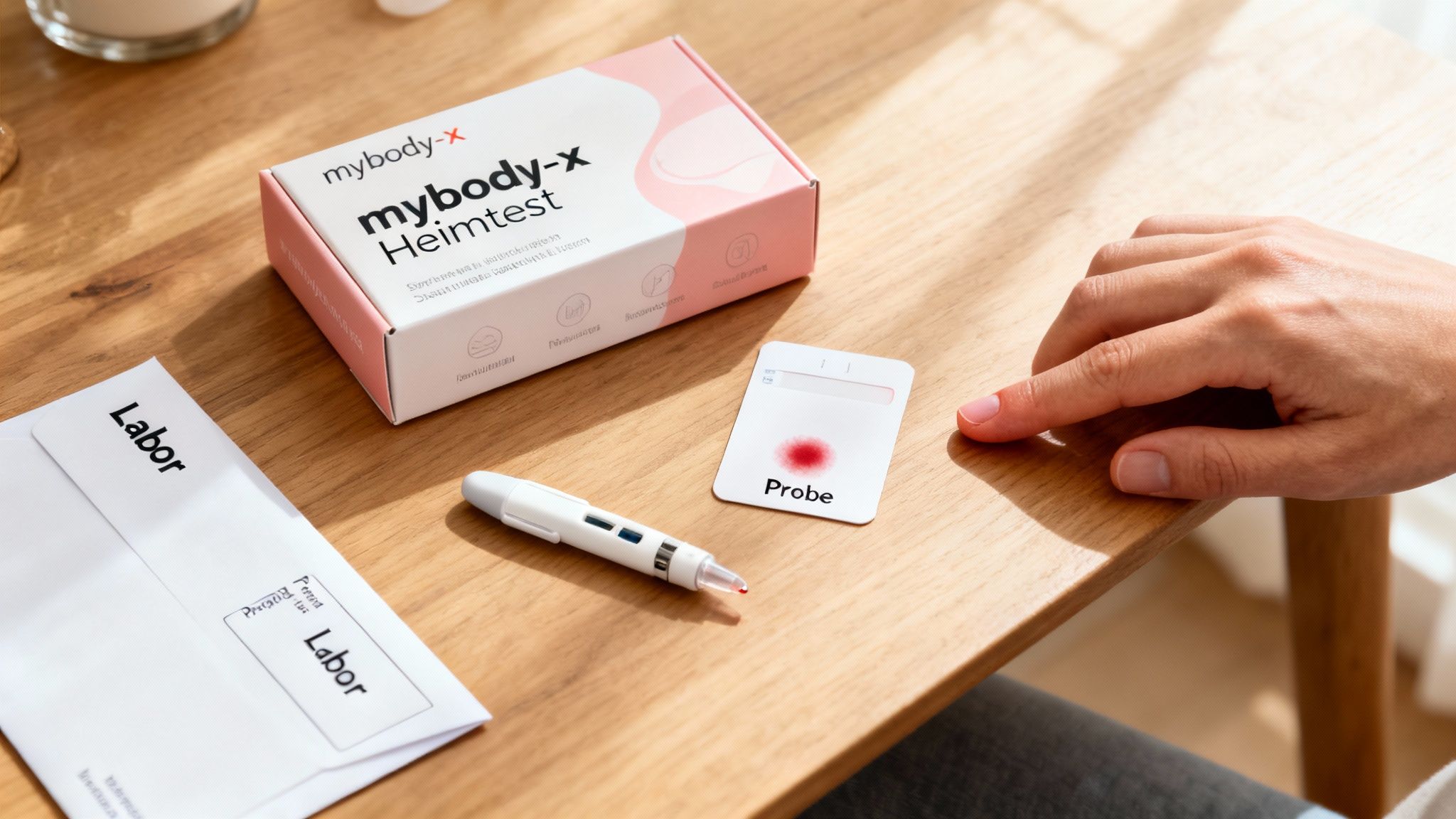
We provide you with detailed instructions showing you exactly how to collect your sample quickly and almost painlessly with a tiny prick in your finger. You will then learn what happens in our certified partner laboratory and how we analyze your IgE antibodies to give you a clear overview of possible sensitizations.
Your path to your results in four simple steps
The entire process is designed to give you maximum clarity with minimal effort. You do not need to make a doctor’s appointment or wait weeks for an appointment. Instead, you can conveniently do everything from home while still receiving a scientifically sound laboratory analysis.
Here’s how it works:
-
Order and activate the test kit You can easily order your Food Allergy Test online. Within just a few days, a compact test kit containing everything you need will arrive in your mailbox. Before collecting the sample, you activate your test online using a unique ID—this ensures that your sample can later be clearly matched to you and that your data remains completely secure.
-
Easy sample collection at home Collecting the blood sample is the part many people feel apprehensive about, but we have made it as easy as possible. With the enclosed lancets, all it takes is a small, barely noticeable prick in your fingertip. You only collect a few drops of blood in the tube. Our illustrated instructions guide you safely through every step.
-
Free return shipping to the laboratory Once the sample is in the tube, you securely pack it in the enclosed return envelope. We have already paid the postage for you. Simply drop off the shipment at the post office, and it will head directly to our certified German partner laboratory.
-
Analysis and personalized results report In the laboratory, experts examine your blood very closely and analyze it for specific IgE antibodies against a wide range of foods. After approximately 10 to 12 business days, the evaluation is complete and we will notify you. Your detailed, easy-to-understand results report will then be waiting for you in your secure online account.
What exactly happens in the laboratory
As soon as your sample arrives at our facility, the highly precise analysis begins. Our laboratory experts use state-of-the-art immunological testing methods to measure the concentration of IgE antibodies against specific food allergens in your blood.
Each sample is carefully prepared and tested in a fully automated process. This not only ensures the highest accuracy but also virtually eliminates sources of human error. The laboratory measures how your blood reacts to allergens from common culprits such as nuts, dairy products, grains, fruit, and vegetables.
Your mybody®x test result is more than just a dry list of values. It is an easy-to-understand overview showing which foods trigger a sensitized response from your immune system. This gives you a powerful tool for adjusting your diet in a targeted way.
It’s truly fascinating how varied the triggers for allergies can be. The most common culprits in Germany vary greatly depending on age. In children, chicken eggs, cow’s milk, and peanuts are the main ones. In adults, however, pollen-associated allergens such as apples, hazelnuts, or carrots often cause problems through cross-reactions. If you would like to learn more about these age-related differences in food allergies, you’ll find interesting information here.
This simple and straightforward process gives you the opportunity to gather reliable data about your body without turning your everyday life upside down. You can then use the results to take the next steps in a targeted way.
What your test results really mean
Okay, you’re holding your results report in your hands—a decisive moment. A positive result from a food allergy test often raises more questions than it answers at first. But don’t worry—we’ll help you interpret your results correctly and plan the next sensible steps.
The most important insight first: Confirmed sensitization, such as that identified by your mybody®x test, does not automatically mean that you have to eliminate a food from your diet forever. It is a valuable clue—a spotlight focused precisely on the potential triggers.
Understanding sensitization: the first step
Your result shows that your immune system has produced IgE antibodies against certain foods. Your body is therefore “sensitized” and, so to speak, ready to launch a defense reaction upon contact. Whether it actually does so and whether you notice anything as a result is an entirely different question.
A clinically relevant allergy is only present when two things come together:
- Detectable sensitization: Your IgE test is positive for a specific food.
- Matching symptoms: You experience typical allergic reactions after consuming this food.
Your test result is therefore your personal roadmap, showing you where you need to take a closer look. It is the scientific basis for finally uncovering the connection between what you eat and how you feel.
Your most important tool: the food diary
Now the real detective work begins, and your most important tool is a simple food diary. It helps you connect the abstract laboratory data with your everyday life. For this purpose, document exactly what you eat and how you feel afterward for one to two weeks.
Do not just record your meals, but also the time and every symptom, no matter how minor. A slight tingling in your mouth, a sudden urge to sneeze, skin redness, or stomach rumbling—all of it counts. This will help you gradually recognize patterns and narrow down the suspects from your test result.
Your results report is the map, and your food diary is the compass. Only together can they reliably guide you to your destination and show you which paths in your diet you may need to avoid.
This step is crucial to avoid unnecessary restrictions. You may find that you react to raw apples (a positive test result) but tolerate applesauce without any problems because cooking has neutralized the allergens.
When professional help is crucial
Your mybody®x test result is a powerful first step that you have taken into your own hands. However, professional guidance is essential for the next steps, especially if you have severe symptoms or are planning a major dietary change.
Talk to your doctor or a qualified nutritionist. Show them your results report and your food diary. They can help you:
- Medically confirming the results: If necessary, your doctor can initiate further steps such as a skin prick test or an oral food challenge to be completely certain.
- Making an elimination diet safe: Targeted elimination of foods should always take place under professional supervision so that you do not risk nutrient deficiencies.
- Identifying cross-reactions: An expert can explain why you may react to celery even though you “only” have a birch pollen allergy.
- Creating a balanced meal plan: Together, you can find delicious and healthy alternatives for the foods you need to avoid. This keeps your diet varied and nutrient-rich.
The mybody®x Food Allergy Test gives you the control and data you need. Use this foundation to make the best decisions for your health together with experts and sustainably improve your well-being.
Frequently asked questions about food allergy testing
You now have a pretty good overview of the world of food allergies and the different testing methods. But, as is often the case, a few specific questions may still remain. That is exactly what we want to clarify here—briefly, clearly, and without technical jargon, so you can resolve any lingering uncertainty.
How reliable is a food allergy test for home use?
A mybody®x home test based on the analysis of specific IgE antibodies is highly reliable when it comes to detecting sensitization. Our tests are evaluated in the same certified German specialist laboratories as the tests performed by your doctor. They therefore provide a scientifically sound basis for identifying possible triggers of your symptoms.
However, it is important to interpret the result correctly. The test shows which foods your immune system reacts to by producing antibodies. This does not automatically mean that you will also experience noticeable symptoms in response to them. The final diagnosis of a genuine, clinically relevant allergy should always be made in conjunction with your observations (ideally recorded in a symptom diary) and, preferably, in consultation with a doctor or dietitian.
Can you outgrow a food allergy?
Yes, this is indeed possible, especially in children. Allergies to staple foods such as milk, eggs, soy, or wheat often simply disappear as children grow. You can think of it as the immune system gradually “learning” that these substances are actually harmless. It then develops a tolerance.
This happens less often in adults, but it is not completely ruled out. Allergies to peanuts, tree nuts, or fish, on the other hand, usually remain with you for life. There are approaches such as specific immunotherapy (desensitization) to retrain the immune system, but this method is still far less established for food allergies than it is, for example, for pollen allergies.
How much does a food allergy test cost?
Costs can really vary widely here. Conventional tests at a specialist’s office, such as a prick test, are generally covered by statutory health insurance when there is clear medical suspicion. More comprehensive IgE blood tests, on the other hand, can quickly become an individual healthcare service (IGeL) that you have to pay for yourself.
With home tests such as those from mybody®x, the prices are transparent and cover the entire service:
- The complete test kit for easy sample collection at home.
- Free return shipping of your sample to our certified laboratory.
- The detailed and precise laboratory analysis of your blood.
- A personalized and, above all, easy-to-understand results report.
This gives you complete cost control from the outset and provides you with a well-founded analysis delivered directly to your home, with no hidden fees.
A home test is an investment in understanding your own body. It provides you with the data you need to proactively uncover the causes of your discomfort and take charge of your health.
How long does it take to receive a result?
A skin prick test at the doctor’s office is lightning-fast—the result is visible after around 15 to 20 minutes, directly as a reaction on your skin. With a blood test that has to be evaluated in a laboratory, of course, a little more patience is required.
If you take a mybody®x home test, you can generally expect your results 10 to 12 business days after your sample arrives at the laboratory. As soon as your personal report is available in your secure online account, we will notify you immediately by email. This way, you will quickly have clarity and can plan your next steps without a long wait.
Should I stop taking certain medications before the test?
This is a very important point, because there is a key difference between the testing methods. For a skin prick test at the doctor’s office, you generally have to stop taking antihistamines (that is, conventional allergy medication) a few days beforehand. The reason is simple: They would suppress the skin reaction and distort the results.
The major advantage of an IgE blood test, such as the ones we use for the mybody®x tests, is that you do not have to stop taking any medication. Whether you take antihistamines or cortisone has no effect whatsoever on the amount of specific IgE antibodies in your blood. You can therefore take the test at any time without having to interrupt your usual medication.
At what age is a test useful?
A food allergy test is generally an option at any age as soon as an allergy is suspected. However, diagnostic testing for infants and toddlers should always be closely supervised by a pediatrician or allergist. In these cases, the triggers are often staple foods such as milk or egg.
Home tests such as those from mybody®x are intended for adults who want to independently gather initial indications. They are the ideal starting point for investigating unclear and recurring symptoms. This gives you a sound basis for discussions with a doctor or therapist. If you want to take responsibility for your well-being, such a test provides valuable and very concrete starting points.
To ensure you have the most important information quickly at hand, we have summarized the most frequently asked questions for you in the following table.
Overview of questions and answers The following questions are answered in detail in the FAQ section to quickly and clearly address common uncertainties.
| Question | Short answer |
|---|---|
| How reliable is a home test? | Very reliable for detecting sensitization; the analysis is performed in certified laboratories according to the same standards as those used by doctors. |
| Can an allergy go away? | Yes, especially in children (e.g., milk, egg). It is less common in adults, but possible. |
| How much does an allergy test cost? | Costs vary. Home tests offer transparent pricing for the entire package, from the test kit to the results report. |
| How long does it take to receive the results? | About 20 minutes for a skin prick test, and approximately 10–12 business days for a home blood test after the sample arrives at the laboratory. |
| Do I need to stop taking medication? | Not for an IgE blood test (home test). For a skin prick test, antihistamines must be discontinued beforehand. |
| At what age is a test useful? | Basically at any age. Home tests are intended for adults who want to independently gather initial indications. |
We hope these answers shed more light on the matter and help you make the right decisions for your health.
Do you finally want to understand what is behind your symptoms and regain control over your diet? With the scientifically based self-tests from mybody®x, you gain clear insights into your body's reactions. Discover the right analyses now and start your journey toward greater well-being and quality of life.



Share now:
Microbiome Test Comparison: How to Find the Right Gut Test for You
How magnesium naturally and effectively helps with menstrual cramps