
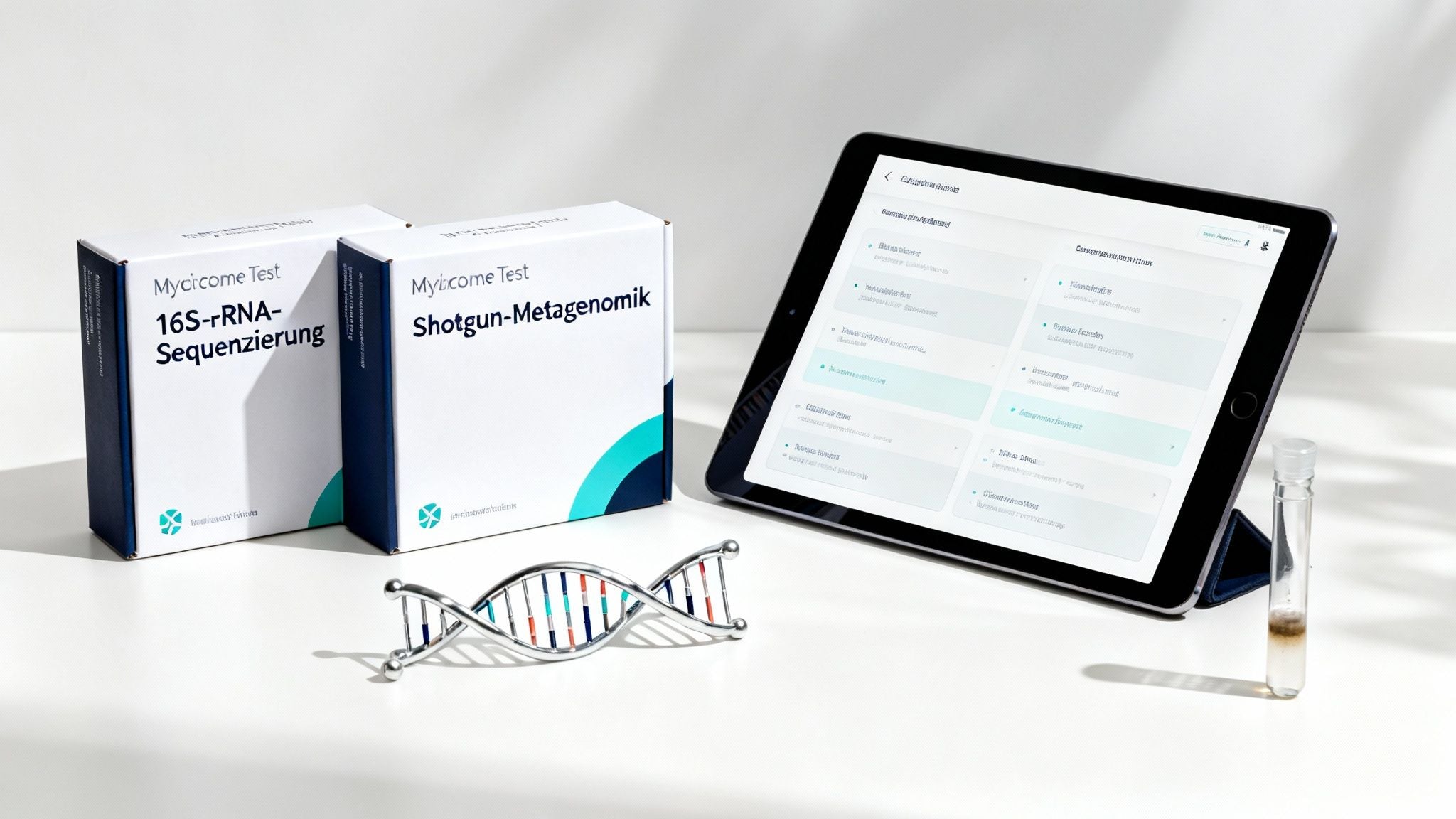
Microbiome Test Comparison: How to find the right gut test for you
A microbiome test comparison quickly gets to the point: While simple tests often provide only a rough overview of bacterial genera, advanced analyses such as those from mybody-x.com give you deep insights into the diversity of species, the functional capabilities of your gut flora, and provide you with specific recommendations for action. The choice therefore depends greatly on whether you are simply curious or want to take targeted control of your health.
Your guide through the jungle of gut tests
Do you finally want to understand your gut health and are you considering taking a microbiome test? An excellent idea. A balanced gut is often the key to greater well-being, more energy, and an immune system that can really stand up to the challenge.
But the range of tests can quickly become overwhelming. The offerings range from simple analyses to in-depth genetic evaluations. This guide is designed to provide clear guidance in the microbiome test comparison and explain in understandable terms why your gut plays such a central role and what specific insights a test can provide.
Why interest in gut tests is growing
Gut health has long since moved beyond the niche. In Germany, the market for related products reached almost 2 billion euros in 2024. No wonder, since three out of five Germans reported experiencing digestive problems in the past twelve months.
Naturally, this is driving up demand for diagnostics and self-tests. The problem is that it’s difficult for many people to understand the scientific differences between the testing methods. You can find more about the latest developments at mintel.com.
Our goal is to give you the knowledge you need to make an informed decision. You’ll learn how these analyses work, how the methods differ, and find the test that truly suits your needs—practical and to the point.
A good microbiome test provides you with more than just data—it gives you a personalized roadmap. It translates complex science into simple, actionable steps for your everyday life.
What you can expect from this comparison
This article helps you separate the wheat from the chaff. We highlight the key criteria that define a high-quality test.
This includes:
- The analysis method: What is the difference between 16S and shotgun sequencing?
- Depth of results: Do you receive only a list of bacteria, or personalized recommendations as well?
- Reliability: What role do laboratory certifications and data protection play?
We’ll show you how the at-home tests from mybody-x.com meet these criteria and help you find targeted answers to your health questions. If you’d like to explore the basics in greater depth, you’ll find more information in our health portal about how to have your microbiome tested. By the end of this guide, you’ll know exactly what matters.
The key criteria for a meaningful comparison
Anyone looking for the right microbiome test among the many options needs clear criteria. A microbiome test comparison is only useful if you know what really matters. It’s about much more than just the price—the quality of the analysis, the depth of the results, and the security of your data are absolutely essential.
So let’s break down the offerings into their most important components. I’ll show you the two key analysis methods, explain why sample quality is so crucial, and discuss what lies behind laboratory certifications and data protection. With this knowledge, you can critically assess providers and make a sound decision.
Understanding the analysis methods: 16S vs. Shotgun
The core of every microbiome test is the method used to decode bacterial DNA from your stool sample. There are two fundamentally different approaches: 16S rRNA sequencing and shotgun metagenomics.
The 16S method is something like a rough inventory. It examines a very specific section of a gene (the 16S rRNA gene) that is found in almost all bacteria. This allows relatively fast and cost-effective classification of bacteria at the genus level—in other words, a kind of family classification. You get a general idea of who lives in your gut.
Shotgun metagenomics, on the other hand, is a much more detailed in-depth analysis. It captures and sequences the complete genetic information of all microorganisms in your sample. This not only enables precise identification down to the species level, but also provides insights into the functional capabilities of your microbiome. So you learn not only who is there, but also what these microbes may potentially do—for example, which vitamins they produce or how they metabolize fiber.
Think of it this way: While 16S analysis shows you which “car brands” (e.g., VW, BMW) are in your garage, shotgun analysis tells you exactly which models (e.g., Golf GTI, BMW i3) they are and what features they have (e.g., engine power, special functions). For targeted, personalized recommendations, the latter is of course much more informative.
At mybody-x.com, we rely on advanced analyses that give you precisely these deep insights into the functional diversity of your gut. This way, you understand not only the symptoms but also their causes.
Analysis methods compared directly: 16S vs. shotgun
A clear comparison of the two leading analysis methods, highlighting their respective strengths and weaknesses for different applications.
| Criterion | 16S rRNA sequencing | Shotgun metagenomics |
|---|---|---|
| Accuracy | Usually identifies bacteria at the genus level (e.g., Lactobacillus). | Identifies organisms down to the species level (e.g., Lactobacillus rhamnosus) and even individual strains. |
| Depth of insight | Indicates who is present. | Shows who is present and what these microbes can potentially do (functional analysis). |
| Organisms | Primarily detects bacteria. | Detects bacteria, viruses, fungi, and other microorganisms. |
| Application | Good for broad population studies and general composition. | Ideal for personalized health recommendations and detailed functional analyses. |
| Cost | Less expensive. | More expensive because it is more complex. |
In short: If you only want a rough overview, the 16S method may be sufficient. But if you really want to understand how your microbiome works and what specific steps you can take for your health, there is no way around shotgun metagenomics.
Sample quality and laboratory standards
Even the best analysis technology is useless if the sample is not collected properly and analyzed in a qualified laboratory. The quality of your results therefore starts at home. Clean and correct sample collection is the basis for everything that follows. In our guide, we show you how to collect a stool sample correctly to ensure the accuracy of your test.
The laboratory's expertise is just as crucial. Be sure to look for these quality characteristics:
- Certification: Does the provider work with a laboratory certified according to ISO standards? This guarantees standardized and verified processes.
- Location: A laboratory location in Germany or the EU ensures that high quality and data protection standards are met.
- Expertise: Does the laboratory have proven experience in microbiome analysis?
This infographic provides a clear summary of what a gut test is fundamentally about: the why, what, and how of the analysis.
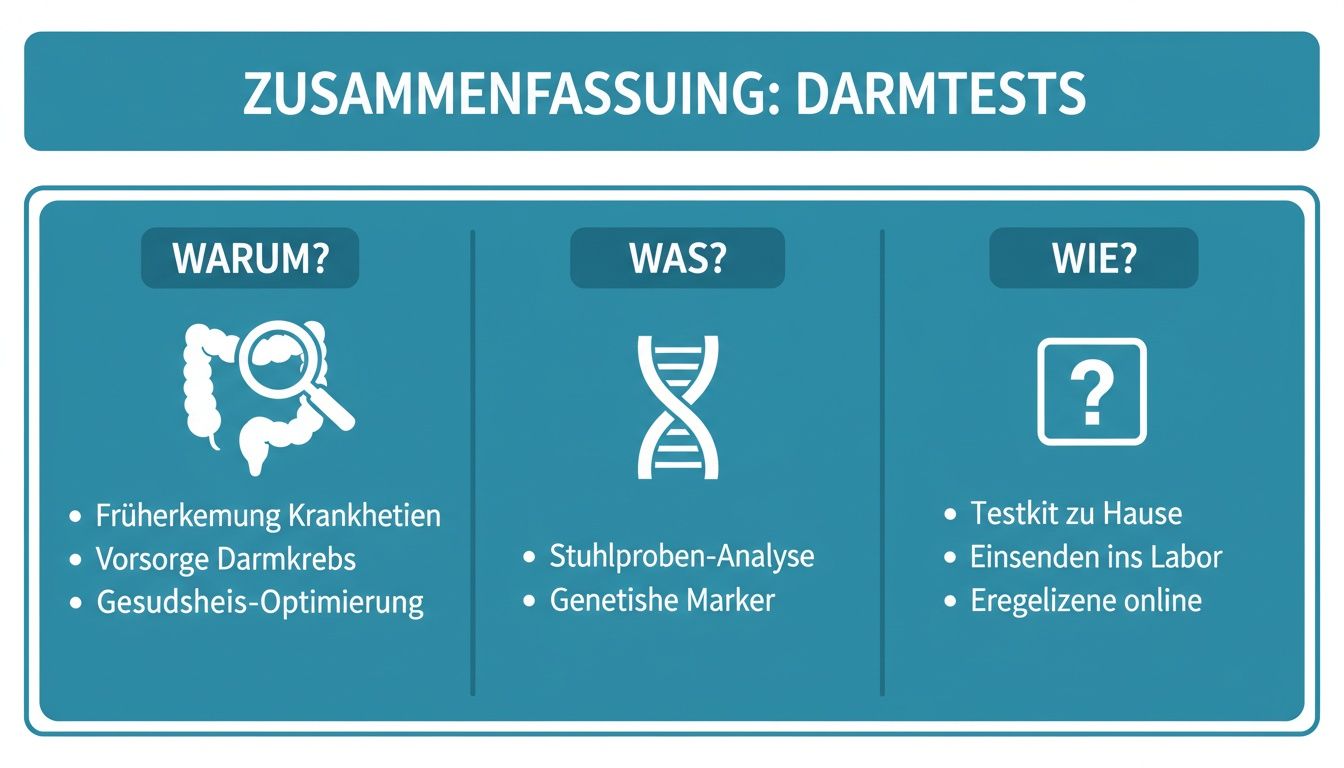
The presentation makes it clear that such a test is far more than a snapshot. It is a tool for proactive healthcare based on precise genetic analysis, made accessible to everyone through a simple at-home process.
Data Protection and GDPR Compliance
Your health data is extremely sensitive. With a microbiome test, you disclose genetic information, and it must be handled with absolute responsibility. Uncompromising data protection is therefore not an option but an obligation. A reputable provider must clearly explain how it protects your data.
So check very carefully whether the provider operates in a GDPR-compliant manner. This means your data must be processed anonymously or pseudonymously and must never be shared with third parties without your explicit consent. Providers such as mybody-x.com place the greatest emphasis on data security in accordance with the strictest German standards (ISO 27001) to protect your privacy at all times.
Providers Compared in Detail and What Really Matters
Now we get to the heart of the matter. Technical details such as the analysis method are one thing, but what really sets providers apart in a microbiome test comparison when it comes to your personal benefit? The key point is often not the laboratory analysis itself, but what comes afterward: processing and translating your results into a clear, actionable plan for you.

Because, honestly: What good is the most precise data collection if, in the end, all you have in front of you is an unexplained list of Latin bacterial names? This is exactly where the wheat is separated from the chaff. We will now look at what really matters when it comes to interpreting results, recommended actions, and value for money.
More Than Just Data – Report Quality
A first-class results report is your personal roadmap to gut health. It must translate highly complex scientific data into language you can understand and show you where you stand and what you can specifically do.
Unfortunately, some providers give you nothing more than raw data or extremely superficial analyses. That may be exciting for scientists, but as a health-conscious person, it often leaves you completely at a loss.
So pay close attention to these features of a truly good report:
- Clarity: Are technical terms explained simply? Are there visual aids such as charts or scales that put your values into perspective compared with a healthy reference group?
- Context: Does the report explain why a particular value is relevant in the first place? For example, what does it specifically mean for your gut lining or your weight if you lack Akkermansia muciniphila?
- Structure: Is the report logically organized? Does it guide you clearly and understandably from analyzing your current situation to concrete approaches for solutions?
The true value of a microbiome test lies not in simply listing bacteria, but in intelligently connecting this data with your well-being. A good report answers not only the question “What is in my gut?” but above all “What does this mean for me, and what can I do now?”
At mybody-x.com, we place the greatest importance on ensuring that you not only see your results but truly understand them. Our reports are designed to give you clear insights and moments of discovery, without requiring you to have studied biology.
From knowledge to action – personalized recommendations
The best data is worthless without concrete recommendations for action. A high-quality test should not only tell you what is happening in your gut, but also how you can initiate positive change. And this is precisely where providers differ substantially.
Some providers are content with general tips such as “Eat more fiber.” While that is not wrong, it is not particularly helpful either. Recommendations only become truly valuable when they are precisely tailored to your individual test results.
A strong provider gives you:
- Personalized nutrition tips: Which specific foods promote the beneficial bacteria in your gut? And which should you perhaps avoid?
- Targeted nutrient recommendations: Are there indications of a deficiency in vitamins or minerals produced by your gut bacteria?
- Practical lifestyle adjustments: Do you receive advice on topics such as exercise, stress management, or sleep that directly affect your microbiome?
That is exactly the approach taken by mybody-x.com. We analyze your unique microbiome and use it to derive specific, practical recommendations tailored precisely to your needs. This turns your test result into a powerful tool for your health.
Cost and processing time – what is fair?
Naturally, cost also plays a role. Prices for microbiome tests can vary widely, usually ranging from €100 to over €400. However, a higher price does not automatically mean better performance.
The value for money is crucial. An inexpensive test that provides only vague information ultimately costs more than a more comprehensive test that delivers genuine, actionable insights. So don’t just compare the price; compare the entire package: analysis method, depth of the report, and quality of the recommendations.
Processing time is another criterion. Generally, you have to wait between two and six weeks for your results after sending in your sample. Reputable providers communicate these time frames transparently on their websites. At mybody-x.com, we rely on efficient processes in our German specialist laboratories to make your results available as quickly as possible without compromising on quality.
The Scientific Foundation and Why Local Data Is Crucial
Imagine taking a test and having your result compared with the average of a population group from a completely different part of the world. Let’s say, people who eat completely differently and live in an entirely different climate zone. The result would be pretty meaningless to you, wouldn’t it? That is precisely the key issue when it comes to a microbiome test comparison: the scientific data basis.

The composition of your microbiome is not a product of chance. It is heavily influenced by your geographical location, your diet, and your overall lifestyle. And these factors differ enormously from one region to another.
Comparing your sample with a primarily US-based reference group can therefore lead to misleading or simply irrelevant results. What is considered “normal” or “optimal” for someone in California does not necessarily have to be the benchmark for you in Germany.
The Importance of Regional Reference Data
A truly high-quality testing provider must take these regional differences into account. It needs a huge—and above all, relevant—reference database to correctly interpret your values in the first place.
More specifically, this means that your results are compared with data from a healthy population group exposed to environmental and lifestyle factors similar to yours. This is the only reliable way to determine whether the composition of your gut flora is balanced or whether there are deviations that you should take a closer look at.
A test based on scientific findings from Europe and Germany in particular enables a much more detailed and precise analysis. It detects the small but important nuances resulting from local eating habits and environmental conditions. This makes the recommendations based on it not only more relevant for you, but also many times more effective.
A test is only as good as its comparison group. If the reference data do not match your living environment, you are comparing apples with oranges—and the resulting recommendations could be useless at best or even counterproductive at worst.
Science from Germany as a quality criterion
Microbiome research is advancing rapidly, including here in Germany. Research institutions such as the University of Tübingen are doing extremely valuable work to strengthen the scientific basis for locally adapted reference databases. Studies from Germany are increasingly providing profiles differentiated by age, sex, and region—an essential prerequisite for valid interpretation of bacterial distribution. This growing scientific activity is increasing the pressure on test providers to make their methods transparent, so that a microbiome test comparison is genuinely meaningful for you as a user in Germany. You can learn more about microbiome research in Germany to better understand the background.
That’s exactly why choosing a provider such as mybody-x.com is so important. We work with German laboratories and rely on a well-founded analysis tailored to the region. This ensures that your results are not interpreted in a vacuum but in the context of your real-life circumstances. That is the absolute prerequisite for providing you with genuinely useful, actionable information for your health. This turns a simple test into a personal guide for your well-being.
Which microbiome test is really right for you? A practical decision-making guide
After working our way through the technical details and quality criteria, let’s now get to the point. A microbiome test comparison is only useful if it ultimately gives you a clear answer to the most important question: Which tool do I need for my personal health goal?
Ultimately, everything comes down to one central question: What exactly do you want to find out? Your answer is the compass that guides you to the right testing method.
Scenario 1: You want to have a general health check-up
Your goal: You actually feel quite well, but you’re curious about what’s going on in your gut. You want to take proactive steps for your health, identify potential weaknesses early, and safeguard your well-being in the long term. You’re looking for a solid baseline assessment.
What matters here: In this case, you need a test that gives you an easy-to-understand overview of the diversity of the microorganisms living in your gut. You want to know whether the balance between beneficial and potentially problematic bacteria is right and how your supply of important substances such as butyrate, a short-chain fatty acid, is doing.
- Diversity index: A high value is usually a good sign of a strong, adaptable microbiome.
- Key bacteria: Are important helpers such as Akkermansia muciniphila (a guardian of the intestinal lining) or Faecalibacterium prausnitzii (a diligent butyrate producer) present in sufficient numbers?
- Dysbiosis score: Is there an imbalance you should keep an eye on, even if you haven't noticed any symptoms yet?
The Gut Microbiome Test from mybody-x.com provides exactly these fundamental insights. Think of it as your personal health barometer. It gives you clear, actionable recommendations on how to maintain or specifically improve your gut health before problems even arise.
Scenario 2: You have specific symptoms and are looking for the cause
Your goal: You've been struggling with digestive problems such as gas, persistent bloating, irregular bowel movements, or you've noticed that you can no longer tolerate certain foods. You may also be troubled by chronic fatigue, skin problems, or mood swings, and suspect that your gut may be connected to them.
What matters here: A simple overview is no longer enough. You need an analysis that goes into depth and examines the functions of your microbiome to uncover potential causes. A test based on shotgun metagenomics is clearly the better choice here, because it shows not only who is there, but above all what these microbes actually do.
Here are the key areas of analysis:
- Functional analysis: How well can your microbiome utilize fiber, produce vitamins, or keep inflammation in check?
- Pathogens & fungi: Could an overgrowth of harmful bacteria or fungi such as Candida be causing your symptoms?
- Intestinal lining integrity: Does the analysis provide indications of a weakened intestinal barrier, also known as “leaky gut”?
When you're looking for a needle in a haystack, you need a magnifying glass, not binoculars. A detailed functional analysis gives you the necessary depth to get to the bottom of the causes of your symptoms and tackle them in a targeted way.
The mybody-x.com test offers exactly this level of depth. It helps you understand why you feel unwell and provides you with a customized action plan—with specific dietary and lifestyle recommendations to help you regain your balance.
Scenario 3: You want to optimize your performance—physically and mentally
Your goal: You are physically active and want to improve your performance, speed up recovery, or optimize your diet for muscle growth and increased energy. You may also see your gut as a central lever for personal biohacking, helping you stay mentally sharp.
What matters here: For this goal, functional insights into your metabolism are essential. You need to know how efficiently your body extracts energy from food and how well your microbial community supports you during recovery and nutrient absorption.
Key focus areas for performance optimizers:
- Energy production: How effectively can your microbiome generate energy from fiber in the form of short-chain fatty acids?
- Nutrient synthesis: How is the production of B vitamins or vitamin K by your gut bacteria? These are essential for energy metabolism.
- Inflammation regulation: A balanced microbiome helps manage exercise-induced inflammation more effectively and shorten recovery time.
With the detailed analyses from mybody-x.com, you receive precise data on exactly these performance-relevant functions. The recommendations based on them help you fine-tune your diet so you can reach your full potential—whether at the gym, in a marathon, or in a demanding job.
Costs, benefits, and what health insurance covers
There is no question that a microbiome test is a worthwhile investment in your long-term health. But before making your decision, you naturally want to know what to expect and whether financial support might be available. Let’s take a closer look at the financial side in the microbiome test comparison.
The cost of a high-quality test may seem a little daunting at first glance. However, it is important to put the price in relation to the benefits. You are not simply paying for a laboratory analysis, but receiving a detailed roadmap to greater well-being, tailored precisely to your body.
Does health insurance cover the costs?
This is one of the most common questions we receive. For people with statutory health insurance (GKV) in Germany, the answer is currently usually: No. At-home microbiome tests are generally considered individual healthcare services (IGeL), which you have to pay for out of pocket.
Why is that? Quite simply: There are not yet any uniform clinical recommendations for offering such tests as routine preventive screening for everyone. In Germany, private buyers therefore finance most of the costs of microbiome tests themselves, with prices ranging from a few dozen to several hundred euros. Medical societies argue that specific recommendations for routine screening are lacking, which makes coverage by statutory health insurance more difficult. That is precisely why independent comparisons are so important—they help you distinguish between purely lifestyle-oriented offerings and clinically validated laboratory tests.
Only in very rare exceptional cases, when there is a specific medical suspicion and a doctor has ordered it, is partial reimbursement conceivable. However, this is the absolute exception and should always be clarified with your health insurer in advance.
Important to know: A test from mybody-x.com is a private investment in your preventive health. The insights you gain help you adjust your diet and lifestyle so that you can proactively take charge of your well-being.
The true value of your test
View the cost as an investment in knowledge that no one can take away from you. Instead of feeling your way in the dark and trying various diets or supplements on a whim, you receive a precise, data-based foundation for your decisions.
The personalized recommendations from mybody-x.com may even help you save money in the long term:
- Targeted nutrition: You only buy the foods your body really needs and can process optimally.
- No unnecessary supplements: You only take what you can demonstrably be lacking, instead of spending money indiscriminately.
- Preventive effect: By actively strengthening your health, you can prevent potential complaints and the associated costs.
Coverage of the costs is a complex topic. If you would like to explore it in more depth, you can find further details in our guide on microbiome testing and health insurance. Ultimately, it is a personal decision how much proactive management of your health is worth to you.
The most frequently asked questions about microbiome testing
After this detailed microbiome test comparison, you may still have a few questions on your mind. That is completely normal—here we answer the most frequently asked questions so that you have complete clarity when making your decision.
How often should I repeat a gut test?
That depends entirely on what you want to achieve. If you want to specifically see the effects of changing your diet or adopting new habits, a follow-up test after about three to six months is definitely worthwhile. This gives your microbiome enough time to respond to the changes and show measurable adjustments.
On the other hand, if you simply want a general health check to make sure everything is in good shape, an annual test is often enough. Think of it as a regular assessment of your internal ecosystem.
Are home tests just as reliable as tests at the doctor’s office?
Yes, the reliability is absolutely comparable, as long as the provider meets key quality criteria. The decisive factor is not where you collect the sample, but what happens to it in the laboratory.
At mybody-x.com, you can be sure of that:
- Certified specialist laboratory: Your sample is sent to an ISO-certified laboratory in Germany—where science matters.
- Standardized analysis: The methods used in the laboratory are the same as those used in scientific research.
- Safe sample collection: The test kit is designed so that you can collect the sample at home easily, hygienically, and correctly. This is the foundation for an accurate result.
The quality therefore lies not in who receives the sample, but in the scientific precision with which it is analyzed.
A high-quality home test combines the best of both worlds: the convenience of testing at home and the uncompromising accuracy of a professional laboratory.
And what am I supposed to do with the results then?
A first-class test doesn’t leave you alone with a list of incomprehensible bacterial names. You receive a clearly presented report that translates complex data into understandable insights.
This report is your personal roadmap. It not only shows you where you currently stand, but also provides specific recommendations tailored to you. These may include tips for your diet and lifestyle or targeted supplementation with specific nutrients. Use your report as a tool to actively and sustainably improve your gut health and, with it, your overall well-being.
Are you ready to take control of your gut health and finally understand what your body really needs? At mybody-x.com, you’ll find the right test to give you precise insights and a clear plan for your well-being. Discover our self-tests now at https://mybody-x.com.



Share now:
Role of nutrition tests – For personalized health
Your food allergy test as a clear guide to your diet