

Test for leaky gut syndrome: what procedures are available and what they measure
The essentials at a glance
There is no test that detects leaky gut syndrome. The reason lies before the laboratory: An independent disease entity by that name does not exist in scientific medicine. What can be measured is something else, namely the permeability of the intestinal wall. It is a documented phenomenon, not a finding that leads to a diagnosis.
This article examines the available procedures individually and asks the same three questions about each one: What does it actually measure, what evidence supports it, and what does it not imply? The zonulin test receives the most attention because it is marketed most often and because the criticism of it comes from the scientific literature itself.
First, you will read what the term refers to and what has actually been described in research. This is followed by a comparison of the procedures, the zonulin test, two persistent assumptions, the lactulose-mannitol test and how it is performed, additional blood markers, and stool tests. The final section discusses who would benefit from testing, which signs should first be evaluated by a doctor, and where the limitations of all the procedures mentioned lie.
What to expect in this article
1. What the term leaky gut syndrome refers to—and what it does not
2. Increased intestinal permeability: what has actually been described
3. The procedures at a glance: what each one measures
4. The zonulin test and the problem with the detection method
5. Three assumptions surrounding these tests
6. The lactulose-mannitol test: procedure, findings, and limitations
7. Additional blood markers: I-FABP and LBP
8. What stool tests can answer and where their limits lie
9. What a microbiome test measures—and what it does not
10. Who would benefit from testing now
11. When the appointment comes before any test
12. Limitations: what none of these procedures can answer
13. What matters when considering this question
Frequently asked questions
Sources
What the term leaky gut syndrome refers to—and what it does not
Anyone looking for a test for leaky gut syndrome is looking for proof of a hypothesis. The hypothesis usually goes something like this: The intestinal wall has become permeable, so substances that do not belong there enter the bloodstream, causing fatigue, skin problems, bloating, or joint pain. The test is supposed to confirm this chain.
That is why the term must be clarified before discussing procedures. A test can only detect something that has been defined beforehand. This is the case with iron-deficiency anemia: there is a name, a definition, a laboratory value, and a reference range. In the case of leaky gut syndrome, the first link in this chain is already missing.
Documented source
“In scientific medicine, the term leaky gut syndrome is unknown.”
Medizin transparent, University for Continuing Education Krems (Cochrane Austria Center)
Article “Leaky Gut Syndrome: Myth of the Leaky Intestine,” as of December 5, 2017
The same article also identifies the practical consequence of this finding. According to this assessment, it is nowhere clearly described how a doctor could reliably determine that someone has such a leaky gut syndrome. Thus, not only is the definition missing, but also the testing procedure against which a test result could even be evaluated.
This source is dated 2017, and that should be mentioned. The editors themselves note there that a renewed search for studies did not change the assessment. Nothing has changed since then that would invalidate the statement: a disease entity called leaky gut syndrome, with established criteria and diagnosed according to those criteria, has still not been established.
Key point
Increased intestinal permeability is a measurable phenomenon. Leaky gut syndrome is a term from popular health literature. The first does not imply the second, and therefore no test can confirm the second.
Why this distinction is not mere nitpicking
The difference determines what a measurement means for you. If leaky gut were a diagnosis, then an abnormal permeability value would be a finding with consequences: it would lead to treatment whose effect could be checked using the same value. That is not the case.
Instead, an elevated permeability value stands on its own. It says that the barrier is allowing more through at that moment than in other people. It does not say why, since when, whether it is causing symptoms, or whether it can be changed. The same number can occur with a chronic inflammatory bowel disease, after a gastrointestinal infection, while taking certain medications, or for no apparent reason.
This very ambiguity is why permeability measurements have their place in research and almost nowhere in clinical practice. They describe a property; they do not ask a question about the patient.
Increased intestinal permeability: what is actually being described
The intestinal wall is not a solid wall. It is a lined surface made up of a single layer of cells, and between the cells are connections that open and close. These connections are called tight junctions, or, roughly speaking, “tight connections” in German. They regulate what can pass between the cells, while nutrients are simultaneously absorbed through the cells.
That this regulation can change is well established. The S3 guideline on irritable bowel syndrome, issued by the German Society for Gastroenterology, Digestive and Metabolic Diseases and the German Society for Neurogastroenterology and Motility, describes increased permeability in colonic biopsies from affected individuals and in human studies in its chapter on pathophysiology (DGVS and DGNM, 2021).
The same guideline also identifies the molecular pathway behind it. It describes changes in tight-junction proteins, increased proteasome activity, and the resulting accelerated breakdown of the tight-junction protein occludin. In addition, increased intestinal permeability is linked there to visceral hypersensitivity, meaning an increased perception of pain originating in the abdominal region.
Observed in a disease does not mean: a disease in its own right
This is where many online accounts change direction. “Increased permeability was measured in people with irritable bowel syndrome” becomes “increased permeability causes the symptoms,” and then becomes a distinct condition with its own name. The first sentence appears in the guideline. The second and third do not.
Irritable bowel syndrome itself is the most common diagnosis under which such symptoms are ultimately recorded. For Germany, the guideline cites an administrative prevalence of 1.34 percent, determined using routine coding data from a large health insurer, with an incidence of 0.34 percent per year (DGVS and DGNM, 2021). This figure describes how often the diagnosis is actually assigned, not how many people have symptoms.
This leads to a practical point concerning the test question. If increased permeability occurs in a disease, but not all affected people show it and not everyone with elevated values has symptoms, then the measurement does not clearly distinguish between the groups. A test that does not distinguish between groups cannot decide anything.
The methods at a glance: what each one measures
Essentially, three approaches are offered, and they measure three entirely different things. The first measures a protein in the blood or stool. The second measures two sugar molecules in the urine. The third measures which bacteria are present in the stool. Only the second targets permeability at all.
The following comparison examines all three using the same criteria. The “What this does not imply” row is the most important, because it states what is regularly missing from sales copy.
| Criterion | Zonulin test | Lactulose–mannitol test | Microbiome test |
|---|---|---|---|
| Sample type | Blood or stool | Urine after consuming a sugar solution | Stool |
| What is measured | A protein measured using an antibody test | The ratio of two excreted sugars | Composition of the bacterial community |
| Targets permeability | Yes, according to its stated purpose | Yes, as a functional test | No, explicitly not |
| Evidence supporting the method | The commonly used test kits do not detect the protein they are supposed to measure (Scheffler et al., Frontiers in Endocrinology, 2018) | Established in research, but interpretation is disputed (Vanuytsel et al., Frontiers in Nutrition, 2021) | Sequencing is established; interpreting individual patterns is not |
| Role in routine practice | No | Not a standard laboratory procedure | No diagnostic role |
| What does not follow from this | No evidence of a permeable intestinal wall | No diagnosis, cause, or treatment decision | No information about the tightness of the intestinal barrier |
The table answers the question of methodology. It does not answer what you should do next if you suspect this may apply to you. There is a separate article for that: Testing for leaky gut: how to gain clarity about your gut health addresses the practical side and describes the path through a medical practice. This article stays focused on the methods and the evidence supporting them.
The zonulin test and the problem with the detection method
The zonulin test is the best-selling test in this field, and its history explains why. Zonulin is a protein that has been described as playing a role in opening tight junctions. The idea behind it is intuitive: If this protein opens the connections, then a high blood level should indicate an open barrier.
When zonulin was identified, it was described as a precursor of the protein haptoglobin 2, or pre-haptoglobin 2 for short. The commercial test kits used by laboratories and providers contain antibodies intended to bind precisely to this molecule. Such an antibody test is called an ELISA, a method that makes a protein visible and measurable through a color reaction.
What the test kits actually bind
A working group led by Laura Scheffler tested these kits in the laboratory against the purified target molecule. The results were published in 2018 in the journal Frontiers in Endocrinology and are unequivocal: The antibody test does not detect pre-haptoglobin 2. Neither the recombinantly produced pre-haptoglobin 2 nor complement factor C3 was detected by the kit.
The same study narrowed down what the test actually binds to. According to its conclusion, the zonulin ELISA does not detect pre-haptoglobin 2, but structurally and possibly functionally related proteins, with properdin being the most likely candidate. Properdin is an immune-system protein with a mass of around 53 kilodaltons and has nothing to do with the opening of tight junctions.
The problem, then, is not a dispute over reference ranges, but one that arises before the reference range. A measurement method that detects a different molecule from the one named does not produce a value that is too high or too low. It produces a value for something else.
How the review literature addresses this
This observation has by now been incorporated into review articles. In Frontiers in Nutrition (2021), Tim Vanuytsel, Jan Tack, and Ricard Farré summarize that the most widely used ELISA methods do not determine zonulin, but rather complement factor C3 and possibly properdin. Their recommendation to the scientific community is to read the existing literature on zonulin as a non-invasive marker for diseases involving impaired barrier function with the utmost caution.
For you as a buyer of such a test, this means two things. First, an abnormal zonulin level is not evidence of a permeable intestinal wall. Second, a normal zonulin level is not an all-clear either, because a method that does not measure the right thing can be wrong in both directions.
Three assumptions surrounding these tests
The following three statements appear in forums, advertising copy, and consultations. All three sound plausible, and all three fail to withstand scrutiny.
Widespread but unproven
Widespread
“An elevated zonulin level proves that my intestinal wall is permeable.”
Documented
The commonly used test kits do not detect the target molecule pre-haptoglobin 2, but rather related proteins such as properdin (Scheffler et al., Frontiers in Endocrinology, 2018).
Widespread
“Leaky gut is a diagnosis that can be tested for.”
Documented
The term is unknown in scientific medicine, and no reliable method for establishing it is clearly described anywhere (Medizin transparent, University for Continuing Education Krems, as of 2017).
Widespread
“A stool test shows me how tight my intestinal barrier is.”
Documented
A stool microbiome test determines the composition of the gut flora. It does not measure permeability, not even indirectly (mybody®x product page, accessed 28 August 2026).
The third assumption is the most persistent because it sounds least like a claim. After all, a stool test examines the intestine, and the intestinal wall is part of the intestine. The faulty inference is that a sample from inside the intestine describes who lives there, not how the adjacent wall is structured.
The lactulose–mannitol test: procedure, significance, and limitations
Of all the methods mentioned, this is the only one that actually tests permeability as a function. It does not measure a protein from which permeability is inferred; instead, it lets two molecules make the journey themselves and checks how much of them arrives.
Two sugars are used. Lactulose is a disaccharide, and mannitol is a sugar alcohol. Both are swallowed, neither is metabolized, and whatever passes through the intestinal wall into the bloodstream is excreted by the kidneys and ends up in the urine.
Drink the sugar solution
A measured amount of lactulose and mannitol in water, taken while fasting. A single dose of more than 5 g is avoided because its osmotic effect would otherwise alter intestinal movement.
Collect urine by time window
The window determines the section of the intestine: 0 to 2 hours represents the small intestine, 2 to 8 hours a mixed area, and 8 to 24 hours predominantly the large intestine.
Determine both sugars
The urine is measured to determine how much of each sugar has arrived. Measuring sugars in urine is not a standard laboratory procedure and must be specifically validated before use.
Calculating the ratio
What is reported is not the amount of either sugar individually, but the lactulose-to-mannitol ratio. It is intended to factor out differences in gastric emptying and kidney function.
Why two sugars rather than just one comes down to the size of the molecules. Mannitol, at about 6.7 Ångström, is the smaller one and is thought to pass through the fine pores of the cell junctions. Lactulose, at around 9.5 Ångström, is larger and is thought to pass through only where the barrier is more widely open. When the proportion of lactulose relative to mannitol increases, this is considered a sign of increased permeability. This account follows the review by Vanuytsel, Tack, and Farré in Frontiers in Nutrition (2021).
Why the test plays no role in routine practice
The first reason is practical. Measuring sugars in urine is not part of a laboratory’s standard repertoire and must be carefully validated before use, as the same review notes. There is no standardized procedure that would make two laboratories comparable: the dose, collection period, and measurement method differ, and so do the numbers.
The second reason carries more weight. The assumption that the two sugars take different routes through the barrier is only weakly supported, according to the same authors. This leads to controversy over the validity and, above all, the interpretation of the lactulose–mannitol test. A ratio is therefore not a value that can simply be entered into a table.
The third reason is the decisive one in everyday practice. Even if the ratio is abnormal, it does not lead to any treatment. There is no recognized therapy based on this value whose success is measured by it. A test whose result changes nothing is a number with no practical consequence.
Additional blood markers: I-FABP and LBP
In addition to zonulin, two other abbreviations appear in test packages. Both come from research, both are occasionally marketed as barrier markers, and both measure something different from what the name in the sales copy suggests.
I-FABP stands for intestinal fatty acid-binding protein. It is a protein located inside mature intestinal cells. When such cells die, it is released and can be detected in the blood. Elevated levels have been described in various diseases involving intestinal cell damage. What is lacking are comprehensive studies that have validated the marker for a specific question.
I-FABP indicates cell death, not permeability. These are two different processes that may or may not occur together.
I-FABP indicates cell death, not permeability. These are two different processes that may or may not occur together. A barrier can become more permeable without cells dying, and cells can die while the barrier as a whole remains intact.
LBP stands for lipopolysaccharide-binding protein. The idea is to detect components of bacterial cell walls in the blood, where they should normally be rare. Because these components themselves are difficult to measure, the binding protein is proposed as a surrogate measure. One study found a clear correlation between LBP levels and the lactulose-to-mannitol ratio, as reported by Vanuytsel, Tack, and Farré in Frontiers in Nutrition (2021).
However, a correlation in a study is not a diagnostic test for individuals. For a marker to become one, it needs a reference range, a known detection rate, and guidance on what to do when the result is abnormal. Neither marker has these.
What stool tests can answer and where their limits lie
Stool tests are the most common approach in this field because they can be done at home and because a stool sample is an obvious choice when the focus is the intestine. It is worth dividing them into two groups because they answer different questions.
The first group consists of inflammation and bleeding markers. They are used in medical diagnostics to distinguish between an inflammatory disease and a functional disorder. They say nothing about permeability, but they answer a question that takes precedence when in doubt: whether there is any inflammation or bleeding at all.
The second group consists of microbiome analyses. Through sequencing bacterial DNA, they determine which species are present and in what proportions. This is a technically established procedure with a clear meaning: it describes a composition. Anyone who reads more into it is reading something into it.
Key point
A stool sample describes the inhabitants of the gut, not the condition of its walls. If you want to know which bacteria are present, a microbiome test is appropriate. If you want to assess the barrier’s tightness, it is not.
Some providers also measure zonulin in stool rather than blood. That does not change what is stated in Chapter 4, because the problem lies not in the sample material but in the antibody. A method that binds the wrong protein in blood does not bind a more correct one in stool.
Which bacterial groups appear in a microbiome analysis at all, and what lies behind names such as Akkermansia or Faecalibacterium, is explained in the mybody®x Gut Encyclopedia. It provides the factual basis for interpreting a result without attributing significance that it does not support.
What a Microbiome Test Measures—and What It Does Not
At this point, a sentence belongs at the beginning—one that a shop would rather not write. A microbiome test measures the composition of the gut microbiome, not the permeability of the intestinal wall. mybody®x (MYBODY Lab GmbH) does not offer a test that determines intestinal barrier permeability, nor one that diagnoses leaky gut syndrome.
So if this is the specific measurement you are looking for, you are in the wrong part of the product range and need to go through a medical practice or specialized laboratory. There is no separate information on the cost of such a determination outside the company’s own offerings, so no figure is provided here.
What a microbiome test can answer is a different question—and, for digestive complaints, it is no less important: which bacterial groups predominate, how diverse the community is, and whether yeasts or fungi are detected. This is a snapshot, not a diagnosis.
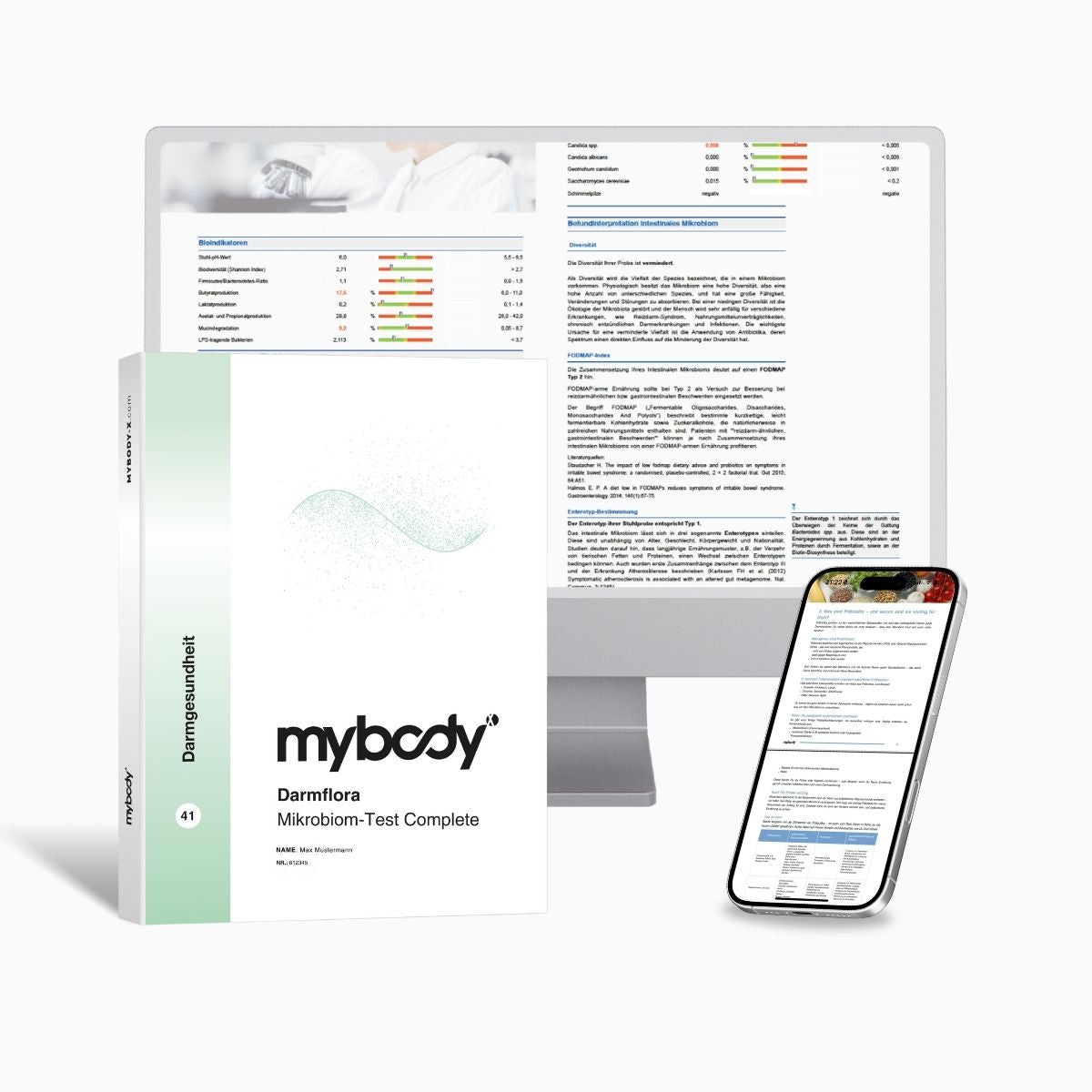
Gut test from a stool sample
Complete Gut Microbiome Test | Complete
Determines more than 1,500 bacterial species through DNA sequencing, along with biodiversity, enterotype, stool pH, and yeasts and fungi. Intestinal barrier permeability is explicitly not included: the test measures neither permeability nor zonulin. Anyone looking for evidence of leaky gut syndrome will not find it here—and, according to the current scientific literature, nowhere else either. The test provides a snapshot of the gut microbiome, not a diagnosis, and does not replace medical evaluation.
Laboratory analysis: 5–10 business days after receipt of the sample
Information from the product page; no laboratory name given; accessed 28 August 2026
Two points left open on the product page
The first directly concerns this article. On the product page for the Mikrobiom Darm-Test, the term leaky gut syndrome appears in a list of possible symptoms, alongside irritable stomach and irritable bowel syndrome. It is not measured there, and no method for doing so is specified on the page. Anyone who reads the list as a promise of services is misreading it, and we would rather say so ourselves than leave it unchallenged.
The second concerns the selection. In addition to Complete, there is the Darmflora Mikrobiom-Test Essential for €129.00, as of 27 August 2026. The difference in scope between the two is not documented on the product pages: the descriptions are identical, and there is no comparison of the analysis scope. As long as this remains the case, no difference is claimed here.
Whether a statutory health insurance provider contributes to the cost of such a test is a separate question with a separate answer. It is covered in the article Microbiome Test and Health Insurance and is not repeated here.
Who can benefit from a test now
After eight chapters of limitations, it is natural to wonder whether anything is useful at all. The answer depends on which question you want answered. The following comparison sets out both directions honestly.
Useful for you if …
You want to know how your gut flora is composed and use this knowledge as a starting point for a conversation.
Your symptoms have persisted for weeks and no one has yet checked whether inflammation or bleeding is behind them. This assessment must be carried out by a medical practice.
You want a baseline measurement to compare against in three to six months.
You are prepared to read a result as a description, not as a verdict.
Probably not if …
You explicitly want to have the permeability of your intestinal wall determined. This value is not included in the range, and no other test replaces it.
You hope the result will confirm a diagnosis. A microbiome report does not identify a disease.
Blood in the stool, unintentional weight loss, fever, or symptoms that wake you at night are involved. In that case, the appointment comes before any self-test.
You are already undergoing medical evaluation and are awaiting a result. An additional finding from another source is more likely to make interpretation difficult than to help.
If you are wondering what a home gut test practically involves, how the sample is collected, and what a report looks like, you can find this in the article At-home gut test. This article stays focused on the question of what each method measures.
When the appointment comes before any test
There are signs for which the order of steps is clear. They are not downplayed here, softened with “usually harmless,” or relegated to a subordinate clause.
Blood in the stool should be evaluated by a doctor. Unintentional weight loss should be evaluated by a doctor. Fever accompanying intestinal symptoms should be evaluated by a doctor. Symptoms that wake you from sleep at night should be evaluated by a doctor.
The same applies to pronounced paleness, exhaustion that significantly worsens within a few days, and symptoms that are new and quickly become more severe. In all these cases, a self-test is the wrong order of steps, regardless of which method it uses.
The reason is simple. A test from the internet answers a question you asked. A medical examination also looks for what you did not ask about. With these warning signs, that is precisely the point.
Chapter at a glance
Blood in the stool, unintentional weight loss, fever, and symptoms that wake you at night should first be evaluated by a doctor. This applies without exception and regardless of which test someone offers. A self-test cannot bring this evaluation forward or replace it, because it only answers what it was designed to assess.
Limitations: what none of these methods answers
None of the methods described provides a diagnosis. A microbiome finding describes a composition, a permeability value describes a property, and a blood marker describes a concentration. None of these descriptions indicates the name of a disease.
None of the methods says anything about the cause. Even if increased permeability had been measured flawlessly, it would still be unclear what caused it. Infections, inflammation, medications, and alcohol are cited in the scientific literature as contributing factors, and the measurement result does not distinguish between them.
None of these methods provides reliable monitoring over time. That would require standardized conditions and known variation between two measurements in the same person. Neither is available for the permeability methods.
And the point that weighs most heavily in this matter: Even a perfectly measured value would not lead to any treatment. There is no recognized therapy based on a permeability value. What is recommended in guides at this point—individual amino acids, collagen, certain bacterial preparations—is not justified by such a value and is therefore not recommended in this article.
What matters in this question
It began with the search for a test that would confirm a suspicion. That is precisely where the idea fails: The suspicion was never defined as a disease, and what can be measured is not the disease itself.
Even so, what remains is more than nothing. The symptoms that brought you here are real, and there are tests with clear results for the most common underlying causes. The way forward is to ask whether there is inflammation, bleeding, or a known intolerance, and that question is addressed by a medical practice, not a test kit.
One final point that is rarely made on this topic: The criticism of the zonulin test does not come from outside skeptics but from the scientific literature itself—and the group from which the zonulin concept originally emerged was also involved in the 2018 paper. When those who proposed a marker describe its own detection method as unsuitable, that is not a peripheral finding. That is the end of the matter.
Frequently asked questions
Is there a test that detects leaky gut syndrome?
No. The term does not refer to a defined disease: It is unknown in scientific medicine, and no reliable method for establishing it has been clearly described anywhere (Medizin transparent, University for Continuing Education Krems, as of 2017). The permeability of the intestinal wall can be measured as a property. However, an abnormal value does not provide a diagnosis or open up any recognized treatment.
Does the Microbiome Gut Test Complete measure the permeability of my intestinal wall?
No. A microbiome test measures the composition of the gut flora, not permeability. The Microbiome Gut Test Complete uses DNA sequencing to determine more than 1,500 bacterial species, as well as biodiversity, enterotype, stool pH, and yeasts. Zonulin, a lactulose-mannitol ratio, or any other barrier marker is not included, and mybody®x has no other test that determines permeability.
How reliable is a zonulin test?
The question of reliability comes first. A study by Scheffler and colleagues in Frontiers in Endocrinology (2018) shows that the widely used commercial antibody test does not recognize the target molecule pre-haptoglobin 2 at all, but rather related proteins, most likely properdin. In Frontiers in Nutrition (2021), Vanuytsel, Tack and Farré recommend reading the literature on zonulin as a barrier marker with the utmost caution.
What exactly does the lactulose–mannitol test measure?
It measures how much of two ingested sugars appears in the urine and calculates a ratio from this. The smaller mannitol, at approximately 6.7 ångströms, is supposed to pass through the fine pores, while the larger lactulose, at around 9.5 ångströms, is supposed to pass only through more widely opened areas. A collection over 0 to 2 hours is considered a reflection of the small intestine. This is not a standard laboratory procedure, and the interpretation of the ratio is controversial (Vanuytsel, Tack and Farré, Frontiers in Nutrition, 2021).
Which symptoms should first be assessed by a doctor?
Blood in the stool, unintentional weight loss, fever, and symptoms that wake you from sleep at night. Also marked paleness and exhaustion that significantly worsens within a few days. In these cases, no self-test is the right first step, regardless of the method it uses.
Next step
Asking the question that can be answered
The permeability of your intestinal wall cannot be measured by mybody®x. What can be determined is the composition of your gut flora. The linked article explains how to proceed practically if you have reason for suspicion and whom to contact.
Microbiome Gut Test Complete Testing for leaky gut: the procedureRead more
You might also be interested in
The practical side of the same question: what to do if there is reason for suspicion and whom to contact.
How a stool sample is collected at home and what is actually included in a report.
Reference guide to the genera and species that appear in a microbiome analysis.
Sources
- Medizin transparent, University for Continuing Education Krems (Cochrane Austria Center): Leaky Gut Syndrome – Myth of the Leaky Gut (as of 05.12.2017) – medizin-transparent.at
- German Society for Gastroenterology, Digestive and Metabolic Diseases (DGVS) and German Society for Neurogastroenterology and Motility (DGNM): Update to the S3 Guideline on the Definition, Pathophysiology, Diagnosis, and Treatment of Irritable Bowel Syndrome, AWMF Register Number 021/016 (as of June 2021) – register.awmf.org
- Vanuytsel T, Tack J, Farré R: The Role of Intestinal Permeability in Gastrointestinal Disorders and Current Methods of Evaluation, Frontiers in Nutrition (2021) – frontiersin.org
- mybody®x (MYBODY Lab GmbH): Product page for Microbiome Gut Test | Complete (accessed 28.08.2026) – mybody-x.com
The verbatim quotation concerning the term leaky gut syndrome, the statement that no method of establishing its presence has been described, and the note regarding the unchanged assessment are taken from source [1]. The information on increased permeability in biopsies, tight-junction proteins, and the degradation of occludin, as well as the administrative prevalence of 1.34 percent and incidence of 0.34 percent per year, comes from source [2]. The description of the lactulose–mannitol test, including molecule sizes, collection periods, and dose limit, its classification as not being a standard laboratory procedure, the controversy surrounding its interpretation, and the information on zonulin ELISA, I-FABP, and LBP come from source [3]. The price, scope of analysis, sample type, and laboratory information for the Microbiome Gut Test, as well as the mention of the term leaky gut syndrome in the list of symptoms there, come from source [4]; processing times follow the central guideline for gut tests. The finding that the commercial zonulin ELISA does not detect pre-haptoglobin 2 but instead binds properdin comes from the work of Scheffler, Crane, Heyne, and colleagues in Frontiers in Endocrinology (2018); it is attributed in the body text by authorship, journal, and year and is therefore not included in this list. All sources were accessed and reviewed on 28.08.2026.

mybody®x Editorial & Expert Team
Microbiome and gut science Laboratory diagnostics Nutritional science Blood test interpretation
This article was created by the mybody®x editorial and expert team. The team combines microbiome and gut science, laboratory diagnostics, and nutritional science. Those who contribute to it are listed on the authors page.
Published on 05.12.2025 · Last updated on 27.08.2026
The content is intended for general information and does not replace medical advice, diagnosis, or treatment. Reference ranges depend on the laboratory, method, and age—what always matters is the information on your test report.




Share now:
Gut health: Everything you need to know for your well-being
Microbiome meaning: impact on health and well-being