

Testing for leaky gut: what you can do when there is a suspicion
The essentials at a glance
Anyone who wants to get tested for leaky gut is looking for an explanation for symptoms that have been present for some time. Nevertheless, the first step is not a sample but record-keeping: for two weeks, note your symptoms, times, meals, and bowel movements. Only after that can it be determined what question actually needs to be clarified.
This article describes the process, not the measurement technology. It tells you when and where to seek help, what a general practitioner’s office rules out first, how to get an appointment with a specialist, and how to recognize when no test is the right next step at all. Wherever information is substantiated, the institution and year are provided.
First, you will read what the term means in the German healthcare system and why there is no finding for it. This is followed by the record-keeping, the signs that require immediate evaluation, and the process in five stages. The final section compares the relevant points of contact, explains what should be clarified before any self-funded examination, and discusses the limitations of this approach.
What to expect in this article
1. What “testing for leaky gut” means in practice
2. Why there is no finding you can receive for this
3. Where the process begins: keeping notes for two weeks
4. The signs that call for a phone call rather than note-taking
5. The process in five stages
6. Why the general practitioner’s office comes first
7. When it is time to see a gastroenterology practice
8. Which point of contact answers which question
9. What should be clarified before any self-funded examination
10. What an intestinal test can contribute at this point
11. Who this approach can help—and who it cannot
12. Limitations: what this approach leaves open
13. Why the order matters
Frequently asked questions
Sources
What “testing for leaky gut” means in practice
People searching for this term are rarely interested in measurement technology. Usually, it is someone who has had bloating, alternating bowel movements, fatigue, or skin problems for months and eventually came across the term. What they want is not “I want a lab value,” but “I finally want to know what is causing this.”
The term refers to increased permeability of the intestinal wall. Technically, this is called intestinal permeability—the property of the intestinal barrier that allows substances to pass through or keeps them out. This property exists, has been described, and varies.
However, there is a gap between the property described and a test order—one that no one explains in everyday practice. Anyone who searches online for a leaky gut test finds offers. Anyone who goes to a medical practice finds no corresponding diagnosis.
Key message
For this topic, the question “Which test should I take?” is the second question. The first is: What symptoms have you had, and for how long, and which of them can be addressed at all through the standard healthcare system?
What this article answers and what the related article answers
This article is about the practical question: What do you do first, what comes next, and how do you recognize that you are looking in the wrong place? It is about the order of steps, where to go, and how to prepare.
The question of testing methods is addressed elsewhere. Which methods are available, what each one measures, and how strong the evidence behind them is are explained in the article Test for Leaky Gut Syndrome: Which Methods Exist and What They Measure. Anyone who wants to know what zonulin is or how a sugar test works can continue reading there. This article starts one step earlier.
Why the order determines the result
Getting the order wrong costs time, and it can make a result unusable. Anyone who independently eliminates gluten and is then tested for celiac disease receives a result that no one can rely on. The same applies to dietary changes shortly before a stool test.
The second reason is more uncomfortable. A self-pay test that is carried out first often produces a finding that no one can interpret because the basic questions remain unanswered. The finding then raises new questions instead of providing answers.
Why there is no finding you can receive for this
In Germany, diagnoses are coded according to an official classification. It is called ICD-10-GM, is published by the German Federal Institute for Drugs and Medical Devices (BfArM), and is currently available in the 2026 version, as of September 12, 2025. Every billing record, sick note, and medical report relies on it.
There is no separate code for Leaky Gut Syndrome. Persistent intestinal symptoms without an identifiable finding are instead coded under K59.9, meaning “functional intestinal disorder, unspecified” (BfArM, ICD-10-GM Version 2026).
This is not a triviality for bureaucrats. In practical terms, it means: No medical practice in Germany can certify that you have Leaky Gut Syndrome, because the diagnosis does not exist as such. Anyone who enters a consultation expecting this is bringing an expectation that cannot be fulfilled there.
What this does not mean
That doesn’t mean your symptoms are imagined. Bloating, abdominal pressure, fatigue after eating, and alternating bowel movements are real symptoms with real causes. The missing diagnostic code says nothing about how you feel. It says something about the label.
This leads to a sober shift in focus. The label is not the goal; the cause is. And for causes that can actually be identified, there is an established process with clear steps.
How to recognize an unserious offer
An offer that promises you a diagnosis that does not exist in the official classification promises more than a laboratory can deliver. That is the first checkpoint, and it costs nothing. If a website says that a test “diagnoses” or “proves” that your intestinal barrier is permeable, then that is a statement about marketing, not laboratory medicine.
The second checkpoint is the question of what should happen after the result. A finding without a subsequent course of action is an expensive piece of paper. Anyone considering a testing service should therefore ask first: What changes for me depending on the result?
Where the process begins: writing things down for two weeks
The first step costs nothing and is nevertheless skipped most often. Before any sample is taken, a record is created. In most cases, two weeks are enough to make a pattern visible.
What to include: the time and nature of the symptom, how long it lasted, what you ate and when, what your bowel movements looked like, how you slept, and which medications or supplements you take. Anyone recording pain should also record its severity on a simple scale from zero to ten.
Documented source
“The more precisely you can describe your symptoms, the easier it is for the doctor to determine what is wrong with you.”
Institute for Quality and Efficiency in Health Care (IQWiG)
gesundheitsinformation.de, “At the doctor’s office,” as of December 18, 2024
The sentence sounds banal, but it is the real lever of this chapter. A conversation that begins with “I often feel sick” leads to different examinations than one that begins with “for eleven weeks, about forty minutes after every substantial meal, lasting two to three hours, never at night.”
Why two weeks and not three days
Three days show only a snapshot. Digestive symptoms fluctuate with sleep, stress, the menstrual cycle, travel, and holidays. Only over roughly fourteen days does it become clear whether there is a connection with particular meals, whether the symptoms are worse in the evening, or whether they tend to coincide with exertion.
Another effect occurs almost every time. People who write things down revise their own account after a few days. “I can’t tolerate anything anymore” often becomes “there was nothing at all on five of the fourteen days, and it was very severe on three days.”
What you make of it for the consultation
Fourteen days of notes become half a page. It includes when the symptoms began, the recognizable pattern, the three strongest episodes, your medications and supplements, and two or three questions you want answered. In the same source, IQWiG expressly recommends noting down key points and bringing a list of the medications you take (IQWiG, status as of 18 December 2024).
The list of supplements and medications is more important than it may seem. Dietary supplements, painkillers, and herbal remedies belong on it. They are part of the picture and are regularly forgotten during the consultation.
The signs that call for a phone call, not note-taking
There are observations for which the order in this article does not apply. They are not observed for two weeks and are not addressed with a privately paid test.
Blood in the stool, unintentional weight loss, fever, and symptoms that wake you from sleep at night belong in a medical practice. This applies regardless of how long they have been present or how well you otherwise know your digestion.
Also concerning are noticeable paleness and exhaustion that go well beyond your usual level, as well as newly occurring, persistent symptoms in older age. A family history of intestinal disease also changes the urgency.
Key message
Blood in the stool, unintentional weight loss, fever, and nighttime symptoms are not reasons to pay for a private test. They need medical evaluation—before considering any test.
Why people so often hesitate here in particular
Anyone who has spent months reading online has already found a harmless explanation for every individual sign. Blood is attributed to hemorrhoids, weight loss to giving up bread, and waking at night to stress. Sometimes that is even correct.
Even so, that decision does not belong in a browser history. The difference between a harmless cause and one requiring treatment cannot be seen from the outside. That is precisely what examinations ordered by a medical practice are for, and a home test cannot provide them.
The five-step path
The following process is not a timetable but a hierarchy. Each step answers something that the next one depends on. Skipping one makes evaluating the step after next more difficult.
The order
Keep a record
For two weeks, note your symptoms, meals, bowel movements, sleep, and supplements or medications. This becomes half a page for the consultation.
See a general practitioner
Describe your symptoms, have warning signs checked, and arrange basic tests. This station puts everything else into context.
Rule out common causes
Celiac disease, intolerances, and inflammatory bowel diseases are investigated where recognized methods for doing so exist.
Proceed to specialist care if necessary
If there are warning signs, abnormal results, or no improvement, a gastroenterology practice takes over.
Additional self-testing
If questions about your own gut microbiome remain afterward, a self-funded test can provide a baseline.
Station five is deliberately at the end, not the beginning. A finding about the composition of the gut microbiome can only be meaningfully interpreted once the questions from stations two through four have been answered.
Why primary care comes first
In this case, the primary care practice is not an obstacle on the way to a specialist, but the place where a list of symptoms becomes a clinical question. It generally knows your medical history and can put what is new into context.
In practice, three things happen there. First, a consultation with a physical examination; second, checking whether any warning signs are present; and third, ordering basic blood and stool tests.
What is typically done there
The standard tests include a complete blood count and inflammatory markers, along with iron, thyroid levels, and antibody testing for celiac disease, depending on the overall picture. A stool sample can be tested for hidden blood and for signs of inflammation in the intestines.
These examinations have one feature that no self-pay service can replace: They are covered by statutory health insurance when there is a medical question behind them, and they have a recognized clinical consequence. An abnormal result leads to a next step that is also covered.
How to conduct the conversation without losing your way
The term Leaky Gut may come up in the conversation. It simply should not be the admission ticket. Those who start with it negotiate over a label. Those who start with fourteen days of records negotiate over symptoms.
In the same source, IQWiG advises answering questions about sleep, diet, exercise, smoking, and alcohol openly, and asking follow-up questions if anything remains unclear (IQWiG, as of 18 December 2024). Both sound obvious, yet they are regularly not done in the consultation room.
If you feel that you are not being taken seriously
This happens, and it is rarely due to bad intentions. An appointment during consultation hours is short, and digestive complaints can have many different meanings. Someone who comes in saying, “My stomach feels kind of strange,” gets a different answer from someone holding a dated record.
If it happens anyway, asking a specific question is more helpful than making a second attempt with the same wording. Ask directly whether a complete blood count, inflammatory markers, and celiac antibodies were measured, and whether a stool test would be appropriate. Then ask for the answer to each of these three questions to be documented.
If the information remains unsatisfactory, you are entitled to seek a second medical opinion. It is not a vote of no confidence; it is generally provided for within standard care. And it is a better option than ordering a test that no one discusses with you afterward.
Chapter at a glance
The primary care practice is the first point of contact for persistent intestinal symptoms. There, warning signs are assessed and basic blood and stool tests are ordered, which are covered by statutory health insurance when medically indicated. Bring records from the past two weeks and a list of all medications and supplements taken. The term “leaky gut” is not a good starting point because it negotiates a label rather than addressing a symptom.
When it is time to see a gastroenterology practice
Gastroenterology is the medical specialty for diseases of the digestive tract. The usual route is via a referral, and it makes sense when one of the following three situations applies.
First: There is a warning sign. Second: A basic examination produced an abnormal result, such as an elevated inflammatory marker in the stool or an abnormal celiac antibody result. Third: The symptoms continue for months despite an attempted treatment, without an explanation having been found.
How to get an appointment
For people with statutory health insurance, the appointment service centers of the Associations of Statutory Health Insurance Physicians are available nationwide at 116117. The Bavarian Association of Statutory Health Insurance Physicians describes the procedure as follows: “All referrals are marked with a booking code, which patients need when calling the appointment service center or booking online through the e-appointment service” (KVB, as of August 27, 2026).
Two deadlines are important here. According to the KVB, the waiting time between the first call and the arranged appointment is no more than five weeks; routine and preventive examinations, as well as minor ailments, are excluded (KVB, as of August 27, 2026). A shorter requirement applies at the primary care level: The appointment service center arranges a treatment appointment within one week.
A referral is required in almost all specialties. The KVB expressly names ophthalmologists and gynecologists as exceptions (KVB, as of August 27, 2026). For gastroenterology, you need the code on the referral form.
What happens in a gastroenterology practice
There is also a consultation at the beginning, and it is more thorough than in a general practitioner’s practice because the previous findings are already available. Depending on the question, this is followed by an abdominal ultrasound, additional laboratory tests, and, if necessary, an endoscopy of the stomach or colon.
These examinations do not target the permeability of the intestinal wall. They target the suspected underlying causes that are actually treatable: celiac disease, inflammatory bowel disease, an infection, or a change in the mucous membrane.
That is precisely the difference between this stage and an ordered test. The outcome is not a single value, but an assessment that can be followed by treatment. Bring the record you made in stage one to this appointment as well.
What you need for this call.
Have ready: the referral with the referral code, your insurance details, and a time window when you are actually available. If you cannot accept an appointment during the call, you lose the referral and have to start over.
And one time-saving tip: The referral service looks for an available appointment, not a specific practice. Anyone who insists on a preferred address chooses the slower route.
Which point of contact answers which question?
The three points of contact that may be relevant to this issue answer different questions. They are not alternatives to one another, but links in a chain. The table shows what each one can and cannot do.
| Criterion. | General practitioner’s practice. | Gastroenterology practice. | Examination at your own expense. |
|---|---|---|---|
| Answers the question. | Is there an underlying condition that needs to be clarified immediately? | What does the gut show when specifically examined? | What is my gut flora composed of? |
| Access. | Directly, without a referral. | Referral with a referral code; appointment service at 116117 (KVB, as of August 27, 2026). | Ordering; no medical involvement required. |
| Who covers the costs? | Statutory health insurance for a medical question. | Statutory health insurance for a medical question. | You. |
| Time until results. | Appointment through the appointment service within one week; laboratory results usually follow a few days later. | Appointment through the appointment service within no more than five weeks, followed by additional time depending on the examination. | Kit shipping: 1–3 business days; laboratory analysis: 5–10 business days after the sample arrives. |
| What may follow. | Diagnosis, treatment, referral. | Diagnosis, treatment, further examination. | A baseline for personal monitoring, not a diagnosis. |
| Answers the leaky gut question. | No, because there is no diagnostic code for it (BfArM, ICD-10-GM version 2026). | No, but it clarifies the suspected underlying causes. | No, a microbiome test does not measure permeability. |
The last line is the most important. None of the three offices answers the question that many readers arrive here with. Two of them do, however, answer the questions that can actually be treated.
What should be clarified before any self-funded test
Three points should be checked off before spending money on a self-funded test. They cost little and prevent the most common wrong turns.
First: Celiac disease—before you eliminate gluten
Celiac disease is a condition in which gluten from grains triggers a reaction in the small intestine. According to IQWiG, around 1 to 2 percent of people in Europe have confirmed celiac disease (IQWiG, as of December 14, 2022). Its symptoms overlap considerably with what is described online as leaky gut.
The order is crucial. Diagnosis involves testing the blood for specific antibodies, and this is generally followed by a gastroscopy with a tissue sample taken from the upper small intestine (IQWiG, as of December 14, 2022). The blood test is “only meaningful if sufficient gluten has been consumed beforehand” (IQWiG, as of December 14, 2022).
So anyone who first gives up bread and pasta and only then gets tested makes the result unusable and may have to eat gluten again for weeks. This is the most expensive avoidable mistake in the entire process.
Second: Intolerances tested using recognized methods
Established tests are available for lactose and fructose, and these are performed in a medical practice. A finding about the composition of the gut microbiome does not answer this question and does not replace these tests.
At the same time, self-tests for so-called IgG antibodies against foods are offered, often in the same breath as the term “leaky gut.” The classification here is clear: allergology societies do not recommend IgG tests for diagnosing food intolerances. Elevated IgG levels indicate contact with a food, not necessarily an intolerance.
Anyone who receives a list of twenty eliminated foods on this basis is left with a more restricted diet and the same symptoms. For genuine allergies, testing for IgE antibodies is the recognized method; the two measurements are not two versions of the same thing.
Third: What you expect from supplements
Products containing individual amino acids, collagen, or bacterial cultures are marketed for “rebuilding” the gut, often right next to the testing offer. No German institution has issued a recommendation on their usefulness for suspected intestinal barrier permeability that this article could rely on.
That is why there is no recommendation here. Anyone who still wants to take something should add it to their list of preparations and discuss it at their next appointment. General evidence on diet for irritable bowel symptoms is provided in the article Diet for Irritable Bowel Syndrome.
What a gut test can contribute at this point
If questions about their own gut flora remain after the four steps, a self-funded test can provide a baseline. mybody®x (MYBODY Lab GmbH) offers a test using a stool sample collected at home and sent to a laboratory. The company has been working in laboratory diagnostics since 2016 and has offered tests to consumers since 2022.
The crucial sentence comes before the product card, not after it: A microbiome test measures the composition of the gut flora, not the permeability of the intestinal wall. It explicitly does not answer the question posed in this article’s title.
What it shows instead: which bacterial groups are present in your gut, how diverse the community is, and how this changes over the course of months when you alter your diet. You can look up which genera and species appear in such a report and what they mean in the gut encyclopedia.
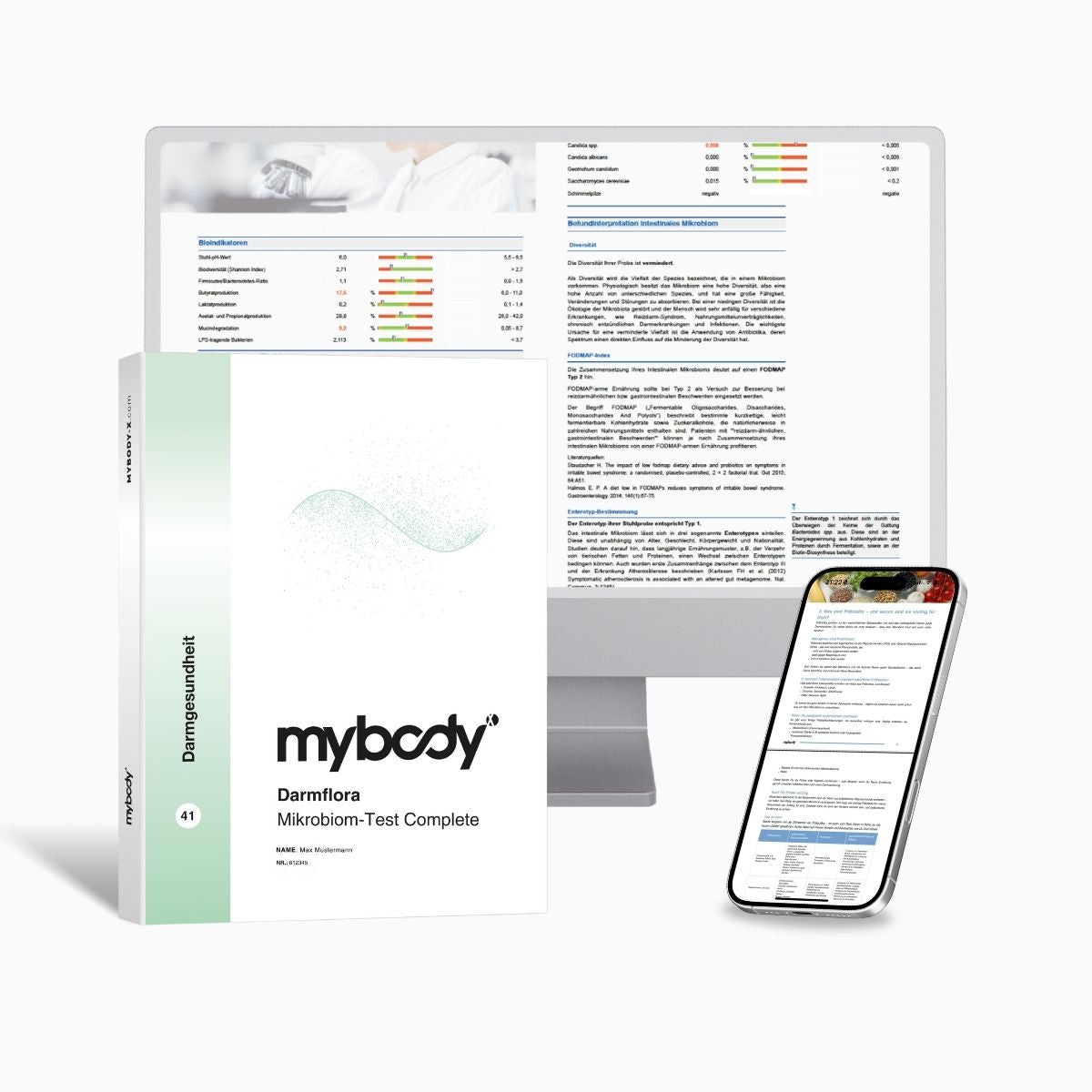
Gut test from a stool sample
Microbiome gut test | Complete
Uses DNA sequencing to detect more than 1,500 bacterial species and describes diversity, enterotype, stool pH, as well as yeasts and fungi. Intestinal barrier permeability is explicitly not included: The test does not measure permeability and therefore provides no answer to the leaky gut question. Nevertheless, the product page includes “leaky gut syndrome” in a list of possible complaints—for this mention, the test has no corresponding procedure, and we state that openly here. The result is a snapshot, not a diagnosis, and does not replace medical evaluation.
Laboratory analysis: 5–10 business days after sample receipt
Product page information; no laboratory name stated; accessed 28 August 2026
Two things that are not clearly distinguished on the product pages
First, the list of symptoms mentioned above. The fact that the term appears there even though no procedure exists for it is a contradiction on our own page. It is mentioned here rather than omitted.
Second, the distinction from the smaller version. In addition to Complete, there is the gut flora microbiome test | Essential for €129.00 (as of 27 August 2026). Both product pages state the same figure of more than 1,500 bacterial species and describe the scope in largely identical wording. The pages do not document how the analyses differ. As long as that remains the case, no recommendation is made here for either version.
The article At-home stool test explains how sample collection at home works in practice and how a report is structured. The article Microbiome tests and statutory health insurance addresses the question of costs in relation to statutory health insurance.
Who this approach can help and who it cannot
The process described does not suit every starting situation. The comparison is deliberately honest in both directions, because a refusal at the right point is worth more than a finding at the wrong one.
Makes sense for you if …
your symptoms have persisted for weeks or months without anyone having asked about them systematically so far
you are willing to keep a record for two weeks before ordering anything
the basic examinations have already been completed without providing an explanation
you want a baseline value for your gut flora so that you can compare a change over several months
Probably not if …
one of the warning signs is present: blood in the stool, unintended weight loss, fever, or nighttime symptoms. In that case, the appointment comes before any test
you expect confirmation of leaky gut syndrome. No examination can provide that
you have just started avoiding gluten. The question of celiac disease must be clarified first; otherwise, the result cannot be evaluated
you are hoping for treatment based on a finding. A baseline value is not therapy and must not be equated with treatment
If you decide against paying for an examination yourself, that does not mean the process ends there. Steps one through four remain open and are the part that answers the questions with consequences anyway.
Limitations: what this approach leaves open
The most honest sentence belongs before the conclusion rather than at the end. This path does not necessarily lead to a diagnosis. After the initial diagnostic workup, some people with persistent intestinal symptoms are ultimately told that nothing requiring treatment was found.
This path does not necessarily lead to a diagnosis.
This feels like a failure, but it is not. Ruling something out is a result: It removes concern about serious causes from the equation and shifts the question toward what can be changed in everyday life.
The second limitation concerns costs. A gut microbiome test paid for out of pocket is not covered by statutory health insurance. Anyone who orders one has to pay for it themselves, and the result does not lead to a prescription.
The third limitation is time. A stool test describes a single point in time. It says nothing about what things looked like four weeks earlier, or what they will look like four weeks from now. It becomes comparable only through a second measurement after several months.
What matters about the sequence
The article began with the question of how to get tested for leaky gut. The well-supported answer is: not as the first step. It may sound disappointing, but it is the only answer that will move you forward, because it shifts your focus from a nonexistent label to causes for which tests and treatments are available.
What was not included in this article: The right time to start recording is almost always today, not the day after your next bout of stomach trouble. If you wait until things get bad, you will only record the spikes and lose the comparison days that make the pattern visible in the first place.
So today, take a sheet of paper or open a notes app and enter the first line: date, time, what you ate, and how you felt afterward. In fourteen days, you will have something that can make a medical appointment more productive. Your symptoms will not change by then, but the quality of your next conversation will.
Frequently asked questions
How can I get tested for leaky gut?
Not through a single test, but through a sequence. First, record your symptoms, meals, and bowel movements for two weeks; then see your primary care doctor, who can check for warning signs and arrange basic blood and stool tests. If questions remain, the next step is a gastroenterology practice. A self-funded test comes at the end of this sequence, not at the beginning. None of these steps can provide evidence of leaky gut syndrome, because it has no code in the official ICD-10-GM diagnostic classification (BfArM, 2026 version).
When should my symptoms be taken straight to a doctor's office?
If there is blood in the stool, unintentional weight loss, fever, and symptoms that wake you from sleep. Other warning signs include noticeable paleness, severe exhaustion, newly occurring persistent symptoms at an advanced age, and a family history of intestinal diseases. In these cases, you do not wait and observe for two weeks or order a self-test. The appointment comes first.
Can the Microbiome Gut Test detect leaky gut?
No. The Microbiome Gut Test | Complete uses DNA sequencing to identify more than 1,500 bacterial species and thereby describes the composition of the gut flora. It does not measure the permeability of the intestinal wall. The fact that the product page mentions “leaky gut syndrome” in a list of symptoms does not change this, and we openly point out this contradiction. The report provides a baseline for personal observation, not a diagnosis or treatment.
How can I get an appointment in gastroenterology faster?
Through the appointment service center of the Association of Statutory Health Insurance Physicians at the nationwide number 116117. You need a referral for this: “All referrals are marked with a booking code that patients need when calling the appointment service center or booking online through the e-appointment service” (Association of Statutory Health Insurance Physicians in Bavaria, as of August 27, 2026). According to the KVB, the waiting time between the initial call and the appointment is no more than five weeks; routine and preventive examinations and minor illnesses are excluded.
Should I avoid gluten beforehand to see whether it gets better?
Not before the evaluation. The celiac disease blood test is “only meaningful if sufficient gluten has been consumed beforehand” (IQWiG, as of December 14, 2022). Anyone who avoids gluten first and then gets tested receives a result that no one can rely on and may have to eat gluten again for weeks. Approximately 1 to 2 percent of people in Europe have confirmed celiac disease (IQWiG, as of December 14, 2022). The process therefore starts with testing and only then moves on to dietary changes.
Next step
First the order, then the sample
Once the basic tests have been completed and questions about the gut flora remain unanswered, the Microbiome Gut Test provides | Complete provides a baseline. The neighboring article explains which measurement methods related to the intestinal barrier are available and what they actually measure.
Microbiome gut test | Complete The methods at a glanceRead more
You might also be interested in this
The procedural side of the same question: what zonulin, sugar tests, and stool markers each measure and how reliable they are.
How sample collection works in practice at home and how a test report is structured.
For reference, which genera and markers appear in an analysis and what they mean.
Sources
- Institute for Quality and Efficiency in Health Care (IQWiG): At the Doctor’s Office (as of 12/18/2024) – gesundheitsinformation.de
- Institute for Quality and Efficiency in Health Care (IQWiG): Celiac Disease (Gluten Intolerance) (as of 12/14/2022) – gesundheitsinformation.de
- Association of Statutory Health Insurance Physicians of Bavaria (KVB): Appointment Service Center 116117 for Patients (as of 08/27/2026) – kvb.de
- Federal Institute for Drugs and Medical Devices (BfArM): ICD-10-GM Version 2026, official classification of diagnoses (as of 09/12/2025) – klassifikationen.bfarm.de
The verbatim quote describing the symptoms, as well as the notes on keywords, the medication list, and open questions for the medical consultation, are taken from source [1]. The information on celiac disease is based on [2]: the prevalence of 1 to 2 percent in Europe, the process involving antibody testing and a tissue sample, and the statement about continuing gluten consumption before testing. The referral code on the referral form, the maximum waiting time of five weeks, the one-week deadline at the primary care level, and the exceptions that do not require a referral come from [3]. The fact that no separate diagnostic code is provided for leaky gut syndrome and that persistent symptoms without an identifiable finding are classified under K59.9 as a functional intestinal disorder is based on [4]. Information on the product name, price, sample type, scope of analysis, and laboratory note comes from the mybody®x product pages, accessed on 08/28/2026; processing times follow the central guideline for intestinal tests. All sources were accessed and reviewed on 08/28/2026.

mybody®x Editorial & Specialist Team
Microbiome and gut science Laboratory diagnostics Nutritional science Blood analysis interpretation
This article was created by the mybody®x editorial and specialist team. The team combines microbiome and gut science, laboratory diagnostics, and nutritional science. Anyone involved in its creation is listed on the authors page.
Published on 06/09/2025 · Last updated on 08/27/2026
The content is intended for general information and does not replace medical advice, diagnosis, or treatment. Reference ranges depend on the laboratory, method, and age—the information on your test report is always authoritative.




Share now:
SIBO Nutrition Counseling: 6 Proven Diet Strategies for 2025
Stop bloating after eating: What really helps