
What Is Estrogen and How Does It Work in Your Body?
Estrogen is so much more than just one hormone—think of it instead as the chief conductor in your body, coordinating countless processes and significantly influencing your well-being. It not only shapes the female cycle but also plays a role in your skin, bones, mood, and even your heart health.
Estrogen: The Hormone That Regulates Your Well-Being

You could describe estrogen as your body's versatile manager. Although it is primarily known as the central female sex hormone produced in the ovaries, its roles extend far beyond reproduction. It is an absolutely key player in health—for women and, by the way, for men too.
We are not talking about just one substance. Estrogen is an entire group of hormones. The three most important representatives—estradiol, estrone, and estriol—take on very different, yet always important, roles depending on the stage of life.
The Three Faces of Estrogen
To truly understand what estrogen does, we need to take a closer look at its three main forms. Each has its own special role and comes to the forefront during specific stages of life.
This table gives you a quick overview of the most important types of estrogen and their key functions in your body.
| Estrogen type | Main production site | Primary function |
|---|---|---|
| Estradiol (E2) | Ovaries | The strongest estrogen, it controls the menstrual cycle during the fertile years. |
| Estrone (E1) | Adipose tissue | The main form of estrogen after menopause, significantly weaker than estradiol. |
| Estriol (E3) | Placenta | The "pregnancy hormone" supports the growth of the uterus. |
So you can see how these three forms are perfectly coordinated and take the lead during different stages of life.
They work by attaching to special receptors in cells. Imagine them as a key that fits only one specific lock. Only then can they transmit their messages and control vital bodily functions.
Estrogen is not only important for the female cycle. It protects the bones from osteoporosis, keeps the skin supple, influences fat metabolism, and even has a protective effect on our cardiovascular system.
Especially during transitional phases such as menopause, the immense importance of this hormone suddenly becomes noticeable. In Germany alone, around 9 million women are affected by menopausal symptoms—a time when the body's own estrogen production declines sharply. This often leads to familiar complaints such as hot flashes and sleep disturbances.
A balanced level is therefore essential for your quality of life. To interpret your body’s signals correctly, it is very helpful to understand these basics. If you would like to explore the topic in greater depth, also read our in-depth guide to the hormone estrogen.
Estrogen’s Journey Through Your Life
Your estrogen level is anything but a fixed number. Instead, think of it as a dynamic companion that changes with the rhythm of your life and plays a major role in shaping your body’s key biological milestones. This journey begins in youth and continues through all the important phases.
It is important not to view these changes as a problem, but as a completely natural part of your life journey. Each phase has its own hormonal signature that shapes not only your body, but also how you feel.
From Puberty to Menopause
Puberty marks the starting point: estrogen stimulates the development of female sexual characteristics. It causes the breasts to grow and triggers the first menstrual period, marking the beginning of the fertile years. During this time, your estrogen levels reach their peak and begin to fluctuate in a monthly cycle.
This rise and fall is the centerpiece of your menstrual cycle. During the first half, estrogen levels rise, promoting the buildup of the uterine lining and preparing for ovulation. After ovulation, levels fall again, which—if pregnancy does not occur—ultimately leads to menstrual bleeding.
This infographic gives you an overview of the typical hormonal turning points in a woman’s life.
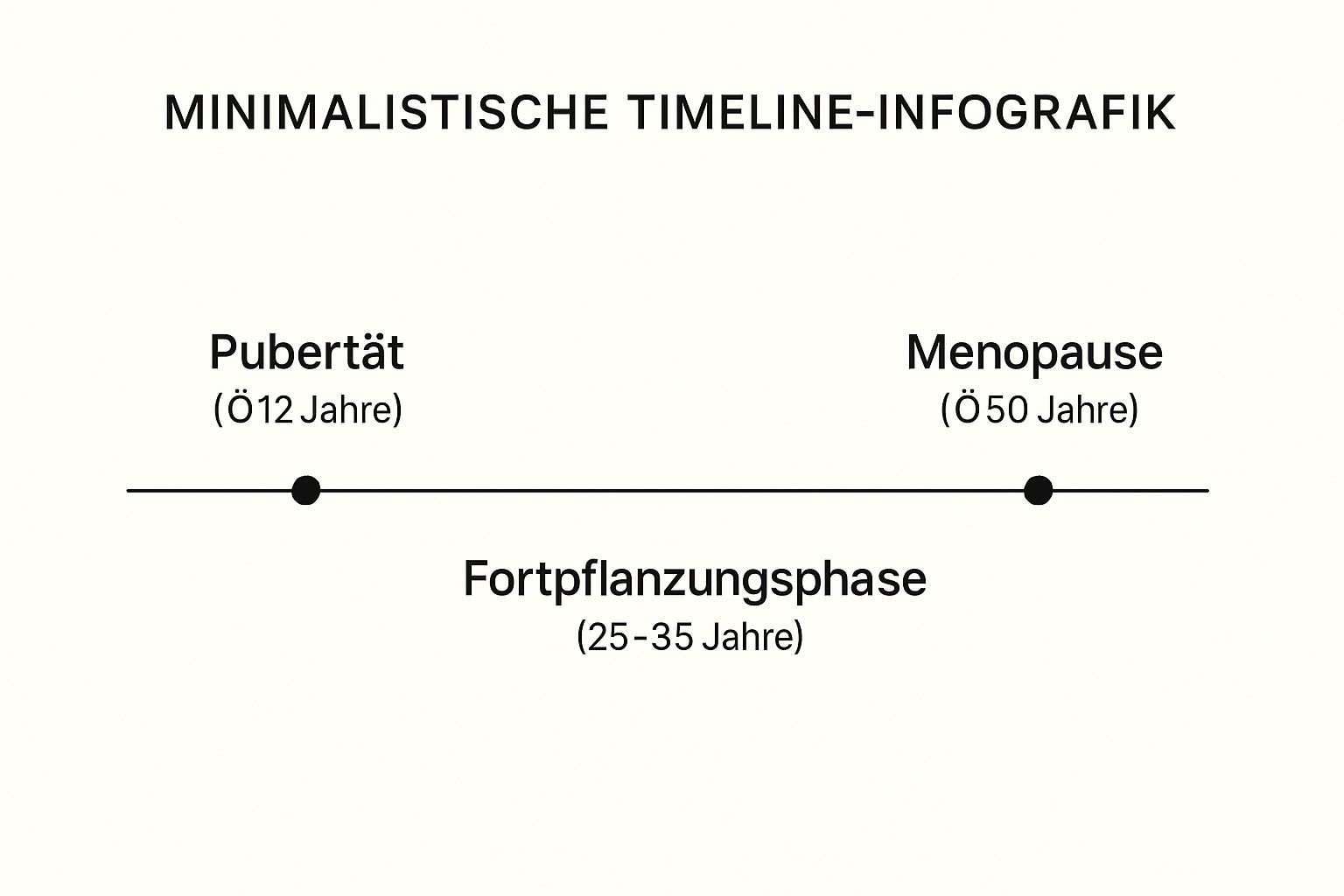
You can immediately see how estrogen production rises rapidly during puberty, reaches its peak during the fertile years, and then naturally declines again as menopause approaches.
The Major Turning Points
Over time, hormone production adjusts again. The years before the final menstrual period, also known as perimenopause, are often characterized by significant fluctuations. During this phase, the ovaries gradually slow their production, which can lead to irregular cycles and the first typical symptoms.
Menopause itself occurs at an average age of 51 and marks the point at which the ovaries almost completely stop producing estrogen. This is not a sudden event, but a gradual transition.
This natural decline is the reason for many of the changes women experience during this stage of life. Knowing these connections is the first and most important step toward understanding your body and actively supporting your well-being. It’s about interpreting the signals correctly and knowing that you are not powerless in the face of these changes. Your body tells a story—and estrogen writes many of its most important chapters.
Signs of a hormonal imbalance

A balanced hormonal system is the invisible force that guides your daily well-being. But what happens when this delicate balance begins to falter? The answer often lies in the extremes: either too much or too little estrogen.
Both conditions—estrogen deficiency and estrogen dominance—can trigger a wide range of symptoms that often gradually blend into everyday life. Many of these signs are so nonspecific that they are quickly dismissed as stress or normal fatigue. But your body is sending subtle signals that you should pay attention to.
When estrogen is lacking
Estrogen deficiency occurs most often during perimenopause and menopause, but it can also affect younger women. Imagine your body suddenly lacking its most important regulator of temperature and mood.
The effects are often immediately noticeable. Sudden hot flashes that overwhelm you out of nowhere, or night sweats that rob you of sleep, are classic signs.
Common symptoms of estrogen deficiency include:
- Hot flashes and night sweats: A sudden, intense feeling of warmth, often accompanied by heavy sweating.
- Sleep disturbances: Difficulty falling asleep or staying asleep, often made worse by night sweats.
- Dry skin and mucous membranes: The skin loses elasticity, and the mucous membranes may also be affected, which can feel very uncomfortable.
- Mood swings: Increased irritability, anxiety, or low moods can suddenly become part of everyday life.
Estrogen deficiency affects not only how you feel now but also your long-term bone health. The hormone protects the bones, and its absence increases the risk of osteoporosis.
In medicine, hormone replacement therapy (HRT) is often used in cases of pronounced estrogen deficiency caused by menopause or surgical removal of the ovaries. It is intended to alleviate menopausal symptoms and prevent osteoporosis promoted by the deficiency. You can read more about the background to HRT at the Federal Institute for Drugs and Medical Devices.
When estrogen predominates
At the other end of the spectrum is estrogen dominance. Here, the absolute amount of estrogen is not necessarily too high; rather, the ratio to its counterpart, progesterone, has become imbalanced.
This imbalance can manifest in very different ways. You may notice unexplained weight gain, especially around your hips and thighs, or your breasts may often feel tender and swollen.
Typical signs of estrogen dominance include:
- Weight gain: Particularly around the hips, buttocks, and thighs.
- Mood swings and PMS: Increased irritability, tearfulness, or tension, especially during the second half of the cycle.
- Tender or swollen breasts: A common symptom before menstruation that can be more pronounced when estrogen is dominant.
- Heavy or irregular periods: Your cycle may change, and bleeding may become significantly heavier.
Recognizing these symptoms is the first and most important step toward improvement. When you understand what’s happening in your body, you can take much more targeted action. In our in-depth article, you can learn more about how to regulate your hormonal balance.
These factors throw your estrogen levels out of balance
Your hormonal system isn’t a rigid structure that runs according to a fixed plan. Instead, picture it as a delicate spiderweb: pluck one spot, and the entire web vibrates. Your hormones react to your lifestyle, diet, and even environmental influences in the same way.
The good news is that you’re not helplessly at its mercy. Once you understand which strings you can pull, you can actively help bring your hormones back into balance.
Your lifestyle as a hormone switch
Your daily routine has a huge impact on your hormonal balance. Chronic stress, lack of sleep, and unsuitable exercise in particular can seriously disrupt this delicate balance.
When you’re constantly under pressure, your body releases the stress hormone cortisol. The problem is that cortisol and sex hormones such as estrogen are made from the same “building blocks.” So if cortisol production is permanently running at full speed, there literally aren’t enough resources left for estrogen.
Your sleep also plays a key role. At night, your body regenerates and regulates hormone production. If you consistently get less than 7 hours of sleep per night, this important process can quickly get out of sync.
How diet and the environment play a role
What ends up on your plate has a direct connection to your hormones. A balanced diet rich in fiber, healthy fats, and high-quality protein helps your liver break down and eliminate excess estrogen.
Some foods can provide targeted support here:
- Phytoestrogens: These are plant-based substances found in flaxseeds, soy, and chickpeas. Their structure resembles that of estrogen, which is why they can attach to the same receptors and, depending on the body’s needs, produce a gentle balancing effect.
- Fiber: It provides nourishment for your beneficial gut bacteria. A healthy gut flora, in turn, is essential for efficiently removing used estrogen from the body.
But it’s not only what you eat that matters. So-called endocrine disruptors—chemicals from our environment—can seriously disrupt your hormonal system. They lurk in many everyday products such as plastics, cosmetics, and pesticides and can act like estrogen in the body.
These substances are also known as xenoestrogens and can place additional strain on your natural balance. Being more mindful of your use of such products is therefore an important step for your hormonal health. Every small step counts and is an investment in your long-term well-being.
Test your estrogen level from home

Do you feel that your hormonal balance has gotten out of sync? Unfortunately, simply guessing won’t get you anywhere. This is exactly where modern diagnostics come in, giving you the clarity you need. A specific measurement is the first crucial step toward finally understanding your body’s signals correctly.
Constantly guessing about symptoms such as mood swings or sleep problems often only leads to frustration. Knowing your hormone status in black and white, on the other hand, is the foundation for making targeted changes—and for having an informed conversation with your doctor or therapist. This helps you move from uncertainty to taking active steps for your health.
Clarity through a simple hormone test
For many people, the idea of getting their hormone levels checked sounds like a huge effort. But it doesn’t have to be. With an at-home hormone test from mybody-x, you can measure your estrogen level—more specifically, the important estradiol (E2)—simply, discreetly, and conveniently from home.
The entire process is deliberately designed to be as simple as possible, so you can access your important health data without any obstacles.
- Effortless sample collection: You collect the sample yourself—just a few painless drops of blood from your fingertip are enough. Detailed instructions guide you through the process step by step.
- Analysis in a specialized laboratory: You send your sample free of charge to our certified German laboratory, where experts examine it closely.
- Easy-to-understand results report: After a short time, you’ll receive a clear, easy-to-understand report. It not only shows your estradiol level but also explains what it means for you.
A measured value is so much more than just a number. It is the evidence that confirms or disproves your suspicions. Above all, it gives you a solid foundation for planning the next steps toward your well-being.
Such a test also provides an important foundation for possible hormone replacement therapy (HRT). Current studies also show how crucial adequate estrogen levels can be. An international study using data from more than 10 million women found that women who used estrogen-only therapy after menopause had a significantly lower risk of death. You can read more about these exciting findings about hormones and a longer, healthier life here.
From knowledge to action
A hormone test provides you with more than just a number—it gives you valuable insights above all. It helps you understand whether your symptoms may be related to a deficiency or dominance. With this knowledge, you can specifically adjust your diet, optimize your lifestyle, or simply establish a much better basis for your next conversation with your doctor.
A hormonal imbalance can also affect your nutrient supply, by the way. That’s why it’s often wise to keep both in mind. In our guide, we explain why it’s so important to also get tested for a possible nutrient deficiency. With mybody-x, you take control of your health data and turn knowledge into targeted, effective action.
Frequently asked questions about estrogen
You probably still have a few questions on your mind. That’s completely normal, because hormones are a complex topic. Here, we’ve summarized the answers to the most frequently asked questions about estrogen for you—in short, your handy reference guide for a quick overview.
Can I influence my estrogen levels through my diet?
Yes, absolutely! What you eat has a direct connection to your hormonal balance. Some foods contain so-called phytoestrogens. These are plant-based compounds that can have a mild estrogen-like effect in the body.
These include, for example, flaxseeds, soy products, and chickpeas. They can help support your hormonal balance naturally. A balanced diet rich in fiber and healthy fats also makes a difference: It supports your liver in processing hormones and promotes a healthy gut microbiome—both of which are extremely important for stable hormone levels.
But remember: Diet is a great tool for positively influencing an imbalance. However, it can never replace a medical diagnosis when symptoms are severe.
Does estrogen also play a role in men?
Absolutely! Although estrogen is often considered the “female hormone,” it is just as essential for men. Men produce it in much smaller quantities, mainly through the conversion of testosterone, but it performs important functions.
In men, estrogen is involved in areas such as these:
- Strong bones: It helps preserve bone density and thus prevents osteoporosis.
- Healthy libido: The right ratio of testosterone to estrogen is crucial for healthy sexual desire.
- Fertility: Estrogen is involved in sperm maturation.
An imbalance—whether too much or too little—can therefore also cause problems in men. Here, the balance between the hormones is the key to well-being.
When is the best time to test estrogen levels?
The ideal time for a hormone test depends entirely on your individual situation. For women with a regular cycle, the second half of the cycle is often the most informative. A good guideline is the period between the 19th and 21st day of the cycle.
If your cycle is irregular or you are already in perimenopause or menopause, you can choose the test day flexibly. The instructions for mybody-x self-tests provide precise recommendations to ensure that your result is as reliable and informative as possible.
What does estradiol (E2) mean in test results?
When you see the estrogen value in your test results, it almost always refers to estradiol (E2). This is the strongest and most biologically active form of estrogen, especially in women of childbearing age.
A high or low E2 level in your mybody-x results gives you a very clear indication of whether you may have estrogen dominance or a deficiency. If you recognize the symptoms of estrogen deficiency in yourself, a test can finally provide clarity and help you understand what is behind your symptoms.
Are you ready to move from guesswork to action and take control of your hormonal health? A mybody-x blood test gives you precise insights into your body and provides the data you need to make targeted improvements. Visit https://mybody-x.com now to discover how easy it is to learn more about yourself from home.



Share now:
Recognize nutrient deficiency symptoms – Your guide to greater well-being
Correct estrogen deficiency and find your balance again