

Recognizing nutrient deficiency symptoms—your guide to greater well-being
Do you often feel tired, unfocused, or simply not at your best? These everyday complaints are more often caused by nutrient deficiency symptoms than you might think. Many people attribute such signs to stress or too little sleep, but your body may be trying to tell you something more important.
What your body reveals about nutrient deficiencies
Your body is a highly complex system. To ensure everything functions smoothly—from energy production to immune defense—it needs a constant supply of vitamins, minerals, and trace elements. If even one building block is missing, the entire mechanism can begin to stall.
You can think of your body as a house. Nutrients are the building materials: iron for the load-bearing walls (that is, oxygen transport), vitamin D for a stable foundation (bones and the immune system), and magnesium for the entire electrical system (in other words, muscle and nerve function). When materials become scarce, small, inconspicuous cracks appear first.
These very “cracks” are the first subtle signals your body sends you. You may notice:
- Persistent fatigue that does not improve even after a full night's sleep.
- Difficulty concentrating and the feeling of going through the day in a fog.
- Brittle nails or hair loss, which are often the first visible signs.
- A high susceptibility to infections because your immune system is no longer working at full capacity.
These signs are not imagined. They are important signals from your body. Understanding them is the first step toward finding the cause instead of merely fighting the symptoms.
Many people live with these vague symptoms for months or even years without recognizing the true cause. A nutrient deficiency often develops gradually. This is where you come in: instead of waiting for serious problems to develop, you can take action yourself.
Instead of groping in the dark and trying supplements at random, taking a targeted look at your nutrient levels finally brings clarity. A simple at-home blood test can provide precise answers. With the mybody-x nutrient tests, you get a clear picture of your nutrient status and can take targeted action—for greater vitality and well-being.
The most common nutrient deficiencies and their typical signs
A nutrient deficiency often creeps quietly into your life. The initial signals are usually so nonspecific that we hardly notice them—a little more fatigue here, one cold too many there. To help you better understand your body's language, let's now take a close look at the most common deficiencies and their symptoms.
We are focusing on the “usual suspects”: iron, vitamin D, vitamin B12, magnesium, and zinc. Many people have an unnoticed gap in their intake of these nutrients, which can have a huge impact on their daily well-being.
Iron deficiency: the hidden energy brake
Think of iron as the most important employee in your body's oxygen logistics system. It is the central building block of red blood cells and responsible for transporting oxygen from the lungs to every single cell. Without iron, your cells are literally left gasping for air.
The nutrient deficiency symptoms of iron deficiency are therefore often very noticeable, even if you don't immediately identify them correctly.
- Persistent fatigue and exhaustion: This is the number-one key symptom. If you constantly feel drained despite getting enough sleep, iron deficiency could be the cause. Find out more about how you can overcome fatigue caused by nutrient deficiencies.
- Pale skin and mucous membranes: A quick look in the mirror or at the inside of your lower eyelids can provide an initial clue.
- Poor concentration and headaches: Your brain is an oxygen junkie. If it doesn't get enough, your performance suffers.
- Brittle nails and hair loss: The body is clever and supplies the vital organs first. Hair and nails unfortunately have to take a back seat.
Vitamin D: the sunshine vitamin for your immune system
Vitamin D is quite unique because your body can produce it itself with the help of sunlight. The problem? In our latitudes, especially in autumn and winter, the sunlight is simply too weak to reliably meet our needs.
This infographic sums up the most important facts about vitamin D deficiency and shows how widespread the problem really is.
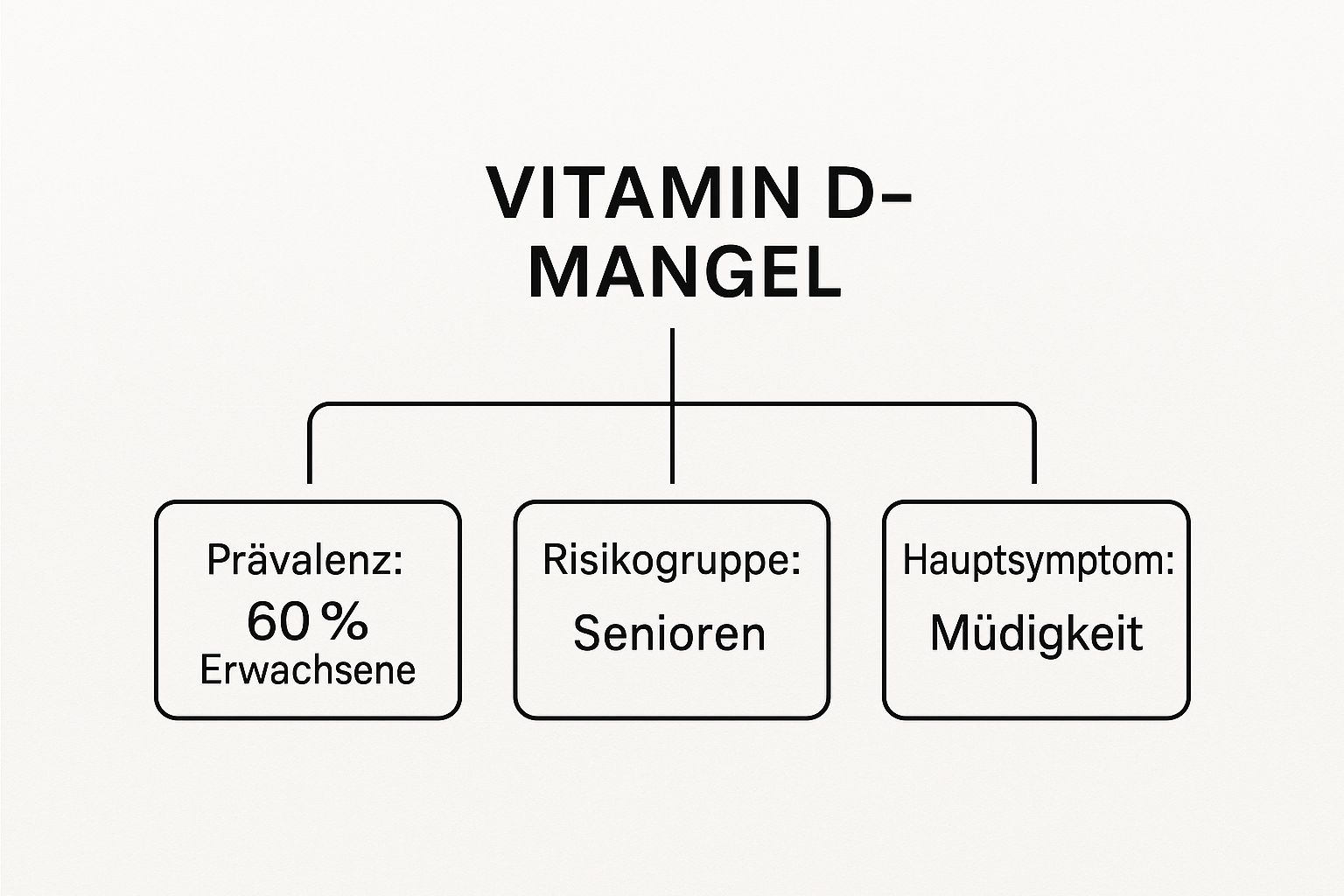
The graphic makes it clear: fatigue is a key symptom, and an alarmingly high number of adults are affected. This underscores how important this vitamin is for us.
A vitamin D deficiency often shows through:
- Increased susceptibility to infections: Do you feel like you catch every cold going around? This could be due to a weakened immune system.
- Fatigue and depressive moods: No wonder it is called the “sunshine vitamin”—it has a direct impact on your mood.
- Bone and limb pain: Vitamin D is the key to enabling your body to absorb calcium and use it for strong bones.
Vitamin B12: the powerhouse nutrient for nerves and blood
Vitamin B12 is found almost exclusively in animal-based foods. Therefore, if you are vegetarian or vegan in particular, you should keep a close eye on your intake. It is essential for cell division, the formation of blood cells, and a functioning nervous system.
Important to know: A vitamin B12 deficiency can cause neurological symptoms such as tingling in the hands and feet, memory problems, or dizziness. You should always take such signs seriously.
Concentration problems and unexplained lack of motivation can also be among the symptoms. The tricky part is that the body can store B12 for a long time, so it can sometimes take years before a deficiency becomes noticeable.
Magnesium and zinc: the managers of your metabolism
Magnesium and zinc are the unsung heroes working behind the scenes. Magnesium is involved in more than 300 metabolic processes, helps relax the muscles, and calms the nerves. Zinc, meanwhile, is key to wound healing, a strong immune system, and healthy skin.
A deficiency in these two minerals can manifest itself in very different ways:
- Muscle cramps and tension (magnesium): The classic symptom is nighttime calf cramps.
- Poor wound healing and skin problems (zinc): Small scratches take forever to heal, and the skin is prone to blemishes.
- Inner restlessness and sleep problems (magnesium): You simply cannot unwind in the evening and have trouble falling asleep.
- Weakened immune system (zinc): Frequent infections may also indicate a zinc deficiency.
Overview of common nutrient deficiencies and their key symptoms
To give you a quick overview, we have summarized the most important information in this table. It shows at a glance the role of each nutrient and how you might recognize a deficiency.
| Nutrient | Main function in the body | Typical symptoms of deficiency |
|---|---|---|
| Iron | Oxygen transport, energy production | Persistent fatigue, paleness, difficulty concentrating, hair loss |
| Vitamin D | Immune system, bone health, mood | Increased susceptibility to infections, fatigue, depressive moods, bone pain |
| Vitamin B12 | Nerve function, blood formation, cell division | Tingling, memory problems, fatigue, lack of motivation |
| Magnesium | Muscle and nerve function, energy metabolism | Muscle cramps, tension, inner restlessness, sleep disturbances |
| Zinc | Immune system, wound healing, skin health | Poor wound healing, skin problems, hair loss, frequent infections |
This overview makes it clear how much the symptoms can overlap. This often makes it difficult to identify the exact cause without a test.
If you recognize yourself in some of these descriptions, there is no reason to panic—it is the first important step. It shows that you are listening to your body. A mybody-x nutrient test can give you exactly the clarity you need now to take targeted action and soon feel fitter and more energized again.
Why a nutrient deficiency develops in the first place
A deficiency in important nutrients rarely has just one single cause. Think of it more like a complex equation: At the end of the day, the balance between intake and consumption has to be right. If you slip into the negative here, a deficit develops. Often, it is a gradual interplay of various factors that affects your nutritional status—even when you are genuinely trying to maintain a healthy lifestyle.
The reasons are as varied as life itself. A nutrient deficiency is therefore not a personal failure, but the result of complex circumstances. The good news: Once you understand them, you can take targeted action.

Your diet as the foundation
The most obvious reason for a deficiency is usually found on the plate. Our modern diet does not always make it easy to get all the necessary vitamins and minerals in sufficient quantities.
- Processed foods: Many highly processed products are rich in calories but shockingly poor in genuine nutrients. They fill your stomach, but they do not truly nourish your body.
- Restrictive diets: Whether low-carb, low-fat, or other strict dietary approaches—once entire food groups are eliminated, important nutrient sources are often lost as well.
- Nutrient-poor soil: Due to today’s intensive agriculture, many of our plant-based foods unfortunately contain significantly fewer micronutrients than they did a few decades ago.
So even those who pay attention to a balanced diet are not automatically guaranteed comprehensive nutritional coverage.
Your lifestyle as a demand booster
Your daily routine has a tremendous impact on how many nutrients your body uses every day. An increased need is one of the most common causes of a relative deficiency—you do absorb nutrients, but your body simply burns through them faster than you can replenish them.
An important thought: A nutrient deficiency does not always mean that you are eating too little. Often, it simply means that your body currently needs more than you are giving it.
The need rises dramatically, especially during certain stages of life:
- Chronic stress: When your body is constantly under pressure, it uses enormous amounts of B vitamins and magnesium to keep stress hormones in balance.
- Intense exercise: Those who sweat a lot lose more than just water. Valuable minerals such as magnesium, zinc, and iron are also flushed out.
- Lack of sleep: Sleep deprivation is pure stress for the body and also depletes the reserves of important protective micronutrients.
Alcohol and nicotine are also well-known nutrient thieves. They can even actively block the absorption of important vitamins in the intestines. If you want to explore this topic in more depth, you can find more background information in our article about vitamin and mineral deficiencies in Germany.
Special stages of life and health factors
Sometimes, it is also completely natural phases of life or certain health circumstances that throw your nutrient balance off track. Your body changes, and so do its needs.
These include, above all:
- Pregnancy and breastfeeding: During this special time, your body is working for two. The need for folic acid, iron, and iodine increases enormously.
- Growth phases: Growing children and adolescents need significantly more building blocks than adults to develop their bones and muscles.
- Age: As the years go by, appetite often decreases, while the intestines may no longer absorb nutrients as efficiently as they did before.
In addition, chronic illnesses can directly interfere with nutrient absorption. In particular, inflammation in the gastrointestinal tract, as with Crohn’s disease or celiac disease, can prevent nutrients from food from reaching the bloodstream in the first place.
Who is particularly susceptible to a nutrient deficiency?
A nutrient deficiency can basically affect anyone. Nevertheless, there are certain stages of life and lifestyles in which the risk of a deficiency increases significantly. Special circumstances can greatly increase your personal need for vitamins and minerals, or your body may have difficulty absorbing the nutrients in the first place.
If you know whether you belong to one of these groups, you can take more targeted preventive measures and better interpret your body's signals. It's not about putting you in a box, but about developing awareness of your individual needs. Think of it as your personal health compass: if you recognize yourself here, you should be especially vigilant.
Vegetarians and vegans
More and more people are choosing a plant-based diet for good reasons. It can be extremely healthy, but it also brings the challenge of consciously keeping track of certain nutrients.
- Vitamin B12: This vitamin is a classic because it is found almost exclusively in animal products. A deficiency often develops gradually over years and can cause serious neurological damage.
- Iron: The iron in plants (non-heme iron) is harder for our bodies to process than the iron in meat. Combining it with vitamin C is a good strategy, but meeting the need often remains a challenge.
- Zinc and omega-3 fatty acids: These important nutrients are also less common or less readily available in plant-based foods and require genuinely thoughtful meal planning.
Athletes and active people
Exercise is great for your health, no question. But if you push your body, you also need to give it the right fuel. With regular training, your metabolism runs at full speed, significantly increasing the consumption of energy and micronutrients.
Through heavy sweating, you lose not only water but also flush out valuable minerals. Athletes often have a significantly increased need for magnesium, zinc, and iron. Magnesium is the key to muscle function, zinc supports recovery, and iron transports oxygen—all critical building blocks for your performance.
Pregnant and breastfeeding women
At no other stage of life does nutritional needs change as dramatically as during pregnancy and breastfeeding. Your body performs a small miracle by not only nourishing itself but also building an entirely new life.
The need for many nutrients is skyrocketing. The following are particularly critical:
- Folic acid: Absolutely crucial for the early development of the baby's nervous system.
- Iron: Needed for the greatly increased blood volume and to support the baby.
- Iodine: Essential for the development of the thyroid and brain.
- Calcium and vitamin D: The building blocks of a child's strong skeleton.
Seniors
As the years go by, our bodies change. Metabolism slows down, appetite sometimes decreases, and the intestines become less efficient at absorbing nutrients. This combination makes older people a classic risk group.
Common deficiencies in old age include vitamin D, because the skin can no longer produce as much of it on its own, vitamin B12, due to declining absorption in the stomach, and calcium, which increases the risk of osteoporosis. The tricky part is that a deficiency often manifests as fatigue or muscle weakness—symptoms you might quickly and mistakenly attribute to aging.
A deficiency is not an unavoidable consequence of aging. With the right knowledge, you can take targeted action and preserve your quality of life for a long time.
People with chronic illnesses
Anyone living with a chronic illness often faces an additional battle on the nutrient front. Diseases of the gastrointestinal tract in particular, such as Crohn's disease, celiac disease, or ulcerative colitis, can seriously sabotage nutrient absorption.
If the intestinal lining is chronically inflamed, vitamins and minerals can no longer be absorbed properly, even when the diet seems perfect. But long-term use of certain medications can also become a nutrient thief—acid blockers, for example, can interfere with the absorption of vitamin B12 and magnesium.
If you would like to delve deeper into the scientific background of nutrient deficiencies, we have more information for you. If you belong to one of these groups, taking a closer look at your nutrient supply is all the more important.
From suspicion to certainty with a nutrient test
Do the descriptions of nutrient deficiency symptoms sound familiar? That is already an important first step. But symptoms are like smoke signals: They indicate that something is burning, but they do not reveal what exactly. This guesswork often leads you to reach for random dietary supplements.
But simply taking high-dose vitamins or minerals is not only often pointless—it can even be harmful in the worst case. An overdose disrupts your body's delicate balance and may create entirely new problems. The only safe and truly effective way is a targeted analysis, such as the one offered by the mybody-x nutrient test.

Your path to clarity couldn’t be easier
Instead of waiting weeks for a doctor’s appointment, you can take matters into your own hands—conveniently, discreetly, and from home. The mybody-x nutrient tests are designed to make the process as easy as possible while delivering highly accurate, reliable results.
The process couldn’t be easier:
- Order your test kit: Choose the right test for your situation. We’ll send the complete kit directly to your home.
- Collect your sample: A few drops of blood from your fingertip are all it takes. Don’t worry—our instructions guide you step by step through the virtually painless sample collection process.
- Free return shipping: Simply place the sample in the enclosed return envelope and send it to our certified partner laboratory in Germany. We cover the postage.
Your body deserves more than just guesswork. A test provides the facts you need to finally make targeted, effective decisions for your health. That way, you’re not investing in just any products, but directly in your well-being.
Your result—finally easy to understand
The best thing about a test result is being able to understand it and immediately know what to do. With us, you won’t receive a laboratory report full of technical jargon that leaves you on your own. We present your results graphically and in clear, simple language.
At a glance:
- Where your levels stand: Are they in the optimal green range, borderline, or already deficient?
- What this means for you: We explain the role each nutrient plays in your body and why a deficiency could correspond precisely to your symptoms.
- Specific recommendations: You’ll receive personalized tips for your diet and lifestyle to help you deliberately replenish your nutrient stores.
This is how uncertainty finally becomes clarity. You’ll discover the true cause of your symptoms and receive a clear roadmap to help you regain your vitality. Would you like to explore the topic in more depth? In our in-depth article, you can learn everything about how to test for a nutrient deficiency. Take control and lay the foundation for health you can truly feel.
Your path to optimal nutrient supply
Congratulations, your test result is here! You’ve taken the decisive step: from the vague feeling that something isn’t right to solid clarity. But don’t view this result as the final destination; see it as your personal starting point. From now on, you’ll know exactly which levers to adjust to reclaim your energy and well-being.
Now the truly exciting part begins, because you no longer have to feel in the dark. We’ll show you how to naturally and sustainably replenish your nutrient stores. With the knowledge from your mybody-x test, you have the perfect tool to take responsibility for your health.
Nutrition as the foundation
By far the most important lever is on your plate. Purposefully adjusting your diet is the absolute foundation for correcting your deficiencies. Don’t worry—it’s not about complicated diets, but about smart and simple choices in everyday life.
Simply focus on adding more nutrient-dense foods to your diet. Here are a few examples of common deficiencies and their best sources:
- For iron deficiency: Red meat, lentils, chickpeas, spinach, and pumpkin seeds are real powerhouses for supporting blood formation.
- For vitamin D deficiency: Oily fish such as salmon or herring is an excellent source. Mushrooms and foods specifically fortified with vitamin D can also help.
- For magnesium deficiency: Reach for nuts (especially almonds), whole-grain products, bananas, and dark chocolate. They help relax your muscles and nerves.
- For vitamin B12 deficiency: Animal products such as meat, fish, eggs, and dairy products are the most important sources. Those following a vegan diet should choose fortified foods or take a supplement.
The art of clever combinations
Did you know that you can significantly improve the absorption of some nutrients through clever combinations? Your body can only properly utilize certain substances when they work as a team.
Imagine your meals as a team game. Only with the right teammates can each nutrient reach its full potential and get exactly where it is needed.
A classic power duo is iron and vitamin C. The vitamin C in peppers, oranges, or broccoli can increase the absorption of plant-based iron from lentils or oats many times over. So a glass of orange juice with your cereal is not only delicious but also really clever.
Another powerful team is made up of the fat-soluble vitamins (A, D, E, K) and healthy fats. A carrot salad (vitamin A), for example, only reaches its full potential with a splash of high-quality olive oil.
When supplements are useful
One thing is clear: Diet always comes first. Sometimes, however, it is not enough on its own to correct a pronounced deficiency quickly and effectively. This is exactly where your mybody-x nutrient test gives you the guidance you need.
Targeted supplementation can be genuinely helpful in these cases:
- In cases of a severe, laboratory-confirmed deficiency: To quickly replenish depleted stores.
- When requirements are increased: For example, during pregnancy, intensive exercise, or stressful periods of life.
- In cases of absorption disorders: When your intestines cannot properly utilize certain nutrients.
- With a vegan diet: Especially to ensure an adequate supply of vitamin B12.
What matters is choosing high-quality supplements and sticking to the recommended dosage. With the certainty provided by your test, you can be sure that you’re giving your body exactly what it really needs—no more and no less. This lays the foundation for lasting health and renewed energy.
Your questions, our answers
To wrap up, we want to answer a few more questions we keep receiving about nutrient deficiency symptoms. This will help clear up any remaining uncertainties and give you the knowledge you need to feel confident. Because only those who understand their body can truly do something for their health.
You’ve probably noticed: The subject is complex, but the solutions are often simpler than you think. It’s about listening to your body’s signals and taking targeted action instead of groping in the dark.
Can I correct a nutrient deficiency through diet alone?
Absolutely! In most cases, this is not only possible but even the best approach. A mindful, nutrient-rich diet is and remains the foundation for sustainably replenishing your stores. This way, you provide your body not just with the one missing building block, but with an entire package of important substances that work together.
There are exceptions, though. If a deficiency is already very severe, your symptoms are clear, or your gut cannot properly absorb nutrients, changing your diet alone often takes too long. In this case, targeted support with supplements—based on your mybody-x test result—is the faster and more effective solution for restoring balance.
How quickly will I notice an improvement if I change something?
Unfortunately, there is no general answer to this question, because every body works differently. How quickly you feel an improvement depends on the type of deficiency, how severe it was, and, of course, your individual metabolism. Your body is not a machine, but a complex organism.
Patience is your most important companion here. Think of it this way: You are finally giving your body the building blocks it may have been waiting for a long time. The repair processes now being initiated simply need time.
However, many people tell us that they notice their first positive changes, such as more energy or better sleep, after just a few weeks. Visible improvements in the skin, hair, or nails usually take a little longer, as these structures grow slowly. The most important thing is to stick with it and pay attention to the small, positive signals your body is sending you.
Are at-home self-tests reliable at all?
We hear this concern often, but we can reassure you. The days when laboratory tests could only be carried out in a doctor's office are over. The mybody-x nutrient tests offer accuracy and reliability that are fully comparable to tests at the doctor's office.
The reason is quite simple: Your sample is analyzed in the same certified medical laboratories in Germany that doctors also work with. The only difference is the convenience for you—you collect the sample yourself at home and receive an easy-to-understand report that immediately shows you what to do.
Are you ready to stop guessing and finally gain clarity about your body? The tests from mybody-x provide the facts you need to take targeted control of your health. Discover the right nutrient test for you now and start your journey toward greater well-being.



Share now:
Recognize the symptoms of estrogen deficiency – How to correctly interpret your body’s signals
What is estrogen, and how does it work in your body?