

Get your hormone levels tested for more clarity
Do you often feel tired, moody, or struggle with unexplained symptoms like sleep problems? A hormonal imbalance might be the culprit. Getting your hormone levels tested can be the crucial first step towards finally gaining clarity and understanding your body better.
Why a hormone test can be the first step
Perhaps you know the feeling: You live a generally healthy lifestyle, but something just doesn't feel right. You lack energy, your mood fluctuates for no apparent reason, or you're gaining weight even though you haven't changed your diet. Such vague symptoms can be incredibly frustrating, especially when the cause remains unclear.
Our hormones are the unsung conductors of our bodies. They control virtually everything – from our energy levels and mood to our metabolism. Even the slightest shifts in this sensitive system can have noticeable effects on your overall well-being.
Learn to understand the language of your body
Instead of simply accepting symptoms, you can learn to interpret your body's signals correctly. A hormone test offers an insightful glimpse behind the scenes. It provides you with objective data that helps you recognize connections. The goal isn't to diagnose an illness, but to proactively take action for your health and better understand your body.
The most important hormones, which are often responsible for an imbalance, play very different roles:
- Estrogen and progesterone: These female sex hormones not only regulate the menstrual cycle but also influence mood, sleep, and skin condition. An imbalance can lead to PMS, menstrual cramps, or hot flashes.
- Testosterone: Often labeled as a "male" hormone, it is also essential for women – for energy, libido and muscle strength.
- Cortisol: Known as the "stress hormone," it regulates our response to stress. A persistently elevated level can lead to exhaustion, sleep problems, and weight gain.
A hormone test is not a judgment, but a tool. It gives you the opportunity to move from passively enduring your health to actively shaping it.
Sometimes symptoms that suggest hormonal imbalances can have other causes. Therefore, in some cases it can be helpful to also learn about ADHD diagnosis in adults to gain a more comprehensive understanding.
Clarity as a basis for targeted changes
When you have your hormone levels tested, you receive more than just numbers. You gain a solid foundation to build upon. Imagine knowing for sure that your cortisol levels are too high in the morning. With this knowledge, you can take targeted action. You can read more about the signs of elevated cortisol levels in our article on symptoms of high cortisol in women .
Mybody-X hormone tests are designed for easy and discreet home use. Simply take a sample, send it to our partner lab, and receive a clear and concise analysis. These results will allow you to make targeted adjustments to your lifestyle – whether it's your diet, exercise, or stress management.
Finding the right testing method for you

You've decided to take a closer look at your hormone levels – great! But now you're faced with the next important question: a blood test at the doctor's office or a home saliva test? This decision is quite crucial, because not every method provides the most meaningful results for every hormone. It's about finding out what makes the most sense for your individual needs .
The confusion is completely understandable, because both approaches are absolutely valid. Think of it like the difference between a wide-angle lens and a macro lens – both show you an important detail, but from a completely different perspective.
Blood test at the doctor's office – the established way
A blood test at the doctor's office is the classic way to determine hormone levels. These tests are the gold standard, especially when it comes to hormones that regulate your thyroid or your menstrual cycle at a higher level.
For these values, a blood test is usually the first choice:
- Thyroid hormones: TSH, fT3 and fT4 are typical blood values.
- Pituitary hormones: Hormones such as FSH (follicle-stimulating hormone) and LH (luteinizing hormone), which control ovulation, are also classically measured in the blood.
The catch? A blood test measures the total concentration of hormones. This means it detects both the freely available and the protein-bound, inactive components. Especially with sex hormones, this can paint an incomplete picture of your actual hormone status.
At-home saliva test – a precise snapshot
This is precisely where mybody-x's saliva tests come in. They focus exclusively on free, biologically active hormones . These are the real players that bind to your cells and exert their effects. Just imagine: only a tiny 2-5% of your sex hormones in your blood are actually freely available. A saliva test measures precisely this small but crucial percentage.
A saliva test is not simply an alternative, but often the more precise method for measuring sex and stress hormones. It shows you what your body is truly using in the here and now.
In modern diagnostics, saliva testing has therefore become firmly established, especially for sex hormones such as estrogen, progesterone, and testosterone, or the stress hormone cortisol. The huge advantage for you: You take the sample precisely when it's most important – for example, on a specific day of your cycle. This can be done conveniently and discreetly from home. Such a precise, cycle-specific analysis is practically impossible with a single doctor's appointment for a blood test. If you'd like to delve deeper into the subject, you can find valuable insights into determining your hormone levels at femna.de .
The advantages of the mybody-x tests at a glance
So, if you want to have your hormone levels tested to finally gain clarity about your well-being, a saliva test from mybody-x offers you crucial practical advantages. No appointment stress, no long waits in the waiting room. You simply take the sample when it suits you best and is most convenient for obtaining a meaningful result.
This is an invaluable advantage, especially for women whose hormones fluctuate significantly throughout their cycle. You can collect the sample specifically in the second half of your cycle to measure your progesterone level precisely when it's most relevant. This convenience, combined with high precision, makes the saliva test an incredibly valuable tool for better understanding your body's signals and finally making informed decisions about your health.
This is how easy your mybody-x hormone test works.
Great, you've decided to get clarity with a hormone test from mybody-x! But what exactly happens next? Don't worry, the entire process is designed to be as simple and stress-free as possible for you – from ordering to receiving your personal results report.
We'll guide you through every single step. So you can't go wrong. With our instructions, you can be absolutely sure that your test will work perfectly and that you'll get a reliable result.
Preparation is key
Before you take the saliva sample, there are a few important details to consider. This is crucial to ensure your results are as accurate as possible. Good preparation ensures that the values aren't distorted by external factors and truly reflect your actual hormone levels.
The most important thing is timing. Hormones are not fixed values; they fluctuate constantly – sometimes throughout the day, but especially during the menstrual cycle.
- For a regular cycle: The ideal time for the test is in the second half of the cycle, more precisely about 6 to 8 days before your expected period . During this phase, progesterone levels should reach their peak, allowing for a truly meaningful analysis in relation to estrogen.
- If you have an irregular cycle: If possible, try to choose a day in the second half of your cycle. However, if you can't determine this precisely, that's not a problem. The test will still provide valuable insights.
- Without a cycle (e.g., after menopause): Here it's very simple: You can take the sample on any day you like.
A practical tip: Don't take the sample on a day that is extremely stressful or deviates significantly from your normal daily routine. Your stress level can influence the cortisol level and distort the result.
On the morning of the sample collection, you should also avoid eating, drinking, or brushing your teeth immediately after waking up. Collect the saliva before doing anything else.
Sample collection – completely relaxed at home
The mybody-x test kit contains everything you need for sample collection, including detailed and easy-to-understand instructions. The process itself is completely painless and takes only a few minutes.
You simply need to follow the instructions and collect the required amount of saliva in the small tube. Make sure to seal it tightly afterwards so that nothing goes wrong on the way to the lab.
Here you can see the entire process at a glance, from preparation to shipping your sample.
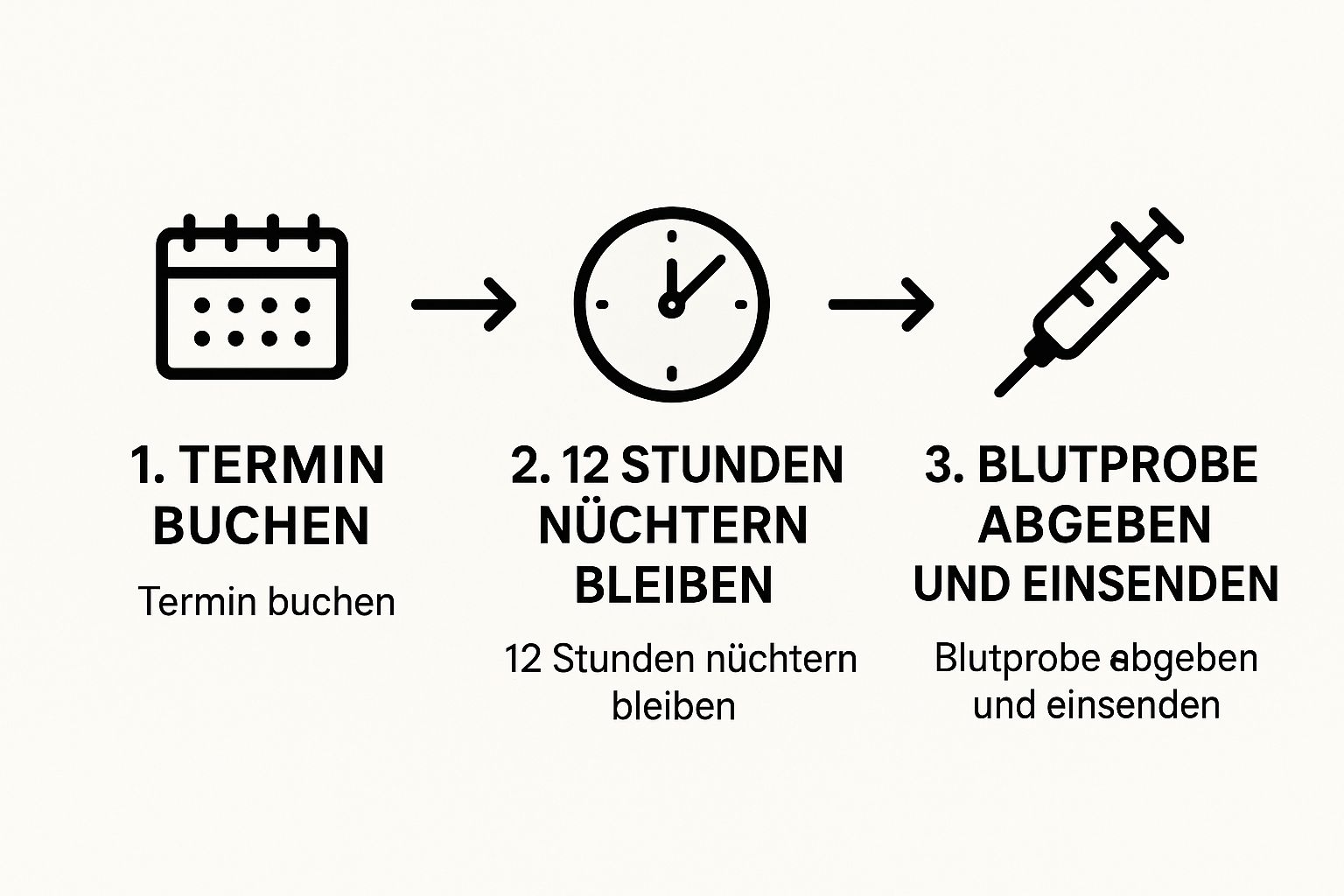
This overview summarizes the most important steps and shows how clearly structured and simple the path to your results is.
The path to the lab and your result
Once the sample is in the tube, pack everything securely in the provided, prepaid return envelope. You can simply drop it off at your nearest post office or in a mailbox. Shipping to our certified partner laboratory in Germany is completely free for you.
Once your sample arrives, it will be analyzed by experts using state-of-the-art methods. As soon as this is complete – which usually only takes a few days – you will receive a notification from us. Your personal results report will then be securely available in your mybody-x customer account.
We deliberately designed the process to give you maximum control with minimal effort. Instead of waiting forever for a doctor's appointment, you can easily integrate the most important part of having your hormone levels tested into your daily routine.
Understanding and utilizing your hormone status correctly
It's finally here: your results report from mybody-x is in front of you. Congratulations, you've already mastered the first and most important step! Now the really exciting part begins: translating all the numbers and graphs into concrete knowledge for your everyday life.
But don't worry, you don't need a medical degree to understand your results. We'll guide you through the findings step by step so you can see where things might be amiss and where everything is fine. This isn't about hard-line diagnoses, but about gaining a better understanding of trends and connections within your body.
Your personal hormone compass
Your mybody-x results report is much more than just a dry collection of data. Think of it as your personal compass, showing you exactly where you stand hormonally. Every single value is clearly presented and compared to a reference range.
This range indicates what is considered "normal" or "optimal" for a healthy person in your situation. If any of your values deviate from this range, it's a very important indication that your body might need some support in that area.
The best way to think of it is like a map:
- Values in the green zone: Everything's great! Your body is functioning perfectly. This is wonderful confirmation that your current habits in this area are absolutely right.
- Values at the edge of the range: This is a minor warning sign. Perhaps an issue you should pay a little more attention to in the near future.
- Values outside the range: This indicates a clear imbalance. This is your opportunity to take targeted action and make a positive change.
It's important to remember: your result is only a snapshot in time. It's not a final judgment on your health, but rather the perfect starting point to take action and specifically support your body.
From number to deed: What now?
The big question, of course, is: Now what? What do you do with this knowledge? Your report won't leave you in the lurch. It provides you not only with figures, but also with initial, very concrete recommendations for action. This is your personal toolkit for restoring your hormonal balance.
Let's take a practical example: Your test shows an elevated cortisol level in the evening. This could indicate chronic stress that's robbing you of sleep. A direct recommendation would then be to avoid strenuous workouts in the evening and instead establish a relaxing routine with a book or gentle stretching.
The building blocks for your hormonal balance
Our recommendations are based on scientific findings and are usually very easy to integrate into everyday life. At their core, they all revolve around three crucial pillars of your health:
- Nutrition: Perhaps you're lacking healthy fats for proper hormone production? Or important micronutrients like magnesium to calm your nervous system? Often it's the little things that make a big difference – like skipping your afternoon coffee.
- Exercise: The type and intensity of your workout has a direct link to your hormones. Gentle yoga or a walk in the fresh air can lower stress hormone levels, while targeted strength training, for example, can have a positive effect on testosterone.
- Stress management & lifestyle: How you deal with stress is absolutely crucial. Techniques like meditation, conscious breathing exercises, or simply taking regular breaks in your daily routine can work wonders. And never underestimate the power of sufficient, good-quality sleep – it's one of the strongest levers for your hormonal balance.
These tips are your starting point. If you'd like to delve deeper into the subject, you'll find lots more valuable information on how to regulate your hormone balance in our blog post.
By having your hormone levels tested , you've taken responsibility for your well-being into your own hands. Consider your results report the starting point for a journey towards more energy, inner balance, and an all-around better feeling in your body.
Hormone tests during menopause: What you should know
Menopause, also known as the climacteric, is not an illness. It is a completely natural and important phase of life that every woman experiences in her own way. However, this time of hormonal change can be quite challenging and often brings with it a whole range of physical and emotional changes – from hot flashes and sleep disturbances to mood swings.
At this stage, the desire to have one's hormone levels tested is more than understandable. Many women long for clarity and confirmation of what is actually happening in their bodies. However, this is where things get a little more complex. Therefore, it is important to realistically assess the significance of a test in this context.
Understanding the ups and downs of hormones
The main characteristic of menopause is the gradual decline in hormone production in the ovaries. However, this doesn't happen smoothly, like a slowly draining battery. Think of it more like a rollercoaster ride: hormone levels, especially estrogen and progesterone, often fluctuate unpredictably and dramatically – not just from month to month, but sometimes even from one day to the next.
A single measurement of your hormone levels is therefore only ever a snapshot in time. A value that is very low today can look completely different next week. This naturally makes it difficult to make a clear statement about the status of your menopause based solely on a single test result.
Your body's signals are often your most reliable compass during menopause. The symptoms and changes you observe tell the most honest story – much more so than a single hormone level.
When is a hormone test still useful during menopause?
Even if the symptoms are the primary concern, there are perfectly valid reasons to get tested. Professional associations also recognize a clear benefit under certain circumstances.
A hormone test is particularly worth considering if:
- If you are under 45 years old and are experiencing typical symptoms such as irregular periods or hot flashes, a test can help rule out other causes and identify a possible premature menopause.
- You are considering or have already started hormone replacement therapy (HRT) . A test can be really useful as a baseline or to check the dosage in order to optimally tailor the treatment to you.
- You simply need personal confirmation to better understand the changes. Sometimes it helps to see in black and white that your hormones are indeed in flux, in order to better accept the situation.
In Germany, approximately 9 million women are currently going through menopause. The German Menopause Society (DMG) emphasizes that routine hormone level testing is not always necessary, precisely because the significant fluctuations make interpretation so difficult. Current guidelines therefore recommend testing for women between 40 and 45 years of age only if corresponding symptoms occur. You can find more information about hormone replacement therapy recommendations at frauenaerzte-im-netz.de .
Ultimately, the decision to undergo a hormone test is a very individual one. A mybody-x test can also provide valuable insights during this phase of life, as long as you consider the results in the right context: as one piece of the puzzle in the overall picture of your well-being.
If you'd like to learn more about the basics of hormone testing for women, check out our comprehensive guide on the topic. It will help you use the results as valuable insights to take good care of yourself.
Hormone tests: What you really need to know
You've already looked into your hormone health a bit and are thinking about finally getting some clarity. Great! But often a few questions remain. That's exactly what we want to clear up here.
We've compiled the most frequently asked questions and provide you with honest, clear answers. This way, you can ultimately make a decision you're completely comfortable with.
How reliable are home saliva tests really?
This is probably one of the most important questions of all – and the answer is quite clear: Yes, saliva tests are a scientifically recognized and very reliable method. They precisely measure the hormones that are freely available to your body and are biologically active. Our partner laboratory in Germany uses state-of-the-art analytical methods for this, the same ones that are standard in medical diagnostics.
The accuracy of your result basically depends on two things:
- The quality of the laboratory: We make no compromises here and only work with ISO-certified laboratories that adhere to extremely strict quality standards.
- Your cooperation: If you follow the really simple instructions – especially regarding the right time in your cycle and taking the sample immediately after waking up – you will get a super precise picture of your hormone status.
Do I need to go to the doctor specifically for a hormone test?
Not necessarily. The great advantage of a mybody-x test is precisely that you can manage everything conveniently and discreetly from home. You order your test kit online, take the sample yourself, and receive your results digitally. This is perfect for getting a first impression of your body and taking action yourself.
However, a doctor's visit is always the right step if you are suffering from severe, clinically significant symptoms. Similarly, if you intend to use the results as a basis for medical treatment, such as hormone replacement therapy, this should be handled by a doctor. Our tests are intended for self-care and health optimization; they do not replace a medical diagnosis.
Think of the mybody-x test as a personal tool. It provides you with valuable data that you can use to have informed discussions with your doctor or therapist, in order to plan the best next steps together.
Can a test reliably determine if I am going through menopause?
A crucial point that often leads to misunderstandings: a single hormone test is not suitable for reliably diagnosing menopause. Why? Because hormone levels fluctuate dramatically during this phase of life. A measurement taken today could show low values that are completely different a week later.
A study on the effectiveness of hormone level tests in Germany has confirmed exactly that. Experts even advise against measuring sex hormones like FSH, estrogen, or LH to predict the onset of menopause. The diagnosis should primarily be based on your symptoms, such as an irregular cycle. You can read more about the study results at test.de.
How much does it actually cost to have your hormone levels tested?
The costs can vary considerably. If you pay for the test yourself at a doctor's office, you can easily end up paying between €60 and over €200 , often with additional consultation fees. Public health insurance companies usually only cover the costs if there is a clear medical suspicion.
With mybody-x, you know exactly what to expect from the start. The price of your test kit covers everything:
- The complete set for sample collection.
- Free shipping to and from the lab.
- Professional analysis by our German partner laboratory.
- A clearly presented results report with initial concrete recommendations for action.
Do contraceptives like the pill distort the result?
Yes, absolutely. Hormonal contraceptives – whether the pill, ring, or IUD – specifically interfere with your natural hormonal balance and essentially shut it down. Under these circumstances, a test wouldn't measure your body's own hormone production, but rather the influence of the introduced synthetic hormones. Therefore, the result would be meaningless.
If you want to have your hormone levels tested , you should ideally have stopped using hormonal contraceptives several months ago. As a general rule, it takes the body about 3 to 6 months for the natural cycle to regulate itself again.
You can find even more answers to your questions in our detailed blog post on hormone testing . We want you to feel confident and well-informed on your journey.


Share:
What is estrogen and how does it work in your body?
Address estrogen deficiency and restore your balance