

What is cortisol, and how does it control your body?
Many people know cortisol only as the “stress hormone.” But that description falls far short of doing it justice. In reality, cortisol is something like your body’s invisible manager—a multitasker that orchestrates your energy balance, inflammatory responses, and even your sleep-wake rhythm.
Think of it as a conductor who ensures that everything in the grand orchestra of your body works together smoothly.
Understanding cortisol as your body’s manager

When you wake up in the morning feeling full of energy, you owe much of that to cortisol. This vital hormone is produced in the adrenal glands, two small glands that sit like caps on your kidneys.
But what exactly does cortisol do? Instead of dismissing it as merely a stress messenger, think of it as your personal energy manager. It mobilizes the resources you need to meet the challenges of the day. So cortisol is not inherently bad—in fact, it is indispensable in the right balance.
Your body’s natural rhythm
Your cortisol level follows a clear daily rhythm known as the circadian rhythm. This internal timekeeper ensures that your body stays in sync with the natural day-night cycle.
- The morning energy boost: Shortly after waking up, your cortisol level shoots up. This increase, also called the “Cortisol Awakening Response,” is like the starting signal for the day. It makes you awake, alert, and capable.
- Gradual decline throughout the day: Over the course of the day, the level slowly falls again. This helps you unwind in the evening and prepare for sleep.
- Low point at night: While you sleep, your cortisol level reaches its lowest point. This is essential for your body to regenerate and recover.
This finely tuned system is the foundation of your well-being. A balanced cortisol rhythm means more energy during the day, better sleep at night, and more robust health. When this rhythm gets out of sync, you often feel the effects immediately.
An overview of cortisol’s most important functions
To give you a quick overview, we have summarized cortisol’s core functions in this table. You’ll see how versatile this hormone really is.
| Area of function | Effects of cortisol |
|---|---|
| Energy metabolism | Mobilizes energy reserves (glucose, fats, proteins) for rapid availability. |
| Stress response | Raises blood sugar and blood pressure to prepare the body for “fight or flight.” |
| Anti-inflammatory action | Has a strong anti-inflammatory effect and suppresses immune system activity. |
| Sleep-wake cycle | Controls the circadian rhythm, ensuring alertness in the morning and relaxation in the evening. |
| Blood pressure regulation | Helps maintain stable blood pressure. |
These functions show why a balanced cortisol level is so important. It is the key to ensuring that your body functions optimally both during stressful periods and at rest.
Its release is controlled by the brain and occurs in several bursts throughout the day. In Germany, morning blood serum levels are typically between 165 and 690 nmol/l, illustrating the natural range of variation. You can find more information about the complex regulation of cortisol on Wikipedia.
Understanding this natural cycle is the first step toward interpreting your body's signals more effectively. With a simple at-home hormone test from mybody-x that measures your daily pattern, you can gain clear insight into your personal hormone balance.
The two faces of cortisol for your health

Cortisol is absolutely essential for our survival. But, as with so many things in life, the dose makes the poison. An optimal cortisol level is your strong ally in everyday life. However, a chronically elevated or excessively low level can have far-reaching and rather unpleasant consequences for your health.
Think of it like an internal scale. When it is balanced, you feel energized, focused, and resilient. But if it tips to one side, your entire system gets out of balance.
Your ally at optimal levels
When your cortisol level is within the healthy range and follows its natural daily rhythm, it can exert its full positive effect. It is then not a messenger of stress, but an intelligent regulator that protects you and helps you perform at your best.
A balanced cortisol level supports you in many ways:
- Intelligent immune regulation: Cortisol keeps your immune system in check and prevents it from overreacting—for example, in the case of allergies.
- Effective anti-inflammatory action: It is one of the body's most powerful anti-inflammatory agents and helps effectively control inflammatory processes.
- Stable energy supply: Your body receives exactly the right amount of energy at the right time, especially in the morning, to help you start the day well.
- Focus and concentration: A healthy cortisol level helps you stay alert and attentive when it matters.
In the right amount, cortisol is your friend. It is the hormone that helps you cope with the demands of everyday life without causing harm to your body.
Your adversary in chronic imbalance
But what happens when this sensitive system falls out of balance? Chronic stress, poor sleep, or an unbalanced diet can cause your body to produce consistently too much cortisol—or, in some cases, too little.
This imbalance rarely remains without consequences. Your body sends you clear warning signals that you should take seriously.
Chronically elevated cortisol levels are often associated with these symptoms:
- Sleep problems: You simply cannot wind down in the evening, often wake up during the night, or feel as though you have been run over when you wake up in the morning.
- Weight gain, especially around the abdomen: Stubborn belly fat that refuses to disappear despite exercise and a healthy diet can be a sign of too much cortisol.
- Constant exhaustion: Although you are actually “running on overdrive,” you feel permanently tired and drained.
- Cravings for sweets and salty foods: Your body is seeking quick energy, which often leads to unhealthy eating habits.
- Weakened immune system: You are more susceptible to infections and get sick more often because excess cortisol suppresses your immune defenses.
Women in particular often react very sensitively to hormonal fluctuations. If you would like to learn more, read our detailed article about the typical symptoms of high cortisol levels in women.
These symptoms are not imaginary—they are your body’s way of communicating. It is trying to tell you that something is wrong. Balanced cortisol levels are the foundation of your long-term well-being—and understanding this hormone’s two faces helps you interpret your body’s signals correctly.
How chronic stress throws your cortisol levels out of balance

In our modern, often hectic world, stress seems to be a constant companion. An important meeting, an impending deadline, or an argument in the family—short-term stress is normal and even useful. It makes you focused and capable. But what happens in your body when these brief stress spikes become a permanent state?
When your body is permanently stuck in “fight-or-flight” mode, your finely tuned hormonal system falls out of balance. The result is persistently elevated cortisol levels, which can have far-reaching consequences for your health.
The chronically activated stress axis
Imagine your stress response as a fire alarm. In a genuine emergency, it is vital for survival. But what happens if the alarm never goes off? That is exactly what happens with chronic stress.
Your body responds to sustained pressure—whether from a heavy workload, emotional worries, or constant availability—by continuously releasing cortisol. The system responsible for this is called the hypothalamic-pituitary-adrenal axis, or HPA axis for short. Under chronic stress, this axis remains permanently active.
Chronic stress forces your adrenal glands to produce cortisol continuously. It is as if you were constantly pressing your car’s accelerator all the way down—eventually, the engine overheats and the components wear out.
At first, your body tries to keep up with the high demands. But over time, this strain leads to system exhaustion, seriously disrupting your hormonal balance. This is not just about feeling “stressed,” but about measurable physiological changes in your body.
From exhaustion to serious illnesses
Chronically elevated cortisol levels are far more than just a feeling of restlessness. They actively interfere with numerous bodily functions and can significantly increase the risk of a wide range of health problems.
The most common consequences of persistently high cortisol levels include:
- Weakened immune system: Cortisol is actually anti-inflammatory, but a constant excess suppresses your immune defenses. The result: You become more susceptible to infections and colds.
- Cardiovascular problems: High cortisol levels can raise blood pressure and blood sugar, increasing the long-term risk of heart disease.
- Mental health strain: The connection between cortisol and mental health is close. Persistently high levels have been linked to depressed moods, anxiety, and ultimately burnout.
- Metabolic disorders: Cortisol promotes the storage of abdominal fat and can trigger cravings. This makes weight control a real challenge.
These symptoms show that stress management is not a luxury but a biological necessity. High workloads and life crises make chronic stress one of the main causes of disrupted cortisol regulation in Germany. Studies suggest that around 20–30% of the German population develop stress-related health problems over the course of their lives, which are closely linked to this hormonal imbalance.
Understanding your genetic stress profile
Interestingly, not everyone reacts to stress in the same way. How well you cope with pressure and how your body regulates cortisol are also influenced by your genes. Certain genetic variants can affect how efficiently your body breaks down stress hormones.
If you would like to explore this topic in greater depth, a DNA stress analysis can provide insight. This knowledge helps you understand how your genes influence your personal stress response, so you can develop more targeted strategies for managing stress and proactively protect your health.
How to correctly interpret your body’s warning signs
Your body is constantly communicating with you. When your cortisol levels are out of balance, they often send subtle but persistent signals that are easily dismissed as everyday stress or fatigue. But this is precisely where the opportunity lies: When you learn to read these signs correctly, you actively take control of your health.
Do you often feel exhausted in the morning despite getting enough sleep and can barely get out of bed? Or do you catch yourself suddenly craving extremely salty or sweet snacks uncontrollably? These are not simply passing moods. They are often biochemical cries for help from your body.
What your body is trying to tell you
An imbalance in cortisol levels can develop in two directions: Either your levels are chronically too high (hypercortisolism), or they are persistently too low (hypocortisolism). Both conditions have their own distinct symptoms, some of which may even be complete opposites.
A chronically high cortisol level is usually the result of ongoing stress. Your body remains in a permanent state of alert, which you may notice through a whole range of changes.
Typical signs include:
- Stubborn belly fat: You watch your diet and exercise, but the fat around your midsection simply will not go away. Cortisol promotes the storage of visceral fat, which accumulates around the internal organs.
- Sleep problems: In the evening, you lie awake, your mind is racing, and you simply cannot switch off. This is a clear sign that your cortisol levels are not settling down as they should.
- Inner restlessness and irritability: You feel constantly “wired,” are nervous, and even minor things make you lose your temper.
- Skin problems: Excess cortisol can make the skin thinner, which can lead to acne or slower wound healing.
Viewed individually, these symptoms may seem harmless. Taken together, however, they are often a clear sign that your stress axis is overloaded.
Signs of a cortisol imbalance compared
To better understand the differences, we have placed the typical symptoms of excessively high and low cortisol levels side by side. This table can provide you with an initial guide.
| Symptoms of high cortisol (hypercortisolism) | Symptoms of low cortisol (hypocortisolism) |
|---|---|
| Unexplained weight gain, especially around the abdomen | Unexplained weight loss |
| Sleep disturbances, difficulty falling asleep | Extreme, chronic fatigue |
| Constant nervousness, anxiety, and irritability | Low stress tolerance, feeling overwhelmed |
| High blood pressure | Low blood pressure, dizziness when standing up |
| Cravings for sweet and fatty foods | Strong cravings for salty foods |
| Skin problems such as acne or thin skin | Darkening of the skin (hyperpigmentation) |
| Weakened immune system, frequent infections | Muscle weakness and joint pain |
This comparison makes it clear how contradictory your body's signals can be. That's why it's so important to listen carefully and not simply guess.
When your energy suddenly disappears
On the other side of the spectrum is low cortisol. If the adrenal glands have been overworked for a long time, they can essentially “burn out” and no longer produce enough cortisol. The result often feels like total, inexplicable exhaustion.
Here, the warning signs are often exactly the opposite:
- Chronic fatigue: You feel deeply exhausted throughout the day, no matter how much you sleep.
- Low stress tolerance: Even the smallest challenges feel like an insurmountable mountain.
- Low blood pressure and dizziness: Especially when you stand up quickly, your vision goes black.
- Craving salty foods: Your body is trying to rebalance its mineral levels, which have been disrupted by the cortisol deficiency.
Since many of these symptoms are nonspecific and can also indicate other problems, it is crucial to gain clarity. If you generally want to learn more about what blood values reveal about your health, you will find useful information in our guide about the cost and scope of a complete blood count.
The following infographic illustrates how effective even simple lifestyle changes can be in lowering cortisol levels.
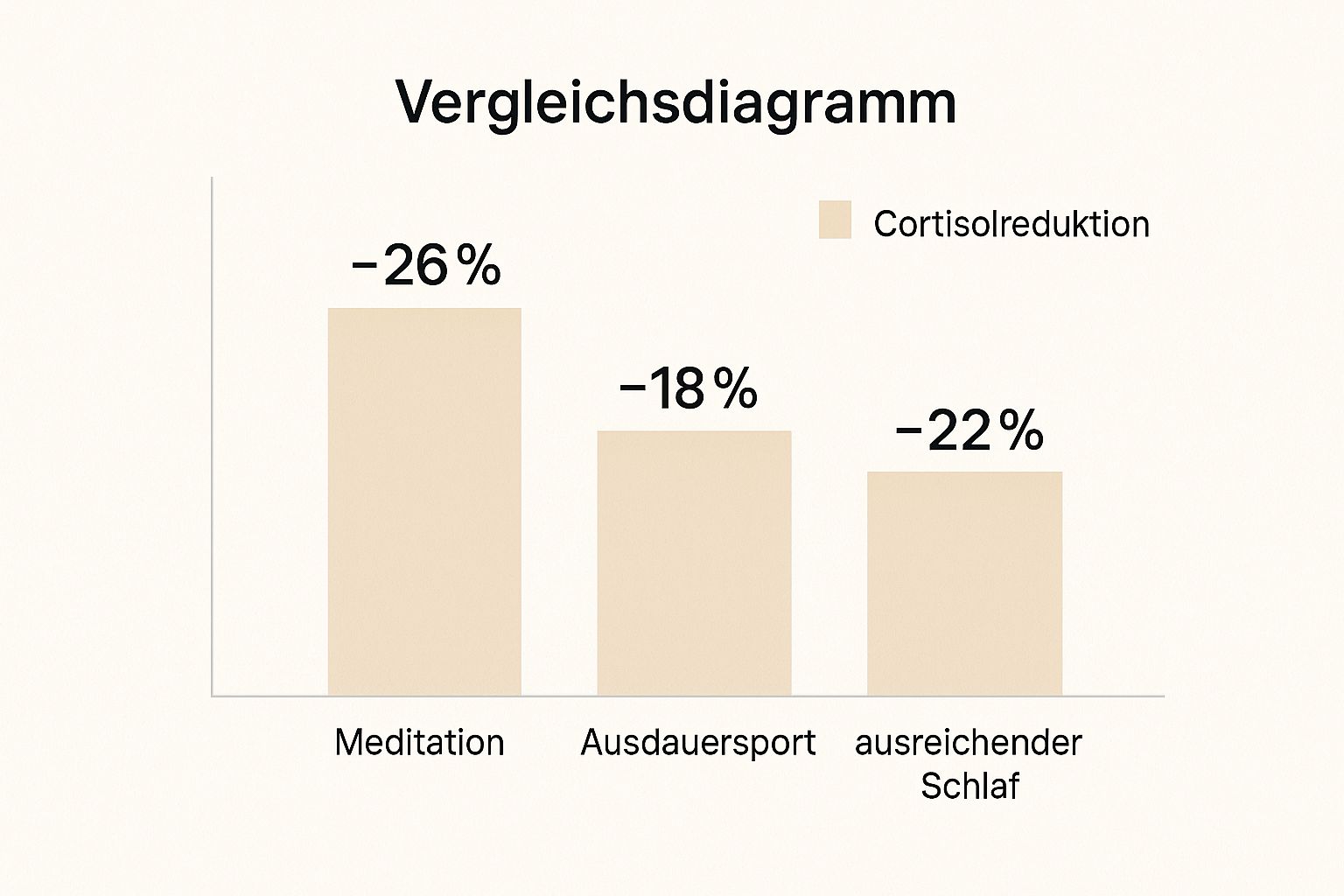
As you can see, even small but consistently implemented habits such as meditation, exercise, and, above all, good sleep can have an enormous impact. They directly help you bring your cortisol levels back into balance.
Reliably measure your cortisol level at home
You can feel your body’s warning signs and suspect that your cortisol level is out of balance. The search often begins online, but half-truths and conflicting advice usually create more confusion than clarity. This is exactly where a reliable, data-based measurement is the crucial next step—to finally move from guessing to taking action.
Instead of feeling your way in the dark, you need valid data about your body. Only then can you make truly informed decisions about your health and regain control.
Why a single measurement is not enough
Your cortisol level is not a fixed number but, as you already know, follows a dynamic daily rhythm. A single blood draw at the doctor’s office therefore provides only a snapshot. It shows you the level at one specific point in time, but not how your cortisol changes throughout the day—and that pattern is what matters.
Imagine you want to analyze rush-hour traffic in a major city but only look at the road at three in the morning. You would wrongly conclude that the roads are always clear. It is the same with your cortisol: to see the full picture, you need measurements at key times of the day.
The daily cortisol profile: the gold standard for home testing
This is exactly where the mybody-x Cortisol Hormone Test comes in. It is a simple saliva test that allows you to create a meaningful daily cortisol profile conveniently and painlessly from home. The key advantage lies in the method:
- It measures free, active cortisol: Unlike a blood test, the saliva test measures bioavailable, or “free,” cortisol. This is precisely the portion of the hormone that can actually bind to and act on your cells—and is therefore relevant to your well-being.
- Several samples throughout the day: You collect a small saliva sample at different times—typically in the morning, at midday, and in the evening. This makes the natural rhythm of your cortisol curve visible.
- Simple and straightforward to carry out: No needles and no waiting at a medical practice. Collect the samples discreetly whenever and wherever works best for you, then simply send them to the laboratory.
With a daily profile, you get a truly meaningful analysis of your individual stress hormone rhythm. You can see in black and white whether your cortisol level is high enough in the morning to get you started for the day and drops sufficiently in the evening so that you can unwind and sleep.
Many trends promising a quick fix are circulating online. However, medical experts are increasingly warning about misleading offers and so-called “cortisol detoxes.” Many of these online tests do not provide valid results because they completely ignore important factors such as the correct timing of sample collection. Learn more about medical warnings about dubious online trends on aerztezeitung.de.
From sample to clear results
The process couldn’t be simpler. After collecting your sample, you send your test kit to our certified specialist laboratory in Germany. There, your samples are analyzed precisely, and you receive an easy-to-understand results report. It not only shows you your levels but also explains what they mean for you and your everyday life. This finally gives you the clarity you need to take targeted action.
If you’d like to delve even deeper into the subject and learn how to measure your cortisol levels correctly, you’ll find a related article on our blog. After all, knowledge is the first and most important step toward balanced hormone levels and greater well-being.
The most frequently asked questions about cortisol
We’ve now taken a deep dive into the world of cortisol—from your body’s behind-the-scenes manager to the loud alarm signals that an imbalance can trigger. To wrap things up, we want to answer a few questions we receive time and again. Here are the answers, short and to the point, so you can feel confident and well informed.
Can I control my cortisol levels through my diet?
Yes, absolutely! What you eat is an incredibly powerful lever for directly influencing your hormones. A balanced diet rich in complex carbohydrates (such as whole grains), high-quality proteins, and healthy fats stabilizes your blood sugar. And stable blood sugar means fewer unnecessary stress responses from your body—and therefore less cortisol release.
Foods rich in magnesium are especially helpful, such as nuts, seeds, and leafy green vegetables, because magnesium acts like a balm for your nervous system. On the other hand, large amounts of sugar, caffeine, and highly processed foods can send your cortisol levels skyrocketing for no reason. So it’s not about deprivation, but about consciously nourishing your body instead of putting it under additional stress.
See every meal as an opportunity to actively support your body in managing stress. Every good choice of nutrient-rich foods is a small but important step toward hormonal balance.
What is the difference between a blood test and a saliva test?
This is an important point that often causes confusion. A conventional blood test at the doctor’s office measures the total cortisol in your bloodstream. However, this also includes the large proportion of cortisol that is bound to proteins and therefore inactive. Your cells cannot use this portion at all.
A saliva test, such as the one offered by mybody-x, has a clear advantage here: It measures only free, bioavailable cortisol. This is precisely the portion that is actually active and produces an effect in your body – in other words, the part that truly matters for your well-being.
The biggest advantage, however, is that you can easily and painlessly collect several samples throughout the day. This creates an informative daily profile that shows the important daily fluctuations of your hormone. A single blood sample cannot capture this dynamic rhythm and provides only a snapshot, which can quickly lead to false conclusions.
How long does it take to lower high cortisol levels?
There is no one-size-fits-all answer to this question, because the answer is as individual as you are. Above all, it takes two things: patience and consistency. Unfortunately, there is no magic pill that can fix everything overnight. Rather, it is a process that requires lasting changes to your lifestyle.
If you consistently work on the three major pillars – stress management, nutrition, and sleep – you will often notice the first positive changes after just a few weeks. Perhaps you will feel more energetic in the morning or find it easier to unwind in the evening.
However, if your levels are significantly elevated or an imbalance has persisted for some time, it may take several months for your hormone balance to settle again. The key to success here is not perfection, but consistency. Regular testing can help you objectively track your progress and stay motivated when you see in black and white that your efforts are paying off. It’s a marathon, not a sprint.
Take charge of your health. With the hormone tests from mybody-x, you gain precise insights into your body and clear recommendations for action to specifically improve your well-being. Discover the possibilities now at https://mybody-x.com.



Share now:
Foods with Histamine: The Complete Guide to Your Well-Being
Recognize the symptoms of lactose intolerance with confidence