
Vitamin D Deficiency: Causes, Symptoms & Simple At-Home Test
You may know the feeling. It is winter, you are constantly tired and somehow lacking motivation, and even though you get enough sleep, you do not feel properly recharged. Maybe your muscles ache a little, maybe you catch colds more often, or maybe you simply notice that your body is not keeping up the way you are used to.
A thought quickly comes to mind: Could it be vitamin D? This is exactly where things often become confusing. Many articles simply list a long range of possible symptoms. A much more helpful question is: Who should actually get tested, and how do you interpret the result correctly afterward?
That is what this article is about. You will learn why vitamin D is important for your body, what causes may be behind vitamin D deficiency, when testing makes sense, and how to interpret your lab value so that you can truly apply it to your everyday life.
The sunshine vitamin and why it is so important for you
Vitamin D is often simply called the sunshine vitamin. That is true, but it makes it sound more harmless than it is. Vitamin D is not just another nutrient among many. It plays a central role in how your body regulates calcium and phosphate. That is important for strong bones and healthy mineralization.
If your vitamin D status is too low, you may not always notice it clearly right away. That is one reason why the issue is so often underestimated. Many people think of vitamin D only in connection with bones. In fact, having adequate levels is often also linked to how resilient you feel in everyday life, whether your muscles function well, and whether you generally feel that your body is functioning steadily.
Why deficiency develops so easily today
The problem is not just the season. Everyday life also plays a role. If you spend a lot of time sitting in an office, commuting, training indoors, or generally avoiding sunlight during the brighter months, your skin often produces less vitamin D than your body could really use.
There is also the fact that diet alone is usually not a reliable safety net. If you would like to know which foods can contribute at all, you can find a good overview at Vitamin D in Foods.
Vitamin D is not just a winter issue. Winter often only makes an existing problem more visible.
Why clarity is more important than guessing
This is where a common mistake occurs. Many people try some supplement on a hunch without knowing whether a deficiency is actually present, how severe it is, or which target range is relevant for them.
It makes more sense to first understand your own body in a measurable way. A blood value removes much of the uncertainty surrounding the issue. Instead of relying on vague signals, you get a concrete basis for deciding on the next steps.
Common symptoms and risk groups for deficiency
Vitamin D deficiency is tricky because it often does not produce a single clear warning sign. Many symptoms are nonspecific. That is precisely why people may overlook it for a long time or attribute everything to stress, lack of sleep, or the darker season.

Typical signs that many people do not immediately recognize
Symptoms that may point to vitamin D status include, for example:
-
Persistent fatigue
You get enough sleep but still do not feel rested. -
Muscle weakness or diffuse muscle pain
Climbing stairs, exercising, or walking for longer periods feels more difficult than usual. -
Bone pain or a general aching sensation in the musculoskeletal system
Especially if you feel that your body is unusually sensitive. -
Repeated fractures or noticeable bone problems
That is when the issue becomes particularly relevant medically. -
Unexplained low moods
Not every difficult phase is related to vitamin D. But if exhaustion persists, it is worth taking a closer look.
If you recognize yourself in several of these points, it may be worth taking a closer look. You can also find a useful overview of the topic in Vitamin D deficiency.
How common is this in Germany
The issue does not affect just a few isolated cases. Vitamin D deficiency is widespread in Germany. According to the Robert Koch Institute’s DEGS1 study, 71.9% of adults had levels below 50 nmol/L, including 25.9% below 30 nmol/L. Among 18- to 29-year-olds, the prevalence below 30 nmol/L was 18.3%, compared with 31.4% among 60- to 79-year-olds. These figures are summarized in the review article in Frontiers in Nutrition on vitamin D status in Germany.
The older a person is, the more often a significant deficiency becomes apparent. This makes personal assessment more important than a general gut feeling.
Who Should Take a Closer Look
Not everyone automatically needs a test. But certain circumstances make it significantly more worthwhile.
-
People with little sun exposure
If you work indoors a lot or rarely spend time outside, the body’s own production can decrease significantly. -
Older adults
This is particularly evident in the more frequent occurrence of low vitamin D status in Germany. -
People with darker skin
Vitamin D synthesis through the skin may be reduced. -
People who largely cover their skin
Religious, cultural, or practical reasons may mean that little UVB reaches the skin. -
People with unclear symptoms plus risk factors
Then a vague suspicion can quickly become a sensible testing question.
If you take a longer-term view of health and individual differences, the Longevity | ALL IN ONE DNA Test may also be of interest. It analyzes genetic risk factors related to aging, inflammation, nutrient utilization, and metabolism. It does not replace a vitamin D blood test, but it can broaden your perspective on your personal health profile.
The Main Causes of Empty Vitamin D Stores
Many people first think of diet. That is understandable, but when it comes to vitamin D, the focus lies elsewhere. The most important source is not food, but production in the skin through sunlight.

The Sun Is the Main Factor
You can think of it as the body’s own production facility. The skin is the factory, and UVB light is the start button. If this button is not pressed often enough, production is limited.
This is particularly important at our latitudes. The body’s own vitamin D synthesis through the skin is the most important source, but during the winter months, the sun’s angle of incidence at our latitudes is not sufficient for any significant production. A deficiency can lead to secondary hyperparathyroidism, which further weakens bone mineralization and increases the risk of osteoporosis. This is described by the Linus Pauling Institute in its overview of vitamin D.
What additionally slows it down in everyday life
Even in summer, sufficient sunlight is not automatically guaranteed. Several factors can reduce the body's own production:
-
A lot of time indoors
Office, working from home, car, gym, evening routine. Many modern days are spent almost entirely indoors. -
Consistent skin coverage
Less exposed skin means less surface area for production. -
Older age
The skin produces vitamin D less efficiently. -
Darker skin
More melanin changes the conditions for synthesis.
Even if two people lead equally healthy lifestyles, their vitamin D status can still differ. Skin type, age, daily routine, and season make a real difference.
Diet and absorption also play a role
Diet is more of a secondary factor, but it is not unimportant. Only a few foods contain significant amounts. Therefore, food alone is often not enough to maintain stable levels.
Absorption in the body can also be impaired. This affects, for example, people with malabsorption or certain intestinal diseases. Some medications or health conditions can also affect vitamin D levels.
Anyone who generally wants to understand how their body processes food and energy can also take a look at the DNA metabolic analysis. It shows genetically determined metabolic types, fat and carbohydrate utilization, and individual weight-related risks. This is not a vitamin D test, but it can be helpful if you want to personalize your diet more broadly.
Test for vitamin D deficiency and finally get clarity
If you have symptoms or belong to a risk group, worrying usually will not get you anywhere. The key question then is not whether vitamin D is theoretically important, but whether your level is actually too low.
The most reliable basis for this is a blood test. The key measurement is the 25(OH)D level, or serum 25-hydroxyvitamin D. This value best indicates vitamin D stores and is the clinical standard.

Who may benefit from testing
In Germany, there is no general recommendation for routine vitamin D screening in people without symptoms. At the same time, a deficiency often goes undetected because the symptoms are nonspecific. Especially when a deficiency is suspected or risk factors are present, targeted testing is key to better assessing individual needs and the appropriate target level. This is how Yale Medicine describes vitamin D deficiency in its overview.
This is important because many people are caught between two extremes. Some never get tested even though they have symptoms. Others take supplements blindly without knowing whether their level is actually low.
What is often confused in diagnostics
A common stumbling block is the laboratory terminology. The active form, 1,25(OH)2D, is not measured; instead, 25(OH)D is measured. The reason is simple: This form better reflects vitamin D status.
A test is particularly useful if one or more of these points apply to you:
- You have symptoms that could be consistent with a deficiency.
- You belong to a risk group, for example because of your age, limited sun exposure, or malabsorption.
- You do not want to start taking supplements blindly.
- You want to check your level after making a change, rather than relying on how you feel.
Only the measurement separates assumptions from clarity.
What a home test can look like in practice
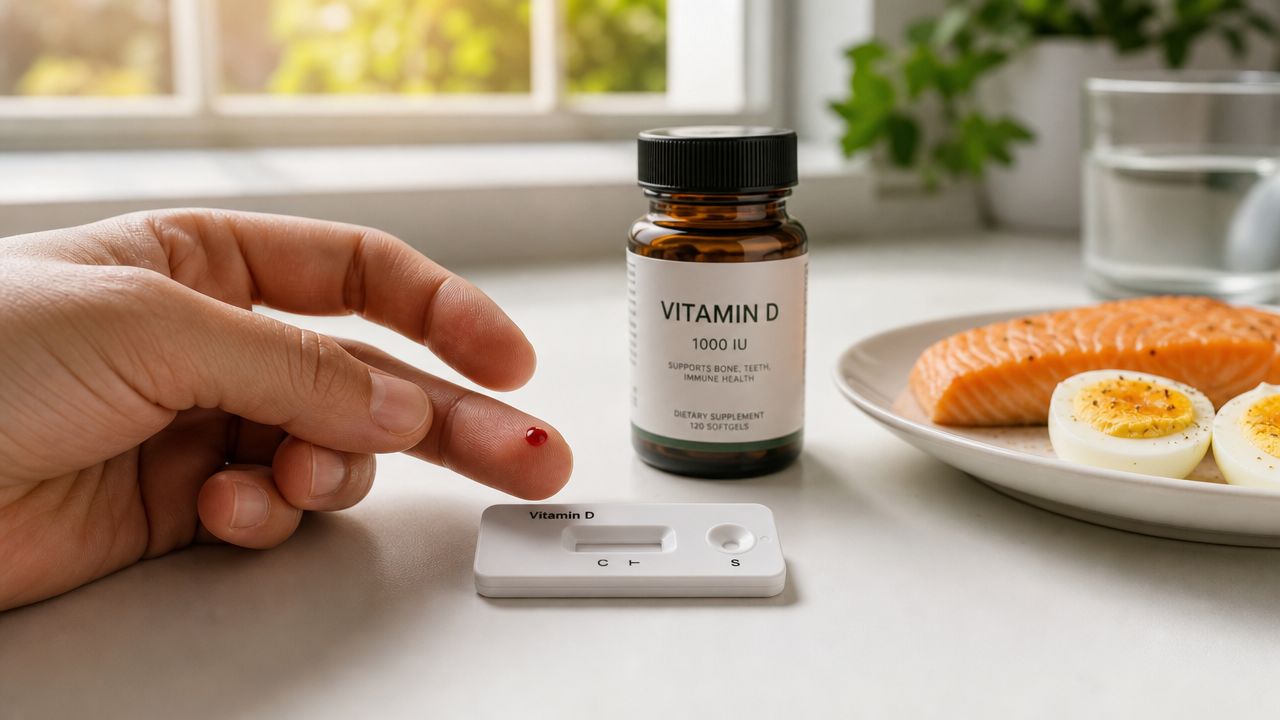
If you do not want to arrange a direct doctor’s appointment, a home test can be a practical option. The mybody®x at-home vitamin D test describes the process, which involves taking a small blood sample from your fingertip, sending it to the laboratory, and receiving the results digitally.
For many people, this is the crucial point. You do not have to wait until symptoms become more pronounced. You can systematically check your status and then take targeted action instead of working your way through contradictory advice on the internet.
Understand your lab results and take targeted action
The test is only half the story. The other half is reading the results correctly. This is where confusion often arises, because different sources use different thresholds and refer to values sometimes in nmol/L and sometimes in ng/mL.
The most important guideline is this: A serum level of below 50 nmol/L (20 ng/mL) is considered insufficient. Levels below 30 nmol/L (12 ng/mL) indicate a clinically significant deficiency associated with an increased risk of bone diseases such as osteomalacia. The 25(OH)D level is measured because it best reflects vitamin D stores. This is clearly described in the specialist article on vitamin D deficiency and diagnostics on PubMed Central.
Understanding the debate over 20 and 30 ng/mL
This is a common misunderstanding. Some people say that a deficiency is present below 20 ng/mL. Others cite 30 ng/mL as the target. This is not simply a contradiction; it is often a question of definition and context.
For practical assessment, you should therefore first distinguish between:
- clearly insufficient
- clinically deficient
- individually appropriate target range
If your level is low, it is not just about a label such as “okay” or “not okay.” It is about how pronounced the deficiency is, whether you have symptoms, and whether additional risk factors are present.
How to read your result
| Status | Value (nmol/L) | Value (ng/mL) | Meaning |
|---|---|---|---|
| Clinically significant deficiency | below 30 | below 12 | Increased risk of bone diseases such as osteomalacia. Medical assessment is particularly important. |
| Insufficient supply | below 50 | below 20 | The level is considered insufficient. It should be assessed together with symptoms and risk factors. |
| Assessment depends on the context | from 50 | from 20 | From this point on, the level is often no longer considered insufficient. The target range that is right for you depends on the overall picture. |
If you are unsure how your lab report displays the values, the article on Vitamin D 3 25 OH D 3 can also help, as it explains the measurement in practical terms.
What you can do after receiving the result
Blindly taking high doses of supplements is not a good idea. A needs-based approach makes more sense. This includes:
-
Take the result seriously
Not every low value is an emergency. But a clear deficiency should not be ignored either. -
Consider your symptoms
A lab result without symptoms should be assessed differently from a low value accompanied by muscle weakness, bone pain, or recurring fractures. -
Choose the right form
If it has been confirmed that you have a deficiency, a product such as Vitamin D3 K2 Complex | Shield may be worth considering. According to the catalog, it combines high-dose D3 with K2 to support calcium utilization, bone health, and the immune system. However, the key point is always that supplementation matches your measured needs. -
Don’t focus only on the numbers
Symptoms, the season, lifestyle, and possible underlying conditions should all be included in the assessment.
Practical rule: A vitamin D level is not a school report. It is a measurement point that helps you plan the next steps sensibly.
What does I U actually mean
Dietary supplements often list I.U., meaning International Units. This is simply a commonly used unit for vitamin D. In everyday life, it matters less which unit appears on the package than whether the dosage matches your measured level and your situation.
Everyday prevention and when medical advice is needed
If you want to prevent vitamin D deficiency, it’s not about perfection. It’s about recognizing the typical obstacles in everyday life and consciously keeping an eye on your vitamin D intake.
What can make sense in everyday life
A few simple habits can already help many people:
-
Use sunlight mindfully
During the brighter months, spending regular time outdoors can help. Naturally, without losing sight of skin health. -
View diet as a supplement
Fatty fish, eggs, and mushrooms can contribute to basic intake. However, relying on them alone is often not enough. -
Assess risk factors honestly
If you spend little time outdoors, are older, or have health-related risk factors, you shouldn’t assume that what applies to others applies to you. -
Measure rather than speculate when you have symptoms
This often saves time, uncertainty, and unnecessary trial and error.
When you need medical advice
Self-tests and taking responsibility for your health can be useful. However, they have limitations. Medical advice is especially important if you have severe bone pain, pronounced muscle weakness, recurring fractures, or suspect an underlying condition. You should also seek medical guidance if you have known intestinal problems, malabsorption, or want to take very high doses.
The most important step is often surprisingly simple: don’t guess—check. Once you know your level, a vague feeling becomes a concrete starting point. That helps you understand your body better and make decisions that truly suit you.
If you no longer want to estimate your vitamin D status but would rather measure it, a mybody x blood test may be a sensible next step. This gives you a concrete basis for better assessing symptoms, risk factors, and possible measures.



Share now:
Test for Omega-3 deficiency: Your guide to the results
Vitamin D deficiency and a large belly: what is proven and what is not