

Blood Nutrient Analysis: Easily Identify Your Deficiencies
Do you often feel tired, unfocused, or simply not at your best? Instead of groping in the dark, a nutrient analysis via blood test can finally give you clear answers. It is the key to understanding which building blocks your body is truly lacking and shows you the direct path to regaining your energy.
Why a Nutrient Analysis Can Transform Your Well-Being
Many of us are quick to blame fatigue and lack of motivation on stress or too little sleep. But the real cause often lies much deeper—in our individual nutrient supply. Imagine your body as a finely tuned orchestra: if even one instrument is missing, the entire melody falls out of rhythm.
This is exactly where a blood nutrient analysis comes in. It does not provide vague assumptions, but an accurate snapshot of your internal balance. Instead of randomly reaching for dietary supplements, you receive a clear, scientifically grounded map of your body.
From Guessing to Targeted Action
The biggest advantage? You move from uncertainty to targeted action. You find out precisely whether you are lacking iron, vitamin D, magnesium, or other important micronutrients. This insight is often the crucial first step toward a noticeably better quality of life.
A nutrient analysis is more than just a test—it is your tool for taking responsibility for your health into your own hands. You make decisions based on facts, not assumptions.
A Widespread Problem That Often Goes Unnoticed
If you have deficiencies, you are far from alone. In Germany, a startlingly large number of people have unnoticed nutrient gaps. According to the National Nutrition Survey II, for example, 82% of men and 91% of women do not meet the recommended daily intake of vitamin D. The situation is similarly dramatic for folate, with 79% of men and 86% of women showing deficiencies. You can read more about these study results on focus.de.
These figures make it clear how important it is to know your own status. Instead of waiting until clear symptoms appear, you can proactively take care of your well-being. A mybody-x nutrient test is the easiest way to do this—conveniently from home and with easy-to-understand results that help you right away. It is your personal compass to greater energy and vitality.
How a Nutrient Analysis in Your Blood Really Works
Imagine being able to look behind the scenes of your body. Not just guessing what you might be lacking, but getting clear, scientifically sound facts. That is exactly what a nutrient analysis of your blood does. The process is much simpler and more informative than most people think—a clear path from vague assumptions to targeted improvements.
You’re probably familiar with the standard blood count from your general practitioner. However, this is usually just a general overview. Although important health markers are checked, the exact concentrations of vitamins, minerals, and trace elements often remain unclear. A specialized nutrient analysis is like a magnifying glass: It examines precisely the building blocks that are crucial for your energy and well-being.
Serum or whole blood? The small but significant difference
One crucial factor determining how meaningful the results are is the type of analysis. Traditionally, only the blood serum is often examined—the liquid that remains after the blood cells have been removed. But this leaves a crucial gap: Many important nutrients do not float freely in the serum; instead, they are found directly inside the blood cells.
This applies, for example, to minerals such as magnesium and potassium, which are essential for your muscles and nerves. A serum-only analysis can give a completely inaccurate picture here and simply overlook a deficiency.
The whole-blood analysis we use at mybody-x examines your blood as a whole—both serum and blood cells. This approach provides a much more accurate and complete picture of your nutritional status because it measures nutrients exactly where they are truly active in the body.
If you want to understand the differences and the general process of a blood analysis even better, take a look at our comprehensive guide on What is a blood analysis?.
Your path to clear results with mybody-x
We have designed the entire process to be as simple and convenient as possible for you. No appointment stress, no long waits in the waiting room. With the mybody-x nutrient test, you take matters into your own hands.
The process is truly straightforward and fits into any daily routine:
- Order your test kit: Everything you need for the sample will be conveniently delivered to your home.
- Nearly painless blood collection: Use a tiny lancet to collect a few drops of blood from your fingertip. It’s quick and almost painless.
- Send in your sample: Simply place your sample in the enclosed return envelope and send it to our certified German specialist laboratory.
- Get your results: After a short time, your personal results report will be ready—clearly presented and including specific tips on what you can do.
This graphic perfectly illustrates the journey: from the first feeling of being unwell to regaining energy through a targeted blood analysis.
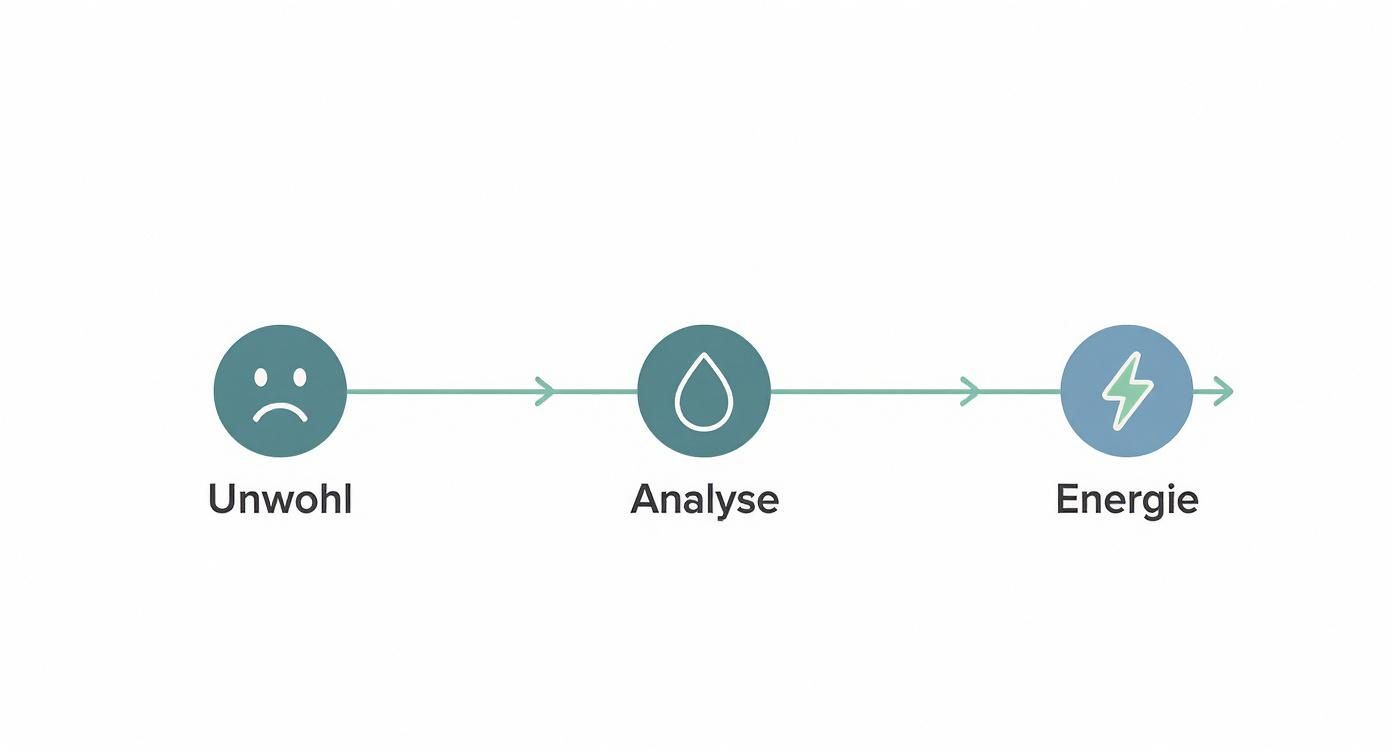
So, as you can see: Blood nutrient analysis is your direct way out of the fog of feeling unwell and toward taking targeted steps for greater vitality.
Understanding the key values in your blood analysis
A nutrient analysis provides far more than dry numbers—it offers a behind-the-scenes look at your body. When you understand which vitamins and minerals are responsible for your energy, immune system, and mood, you can finally take targeted action for your health.
Let us take a look at the most important values covered by a good blood nutrient analysis and what they specifically mean for your everyday life.
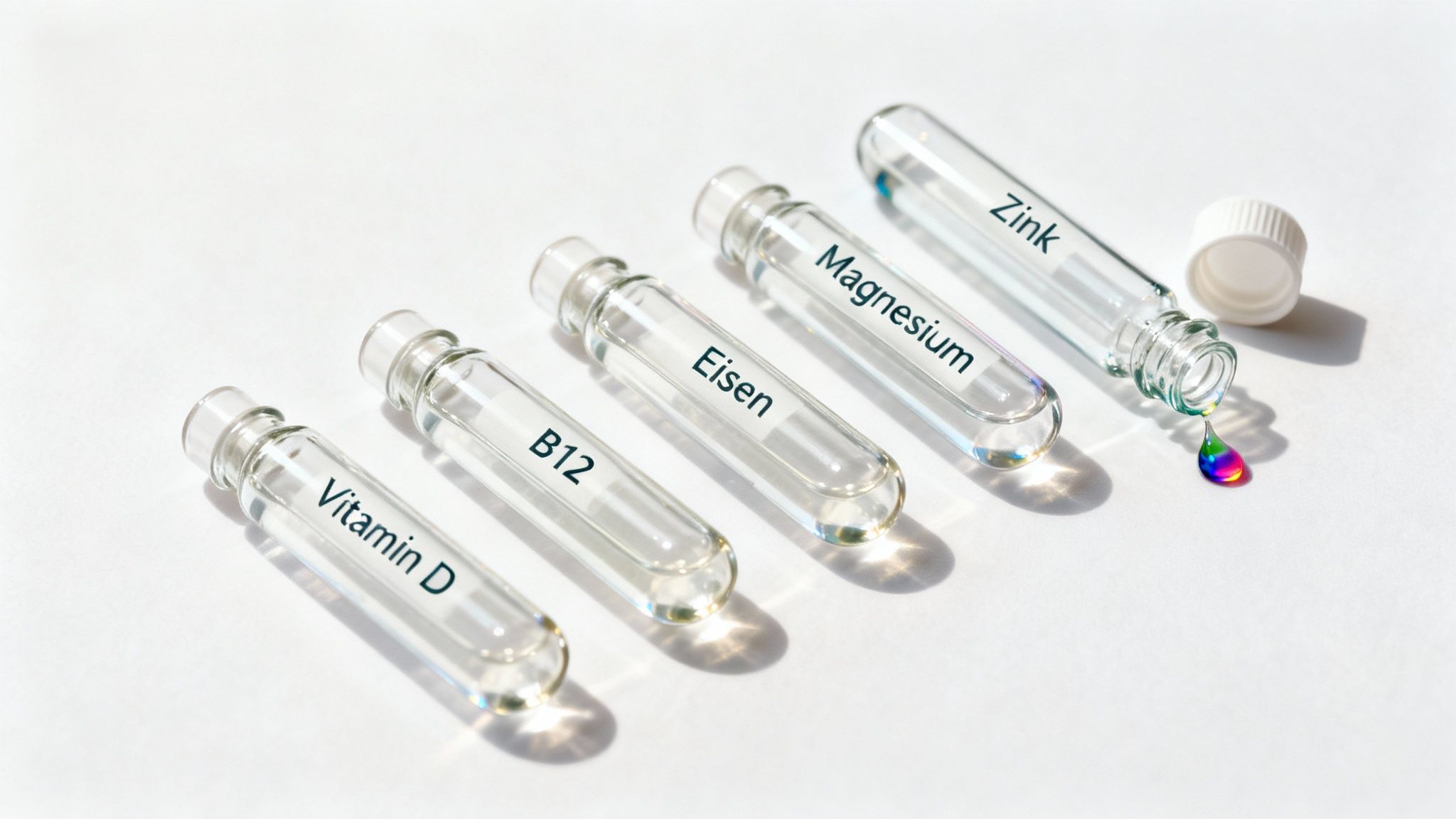
Vitamin D – The sunshine vitamin for bones and the immune system
Did you know that vitamin D is actually a hormone? It plays an absolutely key role in countless processes in your body. Its main task is to ensure that calcium is absorbed from food and firmly incorporated into your bones. Without vitamin D, our bones would be porous and unstable.
At the same time, it is a crucial regulator of your immune system and even influences your mood. A deficiency often develops unnoticed.
Typical signs include:
- Frequent infections: You feel as though you catch every wave of colds going around.
- Fatigue and low mood: Especially in winter, you often feel listless and down.
- Bone and limb pain: Sometimes the pain is diffuse, indicating an insufficient supply.
The problem: In our part of the world, especially from October to April, the sunlight simply is not strong enough for our bodies to produce sufficient vitamin D on their own. Fatty fish such as salmon can help, but the amounts are rarely enough to correct a genuine deficiency.
Vitamin B12 – The energy provider for nerves and blood
Vitamin B12 is the spark that fuels your energy. It is essential for producing red blood cells, which transport oxygen throughout your body. Think of them as little delivery vans. If you lack B12, there are too few delivery vans, and your cells do not receive enough oxygen.
At the same time, it is extremely important for the functioning of your nervous system and cell division. A deficiency can therefore make itself felt in many ways, but it is often mistaken for ordinary stress.
Watch for these symptoms:
- Persistent exhaustion: You constantly feel weighed down, even though you actually get enough sleep.
- Problems concentrating and forgetfulness: Your brain needs B12 to perform at its best.
- Tingling in the hands or feet: This can be an early warning sign of incipient nerve damage.
Since vitamin B12 is found almost exclusively in animal products, vegetarians and vegans in particular face an increased risk. Older people and those with gastrointestinal disorders may also have problems absorbing the vitamin properly.
Your body is a complex system. Every nutrient has a very specific role. If even one small building block is missing, the entire structure can become unstable—you often only notice this once you have not felt truly fit for a long time.
Iron – The oxygen transporter
Without iron, you would literally run out of breath. It is the core component of the red blood pigment hemoglobin, which carries oxygen from your lungs to every single cell in your body. A deficiency directly leads to an inadequate supply and thus to a noticeable loss of energy.
Signs of depleted iron stores:
- Pale skin and constant fatigue: These are the classic symptoms of anemia.
- Shortness of breath during exertion: You are already gasping for air when climbing the stairs.
- Brittle nails and hair loss: Your skin, hair, and nails also suffer from inadequate nutrient supply.
Women of childbearing age, athletes, and anyone who eats little meat should keep an eye on their iron levels. If you want to delve deeper into the topic, be sure to read our article about ferritin levels.
Minerals: magnesium, zinc, and selenium
Alongside vitamins, minerals are the unsung heroes of your health. They often act as small helpers (cofactors) that get countless metabolic processes started in the first place.
-
Magnesium: The ultimate “anti-stress mineral.” It is involved in more than 300 reactions in the body, relaxes the muscles, and calms the nervous system. A deficiency often manifests as muscle cramps, inner restlessness, or sleep problems.
-
Zinc: Think of zinc as the manager of your immune system. It is also essential for wound healing and healthy skin and hair. Frequent colds or skin problems may indicate a zinc deficiency.
-
Selenium: As a powerful antioxidant, it protects your cells from damage caused by free radicals. It is also essential for healthy thyroid function. Fatigue and a weakened immune system can result from a deficiency.
To give you a better overview, we have summarized the most important nutrients and their functions in a table.
| An overview of important nutrients and their functions |
| :--- | :--- | :--- |
| Nutrient | Main function in the body | Typical deficiency symptoms |
| Vitamin D | Bone health, immune system, mood | Frequent infections, fatigue, bone pain |
| Vitamin B12 | Energy production, nerve function, blood formation | Exhaustion, difficulty concentrating, tingling |
| Iron | Oxygen transport, energy supply | Pallor, fatigue, shortness of breath, hair loss |
| Magnesium | Muscle and nerve function, stress reduction | Muscle cramps, restlessness, sleep disorders |
| Zinc | Immune system, wound healing, skin and hair | Susceptibility to infections, poor skin, impaired wound healing |
| Selenium | Cell protection (antioxidant), thyroid function | Weakened immune system, fatigue |
This table clearly shows how closely well-being and a good supply of nutrients are connected.
A mybody-x nutrient test measures precisely these crucial values and gives you a clear picture of where you currently stand. This allows you to specifically correct deficiencies and take an active role in your own well-being.
Who can benefit most from a nutrient analysis
A blood nutrient analysis is no longer just for people with specific symptoms. Rather, it is a smart tool for anyone who wants to take control of their health and understand what their body really needs.
However, certain stages of life and everyday habits significantly increase the risk of nutrient deficiencies. In these cases, taking a closer look at your blood can be particularly revealing.
Do you perhaps belong to one of these groups? Then a test like the one from mybody-x could be the decisive step toward greater well-being.
For athletes and active people
Whether you are an ambitious runner, a strength athlete, or simply work out regularly at the gym—your body performs more and therefore has a higher need for certain nutrients. Every training session and every drop of sweat depletes your vitamin and mineral reserves.
This is often where things become particularly critical:
- Iron: A deficiency slows oxygen transport to your muscles. The result? Your endurance declines, and recovery after training takes forever.
- Magnesium: Essential for every muscle movement. If you lack it, bothersome cramps and a noticeable drop in performance are often the result.
- Zinc: This important trace element is lost through sweat and is also essential for a strong immune system and the body's repair processes.
A blood analysis helps you specifically replenish your stores, improve your performance, and prevent injuries.
For vegans and vegetarians
A plant-based diet is fantastic for your health, but it requires a little more attention to nutrient intake. Some vitamins and minerals are less common in plants or occur in a form that our bodies cannot absorb quite as easily.
A vegan or vegetarian diet does not automatically mean a deficiency. However, a blood nutrient analysis gives you the assurance that your diet is truly well-balanced and that you are optimally nourishing your body.
This is where a closer look is worthwhile:
- Vitamin B12: It is found almost exclusively in animal products. For vegans, it is a critical nutrient that almost always needs to be supplemented.
- Iron: Plant-based iron is absorbed less efficiently by the body than iron from animal sources. A test will show you clearly whether your intake is sufficient.
- Zinc and selenium: Here too, getting enough can sometimes be challenging with a purely plant-based diet.
For anyone who often feels tired and lacking in energy
Constant fatigue is one of the most common—and most frustrating—symptoms of all. Far too often, we blame it on stress or too little sleep, when a significant nutrient deficiency is often the real cause. Before you resign yourself to this condition, you should have the biochemical causes checked.
A deficiency in iron, vitamin B12, or vitamin D can seriously drain your energy reserves. A blood test provides clarity and shows you the most direct way to recharge your batteries.
If you would like to learn more about how closely nutrient deficiencies and exhaustion are linked, read our detailed article on Nutrient Deficiency, Fatigue, and Lack of Drive.
For women who wish to have children and during pregnancy
During this very special phase of life, the body is working at full capacity. The need for certain nutrients increases enormously—not only to support the expectant mother, but also to perfectly nourish the growing life within her. An adequate supply of folic acid, iron, and iodine is absolutely crucial for the healthy development of the child. A nutrient analysis provides a reliable foundation.
For people with chronic digestive problems
If your gut isn’t functioning properly, it can severely disrupt the absorption of nutrients from food. Even the healthiest diet is of little benefit if the valuable nutrients never reach your body in the first place. Do you suffer from irritable bowel syndrome, chronic inflammatory bowel disease, or unexplained digestive problems? Then checking your nutrient levels is particularly advisable to prevent further complications.
A mybody-x nutrient test is a simple and direct way to finally gain clarity in all these cases and specifically improve your well-being.
How to interpret your blood test results correctly
At last, the moment of truth has arrived: You are holding your report in your hands. But what do all those numbers, technical terms, and diagrams tell you? Don’t worry—we won’t leave you in the dark. In this section, we translate the lab jargon of your blood nutrient analysis into easy-to-understand information.
Your mybody-x report is deliberately designed to be simple and visual. Instead of overwhelming you with complicated technical jargon, you can see at a glance what is in the green zone and where you may need to take a closer look. The aim is not for you to self-diagnose, but to give you a solid foundation for your next steps.
What do these reference values actually mean?
In your report, you will find so-called reference values or normal ranges for each nutrient. These ranges indicate what concentration of a substance in the blood is considered normal for a healthy person. But where do these values come from in the first place?
Quite simply: The values of a huge group of healthy people are measured. The range in which the values of 95 % of these healthy test subjects fall is then established as the norm. Conversely, this also means: 5 % of healthy people naturally fall outside this range without anything being wrong with them.
Your personal optimal value does not always have to be exactly in the middle of the reference range. For some values, being in the upper third is great, while for others, being in the lower third is perfectly fine. Think of reference values as a compass, not a law set in stone.
From a single value to the bigger picture
The most common mistake when reading blood test results? Focusing on a single value that may deviate only minimally from the norm. But your body is not a modular construction kit—it is an incredibly complex system in which everything is interconnected. For example, low iron levels may be related to a vitamin C deficiency because your body needs vitamin C to absorb iron in the first place.
That is precisely why it is so important to look at the big picture. A good report, like the one from mybody-x, helps you understand these connections. It provides not only bare figures, but also clear explanations and personalized recommendations that take the interplay between your values into account. This way, you understand why a nutrient is important and how to specifically address a deficiency.
Our dietary habits in Germany have changed significantly. The DGE nutrition reports (German Nutrition Society) have shown for years that both deficiencies and an oversupply of certain nutrients are widespread. Only an individual blood nutrient analysis reveals your actual status—and gives you the tools to make a change.
How to read your mybody-x report step by step
Imagine your report as a map of your body. We’ll guide you through the most important stops:
- The overview: Here you can immediately see what’s going on. A simple traffic-light system (green, yellow, red) shows at a glance which values are in the optimal, borderline, or deficient range.
- The detailed view: Now we get to the heart of the matter. For each individual value, you’ll find a precise analysis with your exact measurement result, the reference range, and an easy-to-understand explanation of what this nutrient actually does in your body.
- Personalized recommendations: This is the centerpiece of your report. Based on your individual results, you’ll receive specific, practical tips—from dietary guidance and lifestyle adjustments to targeted recommendations for dietary supplements.
With this clear structure, you’re never alone. You don’t just receive data, but a genuine guide that enables you to put your knowledge directly into practice and actively improve your well-being.
From knowledge to action: What should you do if you have a nutrient deficiency?
Has your blood nutrient analysis revealed a deficiency? There’s no reason to worry—in fact, quite the opposite! Think of the result as your personal guide to a healthier lifestyle. Now you know exactly what your body needs to regain its balance.

Nutrition as the first medicine
The most direct and natural way to replenish your nutrient stores is through your diet. So before you reach straight for pills and powders, take a look at what you can achieve through your nutrition.
-
For iron deficiency: Consciously incorporate more lentils, chickpeas, spinach, and pumpkin seeds into your diet. Red meat is also a good source, but should be consumed in moderation. The trick: Always combine iron-rich foods with sources of vitamin C, such as bell peppers or broccoli. Vitamin C acts like a turbocharger for iron absorption!
-
For magnesium deficiency: Nuts, especially almonds, are true magnesium powerhouses. Whole-grain products, oats, and bananas can also help replenish your stores. A small piece of dark chocolate in the evening is not only delicious but also provides valuable magnesium.
-
For zinc deficiency: Eat more oats, beef, cheese, and lentils. Zinc is a key player in your immune system and wound healing—so give your body the right building blocks.
Your diet is the foundation of your health. Targeted adjustments are often the most sustainable way to correct deficiencies in the long term and strengthen your well-being from the ground up.
Using dietary supplements correctly
Sometimes changing your diet alone is not enough to quickly correct a severe deficiency. This is where high-quality dietary supplements come in. They can provide a useful bridge until your stores are replenished.
This applies particularly to nutrients such as vitamin D. In our latitudes, it is almost impossible to meet your needs through food and the limited sunlight alone.
When choosing supplements, always look for high bioavailability. This refers to how well your body can actually absorb and use the nutrient. For example, combining vitamin D with vitamin K2 improves absorption and ensures that the calcium actually ends up where it belongs: in the bones. You can learn more about how to properly correct a vitamin D deficiency in our guide.
It’s important not to start taking supplements blindly. Take targeted action based on your results. Your mybody-x report provides clear recommendations tailored to you.
Checking your progress: Did it help?
After changing your diet and adding targeted supplements if necessary, you naturally want to know whether your efforts are paying off. That’s why a follow-up test after around three to six months is so incredibly important.
It shows you in black and white whether your measures have been successful and whether your levels have improved. This completes the cycle. If necessary, you can adjust your strategy and ensure that you are on the best path toward more energy and better health. From testing and taking action to visible results—that’s how easy it is to take your health into your own hands.
Frequently asked questions about nutrient analysis
To conclude, we would like to answer a few more questions that we regularly receive about nutrient analysis in the blood. This will ensure you are well informed and can start optimizing your health with confidence.
Do I need to fast for the test?
No, you do not need to fast for the mybody-x nutrient test. You can collect your blood sample whenever it best fits into your day.
Simply continue eating and drinking as you normally do. This does not affect the key values, such as vitamins and minerals, that we measure in your cells.
How often should I have my nutrient levels checked?
That depends entirely on you and your personal situation. As a general guide, we offer you the following recommendations:
- For an initial assessment: A single test is enough to find out where you currently stand.
- If a deficiency has been identified: A follow-up test after about three to six months is advisable. This lets you see in black and white whether your measures—such as changing your diet or taking targeted supplements—are really paying off.
- For routine prevention: Do you feel healthy and simply want to make sure everything is in order? Then an annual check is completely sufficient to keep track of everything.
Is collecting a blood sample at home really safe?
Absolutely. Our test kits are designed to make sample collection not only extremely easy, but also completely safe and hygienic.
The kit contains everything you need: a sterile lancet for a tiny, barely noticeable prick in your fingertip, disinfectant wipes, and, of course, a bandage. The entire process meets the highest medical hygiene standards.
Your well-being comes first for us. That is why we work exclusively with certified German specialist laboratories. Your sample is analyzed there according to exactly the same strict quality standards you know from a doctor's office.
What should I do if my values deviate significantly from the normal range?
An abnormal result is not initially a reason to panic, but rather your first important step in the right direction. Your mybody-x report gives you more than just the raw numbers: it translates them into clear explanations and provides concrete recommendations tailored to you.
However, if any values deviate significantly or you have serious concerns about your health, we always recommend discussing your results with a doctor or therapist you trust. The test is a fantastic tool for optimizing your health, but it does not replace a medical diagnosis.
Are you ready to finally gain clarity about your nutrient levels and take charge of your well-being? With mybody-x, the path to more energy and better health has never been easier.



Share now:
What is a blood test? Everything important explained
7 Food Intolerance Test Reviews: At-Home Tests 2025