

Vitamin D deficiency and a big belly: what is supported by evidence and what is not
The essentials at a glance
A low vitamin D level and an increasing waist circumference often occur together. However, research predominantly finds this relationship in one direction: more body fat lowers the measured vitamin D level. There is no evidence that a deficiency causes the belly to grow in the opposite direction. Anyone who wants to lose belly fat will not get there through their vitamin D level alone.
This article separates three things that are conflated in the search term: abdominal fat that grows over months, a belly that fluctuates over hours, and the question of vitamin D status itself. Each of the three questions has its own approach, and only one of them has anything to do with vitamin D at all.
You will first read what a big belly consists of, followed by the evidence on the direction of the relationship and a comparison of the three belly types. Next come four common statements in a fact check, the actual signs of a deficiency, and figures on vitamin D status in Germany. The final section covers when a measurement is useful, what it can tell you, and where its limits lie.
What to expect in this article
1. What a big belly actually consists of
2. Which direction the research finds the relationship
3. The three belly types and what each reveals about vitamin D
4. Why the level is lower with more body fat
5. Four statements from the internet checked against the evidence
6. What actually indicates a vitamin D deficiency
7. What vitamin D status is like in Germany
8. When a measurement is useful and when it is not
9. Four steps to clarify the question for yourself
10. What you can measure at home for this question
11. Limitations: what a vitamin D level does not answer
12. For whom a measurement is useful—and for whom it is not
13. What ultimately matters
Frequently asked questions
Sources
What a big belly actually consists of
The sentence “I have a big belly” describes three different conditions that look the same in the mirror but have nothing to do with one another in the body: abdominal fat, intestinal gas, and fluid in the tissue.
These three differ not in their appearance but in their progression over time. Fat tissue builds up over weeks and months. Gas and fluid change within a single day.
Key message
Whether your waist circumference fluctuates between morning and evening or increases steadily over months determines which explanation is even possible. Vitamin D is only relevant in the second case, and not as a cause there either.
Why the question about vitamin D is even being asked
The reason for the connection is an observation, and it is correct: People with more body fat have, on average, lower vitamin D levels in their blood. This observation has appeared in many studies, and it is the starting point for the entire question.
An observation quickly becomes a cause on the internet. Two things occur together, so one explains the other. This is exactly where the argument breaks down, because it assumes a direction that no one has tested.
Someone did check it. The result appears in the next chapter, and it points in the opposite direction from what was expected.
What vitamin D deficiency actually affects in the body
Vitamin D is converted into a hormone in the body and primarily regulates the absorption of calcium and phosphate, and thus bone metabolism. A severe, prolonged deficiency therefore affects the bones first.
The body produces most vitamin D itself. With sufficient exposure to sunlight, the body's own production accounts for 80 to 90 percent of the supply, while the usual diet contributes only 10 to 20 percent (German Federal Institute for Risk Assessment, 2025).
This breakdown explains two things at once. It explains why the level falls in winter, and why a diet plan alone does little to change it.
The direction in which research finds the association
When two things occur together, there are three possibilities: A causes B, B causes A, or something else causes both. For the question of vitamin D and abdominal fat, this has been possible to test with genetic data for several years.
The method is called Mendelian randomization: It uses genetic variants established from birth as natural proxies for a trait. Because the genes were present before lifestyle factors, this makes it possible to assess which of the two traits influences the other.
Documented source
“higher BMI leads to lower 25(OH)D, while any effects of lower 25(OH)D increasing BMI are likely to be small”
Vimaleswaran and co-authors, PLOS Medicine
Causal Relationship between Obesity and Vitamin D Status, 2013
In plain English: A higher body mass index leads to a lower 25-hydroxyvitamin D level, while any reverse effects of a lower 25-hydroxyvitamin D level increasing body mass index are likely to be small. The study by Vimaleswaran and co-authors analyzed data from several populations for this purpose (PLOS Medicine, 2013).
The specific figure is this: a genetically determined 10 percent higher body mass index was associated with a 4.2 percent lower 25-hydroxyvitamin D level. In the other direction, the study found no association between genetically determined low vitamin D and body mass index.
What limits this statement
The study examines body mass index, not waist circumference. The two are related but not the same: body mass index says nothing about where the fat is located. For waist circumference as a separate measurement, there is no comparably clear study in the source material reviewed here.
The objection is justified: A single study does not settle a question. Even so, something else is decisive. For the reverse relationship—that is, for a deficiency as the cause of the abdomen—there is no reliable source. An unsupported claim carries less weight than evidence with limitations.
For you, this does not mean that your vitamin D level is irrelevant. It means that it answers a different question than the one about your abdomen.
The three forms of abdominal enlargement and what each reveals about vitamin D
Before measuring anything, it is worth determining which of the three forms is actually present in your case. The table compares them using the same four criteria.
| Criterion | Abdominal fat | Gas in the intestines | Fluid in the tissue |
|---|---|---|---|
| Progression over time | increases over weeks and months, the same in the morning and evening | fluctuates within a day, flatter in the morning than in the evening | fluctuates over several days, often after salty meals or prolonged sitting |
| Second sign on the body | clothing fits more tightly overall, including away from the abdomen | pressure, a feeling of fullness, or noises after eating | sock marks around the ankles in the evening; rings fit more tightly |
| Relevance to the vitamin D level | more body fat is associated with lower levels, as a consequence rather than a cause | no proven connection in the reviewed source material | no proven connection in the reviewed source material |
| What will help you move forward | Diet, exercise, sleep, and a medical discussion of the overall situation | Evaluation for intolerances and a food diary | Observation over two weeks; medical evaluation if the swelling persists |
The third row is the most important one in this table. Two of the three columns state that no source is available, and that is not an omission for convenience but the finding.
If your abdomen is flat in the morning and extends over your waistband in the evening, it is not a vitamin D issue. This form is described in detail elsewhere: Bloated belly like pregnant examines the causes for which German institutions provide figures.
Why the level is lower with more body fat
The relationship described in Chapter 2 has a simple biological explanation, and it is only indirectly related to the abdomen. Vitamin D is fat-soluble. Among other places, the body stores it in fatty and muscle tissue (Federal Institute for Risk Assessment, 2025).
Someone with more adipose tissue therefore has a larger storage compartment for a substance that the body does not automatically produce more of. The same amount is distributed across a larger volume, and less of it reaches the blood.
The measured blood level therefore describes two things at once: how much vitamin D was produced or absorbed, and how much tissue that amount is distributed across. Two people with the same production in the skin can therefore have different values in their test results.
What follows from this for interpreting your test result
A low level in the presence of a higher body fat percentage therefore calls for an explanation, but is not surprising. It does not necessarily mean that too little vitamin D was produced.
For you, this has a practical implication for talking to your doctor: if there is a test result and your body fat percentage is elevated, that information is relevant. It changes how the same number is interpreted.
And it reverses the order many people expect. It is not the deficiency that explains the belly; the belly explains part of the deficiency.
What this means for possible supplementation
The obvious conclusion would be simply to take a higher dose if you have more body fat. The source material reviewed here provides no substantiated figure for this, which is why no number is given here for an increased requirement.
What is established is the other side of the issue—namely, the amount considered safe. According to the German Federal Institute for Risk Assessment, anyone who wants to take something without prior testing should choose products containing up to about 20 micrograms of vitamin D per day, because this dose is not associated with harmful health effects even when taken long term (2025).
A higher body fat percentage is therefore a reason to have your own level assessed, not a reason to increase the dose on your own. The distinction between the two is precisely where medical assessment begins.
Four statements from online sources checked against the evidence
The following four statements appear in many texts about this search term. All four sound plausible, and all four fail to stand up to scrutiny.
Checked against the evidence
Widespread
“A vitamin D deficiency causes a big belly.”
Substantiated
The genetic analysis by Vimaleswaran and co-authors found the direction of the effect to be reversed: a higher body mass index lowers vitamin D levels, not the other way around (PLOS Medicine, 2013).
Widespread
“If I take vitamin D, my belly fat will go away.”
Substantiated
The German Federal Institute for Risk Assessment notes that people with an adequate vitamin D status generally gain no additional benefit from taking it (2025). There is no established effect on waist circumference.
Widespread
“Almost everyone in Germany has a vitamin D deficiency.”
Substantiated
Serum levels below 30 nmol/l were measured in about 15 percent of adults, while 44 percent reach desirable levels of 50 nmol/l or higher (Federal Institute for Risk Assessment, 2025).
Widespread
“With the right diet, I meet my vitamin D requirements.”
Substantiated
Vitamin D intake from the usual foods accounts for only a relatively small share, 10 to 20 percent, of the supply; the body’s own production contributes 80 to 90 percent (Federal Institute for Risk Assessment, 2025).
The second and fourth sentences have a common root. Both assume that vitamin D status can be controlled through what is on the plate. The larger share is produced in the skin, and this part follows the seasons rather than the shopping list.
What actually indicates a vitamin D deficiency
None of the sources reviewed lists an increasing waist circumference as a sign of vitamin D deficiency. What they mention primarily concerns bone metabolism, because vitamin D regulates the absorption of calcium and phosphate.
A pronounced deficiency that persists over a long period can lead to impaired bone formation in adults. This is the connection for which the evidence is most substantial, and it has nothing to do with the abdomen.
Why the typical descriptions reveal so little
Fatigue, reduced resilience, low mood: These descriptions appear in many guides as signs. They are consistent with vitamin D deficiency, but they are just as consistent with iron deficiency, an underactive thyroid, lack of sleep, and a stressful period in life.
A sign that fits a dozen causes rules nothing out. It is grounds for further investigation, not an answer.
This leads to an uncomfortable conclusion: You cannot tell from how you feel whether you have a vitamin D deficiency. If you want to know, you test for it; if you do not test, you are only guessing.
Who is statistically more likely to have low levels
The consumer advice centre explicitly identifies risk groups for whom testing is advisable before starting supplementation, including people over 65 (2024). The reason is the skin’s declining ability to produce vitamin D.
This also includes people who spend little time outdoors or whose skin is almost always covered. Here, too, the issue is the pathway through the skin, not the diet.
These groups are not less well supplied because they eat differently, but because the component that accounts for most of the supply is missing for them. Changing their diet therefore has the least effect precisely where the gap is greatest.
What is explicitly missing from the list of signs
None of the four sources reviewed for this article mentions an increasing waist circumference as a sign of vitamin D deficiency. This is not an omission from the text, but the finding of the research, and it belongs here just as much as a finding of an association does.
Nor does it state how much a vitamin D level changes after weight loss. A figure for this would be useful, but it is not available in the reviewed material, and that is why there is none here.
Anyone who reads such a figure in a guide should therefore check who collected it and when. Many percentages on this topic circulate without a source.
The state of vitamin D status in Germany
The idea that practically everyone in Germany has too little vitamin D persists. The figures from the German Federal Institute for Risk Assessment paint a different picture, distinguishing three ranges rather than two.
Vitamin D serum levels among adults in Germany
15 %
of adults are below 30 nmol/l and are therefore considered to have inadequate vitamin D status
41 %
are between 30 and below 50 nmol/l, meaning they are in the suboptimal range
44 %
reach desirable levels of 50 nmol/l or higher
Source: German Federal Institute for Risk Assessment (BfR), Selected Questions and Answers on Vitamin D, as of 2025
What the middle group means
The range between 30 and 50 nmol/l is the largest and also the most difficult to interpret. It is not a deficiency in the strict sense, nor does it reach the desirable range.
This is exactly where most test results fall, and exactly where the uncertainty arises that leads many people to use a search engine. A value in this range is no reason for alarm, but it is not a free pass either.
Anyone considering supplementation can find the relevant amount in the guidance from the professional societies: the estimated intake when the body is not producing its own supply is 20 micrograms or 800 international units per day, as stated in the question-and-answer document from the German Federal Institute for Risk Assessment (2025). The article on vitamin D3 drops and their dosage explains what this amount looks like in everyday life.
The route that affects most people
For the body’s own production, it is sufficient to expose the face, hands, and arms to the sun uncovered for about 5 to 25 minutes several times a week, depending on skin type and season (German Federal Institute for Risk Assessment, 2025).
That is a small figure for a large share of vitamin D status. It also explains why a workday with a lunch break outdoors contributes more to the level than any change in meals.
Why the month of testing must be taken into account
The three proportions mentioned above describe a population, not one individual over the course of a year. Anyone who is tested receives a snapshot, and that snapshot depends on the season.
The reason is already apparent in the division between skin and plate. If 80 to 90 percent of vitamin D status comes from sunlight, the value follows the position of the sun. This is exactly what the Robert Koch Institute describes as strong seasonal fluctuations in vitamin D status (2016).
In practical terms, this means two things. A single value from midsummer describes the most favorable point of the year, not winter. And a trend is only a trend if both measurements were taken at the same time of year; otherwise, you are comparing February with August and mistaking the difference for a change.
When testing makes sense and when it does not
This is where things become uncomfortable, because the answer is not that every test is useful. For healthy adults without signs of deficiency, the benefit of testing has not been established.
The Verbraucherzentrale cites the assessment of the IGeL Monitor: The scientific team found no studies examining whether such testing benefits adults without signs of vitamin D deficiency (2024).
The assessment is different for risk groups. For them, the Verbraucherzentrale recommends testing before starting supplementation (2024). The difference lies in the question that is meant to be answered.
Which value is actually measured
The measurement determines 25-hydroxyvitamin D, the storage form produced in the liver. It is considered the marker of vitamin D status because it remains in the blood longer than the active form. The article on the 25-OH-D3 vitamin D3 level explains in detail what this designation means.
The unit is another source of confusion. In Germany, test results are reported in both nmol/l and ng/ml, and the same nutritional status appears as a completely different number in the two units. What matters is the unit shown on your own test result.
A second point concerns the type of result. A rapid test indicates approximately which range the value falls into, while a laboratory test provides a number with a reference range. One is sufficient to answer the question “Do I need to concern myself with this at all?”, while the other is needed for a discussion with a doctor.
This distinction is overlooked in many texts because both methods carry the same name. Both measure 25-hydroxyvitamin D, and they differ in the precision with which they express it.
Four steps to clarify the question for yourself
Up to this point, the focus has been on the evidence. Now it is about the order in which you can make progress for yourself. The four steps prepare you for a conversation at a doctor’s office; they do not replace it.
Measure twice a day
Measure your waist circumference in the morning after getting up and in the evening for two weeks. The difference determines the direction.
Assess the trend over several months
Do your clothes generally fit more tightly than a year ago? Then the issue is body fat, not gas or fluid.
Assess your time in the sun
How often have you been outside with your arms uncovered in recent weeks? That determines the larger part of your vitamin D status.
Only then decide whether to measure
With the three observations in mind, you can assess what question a vitamin D level is actually supposed to answer.
The order is not accidental. Anyone who measures first and observes afterward has a number without context and interprets it in the direction they expected anyway.
What you can measure at home for this question
If your observations suggest that a vitamin D level would be useful, mybody®x (MYBODY Lab GmbH) offers two options that begin at home. One provides a quick estimate; the other provides a laboratory result with additional values alongside it.
A measurement answers the question about vitamin D. It does not answer the question about the abdomen.
A measurement answers the question about vitamin D. It does not answer the question about the abdomen. This applies to both products, and the sentence deliberately appears before the cards rather than after them. Neither test measures body fat, neither measures waist circumference, and neither product page contains a section on weight or abdominal fat. Both answer the question of nutritional status.
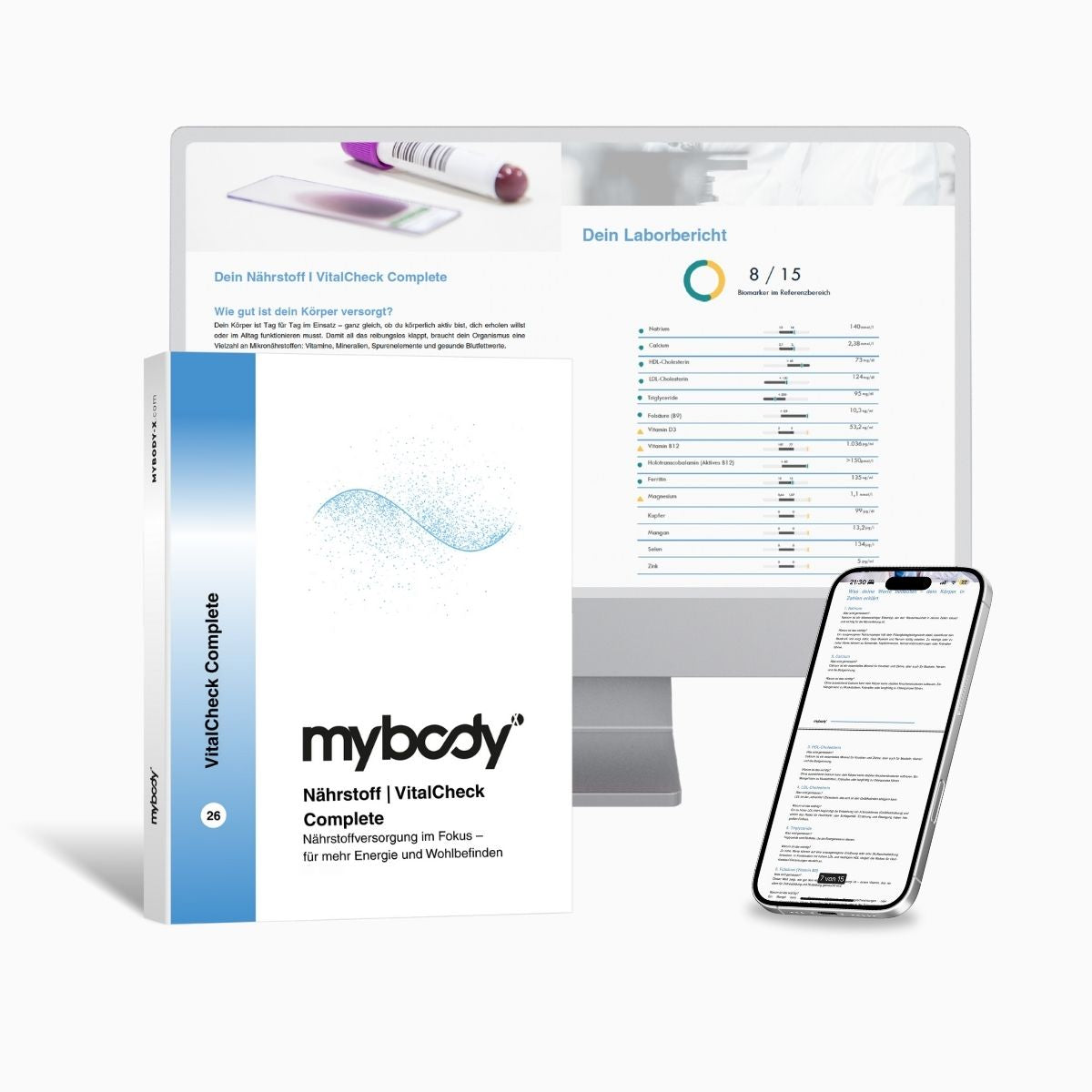
Capillary blood test
VitalCheck | Nutrient & Mineral Test Complete
18 biomarkers from a fingertip blood sample, including 25-OH vitamin D3, plus vitamin B12 and folic acid, as well as iron status based on ferritin, iron, and transferrin. What the test does not do: It measures neither body fat nor waist circumference, and the product page contains no section on abdominal fat or weight. According to its own description, it provides a snapshot rather than a diagnosis; any abnormal result should be assessed by a doctor.
Laboratory evaluation within 3–5 business days after receipt of the sample
Product page information, accessed 27 August 2026

Self-test without laboratory processing
Vitamin D self-test
Measures 25-hydroxyvitamin D from a fingertip blood sample; the result is available at home after approximately 5 to 10 minutes. What the test does not provide: The product page itself describes the result as an approximate value and excludes medical conclusions. It does not replace a laboratory measurement, provide a numerical value for a doctor’s letter, or say anything about waist circumference or body fat.
Result after approximately 5–10 minutes at home
Product page information, accessed 27 August 2026
The difference between the two is not a matter of equipment, but of the question behind it. Anyone who only wants to know whether their own value is roughly within the normal range does not need a laboratory report. Anyone who wants to take a number to a medical practice needs one.
A distinction from our own existing content is also appropriate: The article Test vitamin D yourself covers how to perform a self-test in detail. This article answers a different question, namely the connection with waist circumference.
Limitations: what a vitamin D value does not answer
The first limitation is the biggest and is already stated in this article’s title. A vitamin D value does not explain waist circumference because the documented direction of effect is the reverse. Anyone who measures the value to explain their waist receives a number answering a different question.
The second limitation concerns attributing symptoms. A low value and persistent fatigue can coexist without one causing the other. This attribution requires a medical examination, not a test result alone.
The third limitation is timing. A value describes the time of sampling, not the year. For a substance with pronounced seasonal variation, this is a genuine caveat.
And a boundary in our own right: Reference ranges depend on the laboratory, method, and age. The information on your own report is always authoritative, not the figures from an article.
A fifth limitation concerns what follows from a low level. It does not justify taking high doses on your own; the amount described as safe is up to around 20 micrograms per day (Federal Institute for Risk Assessment, 2025). Anything above that should be decided by a doctor.
This is not an argument against testing. It is an argument against expecting it to provide an answer it cannot give.
Who should have a test—and who should not
Useful for you if …
you belong to a risk group and want to know where you stand before taking it. The Verbraucherzentrale explicitly lists people over 65 for this purpose (2024).
you rarely spend time outdoors or your skin is almost always covered, because in that case the skin-related route is eliminated.
you are already taking vitamin D and want to know after a few months whether the level has changed.
Probably not if …
you hope the number will explain your waist circumference. It does not provide that explanation, and the available evidence argues against it.
you are healthy, have no signs of a deficiency, and spend a lot of time outdoors. For this group, the benefit of testing has not been demonstrated by studies, according to the Verbraucherzentrale (2024).
your belly fluctuates significantly between morning and evening. Then it is a matter of digestion, and a vitamin D level leads away from the actual question.
an acute set of symptoms is the main concern. Then an appointment at a medical practice should come before any self-measurement.
What ultimately matters
If you take away one action from this article, let it be this: Measure your waist circumference morning and evening for two weeks and write down both numbers. This difference costs nothing and sorts out everything else.
If your waist size fluctuates throughout the day, it is not a vitamin D issue but a question of digestion. If it remains the same over weeks and slowly increases, it is about body fat. Only then does the question of a vitamin D level arise, as a separate question alongside the belly.
There is another point that has not yet been mentioned, and it turns the matter around. If more body fat lowers the vitamin D level, then that level also improves with weight loss, without anyone needing to treat it. The connection is real; it simply runs in the opposite direction from what the search query assumes.
At the beginning was the question of whether a vitamin D deficiency explains the large belly. The most honest answer is: The belly is more likely to explain part of the low level. That is less than the question hoped for. And it is useful information because it establishes the order in which you should proceed.
Frequently asked questions
Can a vitamin D deficiency cause a large belly?
There is no robust evidence for this. Observational studies do show that low vitamin D levels and higher body fat often occur together. However, the genetic analysis by Vimaleswaran and co-authors found the direction of causality to be the opposite: A 10 percent higher body mass index was associated with a 4.2 percent lower vitamin D level, while no association was found in the other direction (PLOS Medicine, 2013).
Does taking vitamin D help reduce belly fat?
There is no evidence in the reviewed source material of an effect on waist circumference. The German Federal Institute for Risk Assessment states that people with an adequate vitamin D status generally do not derive any additional benefit from supplementation (2025). For waist circumference, diet, exercise, and sleep remain the areas where evidence exists.
How many people in Germany have too little vitamin D?
Around 15 percent of adults had serum levels below 30 nmol/L, 41 percent were between 30 and below 50 nmol/L, and 44 percent reached desirable levels of 50 nmol/L or higher (German Federal Institute for Risk Assessment, 2025). The widespread claim that almost everyone has a deficiency is not consistent with this.
Should I have my vitamin D level tested if I am healthy?
For adults without signs of a deficiency, the benefit has not been established: The consumer advice center reports that the scientific team of the IGeL Monitor found no studies on this (2024). According to the same source, testing is advisable for at-risk groups such as people over 65 before starting supplementation.
How can I tell whether my belly is made of fat or air?
The trend over time. Measure your waist circumference for two weeks in the morning after getting up and again late in the evening. A clear difference between the two values suggests gas or fluid, because fat tissue does not visibly change within a day. If your waist circumference remains the same throughout the day and increases over months, the cause is body fat.
Next step
Clarify the question first, then look at the number
If your two-week record points to body fat and you want to compare it with your vitamin D status, VitalCheck Complete provides a laboratory report with 18 values. For a quick estimate at home, the vitamin D self-test is sufficient. Neither replaces medical evaluation.
VitalCheck Complete Vitamin D self-testRead more
You might also be interested in
In case your waist circumference fluctuates between morning and evening and the issue is gas rather than fat.
For looking up which measurement is shown on the test report and how the units are related.
Sources
- German Federal Institute for Risk Assessment (BfR): Selected questions and answers about vitamin D (as of 2025) – bfr.bund.de
- Consumer advice center: Vitamin D testing—a useful individual healthcare service? (as of 2024) – verbraucherzentrale.de
- German Nutrition Society (DGE): Reference values for nutrient intake, vitamin D (basis of derivation as of 2012) – dge.de
- Robert Koch Institute (RKI): Vitamin D status in Germany, fact sheet, Journal of Health Monitoring 2/2016 – rki.de
The percentages indicating nutritional status, the breakdown between endogenous production and dietary intake, the recommendation for sun exposure, the information on storage in fat and muscle tissue, and the statement that there is no additional benefit when status is adequate come from source [1], which also reproduces the estimate of 20 micrograms per day from the German Nutrition Society [3]. The assessment of the usefulness of testing in adults without signs of deficiency and the identification of risk groups are based on [2]. The information on seasonal fluctuations comes from [4]. The statements about the direction of the relationship between body mass index and vitamin D status come from the work of Vimaleswaran and co-authors, PLOS Medicine (2013); it is attributed in the body text with the authorship, journal, and year and is therefore not included in this list. Information on price, number of markers, sample type, and laboratory comes from the mybody®x product pages, accessed on 08/27/2026; processing times follow the central guideline for blood and rapid tests. All sources were accessed and reviewed on 08/27/2026.

mybody®x Editorial & Specialist Team
Laboratory diagnostics Blood analysis interpretation Nutritional science Nutrigenetics
This article was created by the mybody®x editorial and specialist team. The team combines laboratory diagnostics, blood analysis interpretation, and nutritional science. Those who contribute to it are listed on the authors’ page.
Published on 09/06/2026 · Last updated on 08/27/2026
The content is for general information and does not replace medical advice, diagnosis, or treatment. Reference ranges depend on the laboratory, method, and age—always follow the information on your test report.




Share now:
Vitamin D Deficiency: Causes, Symptoms & Simple Home Test
Home Test Kit Guide: How Your Self-Test Works