

Vitamin D Self-Test: The easy way to greater well-being
Do you often feel exhausted, struggle to get out of bed in the morning, or feel like you catch every infection? If this sounds familiar, you are not alone. A vitamin D self-test could be the crucial first step toward getting to the root of the problem and understanding your health better. A deficiency in the sunshine vitamin is more widespread than most people think and can significantly hold back your quality of life.
Your first step toward more energy and well-being
Imagine vitamin D as pure sunshine for your cells. It is actually much more than just a vitamin—it acts like a hormone in your body and plays a role in countless processes. Without adequate levels, your immune system runs on low power, your bones may lose stability, and even your mood can hit rock bottom.
Here in Germany, covering your needs through sunlight alone is a real challenge. It becomes particularly difficult during the darker months from October to April. Many health-conscious people therefore do not even realize that their constant fatigue or susceptibility to colds could be caused by depleted vitamin D stores.
Why a lack of knowledge holds your health back
If you do not know what is behind your symptoms, you are feeling around in the dark. You may try all kinds of things, but real improvement fails to materialize. This is not only frustrating; it also prevents you from taking targeted action. The good news: You no longer have to guess.
A vitamin D self-test gives you a clear, scientifically sound answer. Instead of remaining uncertain, you get a precise value that shows where you stand. This is the perfect foundation for taking your health into your own hands.
A test like this is not rocket science. With the mybody-x Vitamin D Test, you can conveniently determine your exact level from home using just a few drops of blood. Analysis at our ISO-certified partner laboratory in Germany provides a result you can rely on—the basis for taking responsibility for managing your own health.
The facts speak for themselves
Vitamin D deficiency is anything but a niche problem. In fact, fewer than 40 percent of adults in Germany have optimal levels. A 2016 study by the Robert Koch Institute (RKI) made this strikingly clear: even then, 30.2 percent of adults had deficient levels—a clear sign of how important it is to know your own status. You can find more information about the study results on adult health in Germany at edoc.rki.de.
Constant fatigue can have many causes, but a nutrient deficiency is often the hidden culprit. A vitamin D self-test is the ideal starting point for finally getting clarity and bringing more energy back into your everyday life. In our guide, you’ll learn which nutrient deficiencies can also contribute to fatigue and lack of energy.
How a vitamin D self-test works
Are you wondering exactly what happens during an at-home vitamin D test? And above all: Can you really trust the result? Don’t worry—the entire process is much simpler and more accurate than you might think. We’ll guide you through it and explain everything step by step.
The key to a truly meaningful result is measuring the right value in your blood. A high-quality test like the one from mybody-x therefore focuses on so-called 25-OH vitamin D, also known as calcidiol. It’s best to think of it as your body’s main vitamin D storage depot. Because it is stored there stably, this value is the international gold standard for reliably determining your vitamin D status.
The difference: Rapid test vs. laboratory analysis
You’ve probably heard of the simple rapid tests from pharmacies. However, they usually only provide a qualitative answer—a simple “yes” or “no” to the question of whether a deficiency is present. While that’s a useful first indication, you simply need more details to optimize your health effectively.
And this is exactly where the crucial difference lies: A lab-based nutrient test like the one from mybody-x provides you with a precise quantitative analysis. This means you receive an exact numerical value, for example in nanograms per milliliter (ng/ml). Only with this precise value can you truly assess your status and take targeted measures that actually make a difference.
Do you often feel tired, or are you simply wondering whether your vitamin D level is within the healthy range? This graphic sums it up.
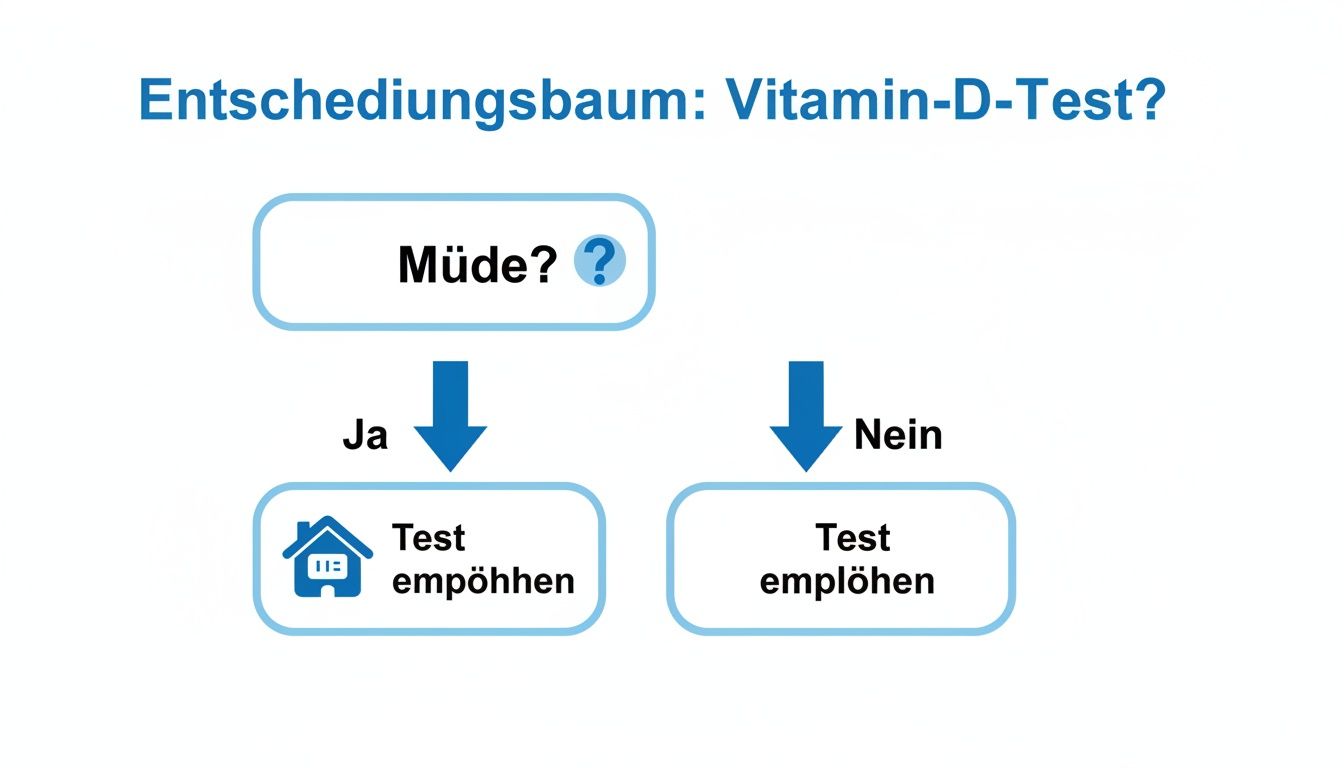
As you can see, symptoms such as fatigue are a strong indication that it’s worth taking a closer look. But even purely as a preventive measure, getting tested makes perfect sense so you can take proactive control of your health.
Comparing test methods for your vitamin D status
To make your decision easier, we have compared the most common methods for you. This gives you an overview of which option best suits your needs.
This table shows the key differences between a mybody-x home test (dried blood spot), a rapid test, and a laboratory test at the doctor’s office.
| Feature | mybody-x self-test (dried blood spot) | Rapid test (pharmacy) | Visit to the doctor (laboratory) |
|---|---|---|---|
| Result | Precise numerical value (quantitative) | Yes/no statement (qualitative) | Precise numerical value (quantitative) |
| Process | Conveniently at home | Conveniently at home | At the doctor’s office |
| Sample type | A few drops of blood (finger) | A few drops of blood (finger) | Venous blood draw (arm vein) |
| Effort | Low, no appointment required | Very low, immediate result | High, appointment scheduling & waiting time |
| Cost | Transparent, one-time price | Affordable | Variable, often covered only when medically indicated |
| Accuracy | Very high (laboratory analysis) | Low, only as an indicator | Very high (laboratory analysis) |
The comparison makes it clear: If you want an accurate, reliable value without having to make an extra trip to the doctor, a laboratory-based self-test is the ideal solution.
Dried blood spot test: The smart alternative to a visit to the doctor
In the past, accurate blood analysis always required a visit to the doctor for a venous blood draw. But modern diagnostics have produced an equally precise and considerably more convenient method: the dried blood spot test.
This method, which is also used by our mybody-x Vitamin D test, requires just a few drops of blood from your fingertip. These are placed on a special filter card, where they dry. This offers several advantages:
- Simple & virtually painless: All it takes is a small prick in your finger.
- Stable & secure: The dried sample has a long shelf life and can be sent to our laboratory easily by mail.
- High accuracy: The laboratory analysis has been scientifically validated and is just as precise as a venous blood sample.
The mybody-x test uses this proven method and guarantees the highest precision and data security through analysis in our ISO 27001-certified partner laboratory.
Getting your result is this easy
The entire process is incredibly easy, and you can complete it comfortably at home. We have thought of everything to ensure that nothing goes wrong from collecting the sample to shipping it.
- Activation: First, activate your test kit online using your personal ID. This ensures that your results are later anonymized and correctly assigned.
- Collecting the sample: Use the included lancet to collect a few drops of blood from your fingertip. It takes just a moment and is barely noticeable.
- Let it dry: Place the blood drops on the dried blood spot card and let them air-dry briefly.
- Shipping: Then place the card in the prepaid return envelope and simply take it to the post office.
To make things even easier for you, we have created a detailed guide. Read here how to perform a blood test at home so you can be perfectly prepared. As soon as your sample arrives at our laboratory, our experts analyze it. Shortly afterward, you will receive your digital results report with clear explanations and personalized recommendations for action.
Interpreting your test results correctly

You have completed your vitamin D self-test and finally have the result in your hands—a number, usually in nanograms per milliliter (ng/ml). But what exactly does this level say about your fitness, immune system, and overall health? Now we get to the heart of the matter: We translate the language of laboratory reports into clear guidance you can use.
Your result is much more than just a number on paper. Think of it as your personal compass. It shows you whether your vitamin D stores are full or whether it is high time to take action to improve your well-being. With this knowledge, you can finally make informed decisions.
What the official reference values really mean
To interpret your level correctly, you need a reliable benchmark. In Germany, standardized reference ranges show you where you stand. These ranges were not chosen arbitrarily; they are based on scientific studies examining the connection between vitamin D levels and bodily functions.
Your level is not simply “good” or “bad.” It is a guide that tells you whether you are in the green zone or whether action is needed—from a critical deficiency that weakens your bones to an optimal level that keeps your immune system working at full capacity.
This classification helps you understand the urgency and plan your next steps. A mild deficiency requires different measures than a serious undersupply.
From deficiency to optimal levels: Where do you stand?
The reference values are clearly structured and provide you with good guidance. A value between 11 and 30 ng/ml is often considered a long-term deficiency that increases the risk of bone problems. A range of 31 to 40 ng/ml is considered sufficient, but the actual target range for optimal prevention is closer to 41 to 60 ng/ml.
So it is not only about avoiding an acute deficiency. The goal should be to reach a level that proactively protects you from health problems and supports your body as effectively as possible.
To help you better interpret your value, we have compiled an overview of what the individual ranges mean for your health.
Vitamin D reference ranges and what they mean
| Value (ng/ml) | Assessment | Possible effects |
|---|---|---|
| < 10 | Severe deficiency | Increased risk of softening of the bones (osteomalacia), a severely weakened immune system, and high susceptibility to infections. |
| 10 - 30 | Deficiency | Fatigue, muscle weakness, increased susceptibility to infections. In the long term, the risk of osteoporosis increases. |
| 31 - 40 | Adequate level | Basic bodily functions are covered, but there is still room for improvement for optimal preventive benefits. |
| 41 - 60 | Optimal level | This is the ideal range! Your stores are well filled, providing the best possible support for your immune system and bone health. |
| 61 - 100 | High level | Still considered safe, but offers no additional health benefits compared with the optimal range. |
| > 100 | Possible overdose | Can be harmful (vitamin D intoxication), but occurs almost exclusively with extreme supplementation. Can dangerously increase calcium levels. |
Your mybody-x test result not only provides the numerical value itself, but also explains it clearly and directly for you. This way, you can see at a glance where you stand.
If you want to delve even deeper into the subject, our article contains everything you need to know about the vitamin D3 (25 OH D) laboratory value.
From knowledge to action: the next steps after the test
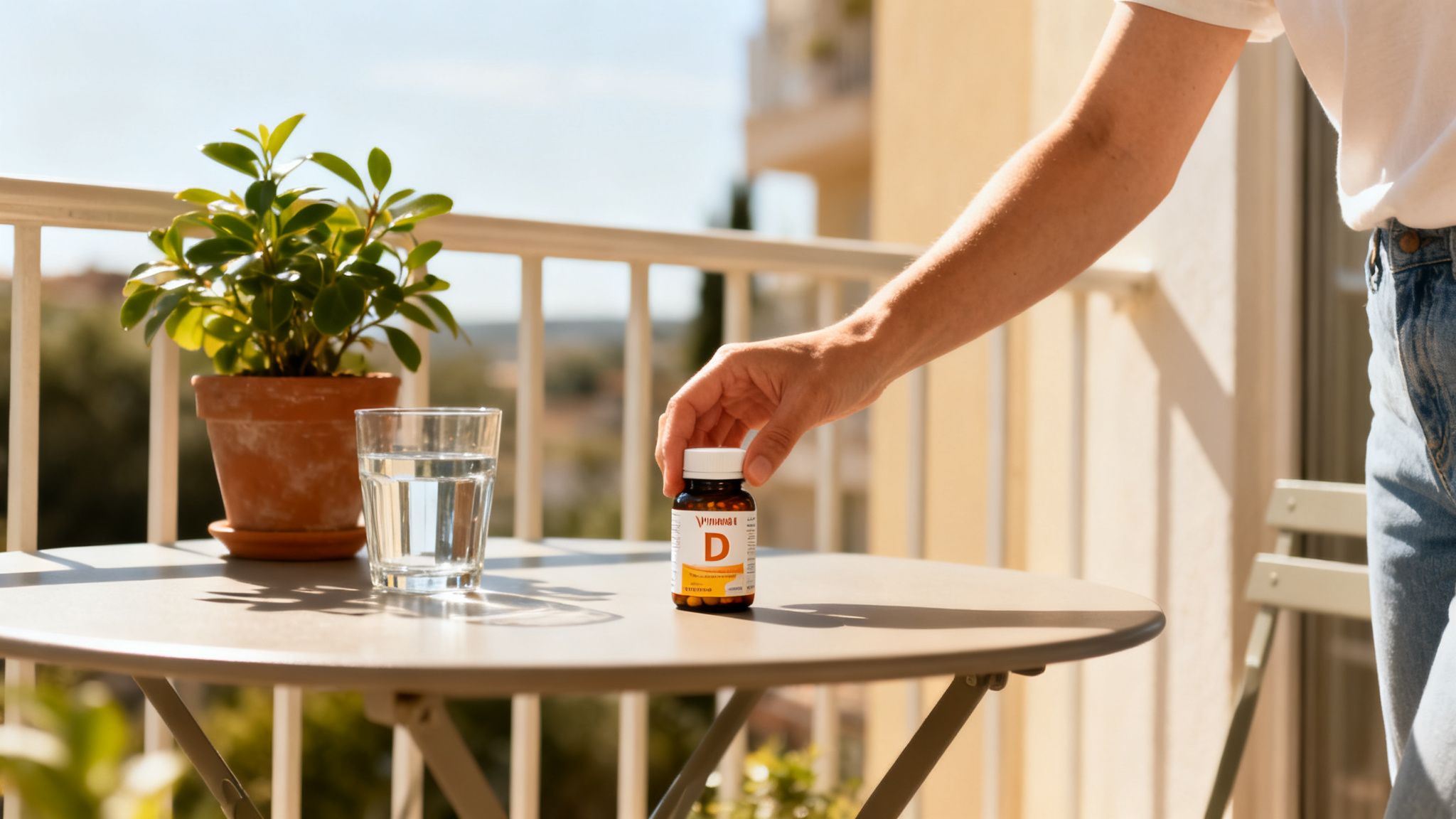
Holding a test result in your hands is only the beginning. The true strength of your vitamin D self-test is that it gives you a clear starting point for taking charge of your health. Instead of being left in the dark, you now have a precise value and can finally take targeted action.
Your mybody-x results report is much more than just a number—it is your personal roadmap. You receive specific recommendations tailored to you and immediately know what to do. The goal is clear: not only to raise your vitamin D level in the short term, but to keep it in the optimal range over the long term.
Optimize your vitamin D level
Does your test show a deficiency or a level that still has room for improvement? Then targeted supplementation is the most effective way to improve it. Taking vitamin D supplements helps you quickly and, above all, reliably replenish your depleted stores.
However, there are a few things to consider to achieve the best possible effect and stay on the safe side. It is not about simply taking any product, but about a well-considered strategy that is precisely tailored to your body.
The key to success is an individually appropriate dosage. The amount you need depends heavily on your starting level, body weight, and lifestyle. A level of 15 ng/ml logically requires a very different approach than a level of 35 ng/ml.
Your mybody-x results report takes the guesswork out of this. It provides a clear dosage recommendation tailored precisely to your personal needs. This ensures safe and effective optimization.
In addition to the right dosage, vitamin D also has another important partner.
Vitamin D3 and K2: a powerful team
You may have heard that vitamin D3 is often recommended together with vitamin K2. There is a very good reason for this: The two vitamins work hand in hand and are like a well-coordinated team.
Think of vitamin D3 as a construction manager who ensures that calcium passes from the intestines into the bloodstream—a crucial process for strong bones. Vitamin K2 then takes on the role of a traffic officer. It directs calcium exactly where it belongs (in the bones and teeth) and prevents it from depositing in the arteries.
- Vitamin D3: Improves calcium absorption.
- Vitamin K2: Regulates the distribution of calcium in the body.
This combination is particularly useful if you are taking higher doses of vitamin D. It ensures that everything proceeds as it should.
Don’t forget natural ways to support your intake
Even though supplements are often unavoidable in cases of deficiency, you should not lose sight of natural sources. They are an important pillar for keeping your intake stable in the long term.
- Get some sun: By far the most effective natural source is sunlight. During the summer months (April to September), try to spend 10–20 minutes in the sun around midday regularly, with your arms, legs, and face uncovered. Most importantly, sunburn must be avoided.
- Vitamin D-rich foods: Some foods can support your vitamin D intake, even though they usually cannot meet your needs on their own. These include primarily fatty fish such as salmon, herring, and mackerel. You can also find smaller amounts in egg yolks, certain edible mushrooms, and vitamin D-fortified products.
When should you consult a doctor?
A vitamin D self-test gives you a great deal of control over your health. Nevertheless, there are situations in which speaking with a doctor or therapist is absolutely advisable.
Medical supervision is particularly important if your level is very low (below 20 ng/ml) or if you have pre-existing conditions. A doctor can order further diagnostic tests and safely supervise a high-dose initial treatment. Your mybody-x results report also gives you a clear recommendation on when it’s advisable to see a doctor.
If you’d like to explore how to address your vitamin D deficiency in more depth, you’ll find even more valuable information in our guide.
Who can benefit most from a vitamin D test
Of course, a vitamin D test isn’t essential for everyone at all times. For many people, however, it can be the decisive first step toward more energy and well-being. There are simply certain stages of life, seasons, and habits in which the risk of deficiency rises significantly.
Do you recognize yourself in any of the following situations? Then a vitamin D self-test is a really smart decision. It gives you the confidence you need to take proactive care of your health instead of waiting until the first signs of deficiency appear. Simply see it as a smart health check that helps you reach your full potential.
When the days get shorter
The most obvious time to take a test is probably the transition into the darker season. From October to April, the sun is so low in the sky at our latitudes that hardly any of the important UVB radiation reaches our skin. Yet we need it for the body’s own vitamin D production. The stores you built up over the summer gradually but surely run low.
Especially in late autumn or midwinter, when fatigue and susceptibility to infections seem to reach their peak, a test gives you valuable clarity. This allows you to take targeted action instead of simply dismissing the energy slump as the “winter blues.”
Your lifestyle and diet
Your daily routine and what ends up on your plate have a huge impact on your vitamin D levels. That’s why certain groups benefit especially from regular testing.
- Office workers and homebodies: Do you spend most of your day indoors? Even in midsummer, the short walk to the car or an evening stroll often isn’t enough to get sufficient sunlight.
- Vegans and vegetarians: Significant amounts of vitamin D are found almost exclusively in animal foods, such as fatty fish or egg yolks. A purely plant-based diet makes it nearly impossible to meet your needs through food alone.
- People with darker skin: Higher melanin levels in the skin act like natural sun protection. While this is beneficial, it significantly slows vitamin D synthesis.
- Older people: As the years go by, the skin’s ability to produce vitamin D noticeably declines. Studies show that production in a 70-year-old is only about 25 % of that in a 20-year-old.
When your body sends you signals
Sometimes it’s your own body giving you unmistakable clues. Vitamin D deficiency often causes rather nonspecific symptoms that are easy to overlook or misinterpret. So take a moment to listen closely to what your body is telling you.
Constant fatigue that won’t go away even after getting enough sleep? Feeling like you catch every infection going around? Or a low mood without any apparent reason? These are classic warning signs that could indicate depleted vitamin D stores.
A vitamin D self-test from mybody-x can finally provide clarity. Instead of continuing to guess, you get a solid basis for finding the cause of your symptoms and taking targeted action. It’s the perfect, simple step toward regaining control of your well-being and confidently taking your health into your own hands.
What to look for when choosing your self-test
The market for at-home health tests is growing, and that’s a good thing—after all, it gives you more control over your own health. But where the range of products grows, there are unfortunately also enormous differences in quality. With a vitamin D self-test, two extremely important things are at stake: your sensitive health data and the absolute accuracy of your result.
An incorrect measurement or careless handling of your data can ultimately leave you more uncertain than reassured. That’s why it’s so important not to choose just any test, but a provider you can truly trust. It’s about making an informed decision for your well-being.
Precision through certified laboratories
The heart of every good self-test is the laboratory that analyzes your sample. An untrustworthy provider that stays silent about its laboratory standards is a huge red flag. So be sure to check that the provider works with ISO-certified specialist laboratories, as we do at mybody-x.
ISO certification is not a flashy advertising label, but rock-solid proof of quality. It ensures that the laboratory complies with the strictest standards—from processes and measurement accuracy to staff qualifications. This means for you:
- Reliable results: Your blood sample is analyzed using scientifically validated methods.
- Maximum accuracy: The measuring devices are regularly calibrated and checked to minimize any deviation.
- Traceable quality: All processes are standardized and documented without gaps.
This is the only way you can be truly sure that the value you ultimately hold in your hands actually corresponds to your vitamin D level.
Your data is your most valuable asset
By providing your blood sample, you disclose highly personal information. That is why data protection should be the top priority. A reputable provider like mybody-x ensures that your data is protected from start to finish. This begins with the anonymized assignment of your test kit via an ID and extends to the encrypted transmission of your results.
A crucial feature for maximum data security is certification according to ISO 27001. This internationally recognized information security standard guarantees that your data is managed according to the strictest rules and protected from unauthorized access.
So always read the fine print and make sure that the provider is transparent about its data protection practices and never shares your data without your explicit consent.
Good service does not stop at the result
A high-quality vitamin D self-test provides more than just a bare number. Truly good service is reflected in the entire experience—from placing your order easily to knowing what you should actually do with your result.
Look out for these points, which distinguish a first-class provider:
- Easy-to-understand instructions: Does the test include clear, simple step-by-step instructions that everyone can understand?
- Transparent pricing: Are there hidden costs, or is the price clearly communicated from the outset?
- Actionable recommendations: Do you receive just a laboratory value, or also specific recommendations tailored to you?
- Personal support: Do you have the opportunity to reach a knowledgeable contact person who can help you with any questions?
Mybody-x meets all these criteria and goes even one step further by giving you access to our health experts. This ensures that you are not left alone with your results, but can use them as a powerful tool for your health.
Your questions about the vitamin D self-test—answered briefly and clearly
Are you thinking about checking your vitamin D level but still have a few questions? No problem, that’s completely normal. We’ve summarized the most frequently asked questions here so you know exactly what to expect.
Does the finger prick really hurt?
We hear this concern often, but we can reassure you: Blood collection for the mybody-x test is virtually painless. You use a tiny, sterile lancet for a quick prick in your fingertip.
It feels more like a slight pinch—there’s absolutely no comparison with having blood drawn from a vein in the arm at the doctor’s office. It takes just a few seconds and is designed so that you can complete it yourself quickly and easily.
How quickly will I get my result?
Of course, when you send in a sample, you don’t want to wait forever for the answer. As soon as your sample arrives at our laboratory, our experts get straight to work. As a rule, your personal report will already be ready for you within a few business days.
You don’t have to keep checking either—we’ll conveniently notify you by email as soon as your report is available in your secure mybody-x account. This gives you clarity quickly and allows you to plan your next steps.
Your result is far more than just a number. We explain exactly what your value means and provide you with specific, scientifically sound recommendations for action. This way, you immediately know what to do to optimize your levels.
Does health insurance cover a self-test?
A vitamin D self-test from mybody-x is considered a private healthcare service, also known as IGeL. The costs are therefore generally not covered by statutory health insurance providers. Coverage is usually provided only when a doctor has reasonable grounds to suspect a deficiency or resulting condition and orders a laboratory test.
However, the key advantage of a self-test lies in taking the initiative yourself. You don’t have to wait for symptoms or a doctor’s appointment before taking action. You take a proactive approach to your health—exactly when you feel it’s right.
Are you ready to finally gain clarity about your vitamin D status and take your health into your own hands? At mybody-x, you’ll find the right nutrient test to check your levels easily and conveniently from home. Start your journey toward greater well-being now: https://mybody-x.com



Share now:
Lowering Cortisol with Magnesium: Your Practical Guide to Greater Inner Calm
Nutrient deficiency symptoms – recognize them early, take targeted action