

Causes of chronic fatigue and how to regain your energy
The true causes of chronic fatigue are incredibly diverse. They range from simple nutrient deficiencies and hormonal imbalances to hidden inflammation smoldering in your body. This deep feeling of exhaustion is more than just annoying—it is often a clear warning signal from your body that something has fallen out of balance.
Why you are constantly tired and what your body is trying to tell you
Do you sometimes feel as though you are getting through the day with the handbrake on? Constant fatigue is completely different from the normal sluggishness after a short night. It is a state of deep physical and mental exhaustion that simply does not go away, no matter how much you sleep. A feeling that can paralyze your entire daily life.

Imagine your body as a finely tuned clockwork mechanism. Every cog must mesh perfectly with the others for everything to run smoothly. If even one tiny component is missing or a gear jams, the entire system begins to stall. The real reasons for your fatigue are often invisible and usually have little to do with classic sleep deprivation.
More than just lack of sleep
Many people believe that eight hours of sleep are the solution to all energy problems. But if your body is struggling with problems elsewhere, even the best sleep is only a drop in the ocean. Much more often, silent energy drains are working unnoticed in the background.
Some of the most common invisible causes include:
- Nutrient deficiencies: Your body needs certain vitamins and minerals, such as iron or vitamin B12, as spark plugs for energy production. Without these important building blocks, your engine sputters.
- Hormonal imbalances: Hormones, such as those produced by your thyroid or the stress hormone cortisol, are the conductors of your metabolism. When they fall out of sync, your energy level collapses.
- Silent inflammation: Unnoticed inflammatory processes, often triggered by food intolerances, force your immune system into a constant state of activity. That takes an incredible amount of energy.
These factors continuously strain your system and drain your reserves without you noticing it directly.
Chronic fatigue is not a fate you simply have to accept. It is a clear signal from your body that an imbalance exists—one you can uncover and correct.
Find the real energy drains
Instead of feeling around in the dark and trying different diets or supplements on a whim, you should start at the very beginning: find the exact cause. This is where precise analyses come in. With a targeted at-home blood test from mybody-x, you can see in black and white whether you are lacking important nutrients, your hormones are out of balance, or certain foods are putting a strain on your system.
The mybody-x tests are designed precisely to provide you with clear, data-based answers so you can better understand your body. This allows you to make targeted changes in the right place to regain your energy, instead of continuing to struggle through your foggy daily life. This article guides you through the most common causes and shows you how to take back control of your health.
To give you a quick overview, we have summarized the most common causes of fatigue in a table.
Common causes of fatigue at a glance
A summary of the main categories that may contribute to chronic fatigue, giving you a quick overview.
| Cause category | Possible triggers | Typical signs alongside fatigue |
|---|---|---|
| Diet & nutrients | Iron deficiency, vitamin B12 deficiency, vitamin D deficiency | Pale skin, brittle nails, difficulty concentrating, susceptibility to infections |
| Hormonal system | Underactive thyroid, adrenal fatigue, cortisol imbalance | Weight gain, sensitivity to cold, hair loss, inner restlessness |
| Metabolism & digestion | Food intolerances, leaky gut, blood sugar fluctuations | Bloating, abdominal pain, cravings, skin problems |
| Mental health & stress | Chronic stress, burnout, depression | Sleep disturbances, lack of motivation, irritability, social withdrawal |
| Infections & immune system | Chronic inflammation, undetected infections (e.g., EBV) | Body aches, swollen lymph nodes, mild fever |
This table is intended to give you an initial overview. Often, several factors interact and reinforce one another, which makes finding the root of the problem so important.
Detecting the invisible energy thieves in your blood
Imagine your body as a highly precise engine. It runs at full speed every day, but it also needs the right fuel. This means not only calories, but above all the tiny yet crucial micronutrients—vitamins and minerals. If these small “spark plugs” of your metabolism are missing, the engine starts to sputter. One of the most common causes of chronic fatigue is hidden right here: a deficiency that cannot be seen with the naked eye.
When we feel tired, many of us reflexively reach for coffee or lie down for a power nap, overlooking the actual problem. If your body lacks important building blocks for an extended period, it cleverly switches to energy-saving mode. This is not a sign of weakness but a smart mechanism signaling: “Stop—something important for energy production is missing here!”
The top 3 energy drainers caused by nutrient deficiencies
There are many nutrients that play a role in your vitality. But three of them are absolute key players when it comes to your energy levels. A deficiency in just one of these nutrients can noticeably slow you down.
1. Iron deficiency – When oxygen runs short Iron is the heart of the red blood pigment hemoglobin. Its main job? Delivering oxygen from the lungs to every single cell in your body. Think of it as an energy courier service. With iron deficiency, there are too few couriers on the road, and the cells simply do not receive enough oxygen to produce energy.
Typical signs that may indicate an iron deficiency:
- Pale skin and pallid mucous membranes
- Brittle nails and sometimes hair loss
- Difficulty concentrating and the feeling of being “out of it”
- Shortness of breath, even with light exertion
2. Vitamin B12 deficiency – The nerve killer Vitamin B12 is a true all-rounder: essential for blood formation, cell division, and the functioning of your nervous system. A deficiency often develops gradually and manifests as deep, unexplained exhaustion. Because the vitamin is found almost exclusively in animal products, people who follow a vegetarian or vegan diet should pay particular attention to it.
A deficiency may manifest as follows:
- Persistent, debilitating fatigue and weakness
- Tingling or numbness in the hands and feet
- Memory lapses and unexplained mood swings
3. Vitamin D deficiency – The empty sunshine account Vitamin D, our “sunshine vitamin,” is actually a hormone and is involved in countless processes in the body—from immune defense to muscle strength. Especially during the darker months from October to April, many people in our latitudes are unable to produce enough of it through their skin. Studies show that in Germany, around 30% of adults have a significant vitamin D deficiency.
A low vitamin D level is directly linked to fatigue, muscle weakness, and increased susceptibility to infections. So if you constantly feel drained, especially in winter, your sunshine account may simply be empty.
Knowledge instead of guesswork: Your path to clarity
The thing is, the symptoms of a nutrient deficiency are often nonspecific and are quickly mistaken for stress or too little sleep. But blindly taking random supplements is rarely the solution—an overdose can be just as problematic as a deficiency.
The only sensible way is to get certainty. A targeted nutrient test from mybody-x shows you precisely where your nutritional gaps are. With a simple blood sample taken at home, you receive a clear, scientifically based evaluation of your results. This lets you see in black and white whether you are lacking iron, vitamin B12, vitamin D, or other important building blocks.
This means you no longer have to grope around in the dark—you can take targeted action based on your needs. You receive not only your results but also specific recommendations for action to replenish your reserves and get your engine running again. Learn more in our health portal about how nutrient deficiencies causing fatigue and lack of motivation can be specifically identified. This turns your blood work from a puzzle into a clear roadmap on your journey toward more energy.
How hormones and stress sabotage your energy
Do you sometimes feel like you're being remotely controlled? As if someone else were turning the dials controlling your energy, mood, and even your weight? Often, the invisible conductors behind this are your hormones. When they fall out of sync, they can throw everything into disarray.
Especially when it comes to the causes of chronic fatigue, two main suspects come into focus: an underactive thyroid and the notorious stress hormone cortisol.

Your hormonal system is an incredibly finely tuned network. Even tiny disruptions can trigger a chain reaction that brings you to a complete standstill. So it is crucial to understand these signals from your body instead of simply dismissing them as a “bad day.”
The thyroid—your body's own power plant
Think of your thyroid as the accelerator pedal of your metabolism. This small, butterfly-shaped organ in your neck tells every single cell how quickly to work and burn energy. If it produces too few hormones—a condition known as hypothyroidism—your entire body runs on low power.
The consequences often creep unnoticed into everyday life and are about much more than just fatigue:
- Unexplained weight gain: Your metabolism is so sluggish that you feel as though you gain weight just by looking at food.
- Constantly feeling cold: Your internal heater has been turned down. You often feel cold even when others find the temperature pleasantly warm.
- Lack of motivation and depressive moods: The hormonal imbalance directly affects your mental health.
- Dry skin and hair loss: Skin and hair suffer too because cell activity has slowed down.
The insidious part? These symptoms often begin gradually and are mistakenly attributed to age or everyday stress. Many people live for years with an undiagnosed underactive thyroid without knowing the true cause of their exhaustion.
Cortisol—the double-edged stress manager
Stress is not inherently bad. The hormone cortisol, produced in the adrenal glands, helps us get going in the morning and react in a split second in dangerous situations. It mobilizes energy reserves and sharpens the senses. A true helper—as long as stress remains the exception.
But when stress becomes chronic—due to relentless pressure at work, personal worries, or too little recovery—cortisol changes from a helper into a saboteur.
A consistently high cortisol level forces your body to remain in a state of constant alarm. The result is a vicious cycle: Your energy reserves are literally drained, leaving you feeling exhausted and foggy during the day. At night, however, high cortisol causes inner restlessness and robs you of deep, restorative sleep.
Chronic stress is one of the main causes of persistent fatigue in Germany. A representative survey by the KKH health insurance company shows that 82 percent of Germans occasionally feel exposed to intense pressure. Among those who are frequently stressed, 78 percent report fatigue and sleep disorders. You can read more in the findings on stress levels in Germany.
This kind of hormonal chaos can severely limit your quality of life. The good news is: You’re not helplessly at the mercy of these invisible factors.
Uncover hormonal chaos
If you recognize yourself in the symptoms described, it’s time to get clarity. Guesswork won’t get you anywhere, but concrete data will. An imbalance in thyroid hormones or cortisol levels can be reliably detected through a blood test.
A hormone test from mybody-x offers you a simple and discreet way to check from home whether your hormones are in balance. Instead of being left in the dark, you gain clear insight into your inner balance.
Would you like to learn more? We explain everything you need to know about how to test your hormone balance and regain control. Because only once you know the cause can you take targeted steps to restore your energy and well-being.
When exhaustion persists after an infection
A flu-like infection, a nasty cold, or a recovered COVID-19 infection—almost everyone knows what it feels like to remain slowed down for weeks afterward. You simply feel drained. But what if this crushing exhaustion never goes away? What if it takes hold in the body and your former energy still does not return even after months?
Then it could be more than a slow recovery. This is known as post-viral fatigue syndrome, a condition in which the immune system and energy metabolism simply fail to settle down after an infection. Viruses can trigger a kind of chain reaction in the body that puts the system into a permanent state of alarm, even when the actual enemy has long since been defeated.
ME/CFS: The most severe form of post-viral exhaustion
In the worst-case scenario, an infection can even trigger a severe, complex neuroimmunological disease: myalgic encephalomyelitis, also known as chronic fatigue syndrome (ME/CFS). This is no longer just ordinary tiredness. ME/CFS is a serious physical illness that often completely upends the lives of those affected. The causes of chronic fatigue lie deep within the nervous, immune, and energy systems.
Since the pandemic, ME/CFS has become much more prominent in the public consciousness. Experts estimate that the number of people affected in Germany has roughly doubled since 2020. The disease is often triggered by a viral infection and is now considered the most severe form of Long COVID. The consequences are dramatic: 60 to 75 percent of those affected can no longer work. You can read more about the background to the rising number of ME/CFS cases here.
Post-Exertional Malaise: Understanding the Core Symptom
There is one crucial characteristic that distinguishes ME/CFS from all other forms of exhaustion: the so-called post-exertional malaise (PEM).
Imagine your battery has only 10 % Capacity, but your body only realizes it when it is completely empty—and then needs days or even weeks to recharge even minimally. That is exactly what PEM is.
Even the slightest physical, mental, or emotional exertion can lead to a massive worsening of all symptoms. A short shower, a phone call, or answering an email can be enough to trigger a “crash.” The result: extreme exhaustion, muscle pain, concentration problems (“brain fog”), and flu-like feelings. What makes this particularly insidious is that this state often does not occur until hours or days after the exertion, making it incredibly difficult for those affected to recognize their limits.
What tests can do in this case
Unfortunately, there is currently no single blood marker that can definitively prove ME/CFS. The diagnosis is therefore made by systematically ruling out other conditions with similar symptoms. And this is exactly where blood tests become an indispensable tool.
A targeted blood analysis can identify or rule out other causes of chronic fatigue. These include, for example:
- Nutrient deficiencies: An undetected deficiency in iron or vitamin B12 can cause severe fatigue.
- Hormonal imbalances: An underactive thyroid is a classic energy drain.
- Reactivated viruses: The Epstein-Barr virus (EBV), for example, can reactivate and is often associated with ME/CFS.
Chronic inflammatory processes can also play a major role. These silent “fires” force the immune system to run at full speed nonstop, consuming enormous energy reserves. You can learn how to uncover such processes in our article about the test for silent inflammation. A comprehensive blood test is like a puzzle: It provides you and your doctor with important pieces to understand the overall picture of your health and develop the right strategy for you.
Which tests really provide clarity when you are fatigued
Okay, you now have a whole list of possible suspects that could be behind your constant exhaustion—from depleted nutrient stores and hormonal chaos to silent inflammation. But merely guessing what it could be will not move you forward. The crucial point is to finally find out what the real cause of chronic fatigue is for you personally. And to do that, you need to move from guessing to knowing.
This is exactly where a targeted blood test becomes your most important ally. Think of it as looking under the hood of your body. Instead of continuing to grope around in the fog, it provides clear facts about what is really going on in your system.
Your personal health navigator
A test like this is essentially a navigation system for your health. Without data, you are driving blind and hoping to somehow reach the right destination. With the right values, you get an exact route to more energy and well-being.
mybody-x self-tests were developed specifically for this purpose. They are your direct path to the information you need to take control again—conveniently, discreetly, and based on scientific research from the comfort of your own home.
This short decision tree can help you choose an initial direction.
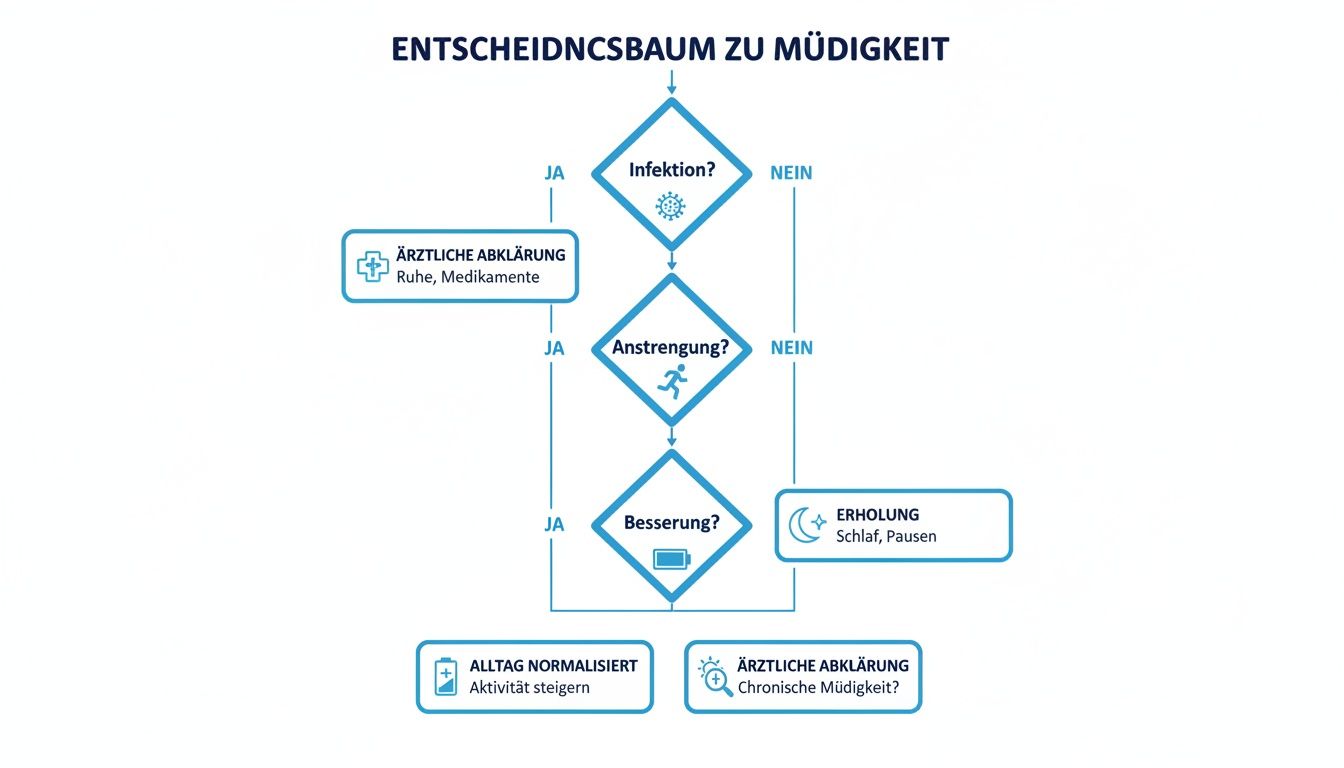
The graphic makes it clear: If the fatigue persists after an infection, simply does not improve, or has no clear cause, it is worth taking a closer look to determine the right steps.
Which test is right for you?
Depending on which symptoms you notice in addition to fatigue, another mybody-x test may be better suited to your situation. Here is a quick guide to help you decide:
1. The nutrient test when depleted nutrient stores are suspected
This test is the perfect first step if your fatigue is accompanied by symptoms such as difficulty concentrating, paleness, brittle nails, or frequent infections. It checks the typical energy drainers directly in your blood.
- Focus: Measures key values such as iron (ferritin), vitamin B12, and vitamin D.
- Who it’s for: Ideal for you if you suspect that your diet or lifestyle is leaving gaps in your nutrient intake—especially if you follow a vegetarian or vegan diet.
With a precise analysis, you can see in black and white whether your nutrient stores need replenishing. We have summarized in detail for you how a blood nutrient analysis can provide clarity.
2. The hormone test for when your hormones go haywire
In addition to exhaustion, are you struggling with weight gain, constantly feeling cold, experiencing hair loss, or feeling restless inside and sleeping poorly? It sounds as though your hormones have fallen out of balance.
- Focus: Analyzes important thyroid levels, such as TSH, and the stress hormone cortisol.
- For whom: Perfect for you if you want to understand whether ongoing stress or an underactive thyroid is sapping your energy.
A hormone test reveals whether your body's own “accelerator” is sticking or whether constant stress is quietly draining your energy reserves.
3. The intolerance test for when food makes you tired
Do you notice that you feel particularly sluggish, bloated, or foggy after certain meals? Then your immune system may be reacting to certain foods, which takes a tremendous amount of energy from your body.
- Focus: Identifies IgG4 antibodies against a wide range of foods.
- For whom: Suitable for you if you have digestive problems, skin blemishes, or the vague feeling that food makes you tired rather than energized.
When it comes to medical examinations, protecting your personal data is naturally the top priority. Understanding data protection in medical facilities is essential. Mybody-x guarantees the highest standards under the GDPR and ISO-27001 for maximum data security.
Each of these tests is a targeted step toward finally bringing the invisible causes of chronic fatigue to light. Instead of continuing to grope in the dark, you give yourself the chance to make informed decisions about your health—targeted and based on your very own values.
Your path to more energy starts now
Chronic fatigue is not a fate you simply have to accept. If you have read this far, you know: Your energy is the result of a delicate interplay between nutrients, hormones, your immune system, and a healthy lifestyle. The true causes of your fatigue almost always lie in a disruption of this complex balance.
View your exhaustion as an important signal, a kind of cry for help from your body. It is telling you that something is wrong. Instead of merely fighting the symptoms, we want to encourage you to take matters into your own hands and get to the root of the problem.
The first step toward clarity
The most important step is to uncover your personal causes. Stop groping in the dark and trying out different methods at random. To make truly targeted changes, you need concrete data about your body. That is exactly where mybody-x home tests come in.
You do not have to guess—you can know. A simple blood test provides the facts you need to make the right decisions for your health.
Our tests are designed to give you clear, easy-to-understand insights, without any medical expertise. They are the tool that puts you back in control.
Take charge of your health
Your path to more energy and joy in life can begin today. It starts with the decision to stop merely functioning and start truly participating in life again. Find out what is really behind your fatigue and tackle the problem effectively.
- Suspect a nutrient deficiency? The nutrient test shows you in black and white whether your nutrient stores need replenishing.
- Suspect hormonal chaos? The hormone test gives you clarity about your thyroid and stress levels.
- Exhausted after eating? An intolerance test can uncover hidden energy drains.
You have it in your hands to break this cycle of exhaustion. Start now by giving your body the attention it deserves and finally find out what you are truly lacking.
Your questions, our answers: Chronic fatigue explained clearly
You now have a deep insight into the many possible causes of chronic fatigue. To conclude, we would like to answer some of the most common questions we receive time and again—briefly, clearly, and to the point.
Does chronic fatigue simply come from not getting enough sleep?
No, that is one of the biggest misconceptions. Of course, lack of sleep makes you tired, but chronic fatigue is usually caused by something more. If you constantly feel exhausted despite getting enough sleep—seven to nine hours per night—that is a clear warning sign.
Your body is trying to tell you that something in its system has become unbalanced. Often, invisible troublemakers such as an iron or vitamin B12 deficiency, a hormonal imbalance in the thyroid, or disrupted cortisol levels are draining your energy.
Which blood test makes the most sense for constant fatigue?
It depends entirely on your accompanying symptoms. A comprehensive nutrient test is an excellent starting point and often provides the decisive clue. It checks the exact values that are essential for your energy production. Are you also experiencing concentration problems, often looking pale, or constantly getting sick? Then this test is exactly right for you.
However, if you also notice symptoms such as weight fluctuations, constantly feeling cold, or inner restlessness, you should opt for a hormone test that examines your thyroid and stress levels. mybody-x self-tests are designed precisely so that you can specifically investigate the most likely causes.
How quickly will I notice an improvement once a deficiency has been corrected?
This is where a little patience is needed, because every body works differently. With a significant iron deficiency, it can take several weeks to months for your stores to be replenished and for you to feel a real boost of energy. Vitamin B12 deficiency can usually be corrected a little faster, but your body needs time here, too.
The two most important things are: Be consistent in following the recommendations and trust your body. Regular follow-up tests are ideal for seeing your progress in black and white and making sure you’re on the right track.
Infections such as COVID-19 have emerged as one of the main causes of long-lasting exhaustion. The number of ME/CFS cases, the most severe form of Long COVID, has roughly doubled since the beginning of the pandemic. This serious illness often leads to a decline in performance of over 50 % and is associated with the lowest vitality levels of all chronic diseases. Learn more about the connections on the website of the German Society for ME/CFS.
Are you finally ready to find out what’s behind your fatigue? At mybody-x, you’ll find the right at-home blood test to gain clarity and reclaim your energy.



Share now:
What is non-HDL cholesterol: Why this value often tells you more
Which blood test results really provide insight into fatigue