
Discover the TSH hormone test: Understanding your thyroid made easy
Do you often feel tired and lacking in energy? Are you struggling with your weight even though you seem to be doing everything right? The answer to these questions could be hidden in a small but powerful messenger substance in your blood: TSH. A TSH hormone test is the most important first step in finding out whether your thyroid—the engine of your metabolism—is working properly. It tells you whether it may be overactive (hyperthyroidism) or underactive (hypothyroidism).
What your TSH level really reveals about your well-being
Imagine your body as a finely tuned orchestra. The thyroid is the instrument that sets the rhythm for your entire metabolism—how quickly your body burns energy, how warm you feel, and how fast your heart beats. But the conductor of this orchestra sits in the brain and is called TSH.
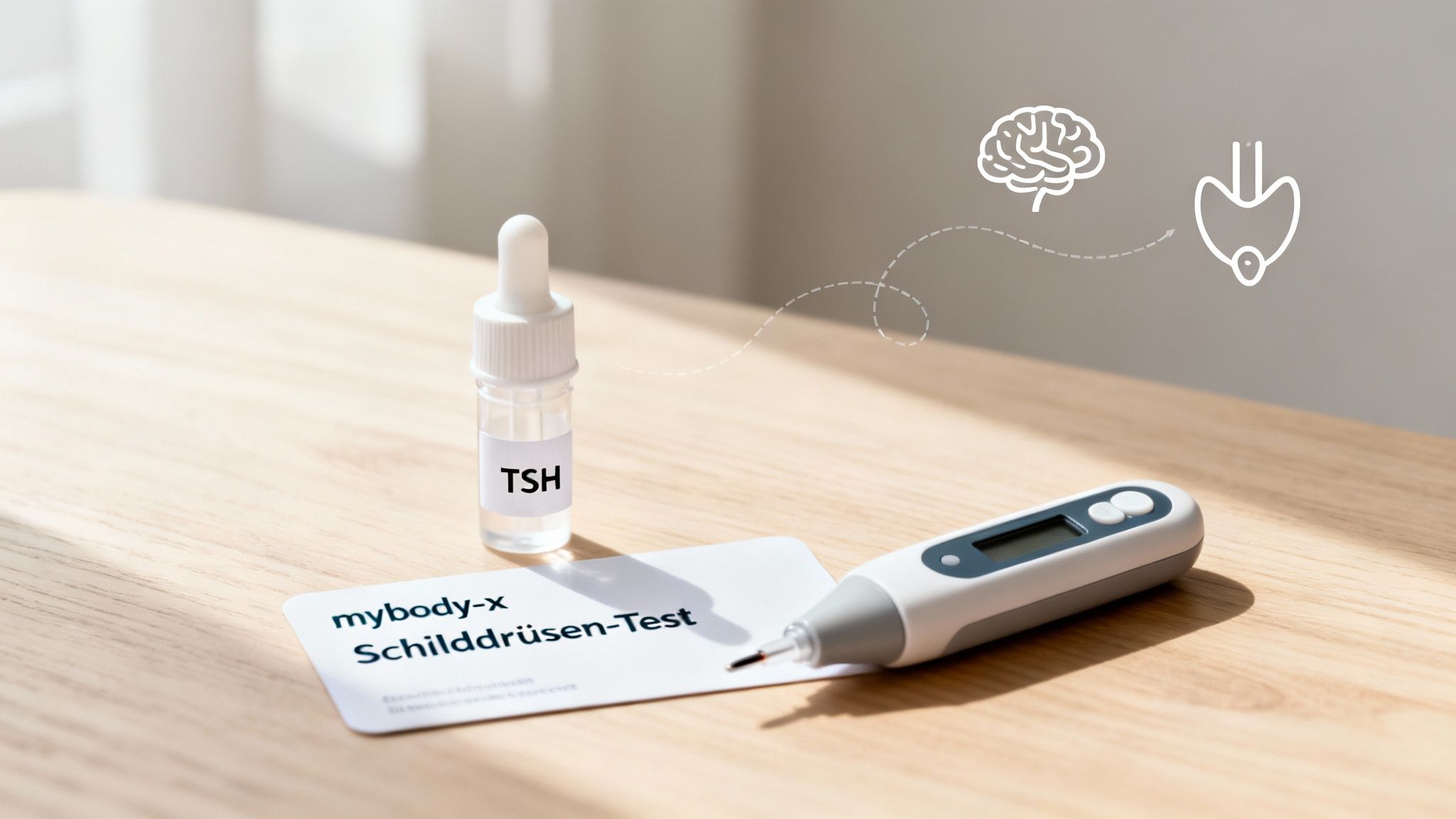
The hidden conductor of your metabolism
TSH is short for thyroid-stimulating hormone (also known as thyrotropin). It is produced in the pituitary gland and has a central role: It signals your thyroid to produce the vital hormones T3 and T4. These two are the actual workers that drive metabolism in every cell of your body.
This system works like an intelligent thermostat in your home:
- When thyroid hormone levels in the blood drop, the pituitary gland detects this and releases more TSH. This is the clear command to the thyroid: “Turn up the heat, we need more energy!”
- When there are too many thyroid hormones, the pituitary gland slows down TSH production again. The signal is then: “Enough energy, turn down the heat!”
A TSH hormone test therefore does not directly measure the thyroid hormones themselves, but rather the instructions your thyroid receives. That is precisely what makes it so incredibly informative. It is an extremely sensitive early-warning indicator that often detects even the slightest functional disorders before you notice any severe symptoms.
To help you quickly grasp the most important facts, we have created this overview for you.
TSH at a glance – the most important facts
This table summarizes the basics of the TSH hormone so you can quickly understand its key role in your health.
| Characteristic | Importance for your body |
|---|---|
| What is TSH? | A hormone produced by the pituitary gland that controls the thyroid. |
| Main function | Signals the thyroid to produce the metabolic hormones T3 and T4. |
| High TSH level | Often signals an underactive thyroid (hypothyroidism). The body “calls” more loudly for more hormones. |
| Low TSH level | Often signals an overactive thyroid (hyperthyroidism). The body slows down hormone production. |
| Why test? | Serves as a sensitive early indicator of thyroid problems and helps clarify the causes of symptoms such as fatigue or weight issues. |
These connections show how intelligently your body is regulated and why the TSH level is such a central health marker.
Why a simple test can make such a big difference
Many everyday complaints, such as constant fatigue, unexplained weight gain, hair loss, or inner restlessness, are often caused by an undiagnosed thyroid disorder. A surprisingly large number of people live with these symptoms for years without ever learning the true cause.
A TSH test is the crucial first step toward finally gaining clarity. It enables you to proactively take control of your health and uncover the causes of your discomfort instead of merely treating the symptoms.
This is exactly where the thyroid test from mybody-x.com comes in. It gives you the opportunity to check this important value easily and conveniently from home. Instead of waiting weeks for a doctor's appointment, you can take action yourself and gain valuable insights into one of your body's most important control centers. In the next section, you'll learn which specific symptoms could indicate an imbalance.
Your body's language: What your TSH symptoms are trying to tell you
Your body is constantly communicating with you—you just have to learn to understand its language. Many nonspecific symptoms that you may attribute to stress or a hectic daily routine may actually be quiet cries for help from your thyroid. A TSH hormone test is the best way to truly get to the bottom of these signals.
Think of your thyroid as your body's central heating system. It ensures that you always have the right operating temperature, use your energy efficiently, and that all processes run smoothly. TSH acts as the thermostat that controls this heating system. When this thermostat does not work properly, the entire system becomes unbalanced—and you feel it throughout your body.
When the heating sputters—symptoms of a high TSH level
An elevated TSH level means your brain is practically shouting at your thyroid: “Step it up, produce more hormones!” But the thyroid simply does not respond enough. This scenario is called hypothyroidism (underactive thyroid). The metabolic engine is running on low power, and everything slows down.
The signs are often gradual and incredibly varied:
- Unexplained weight gain: Your metabolism is so sluggish that you gain weight despite a healthy diet and exercise, or can lose weight only with great difficulty.
- Constant tiredness and exhaustion: You often feel exhausted as soon as you wake up and can barely get going during the day, no matter how much you sleep.
- Sensitivity to cold: You are constantly cold, even when others feel perfectly comfortable. Your internal “heating” simply is not working properly.
- Dry skin and hair loss: Your skin feels tight, rough, and flaky. Your hair becomes brittle and dull, and more of it falls out.
- Constipation and sluggish digestion: Your intestines also work more slowly, which can lead to digestive problems.
- Concentration problems and memory impairment: You often feel foggy (“Brain Fog”) and have difficulty concentrating.
- Low mood through to depression: A deficiency of thyroid hormones can have a significant impact on your mental state.
These symptoms can severely affect your life. Many people affected search for a cause for a long time, even though the answer is often just one blood test away.
When the heating is running at full speed—symptoms of a low TSH level
A TSH level that is too low is the exact opposite. Your brain only whispers very softly because there are already far too many thyroid hormones circulating in your blood. The thyroid is working at full speed—a situation known as hyperthyroidism (thyrotoxicosis). Your entire body is running in the red.
This can manifest through the following signs:
- Inner restlessness and nervousness: You constantly feel driven, shaky, and can barely sit still.
- Racing heart and high pulse: Your heart often beats quickly and irregularly, even when you are at rest.
- Unexplained weight loss: You are losing weight even though you eat normally or even more than usual. Your body is burning energy at top speed.
- Excessive sweating and heat intolerance: You often feel too warm and sweat very easily, even with little exertion.
- Sleep disturbances: You have difficulty falling asleep or often wake up at night because your body simply cannot relax.
- Frequent bowel movements or diarrhea: Your metabolism is so accelerated that your digestion is also running at full speed.
- Muscle weakness and trembling: Your hands are trembling and you feel weak overall.
Do you recognize yourself in some of these descriptions? These are not figments of your imagination, but concrete signals from your body. A TSH hormone test is the most effective way to check whether your internal thermostat is set correctly.
The frequency of these tests underscores their importance. In Germany, TSH testing is one of the most common laboratory examinations in primary care practices. An analysis in Baden-Württemberg found that the TSH level was measured within one year in almost 25% of people with statutory health insurance—often because of nonspecific symptoms such as fatigue or weight fluctuations. You can read more about the importance of the TSH test in the current medical guidelines.
These figures show how important it is to take proactive steps when relevant signs appear. With a simple at-home self-test, such as the thyroid test from mybody-x.com, you can quickly and easily gain clarity and take the first decisive step toward greater well-being.
Interpreting and understanding your TSH levels correctly
You are holding your lab report, see a number next to “TSH,” and wonder: What exactly does this mean for me? A lab value is more than just a digit—the context is always what matters. Here, we provide you with the knowledge you need to confidently understand your TSH level, as also reported in the thyroid test from mybody-x.com.
You will quickly realize that “normal” does not mean the same thing for everyone and why your result must always be considered in the context of your personal symptoms.
What is a normal TSH level?
A laboratory report generally provides what is known as a reference range. This range shows where the levels of most healthy people fall. For a long time, a rough guideline of 0.4 to 4.0 mU/L (milliunits per liter) was considered normal for TSH.
However, this rigid threshold simply does not do justice to the complexity of our bodies. Recent findings show that the ideal TSH level depends on many factors, above all age. Your body changes over the course of your life, and so does your hormonal balance.
A TSH level is not a static number but a dynamic marker that must be interpreted in the context of your stage of life and individual well-being. A level that is optimal for one person may already be a warning sign for another.
This perspective has also become established in medical practice. In Germany, an “abnormal” TSH level no longer automatically indicates a thyroid disorder requiring treatment. Current recommendations take age and clinical context into account much more closely. According to the 2023 S2k guideline, an elevated level in adults up to 70 years of age is generally considered relevant only above > 4.0 mU/L. For people between 70 and 80 years of age, the threshold is > 5.0 mU/L, and for those over 80, it is not considered relevant until above > 6.0 mU/L. You can learn more about these age-dependent assessments in the current medical guidelines.
This adjustment is important because TSH levels naturally rise slightly with age, without necessarily indicating an underlying illness.
Your age plays a crucial role
To illustrate how strongly age influences assessment, we have compiled an overview of the typical upper limits. It will help you better understand your results.
An overview of age-dependent TSH reference values
This table shows how the “normal” TSH range can shift with age and helps you assess your results individually.
| Age group | Typical upper limit for TSH (mU/L) |
|---|---|
| 18–30 years | approx. 4.1 mU/L |
| 31–50 years | approx. 4.2 mU/L |
| 51–70 years | approx. 4.7 mU/L |
| 71–90 years | approx. 5.7 mU/L |
| Over 90 years | approx. 7.0 mU/L |
This table makes it clear: A TSH level of 4.5 mU/L could be completely harmless in a 75-year-old. However, in a 30-year-old woman who wants to have children or has severe symptoms such as fatigue and weight gain, the same level would be a clear warning sign of developing hypothyroidism.
It is therefore essential to consider not only the number but also your stage of life. Deepen your understanding of these connections and learn more about how you can interpret your thyroid levels optimally in our follow-up article.
Symptoms as your most important guide
Numbers are one thing; how you feel is another. You yourself are always the most important measure of your health. A lab result that is mathematically “within the normal range” is of little value if you still feel ill, tired, or unwell.
That is why it is so important to always compare your test results with your personal symptoms. A TSH hormone test gives you the objective data, but your body provides the crucial context.
This infographic shows at a glance how a TSH level that is too high or too low can affect your body—often accompanied by the feeling that your internal “heating system” is not working properly.
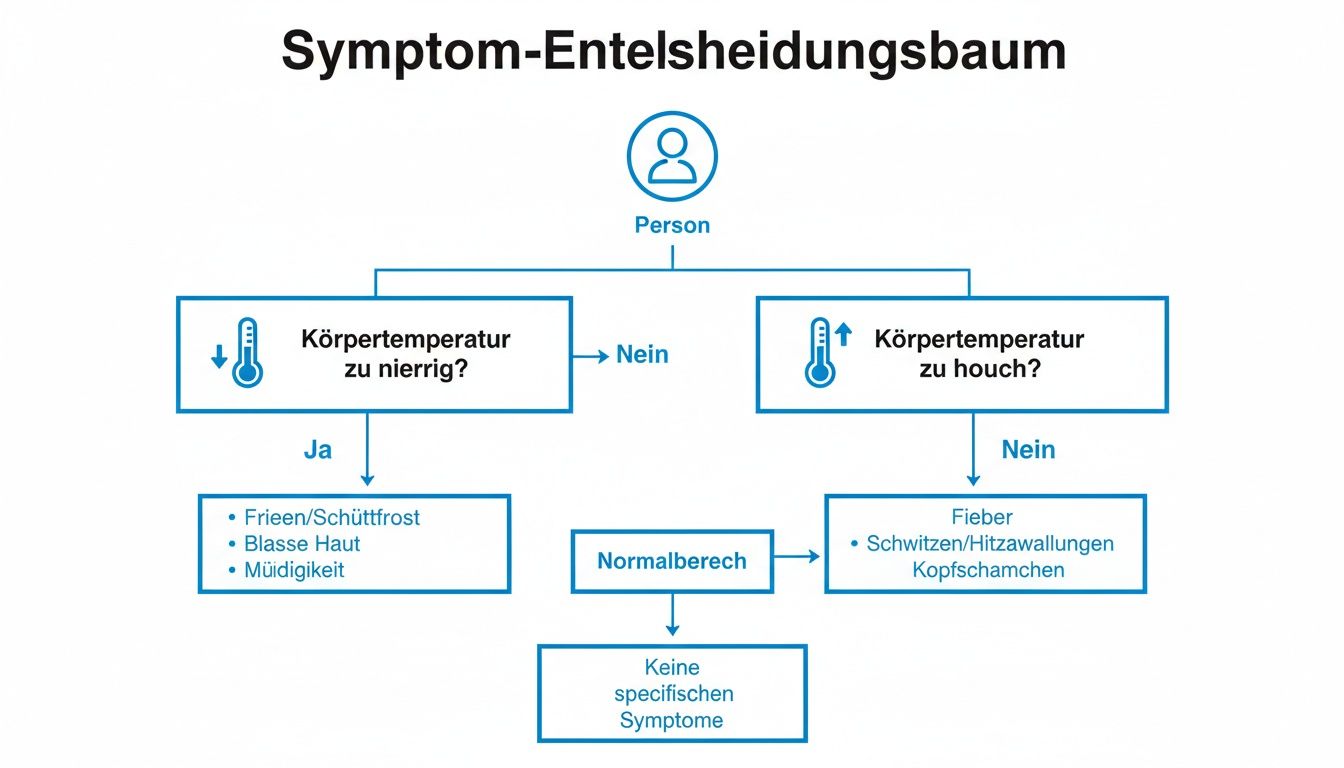
The graphic makes it clear: Symptoms such as constantly feeling cold and fatigue often accompany a high TSH level (underactive thyroid), while inner restlessness and excessive sweating may indicate a low TSH level (overactive thyroid).
Listen to your body. If you have symptoms that suggest a thyroid problem, getting tested is always a sensible step—regardless of what an old lab result may say. The combination of precise measurements, such as those provided by the thyroid test from mybody-x.com, and your self-awareness is the key to genuine clarity.
Why fT3 and fT4 complete the puzzle of your thyroid health
The TSH level is, so to speak, the captain of your thyroid—it gives the orders. But the actual work in the engine room of your metabolism is done by two other hormones: fT3 and fT4. Looking only at the TSH level is often like listening only to the captain without checking whether his instructions are actually reaching the engine room and whether the machines are really running.
Imagine this regulatory circuit as a modern heating system:
- TSH is the thermostat: It measures the perceived “room temperature” and decides whether more or less heat is needed.
- fT4 (free thyroxine) is the boiler: It is the storage hormone produced by the thyroid at the command of TSH. You could say it is the energy that has been made available but is not yet active.
- fT3 (free triiodothyronine) is the heat that actually flows from the radiators: It is the active hormone that reaches your cells directly and really gets your metabolism going. Most of it is produced by converting fT4.
A simple TSH hormone test therefore only tells you what the thermostat wants. But what if the boiler (fT4) is full to the brim while the conversion into perceptible heat (fT3) is faltering? Then you may feel tired and cold despite a TSH level that perhaps appears unremarkable.
Subclinical or overt—an important distinction
This is precisely where it becomes important to distinguish between two conditions. Only measuring TSH, fT3, and fT4 together makes a truly accurate diagnosis possible.
- Subclinical (hidden) hypothyroidism: Your TSH level is already elevated, but your thyroid gland is just managing to produce enough fT3 and fT4. You may already have the first mild symptoms, but the hormone levels themselves are still within the normal range. The captain is shouting louder, but the crew is still working.
- Overt (obvious) hypothyroidism: Your TSH level is high and your fT3 and fT4 levels are already too low. The captain is shouting, but the crew is exhausted and performance is deteriorating. Your symptoms are usually very noticeable by now.
Without measuring the free hormones fT3 and fT4, mild hypothyroidism could remain undetected for a long time. You might wonder why you feel unwell even though your TSH level is “just barely” within the normal range.
Why the overall picture is so important
Looking at TSH alone can be misleading. German data show that “the one TSH value” cannot be assessed in the same way for everyone—age and sex in particular play a measurable role. A large study determined sex-specific reference ranges across different age groups. In women aged 30 to 39, the median TSH level was 1.5 mIU/L, while women aged 60 to 69 had a higher median of 1.9 mIU/L. The study explicitly recommends sex- and age-specific assessment, underscoring the need for a comprehensive view. Learn more about these age- and sex-specific thyroid values in the current study.
A comprehensive test that measures all three values—TSH, fT3, and fT4—provides a much sharper and more meaningful picture of your thyroid health. It reveals not only whether a problem exists, but also where the regulatory system is disrupted.
That is precisely why the thyroid test from mybody-x.com deliberately measures all three key markers. This gives you a complete picture that helps you truly understand the cause of your symptoms. This knowledge is the foundation for taking targeted and effective next steps toward your well-being. Would you like to take a deeper dive? Our article explains everything about the optimal fT3-to-fT4 ratio and why this balance is so important for your energy.
Your simple path to clarity with the at-home test
Would you like clarity about your thyroid levels, but the thought of crowded waiting rooms, appointment-related stress, and traveling to the doctor’s office puts you off? That is completely understandable. In our hectic daily lives, we look for solutions that adapt to our lives—not the other way around.
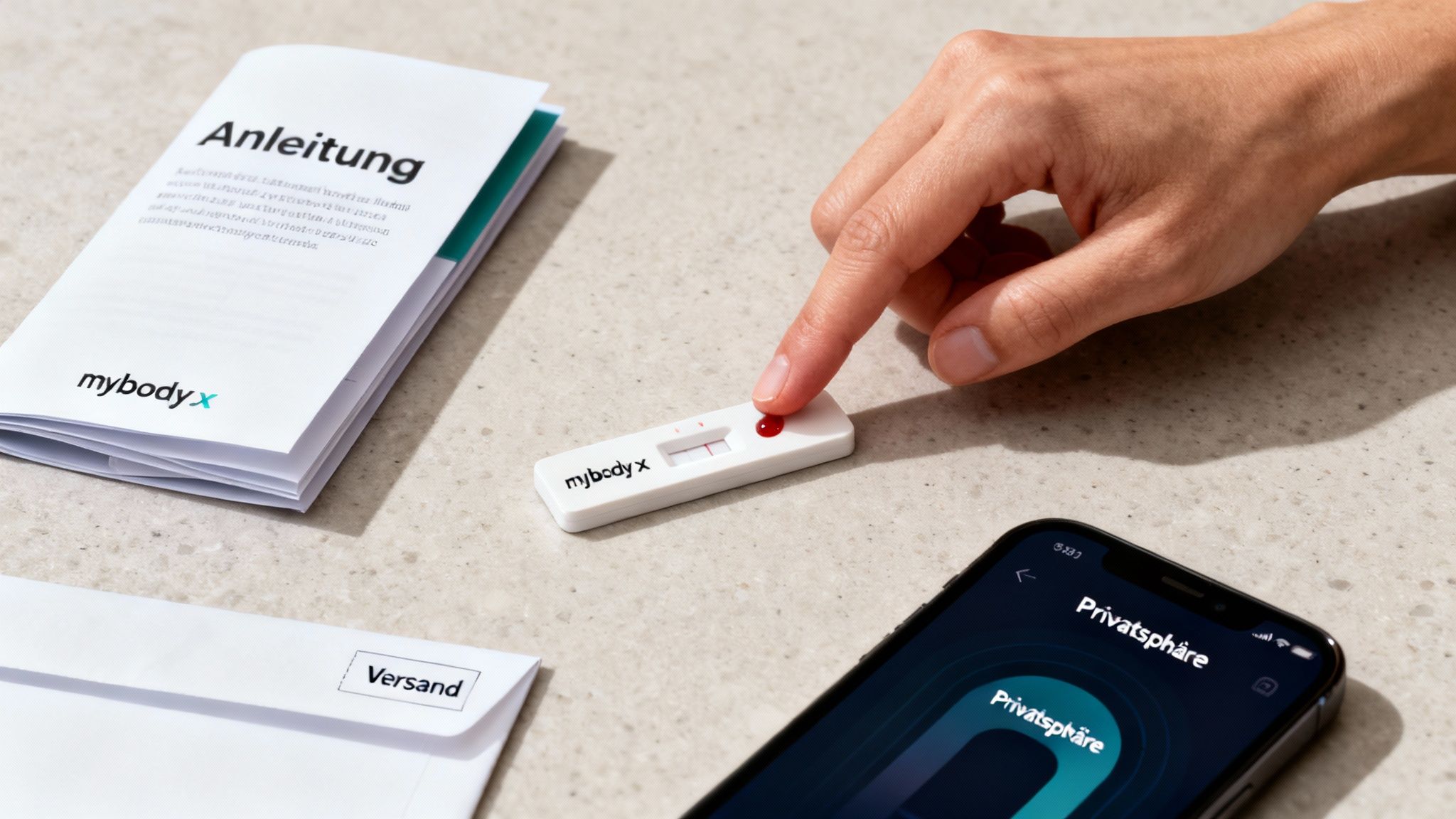
This is where a modern alternative comes in: the thyroid test from mybody-x.com. It allows you to perform an accurate TSH hormone test easily and discreetly at home. This puts you proactively in control of your health without having to disrupt your schedule.
Your path to clear results in 4 steps
The entire process is deliberately kept simple so that you can focus on what matters most: your well-being. We support you from ordering through to the results report—everything is designed to provide you with security and comfort.
- Order online and prepare: You conveniently order the test kit online and have it delivered directly to your home. The package contains everything you need to collect the sample, including easy-to-understand step-by-step instructions.
- Simple and virtually painless blood collection: Using a small lancet, you collect a few drops of blood from your fingertip yourself. The process is quick, straightforward, and far less intimidating than having blood drawn from a vein at the doctor’s office. In our detailed guide, we explain exactly how to perform a blood test at home to achieve the best possible results.
- Free return shipping to the laboratory: You securely package your sample in the enclosed return envelope and send it to our certified partner laboratory in Germany. We will of course cover the postage for you.
- Receive easy-to-understand results online: As soon as the analysis is complete, you will receive a notification. Your results will not be presented as an incomprehensible column of numbers, but will be clearly and neatly organized in your personal online portal.
The benefits of a home test at a glance
Choosing a TSH hormone test for home use offers significant benefits that fit perfectly with a health-conscious lifestyle.
- Maximum privacy: You take the test in the comfort of your own surroundings, without prying eyes or crowded waiting rooms.
- No waiting times: You do not have to wait weeks for a doctor’s appointment. You decide when the right time to take the test is.
- Complete flexibility: The test fits into your life. Whether on the weekend or after work, you are in control.
- Easy-to-understand explanations: We translate the “lab jargon” for you, so you can truly understand your results and the recommendations that follow.
A home test does not mean compromising on quality. Our German partner laboratory operates according to the highest quality standards and is certified to ISO 15189—the gold standard for medical laboratories. Your sample is analyzed with the same precision as it would be by your doctor.
The thyroid test from mybody-x.com is therefore more than just a measurement. It is your personal tool for taking proactive, self-directed care of your health and finally finding the answers you may have been looking for for a long time.
The most important questions about the TSH hormone test
You have now learned a great deal about what your TSH level reveals about your thyroid. Even so, there are always very specific questions that many people have before taking the first step. Here you will find the answers—clear, easy to understand, and straight to the point, so no uncertainties remain.
When is the best time to take a TSH test?
Your TSH level is not a fixed value; it naturally fluctuates throughout the day. It reaches its peak at night and in the early morning hours. So, to obtain a truly meaningful and, above all, comparable result, the best time for the blood sample is clearly: in the morning and on an empty stomach.
For the thyroid test from mybody-x.com, this means specifically:
- It is best to take the test immediately after getting up, before eating or drinking anything. A glass of water is of course allowed.
- Avoid coffee or tea that morning. The caffeine could slightly affect the result.
With this small amount of preparation, you ensure that the measurement provides an accurate picture of your thyroid function.
Do I really need to fast for the test?
Yes, it is absolutely recommended. Eating, especially a meal high in fat or sugar, can temporarily stimulate your metabolism and disrupt your hormone levels. This would distort the result.
To prevent this, ideally you should not eat anything for 8 to 12 hours before the blood sample is taken. This gives your body the chance to enter a true resting state, and the measured value reflects the basic function of your thyroid without short-term interfering influences.
How often should I have my TSH level checked?
That depends entirely on your personal situation. There is no rule that applies to everyone, but there are clear guidelines you can use as a reference:
- For unclear symptoms: If you constantly feel tired, struggle with your weight, or suffer from hair loss, a one-time initial measurement is the absolutely right first step toward gaining clarity.
- For routine prevention: Even if you feel perfectly healthy, an annual check as part of a health screening may be worthwhile. This allows changes to be detected early, before they become problems.
- If you have a known thyroid disorder: If you have already been diagnosed with a dysfunction and are taking medication, your doctor will determine the testing intervals. Usually, monitoring then takes place every 6 to 12 months.
Taking responsibility for your own health begins with knowledge. Regularly checking key values such as TSH enables you to take proactive action instead of only reacting to symptoms.
A home test such as the one from mybody-x.com makes it especially easy to incorporate this monitoring into your daily routine without having to depend on appointment schedules.
Can stress or medications affect TSH levels?
Yes, definitely. Your hormone system is a highly sensitive network that responds to countless influences. Stress and certain medications are among the most important factors that can significantly disrupt your TSH level.
How stress affects it: Chronic stress floods your body with the hormone cortisol. Persistently elevated cortisol levels can disrupt the delicate communication between the brain and thyroid and reduce TSH production. The result? Your TSH level could appear falsely low, even though your thyroid may already be underactive.
Medications that may interfere: A whole range of medications can affect TSH measurement. The best-known include:
- Biotin (vitamin B7): High-dose biotin, often found in dietary supplements for hair and nails, can significantly interfere with laboratory analysis and lead to falsely low TSH values. It is best to stop taking it a few days before the test.
- Certain painkillers and anti-inflammatory drugs
- Hormone preparations such as the birth control pill or cortisone
If you take medication regularly, it is important to take this into account when evaluating your results. In the mybody-x.com portal, you can note this information so that we can provide you with an even more precise interpretation.
My result is abnormal—what now?
An abnormal value in the TSH hormone test is no reason to panic. Quite the opposite: it is a valuable guide. Think of it as the starting point for finally getting to the bottom of the cause of your discomfort and taking targeted action.
The mybody-x.com report not only provides your laboratory values but also translates them into easy-to-understand language. You receive specific recommendations tailored to you. These may include simple adjustments to your diet and lifestyle or a recommendation to discuss your values with a doctor. Our goal is always to empower you to approach the next steps confidently and with the right information.
Are you ready to finally gain clarity about your thyroid health and take control of your well-being? The thyroid test from mybody-x.com measures all three important values (TSH, fT3, fT4) and provides you with easy-to-understand results and personalized recommendations—all from the comfort of your home.



Share now:
What causes menstrual pain and how you can effectively relieve it
What helps with hot flashes? Quick tips and causes for your women’s health