

Testosterone reference ranges for men in ng/dl: Understand and optimize your level
When you hold a laboratory report showing your testosterone level, the unit ng/dl—nanograms per deciliter—will probably catch your eye first. Typically, reference ranges for a man fall somewhere between 250 and 1000 ng/dl. But beware: This range is huge and, on its own, says very little.
The value depends heavily on your age and can even vary slightly from one laboratory to another. That is why it is so important not to consider the number in isolation, but to put it into context and understand what it means for you and your well-being.
What testosterone reference ranges in ng/dl really mean
A laboratory report can seem quite cryptic at first glance. Numbers, units, reference ranges—what does it all mean? Let’s break it down in simple terms. The value in ng/dl indicates how many nanograms of testosterone are present in one deciliter of your blood. This is the most common unit of measurement used in Germany to determine the concentration of this important hormone and better understand your body.
Your age plays the leading role
By far the most important factor in assessing your testosterone level is your age. It is completely normal and natural for a 25-year-old to have a very different “normal value” than a 60-year-old. Your body adjusts its hormone production over the course of your life—a completely natural process.
So there is no single perfect value for everyone. Instead, doctors use so-called reference ranges to give you a rough indication of whether you fall within a healthy range.
Important to understand: A reference range is not a goal you have to reach. It only shows the range in which the values of most healthy men in a particular age group fall. Your personal well-being and how you feel are at least as important as the bare number on the page.
Typical reference ranges in Germany
Although there are no nationally standardized reference ranges in Germany, most laboratories use very similar ranges. As a general rule of thumb, a reference range of approximately 249–836 ng/dl applies to an adult man between 20 and 49 years of age. For men aged 50 and over, this range shifts to approximately 193–740 ng/dl. For a more detailed look at laboratory-specific values, you can view the information from an endocrinology laboratory here.
So you can see: A level that is perfectly normal at age 60 could already be considered low in a 25-year-old. It always depends on the interaction between the lab value, your age, and how you personally feel. To explore the topic in greater depth, you can find more details about testosterone in our health portal.
Total, free, and bioavailable—which value really matters?
When you look into your testosterone levels, you inevitably come across a few terms that may sound confusing at first: total testosterone, free testosterone, and bioavailable testosterone. Understanding them is not rocket science, but it is absolutely essential for getting a clear picture of your hormonal status.
It’s best to imagine your total testosterone as all the water in a huge water tank. It’s all there, but you can’t use it all immediately. A huge portion of this water—around 98% of your testosterone—is bound in the blood to specific transport proteins and is therefore essentially “reserved.”
The bound and free players
The vast majority of your testosterone is coupled to two main proteins: sex hormone-binding globulin (SHBG) and albumin. It is very tightly bound to SHBG and is not directly available to your body. You can think of it as inactive, locked away in a “secure safe.” It is only loosely bound to albumin, however, like being held by a rubber band, and can be released relatively easily when needed.
What is truly decisive for your energy, drive, libido, and muscle strength, however, is free testosterone. This accounts for the tiny 1–2% that circulates completely unbound in the blood. Only these free, unbound molecules are immediately biologically active. They are the keys that fit directly into your cells’ locks and trigger a reaction there.
Remember: Total testosterone shows you the total amount in the tank. Free testosterone tells you how much of it actually comes out of the tap and can be used.
Let’s briefly summarize:
- Total testosterone: The sum of everything—the tightly bound, loosely bound, and free testosterone.
- Free testosterone: The small but highly effective fraction that is not bound to any proteins at all. This is the active “player.”
- Bioavailable testosterone: This value includes free testosterone plus testosterone that is weakly bound to albumin. In other words, it is everything that could potentially be available to your body.
Why free testosterone is often more meaningful
A total testosterone level that is only just within the normal range can sometimes be misleading. Imagine that your SHBG level is also quite high, as is often the case with increasing age. SHBG then binds a larger portion of your testosterone and leaves less free, active hormone available.
Your total level on the lab report may still look “okay,” but you may nevertheless experience the typical symptoms of a deficiency—because your body simply lacks the active, usable form.
This concept map sums it up: assessing your testosterone level always involves a combination of the measured value itself, your age, and how you personally feel.
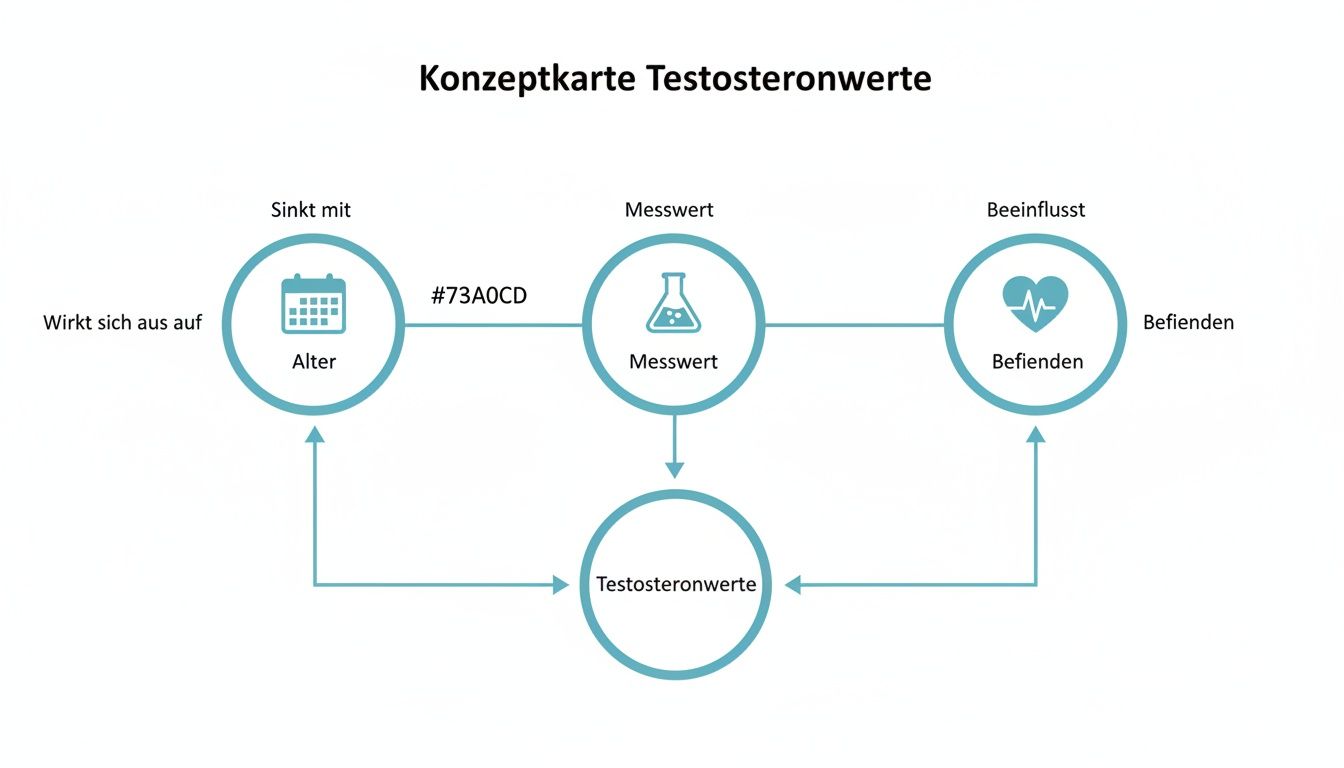
The visualization makes it clear that an isolated number says little. Only when considered in the context of age and possible symptoms does the full picture emerge. That is precisely why, in cases of borderline results or pronounced symptoms, it makes sense to have not only total testosterone but also SHBG measured. Free testosterone can then be calculated from these values, providing a much more precise picture of what is really going on in your body.
Why your testosterone levels decline with age
It is one of those biological facts that affects every man: your hormone balance changes over the years. This is no cause for concern, but a completely natural process—much like your skin changing or your hair turning gray. After all, your body is not a machine that runs at the same level forever, but a dynamic system that adapts.
From around the age of 30, testosterone levels gradually but steadily decline in most men. Studies show that levels decrease by an average of about one percent per year. That may not sound like much at first, but it adds up significantly over the decades.
That is precisely the main reason why normal testosterone levels for a man in ng/dL depend so heavily on age. A level of 450 ng/dL can be perfectly within the normal range for a 60-year-old, while the same level in a 25-year-old might be a reason to take a closer look.
The natural course of hormone production
Why does your body slow down hormone production as you age in the first place? There are several reasons. For one, the testicles, which produce the lion’s share of your testosterone, become somewhat less active. They no longer respond quite as sensitively to the regulatory signals sent by the brain. In addition, levels of a binding protein called SHBG often increase over the years. SHBG grabs onto free testosterone, effectively “binding” it and rendering it inactive.
The result is that both the total amount of testosterone and the crucial proportion of free, active testosterone decline. However, it is important to understand that this age-related decline is entirely normal and does not automatically indicate a medical problem.
Your body adapts. The goal is not to chase the hormone levels of a 20-year-old forever. Instead, you should aim for healthy levels appropriate for your age that help you feel vital and capable.
When does the decline become a problem?
A gradually declining level does not automatically mean that you will develop a deficiency requiring treatment. Many men cope extremely well with levels appropriate for their age and notice hardly any limitations. It only becomes a problem when the level falls significantly below the normal range typical for your age and you are also experiencing clear symptoms such as severe fatigue, lack of drive, or loss of libido.
Data from German men’s health research confirms this trend. It even shows that free testosterone in particular can decline by around 1.2% per year from the age of 40 onward. Nevertheless, only a small proportion of men develop a clinically relevant deficiency that genuinely requires treatment. You can read more about the background, for example, in Background information on testosterone levels in men on labor-vidotto.at.
The key message is this: A lower level with age is to be expected. As long as you feel well, there is usually no reason to worry. However, if you are unsure or notice symptoms, a test can provide clarity and show whether your level is still within the healthy, age-appropriate range.
Interpreting symptoms correctly—when you should have your level checked
Your testosterone level is far more than just a number on a lab report. It is one of the most important regulators of your energy, drive, and overall well-being in everyday life. But how can you tell that your level may no longer be within the optimal range? The tricky part is that these are often gradual changes that are all too easily attributed to stress, too much work, or simply a demanding lifestyle.

Do you often feel exhausted for no apparent reason, even though you have actually had enough sleep? Has your inner engine started to sputter, making it difficult to motivate yourself to do things you used to enjoy? These could be the first subtle warning signs that you should definitely pay attention to.
The classic signs of testosterone deficiency
A testosterone level that is too low can manifest itself in surprisingly diverse ways. Some signs are quite well known, while others are much subtler. If you recognize several of the following points in yourself, it could be a clear indication that your hormone balance is out of equilibrium.
The most common symptoms include:
- Persistent fatigue and lack of motivation: You often feel weak and lacking in energy without an obvious reason.
- Reduced libido: Your sexual desire has noticeably decreased.
- Difficulty building muscle: Despite regular training, you find it difficult to build muscle or even lose strength.
- Mood swings and irritability: You become irritated more quickly, feel down, or experience emotional instability.
- Increase in abdominal fat: More fat accumulates, particularly around the midsection, while muscle mass declines at the same time.
These physical and mental signals are often the first that men notice. They affect not only performance at work or during sports, but also significantly diminish overall quality of life.
Subtler signs you should not ignore
In addition to the obvious symptoms, there are also lesser-known signs that may indicate a low testosterone level. These include sleep problems, particularly difficulty staying asleep, as well as declining concentration and memory.
Testosterone deficiency is not a question of age, but of physical condition. When your body sends you clear signals, it is time to seek clarity instead of merely guessing.
If you recognize yourself in these descriptions, checking your current status is a very sensible step. A modern hormone test, such as the mybody-x testosterone test, offers a straightforward and reliable way to determine your level directly from home. This gives you a sound basis for understanding what is happening in your body and taking targeted next steps for your health.
Measure your testosterone level simply and reliably
Do you recognize yourself in some of these symptoms, or are you simply curious about where you stand? The path to reliable information about your hormone status no longer has to be complicated or uncomfortable. You can take control of your health data yourself—conveniently and discreetly from home.
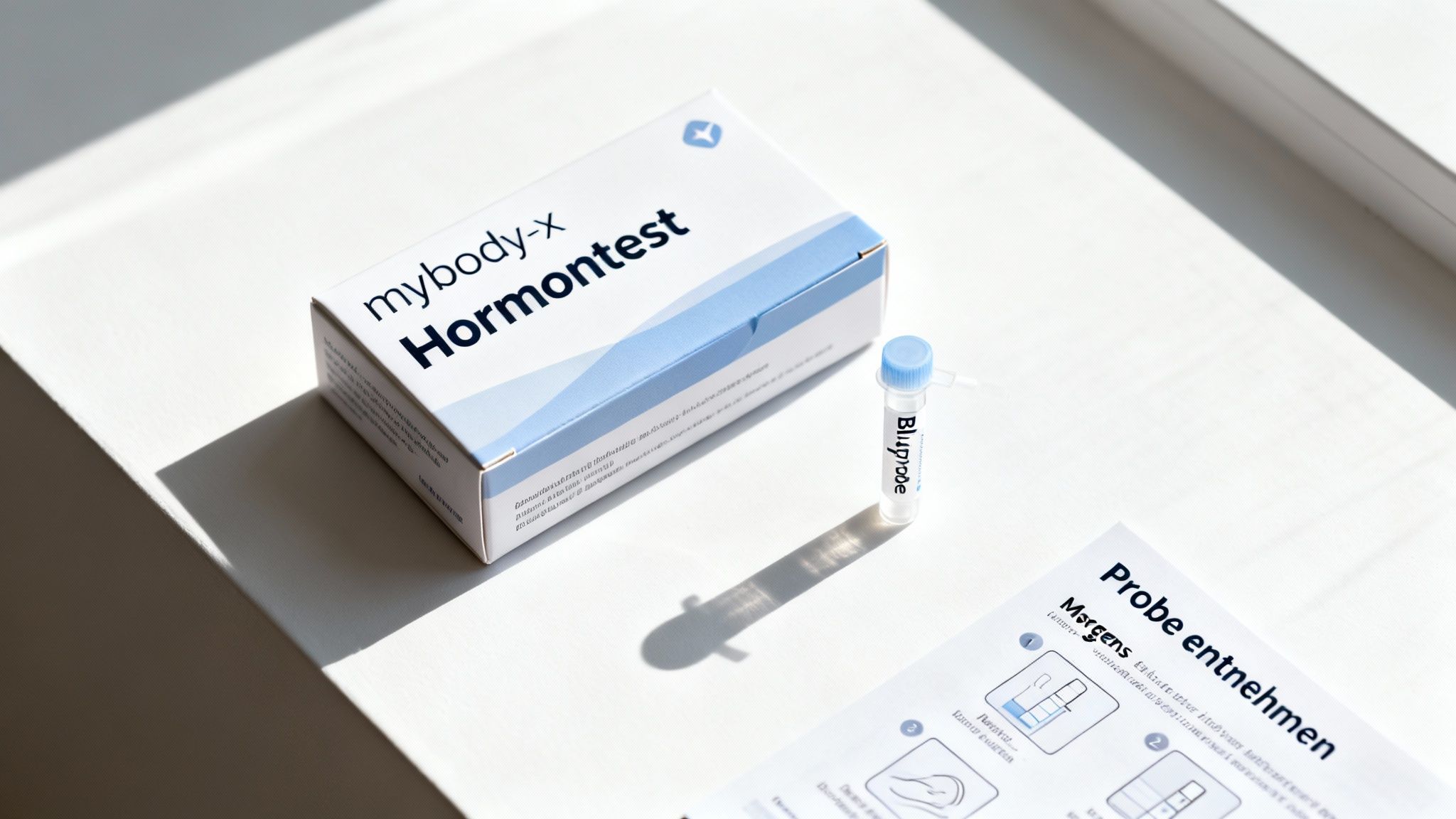
Timing is everything. Your testosterone level is not static but subject to natural daily fluctuations. It typically reaches its peak in the early morning hours. To obtain a truly meaningful and comparable result, the blood sample should always be collected in the morning between 7 and 10 a.m. while fasting. This ensures that you measure your peak level and that the result is not distorted.
How the mybody-x test works
We designed the mybody-x hormone test to make this process as easy as possible for you. No waiting for a doctor’s appointment, no crowded waiting rooms. You stay fully in control and can seamlessly integrate the test into your daily routine.
The process couldn’t be simpler and is broken down into three clear steps:
- Order the test kit: Simply order the test online, and it will be delivered directly to your home in discreet packaging.
- Collect your sample: The kit contains everything you need, including an easy-to-follow step-by-step guide. A small prick to your fingertip is all it takes to collect a few drops of blood—it’s quick and virtually painless.
- Send your sample: Then place your sample in the enclosed return envelope and send it free of charge to our certified German partner laboratory.
Your sample is analyzed at our partner laboratory using exactly the same scientific methods used in doctors’ offices and clinics. This guarantees a result of the highest medical standard.
As soon as the analysis is complete, you’ll receive your personal results report. We deliberately designed it so that you can understand it at a glance, even without a medical degree. You’ll see your exact testosterone level in ng/dl, clearly categorized according to the reference ranges that apply to your age.
But we won’t leave you alone with the numbers. Your report also provides clear, actionable recommendations showing you how to specifically support your hormonal balance if needed. Take control of your health—based on scientific evidence and without much effort.
If you’d like to learn more about exactly how this works, you’ll find all the details in our guide to the at-home hormone test.
What your test result means and what you can do now
Okay, you’re holding your results report in your hands—a crucial step is complete. But a number like 450 ng/dl on its own is only one piece of the puzzle. Now it’s about interpreting this result correctly and turning it into a clear plan for your well-being.
The first and most important step is to put the level into the right context. A level is never inherently good or bad in isolation. What matters is the interplay between your age, how you personally feel, and, of course, the measured level itself. A level that is optimal for a 65-year-old may already be considered low for a 25-year-old.
Interpreting the results correctly
To give you some guidance: Men’s health clinics in Germany often cite a functional reference range for total testosterone of 350–1.150 ng/dl. If your level falls significantly below 230 ng/dl and you are also experiencing symptoms, this is generally classified as requiring treatment. Levels between 230–350 ng/dl fall into a gray area where an individual assessment is particularly important.
But no matter where your level falls, you always have the opportunity to actively support your body.
Your test result is not a final verdict, but a starting point. It gives you the information you need to initiate targeted, positive changes for your health and performance.
Practical steps for your everyday life
You can positively influence your hormone balance naturally. Even small but consistent adjustments to your daily routine can make a big difference.
Here are the four most important levers you can use:
-
Optimize your diet: Your body needs the right building blocks for hormone production. A balanced diet with sufficient healthy fats, protein, and micronutrients is the foundation. To provide your body with optimal support, it is helpful to know which essential minerals the body needs.
-
Targeted strength training: Regular, intense workouts—especially with heavy weights, such as squats or deadlifts—have been shown to stimulate testosterone production.
-
Prioritize sleep: While you sleep, your body regenerates and produces a large proportion of its testosterone. Seven to nine hours of high-quality sleep per night are essential.
-
Reduce stress: Chronic stress causes the release of the stress hormone cortisol, which directly counteracts testosterone. Techniques such as meditation, walks in nature, or mindful breaks help lower cortisol levels.
These measures form the foundation for healthy hormone balance. You can also find further insights and detailed connections in our article about the importance of testosterone levels in men.
The most important questions about testosterone levels, answered succinctly
Here, we briefly and concisely answer the most frequently asked questions about testosterone to give you a quick overview.
Can I influence my testosterone levels through my diet?
Yes, very significantly. Your diet is the foundation for healthy hormone production. Important building blocks include zinc (found in nuts and meat), vitamin D (from sunlight or oily fish), and healthy fats (from avocados and high-quality olive oil).
On the other hand, being overweight and consuming a lot of sugar are genuine testosterone killers. A conscious and balanced diet is therefore one of the most powerful factors you can control yourself.
How reliable is an at-home testosterone self-test?
Very reliable—provided the sample is analyzed in a certified laboratory. The mybody-x tests, for example, use the same German, ISO-certified partner laboratories that are also used by many medical practices. The analysis is therefore identical.
The decisive factor for an accurate result is you: Follow the sample collection instructions exactly, especially the correct time in the morning.
Is it enough to measure only total testosterone?
Total testosterone is a great indicator for an initial assessment. But if your level is in the lower end of the normal range and you are also experiencing noticeable symptoms, it becomes interesting.
In that case, additionally measuring SHBG to calculate free and therefore active testosterone can be extremely informative. This gives you a much more complete picture of your actual hormonal status.
A low total level is a good indication. But only the combination of free testosterone and how you personally feel provides the complete picture of your hormonal situation.
At what level is it considered a deficiency?
There is no rigid threshold that applies to every man. Generally, however, it becomes critical when total testosterone falls below 230–350 ng/dl (that is, 8–12 nmol/l) AND you are also experiencing typical symptoms.
Ultimately, a doctor always decides whether treatment is necessary. They assess the overall picture based on your lab results, symptoms, and age.
Would you like clarity about your hormone levels and an understanding of what your body really needs? Discover the reliable hormone tests from mybody-x and receive a scientifically grounded results report with clear recommendations for action. Learn more here at mybody-x.com.



Share now:
Night Sweats in Women: Understanding the Causes and Finally Sleeping Better
What causes menstrual pain and how you can effectively relieve it