

Symptoms of iron deficiency: How to recognize it—and how not to
The most important points at a glance
According to IQWiG (2023), typical symptoms of iron deficiency include pale skin, fatigue, unusual exhaustion after exertion, difficulty concentrating and forgetfulness. All five complaints are nonspecific and can have many other causes. Iron deficiency therefore cannot be identified by how you feel, but only through blood values.
This article puts the typical symptoms into context, explains the laboratory values involved, and shows why a single measurement is rarely enough. Diagnosis assesses several values together: ferritin, transferrin, hemoglobin, as well as the size and pigment content of red blood cells. One point is particularly important and often overlooked: ferritin rises during inflammation and can therefore mask existing iron deficiency.
Read chapter 1 for an overview of the symptoms, chapter 6 for a comparison of the blood values, and chapter 7 if you want to know why a normal ferritin level does not rule out iron deficiency.
What to expect in this article
2. Why does iron deficiency cause symptoms at all?
3. Why are the symptoms so nonspecific?
4. How common is iron deficiency—and who is affected?
5. How does iron deficiency develop?
6. Which blood values indicate iron deficiency?
7. What does the ferritin level indicate—and what doesn’t it?
8. What should you do if you suspect iron deficiency?
9. How much iron do you need per day?
10. How to measure your ferritin level with mybody®
11. Putting it into perspective: What a blood test can—and cannot—do
12. Conclusion
Frequently asked questions
Sources
What symptoms suggest iron deficiency?
The Institute for Quality and Efficiency in Health Care (IQWiG, 2023) explicitly lists “pale skin, fatigue, unusual exhaustion after exertion, difficulty concentrating and forgetfulness” as possible signs of iron deficiency. These five complaints form the core of what is described in practice as a symptom complex.
The order in which many people notice the symptoms is striking. Usually, a decline in performance is noticed first: activities that were previously manageable without difficulty suddenly require noticeably more energy.
The signs identified by IQWiG (2023) at a glance
- ✓ Pale skin – a visible change that family members often notice before those affected do themselves.
- ✓ Fatigue – persistent and regardless of whether the night was sufficiently long.
- ✓ Unusual exhaustion after exertion – the key word is “unusual”: the comparison is with your own previous state.
- ✓ Difficulty concentrating – tasks that require focus take more attempts and more time.
- ✓ Forgetfulness – Appointments, names, and everyday details slip your mind more often than usual.
None of these signs necessarily occurs, and none occurs only with iron deficiency. Iron deficiency can also persist for a long time without being noticed at all—especially when it develops gradually and the body slowly adapts to the situation.
Key message: The symptoms of iron deficiency named by IQWiG (2023)—pale skin, fatigue, unusual exhaustion after exertion, difficulty concentrating, and forgetfulness—are all nonspecific. No single symptom and no combination of them proves iron deficiency.
This article deliberately examines iron deficiency from the perspective of its symptoms. If, on the other hand, you want to know how a nutrient deficiency is generally identified, Nutrient Deficiency Test is the right place to start; Vitamin and Mineral Test explains which vitamins and minerals can meaningfully be measured. If you are more concerned with persistent exhaustion related to energy metabolism, Poor Metabolism: What to Do? may be more suitable.
Why does iron deficiency cause symptoms in the first place?
Iron is a building block that the body needs continuously and cannot produce itself. The German Nutrition Society (DGE, 2023 edition) states this in its reference values as follows: “Iron is an essential trace element and cannot be produced by the body itself.”
If the body lacks iron for an extended period, this affects more than just one organ. It affects processes that take place throughout the body—and that is precisely why the symptoms are so varied and so difficult to attribute to a specific cause.
“
“Iron deficiency can impair physical performance, disrupt the body’s temperature regulation, and increase susceptibility to infections.”
German Nutrition Society (DGE)
Reference values for nutrient intake – iron, 2023 edition
This one sentence explains three very different groups of symptoms. The reduced physical performance is consistent with the “unusual exhaustion after exertion” described by IQWiG (2023). Impaired temperature regulation explains why some people affected report a persistent feeling of cold.
Increased susceptibility to infections is the third point and the one least often associated with iron. People who catch colds more often than before are more likely to think of stress or generally weak defenses than of their iron balance.
The DGE’s wording is important here: it says “may.” Iron deficiency does not automatically lead to all three consequences, and conversely, none of these consequences alone proves iron deficiency.
Why are the symptoms so nonspecific?
Fatigue, difficulty concentrating, and exhaustion are among the most common complaints—and among the least specific. They occur with sleep deprivation, infections, prolonged stress, insufficient energy intake, and a whole range of conditions requiring treatment.
A symptom is an indication that something is not working properly. It does not indicate what is not working properly. This is precisely where most online self-diagnoses fail.
There is another point to consider: iron deficiency is not always the same. According to IQWiG (2023), around 5 to 10% of people in Europe are affected by iron deficiency, whereas only about 2 to 5% have iron-deficiency anemia. The deficiency and its more severe form are therefore two conditions with different prevalences.
For you as a reader, this means that depleted iron stores do not necessarily indicate anemia, and symptoms may be present even when blood formation is still unremarkable. That is why looking at just one value is not enough.
Key message: According to IQWiG (2023), around 5 to 10% of people in Europe are affected by iron deficiency, while about 2 to 5% have iron-deficiency anemia. Iron deficiency therefore does not necessarily lead to anemia.
A third reason for the uncertainty lies in the progression over time. Iron deficiency generally develops slowly, over weeks or months. People who gradually become accustomed to a lower energy level often do not perceive the change as a change at all, but as their new normal.
That is why, in practice, the question “Since when?” is almost more important than the question “What exactly?” Comparing your current state with how you were six months ago says more than comparing yourself with a general list of symptoms.
This uncertainty is no reason for concern, but rather a reason to be careful. Anyone with symptoms does not need a quick explanation, but a verified one—and that comes from test results and medical assessment, not from a list of symptoms.
How common is iron deficiency—and who is affected?
Iron deficiency is widespread, but not universal. The following three figures put into perspective how often it occurs and what intake level adult women between 19 and 50 can use as a guide.
Source: IQWiG, 2023 (frequency) · German Nutrition Society (DGE), as of 2023 (reference value)
The distribution is not random. IQWiG (2023) states: “Iron deficiency is more common in women before menopause, mainly due to menstrual bleeding.”
This observation also explains why the DGE (as of 2023) gives women aged 19 to 50 a reference value of 16 mg of iron per day, while men aged 19 and older are given 11 mg per day. The difference reflects regular losses, not different biological value.
Being in one of these groups does not mean that you have iron deficiency. It merely increases the likelihood—and is a reason to think about iron status earlier when relevant symptoms occur.
How does iron deficiency develop?
Iron deficiency always develops when losses and requirements exceed the amount consumed and absorbed over an extended period. Three pathways lead to this, and they can be clearly distinguished.
Pathway 1: blood loss, especially from menstrual bleeding
Blood contains iron, so every loss of blood also means a loss of iron. IQWiG (2023) explicitly identifies menstrual bleeding as the main reason why iron deficiency is more common in women before menopause.
Blood loss can also come from other sources that are not visible. Therefore, newly diagnosed iron deficiency should always be medically evaluated—not merely treated, but understood in terms of its underlying cause.
Pathway 2: increased requirements during certain stages of life
The requirement increases significantly during certain stages of life. This is most clearly shown by the DGE reference values (as of 2023): For pregnant women, the value is 27 mg of iron per day—well above the 16 mg per day specified for women aged 19 to 50.
For breastfeeding women, the DGE (as of 2023) again recommends 16 mg per day. The increased value therefore does not apply permanently, but only during a clearly defined phase.
Pathway 3: insufficient intake or poorer absorption
Not every milligram of iron consumed is absorbed equally well. The DGE (as of 2023) describes it as follows: “The body can utilize iron from foods of animal origin (ferrous iron) better than iron from plant-based foods.”
For people who eat an entirely plant-based diet, this does not automatically mean a deficiency. It means that the amount consumed and its composition deserve more attention than with a mixed diet.
This context leads to a practical conclusion: The calculation “reference value reached, therefore adequately supplied” does not hold up. Between the amount on the plate and the amount that reaches the stores, there is an absorption step that a nutrition table cannot reflect.
The three pathways are not mutually exclusive either. Several factors often come together – for example, an increased need during a particular stage of life and, at the same time, a diet from which iron is less readily absorbed. That is precisely why every confirmed case of iron deficiency requires investigating its cause.
Key message: The German Nutrition Society (DGE, as of 2023) states that the body can utilize iron from animal-based foods better than iron from plant-based foods. Therefore, the amount consumed alone says little about actual iron status.
Which blood values indicate iron deficiency?
Iron deficiency is not determined based on a single laboratory value, but on several values considered together. IQWiG (2023) describes the diagnostic process verbatim as follows: “Various values are measured and assessed together – including how well the iron stores are filled (the ferritin value and transferrin value), the size of the red blood cells (the MCV value), how much red blood pigment they contain (the MCH value), and the total amount of red blood pigment in the blood (the hemoglobin value).”
This sentence is the most important technical note in the entire article. It says: One value alone cannot establish a diagnosis – even when it appears conclusive.
The following overview compares the four groups of values mentioned according to the same four criteria. The last column transparently shows which of them are included in the nutrient | are included in mybody®’s VitalCheck Complete – and which are not.
| Criterion | Ferritin | Transferrin | Hemoglobin | MCV and MCH |
|---|---|---|---|---|
| What does the value show? | How well the iron stores are filled (IQWiG, 2023); according to IQWiG (2025), the value indicates how much iron is stored in the body | Also, how well the iron stores are filled – according to IQWiG (2023), assessed together with the ferritin value | The total amount of red blood pigment in the blood (IQWiG, 2023) | The size of the red blood cells (MCV) and how much red blood pigment they contain (MCH) – IQWiG, 2023 |
| What can distort it? | Inflammation, infections, and tissue damage increase the ferritin value (IQWiG, 2025) | No individual value is specified in the source material used here; according to IQWiG (2023), the assessment is based only on the values considered together | No individual value is specified in the source material used here; a normal value does not rule out iron deficiency | No individual value is specified in the source material used here; both values describe the red blood cells, not the iron stores |
| Is the value alone enough for a diagnosis? | No | No | No | No |
| The nutrient | Included in VitalCheck Complete? | Yes—ferritin is one of the 15 markers | No | No | No |
The last sentence is deliberately worded so clearly. A home test that measures ferritin covers part of the diagnostic process—namely, the part that provides information about iron stores. Serum iron, transferrin, hemoglobin, MCV, and MCH are not included.
What does the ferritin level indicate—and what does it not indicate?
Ferritin is the value most often equated with iron status. IQWiG (2025) describes it matter-of-factly: “Ferritin is a protein that can bind iron.” It continues: “The ferritin level provides information about how much iron is stored in the body.”
IQWiG (2025) gives a normal range of 9 to 140 µg/l for women over 18 and 18 to 360 µg/l for men over 18 as a guide. These ranges are deliberately broad—a value within the range is not a judgment on your symptoms.
The crucial limitation: Ferritin increases with inflammation
Ferritin behaves like an acute-phase protein. IQWiG (2025) states verbatim: “During inflammation, infections, or tissue damage, more ferritin is present in the blood to inhibit the growth of bacteria.”
And further, also verbatim (IQWiG, 2025): “An elevated ferritin level, however, often does not indicate problems with iron metabolism, but rather inflammation.”
This leads to the most important caveat of this article: A normal or high ferritin level does not rule out iron deficiency. If inflammation or an infection is occurring in the body at the same time, the level may appear normal even though iron stores are low.
In practice, this means that anyone who has had an infection shortly before the blood test should take this into account during the assessment and discuss the timing of the test with their doctor. A single value without this context can be misleading.
In brief
According to IQWiG (2025), the ferritin level indicates how much iron is stored in the body and is within the normal range of 9 to 140 µg/l for women over 18 and 18 to 360 µg/l for men over 18. However, ferritin increases with inflammation, infections, and tissue damage. A normal or elevated ferritin level therefore does not rule out iron deficiency. A diagnosis is only made when several blood values are assessed together by a doctor.
What do you do if you suspect iron deficiency?
The sensible first step is not reaching for an iron supplement, but gathering information. Symptoms, their progression, and possible triggers form the basis for any subsequent assessment.
The following process describes the sequence that has proven effective in practice. It does not replace medical advice but helps prepare for it.
Record your symptoms
Note which of the signs mentioned by IQWiG (2023) are present, how long they have been present, and how severe they are. The progression is more informative than a snapshot.
Have your blood values measured
According to IQWiG (2023), diagnosis involves measuring several values and assessing them together—ferritin, transferrin, MCV, MCH, and hemoglobin.
Have the cause clarified
A confirmed iron deficiency always has a cause. The German Institute for Quality and Efficiency in Health Care (IQWiG) (2023) identifies menstrual bleeding as a common cause in women before menopause.
Have your treatment plan determined by a doctor
Whether and how iron should be taken should be decided by a doctor. Taking iron supplements on suspicion is not a good idea—excessive intake can be harmful.
The last point deserves special emphasis. Iron is a trace element, not a harmless everyday product: Taking it without a proven need can be harmful and can also make it more difficult to assess later test results.
If symptoms persist for weeks or worsen, they should be assessed by a doctor—regardless of what a self-test has shown.
How much iron do you need per day?
The German Nutrition Society (DGE) publishes reference values for daily iron intake. They vary by sex, age, and stage of life—and more significantly than many people expect.
Reference values for daily iron intake (DGE, as of 2023)
Source: German Nutrition Society (DGE), Reference Values for Nutrient Intake – Iron, as of 2023. Figures in milligrams per day.
The gap between men aged 19 and over at 11 mg per day and pregnant women at 27 mg per day is almost two and a half times as large (DGE, as of 2023). It shows how strongly requirements depend on the circumstances of life.
It is important to put these values into context: A reference value describes the recommended intake, not the measured status. Even if you mathematically reach 16 mg per day, you may still have low iron stores—for example, due to higher losses or poor absorption.
The reverse is also true: Merely falling below the reference value mathematically does not mean you have a deficiency. The values are guidelines for intake—the actual nutritional status is only revealed by the blood test.
How to measure your ferritin level with mybody®
mybody® (MYBODY Lab GmbH) offers an at-home blood test to assess nutritional status. It measures 15 markers from capillary blood collected yourself via a finger prick; the analysis is performed in an ISO-certified laboratory in Germany, and the data processing complies with the GDPR.
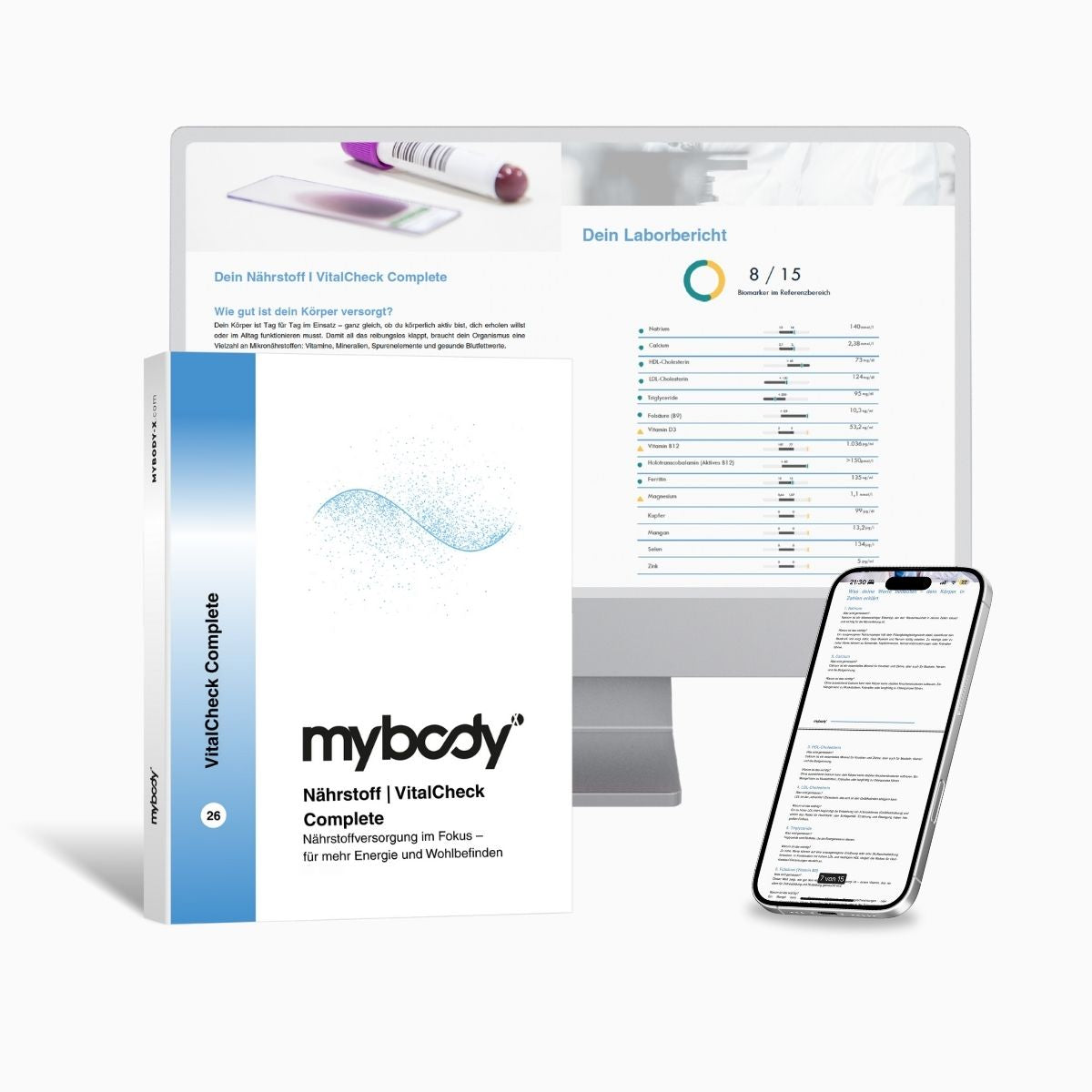
Nutrient | VitalCheck Complete
The VitalCheck Complete measures 15 markers from capillary blood: 25-OH vitamin D3, calcium, magnesium, ferritin, folic acid, sodium, transcobalamin, vitamin B12, HDL, LDL, triglycerides, selenium, manganese, copper, and zinc.
For assessing iron status, exactly one marker is relevant: ferritin. Serum iron, transferrin, hemoglobin, MCV, and MCH are not included—nor are potassium or thyroid values. The test therefore does not replace medical iron deficiency diagnostics, which, according to IQWiG (2023), assesses multiple values in combination.
Price: €169.00 (instead of €199.00) · Sample type: Capillary blood collected at home · Processing time: 4–8 days after receipt of the sample · Laboratory: ISO-certified, in Germany
For nutrients | VitalCheck CompletePrice information as of July 28, 2026. Prices, marker coverage, and processing times may change—the linked mybody® product page (MYBODY Lab GmbH) is always authoritative.
Such a test is most useful as a baseline assessment: It provides you with a measured ferritin value rather than a guess. What this value means in relation to your symptoms can then be clarified at your doctor’s office.
For context about the brand: mybody® belongs to MYBODY Lab GmbH, works with an ISO-certified partner laboratory in Germany, and processes samples pseudonymously. Results are transmitted using SSL encryption.
Context: What a blood test can—and cannot—do
A self-test provides measurement results, not a diagnosis. This distinction is the most important sentence in this chapter—and the one most frequently overlooked.
In concrete terms for iron status, a ferritin value alone does not indicate iron deficiency. IQWiG (2023) explicitly describes diagnosis as an assessment of multiple values in combination, including transferrin, MCV, MCH, and hemoglobin.
The value itself is also susceptible to interference. Because ferritin rises with inflammation, infections, and tissue damage according to IQWiG (2025), an unremarkable result can conceal an existing deficiency. A normal ferritin value is therefore not an all-clear.
The time perspective is also limited. A blood value is a snapshot; it becomes particularly meaningful over time, through a second measurement after a dietary change or medically supervised treatment.
One point that distinguishes it from other types of tests: A DNA test cannot measure iron status. Genetic analyses describe predispositions, not the current concentration of a storage protein in the blood—for the question “What does my iron store look like today?” a blood test is the appropriate tool.
And finally: No test replaces a medical search for the underlying cause. Confirmed iron deficiency is a finding that requires an explanation—and that explanation is not found in a lab printout, but through discussion and further evaluation.
Conclusion
The symptoms of iron deficiency are well known but nonspecific. Pale skin, fatigue, unusual exhaustion after exertion, difficulty concentrating, and forgetfulness (IQWiG, 2023) are indications—but nothing more.
The figures put the issue into perspective: According to IQWiG (2023), around 5 to 10% of people in Europe are affected by iron deficiency, while around 2 to 5% have iron-deficiency anemia. Common, but not inevitable.
It is equally important to know what does not indicate iron deficiency: not a single symptom, not a list of symptoms on the internet, and not a single unremarkable ferritin level—because, according to IQWiG (2025), ferritin rises during inflammation.
Specifically, this means: Write down your symptoms, have your blood levels tested, and have a doctor interpret the results. Taking iron supplements on suspicion alone is not part of this process.
If you want a measured ferritin level as a first step, an at-home blood test is an objective starting point—with the clear understanding that it provides a storage value, not a diagnosis.
Frequently asked questions about symptoms of iron deficiency
Would you rather have your ferritin level measured than guessed?
The nutrient | VitalCheck Complete measures 15 markers from capillary blood collected at home—including ferritin. Results are available 4–8 days after the sample arrives at an ISO-certified laboratory in Germany. The test provides measured values, not a diagnosis: serum iron, transferrin, hemoglobin, MCV, and MCH are not included.
Go to VitalCheck Complete View all nutrient testsYou might also be interested in
→ Nutrient Deficiency Test
How a nutrient deficiency is generally identified and which steps are involved.
→ Vitamin and Mineral Test
Which vitamins and minerals can be meaningfully measured—and what the values indicate.
Sources
- German Nutrition Society (DGE): Reference values for nutrient intake – iron (as of 2023)
- Institute for Quality and Efficiency in Health Care (IQWiG): Iron deficiency and iron-deficiency anemia (2023)
- Institute for Quality and Efficiency in Health Care (IQWiG): Ferritin (2025)
The institute quotation, all reference values for daily iron intake, and information on the utilization of iron from animal and plant foods are taken from [1]. The list of symptoms, prevalence figures for Europe, and description of diagnostics are based on [2]. The definition of ferritin levels, reference ranges, and information on inflammation, infections, and tissue damage are taken from [3]. All other information mentioned in the text is identified at the relevant point with the institution and year and can be found there. All product information for mybody® (MYBODY Lab GmbH) comes from the official product pages at mybody-x.com, as of July 28, 2026.

mybody® Editorial & Expert Team
Iron metabolism Blood analysis interpretation Laboratory diagnostics Nutritional science Nutrient supply
This article was created and medically reviewed by the mybody® editorial and expert team at MYBODY Lab GmbH. The team brings together expertise in nutritional science, laboratory diagnostics, blood analysis interpretation, microbiome research, and nutrigenetics. Learn more about the people behind it on the mybody® authors page.
Published on July 28, 2026 · Last updated on July 28, 2026
Medical information: This article is intended for general information and does not replace medical advice, diagnosis, or treatment. Self-tests provide indications, not diagnoses. If you experience persistent fatigue, paleness, shortness of breath, a racing heart, unintended weight loss, or visible blood loss, please consult a doctor. Do not take iron supplements without a confirmed need—excessive intake can be harmful. If you take medication, are pregnant, or are breastfeeding, discuss dietary changes and supplements with a doctor beforehand.




Share now:
When should you take electrolytes? The 5-step timing plan
Low fT3 level: what the lab value means—and what it doesn’t mean