

fT3 value too low: what the laboratory value means—and what it does not
The essentials at a glance
According to IQWiG, a low fT3 value may indicate hypothyroidism—but by itself, it says nothing more. The thyroid is first assessed using another value: TSH. It is measured to assess thyroid function using a measurable indicator, and an elevated TSH value suggests hypothyroidism.
This leads to the most practically important point of this article: a low fT3 value without an abnormal TSH value is different from a low fT3 value with elevated TSH. The number alone does not provide a diagnosis, and a single laboratory value is never evaluated in isolation.
This article puts these points into context. First, what fT3 actually is and why TSH comes first. Then it covers the prevalence of hypothyroidism, reference ranges, three common misconceptions, and why a single value fluctuates. Finally, it explains which values should be measured together and where the limits of any self-assessment lie.
What to expect in this article
1. What fT3 is and why TSH comes first
2. How common hypothyroidism is
3. Reference ranges and what they provide
4. Three misconceptions about the fT3 value
5. Why a single value fluctuates
6. Which values belong together
7. How you find out your thyroid levels
8. What a laboratory value does not answer
9. What ultimately matters
Frequently asked questions
Sources
What fT3 is and why TSH comes first
Triiodothyronine, or T3 for short, is a thyroid hormone according to IQWiG. In the blood, it occurs in two forms: bound to protein and circulating freely. Total triiodothyronine is the sum of free triiodothyronine—the fT3—and the protein-bound fraction (as of 2025).
Today, usually only free triiodothyronine is measured. According to IQWiG, total T3 is used only for specific questions. So anyone who finds an fT3 value on their test result is looking at the value that is generally measured.
Why the free form in particular
The difference between bound and free is not a detail for experts; it is the reason why there is a small “f” before T3 on your test result. By far the greater proportion of the hormone is bound to transport proteins in the blood and is not immediately available in this state. The free fraction is the portion that circulates unbound.
Because total T3 is the sum of both fractions, it also depends on how much transport protein is currently present. If the amount of these proteins changes, the total value changes with it—even if the free fraction itself has not changed. This is the practical explanation for why the free form has become the standard, while total T3 is now reserved for specific questions.
For you as someone reading a test report, this leads to a small but useful rule: Pay attention to whether it says “T3” or “fT3.” The two values use different numerical scales and have different reference ranges. A value that is unremarkable on one scale cannot readily be transferred to the other.
The value that supports the assessment
The actual control parameter in thyroid diagnostics is another hormone. TSH is not produced in the thyroid, but in the pituitary gland—and it is the value used first to assess thyroid function.
“
“TSH is measured to assess thyroid function using a measurable parameter.”
Institute for Quality and Efficiency in Health Care (IQWiG)
Thyroid-stimulating hormone (TSH), as of 2025
Key message
A low fT3 value may indicate hypothyroidism—but thyroid function is assessed first using the TSH value.
The feedback loop behind it
According to IQWiG, TSH is a hormone produced by the pituitary gland and released into the blood. It stimulates the thyroid to produce hormones—and the amount released depends on how much thyroid hormone is already in the blood.
If the concentration of thyroid hormones in the blood is too high, the pituitary gland reduces TSH production. If it falls, more TSH is produced to maintain the balance (IQWiG, as of 2025).
This feedback loop explains why TSH is the more sensitive measure. It responds to changes in thyroid hormones before the hormones themselves fall outside the reference range. According to IQWiG, elevated TSH levels indicate hypothyroidism, while low levels may indicate hyperthyroidism.
At first glance, the result seems backwards: In hypothyroidism, the TSH level is actually high. This becomes understandable when TSH is viewed not as a thyroid hormone, but as an instruction to the thyroid. If it supplies too little, the instruction becomes louder—the level rises. If it supplies too much, the instruction becomes quieter. TSH therefore describes not the supply, but the demand.
That is precisely what determines the order of diagnostic testing. As long as the thyroid can still compensate, the hormone levels remain within range—but by that point, the control signal has already shifted. Anyone who looks at fT3 first simply misses this early stage of the process.
That is why an isolated low fT3 value is incomplete information, not an alarming finding. It may point in one direction. Whether it does is determined by the value next to it.
Distinction: Ratio or individual value
If you are interested in the ratio of fT3 to fT4—that is, how the two values relate to each other—our article Optimal fT3/fT4 ratio is the right resource. This article focuses exclusively on an individual low fT3 value and how to interpret it.
How common hypothyroidism is
Before assessing it, it helps to put the prevalence into perspective. Hypothyroidism is neither rare nor commonplace.
Source: Institute for Quality and Efficiency in Health Care (IQWiG), 2024 and 2025
IQWiG notes that women and older people are particularly frequently affected (as of 2024). So a woman past middle age who finds an abnormal result is statistically closer to the truth with that assumption than a young man with the same finding.
This figure can be read in two ways, and both are useful. Five out of one hundred means that hypothyroidism is not exotic, the suspicion is not an exaggeration, and investigating it is not excessive. But five out of one hundred also means that ninety-five out of one hundred do not have it. Anyone who notices fatigue, lack of energy, or changes in weight has a reason to look into it—but not yet a reason to assume they have already found the cause.
Signs of hypothyroidism
IQWiG lists weakness and fatigue, concentration and memory problems, dry skin, and slight to moderate weight gain among the symptoms of hypothyroidism (as of 2024). What stands out about this list is less what it contains than how nonspecific each individual item is on its own.
Fatigue has many causes, as do concentration problems, and dry skin is no exception. No single item on this list points to the thyroid on its own. What supports the suspicion is more the pattern: several of these symptoms occurring together over a longer period, without a more obvious explanation.
That is the decisive point when evaluating a laboratory value. Symptoms without a test result leave the question open. A test result without symptoms also leaves the question open. Only when both come together do two clues form a picture—and even then, interpreting it remains a medical task.
What lies behind hypothyroidism
According to IQWiG, hypothyroidism is most commonly caused by thyroid inflammation. The source also cites removal of the thyroid, radiation therapy, severe iodine deficiency, certain medications, and rare genetic causes.
This list explains why the search for the cause does not end with the laboratory value. A low fT3 value says nothing about which of these causes is present—and treatment is guided by the cause, not by the number.
The range of these causes is also what makes self-assessment so unreliable. Thyroid inflammation, surgery, radiation therapy, severe iodine deficiency, a medication, and a rare genetic predisposition have little in common—yet in the laboratory they can produce similar numbers. It is therefore not possible to infer the cause from the number.
It is also notable how many of these causes are already known from a person’s medical history. Anyone who has had thyroid surgery, undergone radiation therapy, or takes medication long term has information that no measurement can provide. That is precisely why medical assessment begins with a conversation, not with the report.
In brief
According to IQWiG, around 5 in 100 people in Germany have an underactive thyroid, particularly women and older people. The TSH reference range for adults is 0.3 to 3.5 mU/L, while the T3 range from age 18 onward is 1.1 to 2.0 nmol/L. The most common cause of an underactive thyroid is thyroid inflammation—but the fT3 value does not reveal the cause in an individual case.
Reference ranges and what they do
A reference range describes which values are measured in a comparison group of healthy people. It is therefore a statistical measure, not a judgment about an individual person.
For TSH, IQWiG provides age-dependent ranges: up to age 20, 0.51 to 4.3 mU/L; for adults, 0.3 to 3.5 mU/L; and from age 50 onward, 0.3 to 4.5 mU/L (as of 2025). For T3, the same source gives 1.1 to 2.0 nmol/L, or 70 to 132 ng/dL, for adults aged 18 and over.
Why your report may show different limits
A laboratory report shows the limits used by the testing laboratory, and these may differ from those listed here. The reason lies in the measurement method used—different methods produce different scales.
In practice, this means you should always compare your value with the reference range shown on the same report, not with a range from another source. And compare two reports from different laboratories with caution.
What a value just outside the range means—and what it does not
A reference range is not a wall at which health ends and illness begins. It shows which values were measured in a comparison group and, by its nature, does not include every healthy person. A value just below the limit may indicate an emerging change—or simply be a normal value for that person.
The reverse is also true: A value within the range is not a certificate of harmlessness. Someone who was previously significantly higher and is now at the lower end has undergone a change that the number alone does not reveal. That is why one’s own previous result is often more informative than any general threshold.
It is also noteworthy that IQWiG differentiates the TSH range by age: up to 20 years, for adults, and again from age 50, when the upper limit is somewhat higher. A value at the upper end for a 35-year-old may be unremarkable for a 60-year-old. Age is therefore part of the assessment, not just the number.
All of this leads to a calmer attitude toward one’s own test result. A value slightly outside the range is a reason to take a closer look. It is not a result that stands on its own, let alone one that requires haste.
Three misconceptions about the fT3 level
A number of assumptions have become established around thyroid values that sound plausible and nevertheless lead people astray. Three of them are particularly common—and all three share the same core: They make a number mean more than it actually does.
The third misconception is the most persistent because it feels so reassuring. After months of unexplained fatigue, anyone who finally finds an explanation does not want to let it go again. IQWiG’s cautious wording—low values may indicate—is not an evasive maneuver but a precise description of what a single value can tell us.
The practical value of this caution becomes apparent by the second step at the latest. Anyone who considers the thyroid issue settled stops looking further—and may overlook the cause that is actually behind the symptoms. In this case, leaving an open question open is the fastest route to an answer.
Why a single value fluctuates
Laboratory values are snapshots. This is especially true of thyroid values because they are part of a feedback loop that continuously adjusts.
A low fT3 value without an abnormal TSH value is different from a low fT3 value with elevated TSH.
The time of day explains some of the fluctuation, and overall health explains another part. In severe illnesses, thyroid values can change without the thyroid itself being affected—a reason why values during such phases should be interpreted cautiously.
Medications also play a role. IQWiG explicitly lists certain medications as possible causes of an underactive thyroid. Which medications these are in an individual case belongs in the discussion with your doctor and on the medication list you bring with you.
What else influences the number
In addition to the time of day and state of health, the circumstances of the measurement itself play a role. When the blood was drawn, how long the sample was in transit before analysis, and which method the laboratory uses—all of this forms part of the conditions under which the number was generated. It therefore never stands entirely on its own.
Anyone wanting to compare two results will find it easier if the conditions are the same: preferably the same laboratory, preferably the same time of day, and preferably the same interval from meals and medication intake. This does not make the numbers more accurate, but it does make them more comparable—and for a value that naturally fluctuates, comparability is often more valuable than precision in an individual instance.
The question of how to handle the result belongs here too. In practice, a finding that is borderline on one occasion is checked again after some time rather than immediately leading to treatment. This waiting period can feel unsatisfactory, but it is precisely the response that fits the nature of the value.
For you, this means that a single borderline result is a reason for a follow-up test, not for drawing a conclusion. Only two measurements taken some time apart show whether it is a trend or a snapshot.
Which values belong together
Because the three values are part of a feedback loop, their combination is what produces a meaningful picture. The following comparison organizes them according to the same criteria.
Two cells in the table are intentionally left blank. The source material used makes no substantiated statement about fT4 as an individual value and does not provide a reference range for it. Explicitly acknowledging this gap is more honest than filling it with a number of unclear origin—especially in an article about how much a single number can tell us.
| Criterion | TSH | fT3 | fT4 |
|---|---|---|---|
| Where it is produced | In the pituitary gland | In the thyroid | In the thyroid |
| Role in the feedback loop | Control signal – stimulates the thyroid | Active hormone in the tissues | Thyroid hormone |
| Assessed first? | Yes – function is assessed based on this measurement | No – supplementary | No – supplementary |
| What a low value may indicate | An overactive thyroid | An underactive thyroid | No substantiated individual statement in the source material used |
| Reference range for adults | 0.3–3.5 mU/l; from age 50: 0.3–4.5 mU/l | For T3 from age 18: 1.1–2.0 nmol/l | No information in the source material used |
Information based on the Institute for Quality and Efficiency in Health Care (IQWiG), 2024 and 2025. Two cells are explicitly left blank because the source material used provides no information about them.
The table reveals a rule for interpretation. The TSH level indicates whether anything is out of balance at all. The two thyroid hormones indicate how well the thyroid is still meeting this demand. Only together do they show where in the regulatory system the shift is occurring.
This is also why a result containing only one of these values is rarely very informative. A low fT3 level alone leaves open whether the regulatory system is already compensating. A TSH level alone leaves open how far the thyroid can still respond to this signal. If you are going to go through the effort of testing anyway, the complete combination provides significantly more information than an individual value.
How to find out your thyroid levels
The usual route is through a general practitioner or specialist practice. If you want an interim update between appointments, you can also have the values measured at home from capillary blood. mybody®x (MYBODY Lab GmbH) offers two options for this, which differ in how comprehensive they are.

Women's Wellness Check | Women's Health Test
Measures 16 biomarkers from capillary blood and is the only test in the range that measures TSH, fT3, and fT4 together—as well as 25-OH vitamin D3, ferritin, cortisol, HbA1c, and blood lipids, among others. What the test does not do: It does not provide a diagnosis or determine the cause. Whether an abnormal result is due to thyroid inflammation, medication, or something else requires medical evaluation.
Price: €169.00 (instead of €199.00) · Sample type: Capillary blood · Processing time: Kit shipping 1–3 business days, laboratory analysis 3–5 business days after receipt of the sample · Laboratory: ISO-certified laboratory analysis in Germany
About the Women's Wellness CheckIf you are simply looking for quick guidance on your TSH level, a rapid test can also be useful—with the caveat that it measures neither fT3 nor fT4 and therefore omits precisely the aspect discussed in this article.
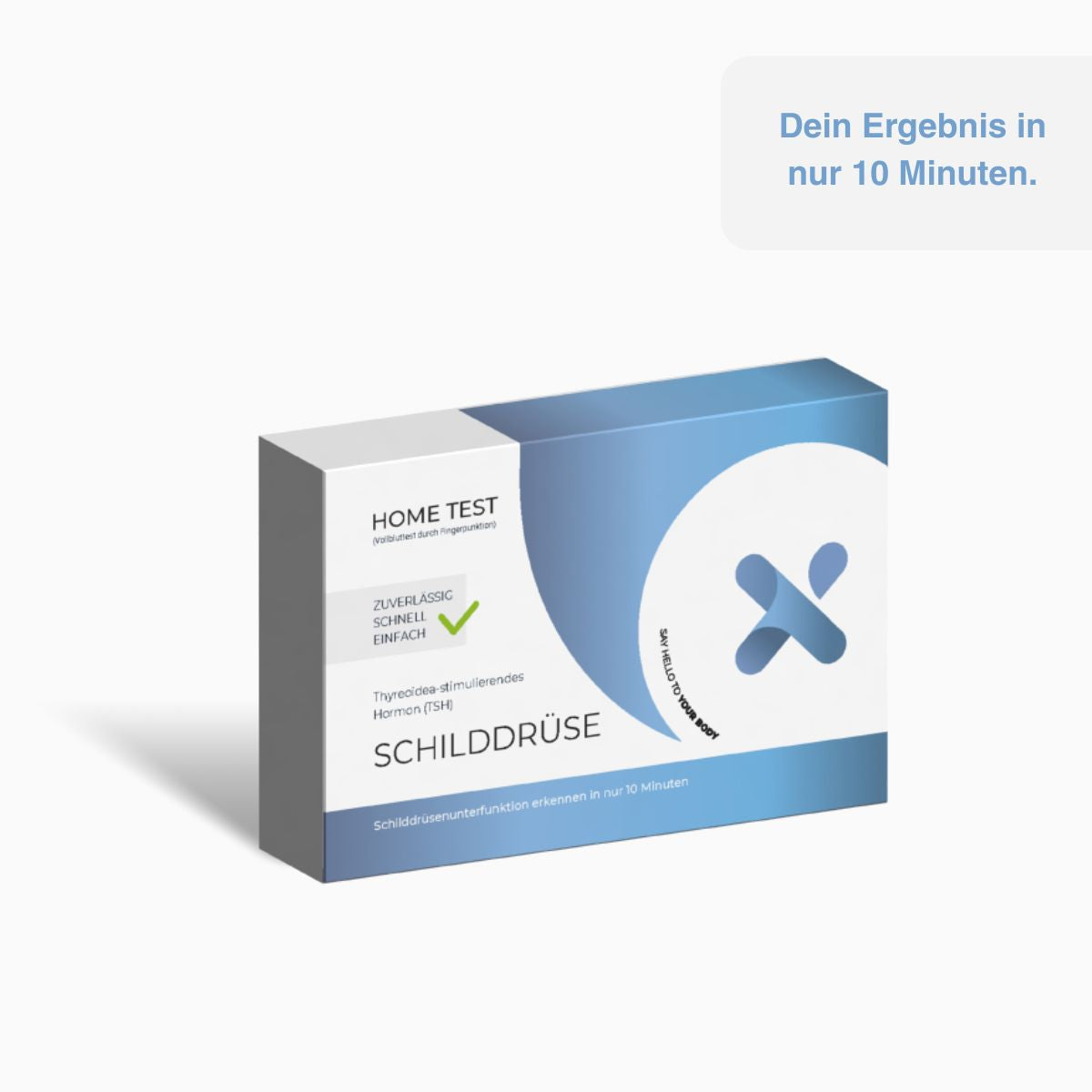
Thyroid TSH Level Self-Test
Tests the TSH level from capillary blood and delivers the result to your home. What the test does not do: It measures neither fT3 nor fT4 and does not provide an exact numerical value, but rather a threshold result. An abnormal result should be medically confirmed—and an unremarkable result does not rule out thyroid disease.
Price: €14.50 · Sample type: Capillary blood · Processing time: Result in 5–10 minutes · Laboratory: no laboratory processing, evaluated at home
To the thyroid TSH self-testAll price and service information is current as of August 5, 2026. Prices and the scope of services may change; the relevant product page always governs.
What a laboratory value does not answer
The first limitation is the most important: A laboratory value is not a diagnosis. Only together with symptoms, medical history, medications, and, where applicable, further examinations does it become an assessment—and that assessment is made by a doctor.
The second limitation concerns the cause. Even if an underactive thyroid has been confirmed, the value says nothing about whether the cause is thyroiditis, iodine deficiency, a medication, or something else. The treatment depends on precisely this.
The third limitation is self-treatment. According to IQWiG, L-thyroxine is taken once a day for an underactive thyroid, preferably half an hour before breakfast; as a result, the symptoms usually disappear completely. This is a prescription medication with a dose determined by a doctor—there is nothing to manage yourself here.
And a fourth: Taking iodine-containing supplements on speculation is not a good idea. A pronounced iodine deficiency is one of several possible causes, but only one—and no self-assessment can determine whether it is present.
What a laboratory value can very well do, however, is easily overlooked in the list of limitations. It makes visible something that would otherwise only be suspected, provides a starting point for monitoring changes over time, and gives the conversation with your doctor a concrete basis. Someone who comes to the practice with a question and a number enters the conversation differently from someone who describes only a vague sense of feeling unwell.
The difference lies in the expectation. A value intended as the starting point for a conversation delivers what it promises. A value intended as an answer reliably disappoints—not because the measurement is poor, but because it has been assigned a task it was never designed for.
What matters in the end
A low fT3 level may indicate an underactive thyroid. It does not prove it, and it is not the first consideration in the assessment—TSH comes first because it reflects thyroid function using a measurable parameter.
What this means for you is a sequence. First look at the TSH level, then at the combination of the three values, then at the symptoms—and then have the conversation with your doctor, where both come together.
Your specific next step: Check your report to see whether a TSH level is listed alongside the fT3 level, and compare it with the reference range on the same page. If the TSH level is missing, that is the one piece of information still needed for proper interpretation—and the reason to schedule an appointment.
Frequently asked questions
What does an fT3 level that is too low mean?
According to IQWiG, it may indicate an underactive thyroid—but on its own, it does not tell you more than that. Thyroid function is initially assessed using the TSH level; an elevated TSH level may be a sign of an underactive thyroid. A low fT3 level without an abnormal TSH level must therefore be assessed differently from one accompanied by elevated TSH.
What fT3 level is normal?
For adults aged 18 and over, IQWiG gives a range for T3 of 1.1 to 2.0 nmol/l or 70 to 132 ng/dl. Important: Your laboratory report may show a different range because it depends on the testing method used. Therefore, always compare your value with the reference range on the same report.
Why is TSH measured first instead of fT3?
Because TSH is the control signal of the regulatory system. According to IQWiG, it is produced in the pituitary gland: If the concentration of thyroid hormones in the blood is too high, the pituitary gland reduces TSH production; if it falls, more TSH is produced. As a result, TSH responds to changes earlier than the thyroid hormones themselves and is suitable as an initial measurement.
What is subclinical hypothyroidism?
According to IQWiG, this refers to a situation in which the TSH level is elevated, but sufficient thyroid hormones are produced and no symptoms occur. An abnormal laboratory value therefore does not automatically mean that treatment is needed—whether and when to treat is a medical decision.
Can I measure my thyroid levels at home?
The blood sample can be collected at home from the fingertip, while a laboratory performs the analysis. Pay attention to the scope of the test: A TSH-only rapid test measures neither fT3 nor fT4. Regardless of the scope, one thing applies: A laboratory value is not a diagnosis. It can only be assessed medically in conjunction with symptoms, medical history, and medications.
The three values belong together
A single fT3 value is not enough to make an assessment. If you want an interim picture, it is worth taking a test that measures TSH, fT3, and fT4 together—as a basis for discussing the results with your doctor, not as a substitute for medical advice.
View Women's Wellness Check TSH Self-TestYou might also be interested in
→ Optimal fT3/fT4 Ratio: What Your Blood Values Really Mean
When it is not about the individual value, but about how the two relate to each other.
→ TSH Thyroid Values: Your Guide to Thyroid Health
The value that comes first in the assessment, explained in detail.
Sources
- Institute for Quality and Efficiency in Health Care (IQWiG): Thyroid-stimulating hormone (TSH), as of 2025 — gesundheitsinformation.de
- Institute for Quality and Efficiency in Health Care (IQWiG): Total triiodothyronine (T₃), as of 2025 — gesundheitsinformation.de
- Institute for Quality and Efficiency in Health Care (IQWiG): Hypothyroidism, as of 2024 — gesundheitsinformation.de
The description of TSH, the feedback loop involving the pituitary gland, the statements on elevated and decreased TSH levels, and the TSH reference ranges are based on source [1]. The distinction between total T3 and free T3, the information on standard measurement practices, the statement on decreased T3 levels, and the T3 reference range are taken from source [2]. Frequency, sex and age distribution, symptoms, causes, the definition of subclinical hypothyroidism, and information on treatment with L-thyroxine are taken from source [3]. The notes on laboratory-dependent reference ranges and fluctuations are general laboratory-medicine context and are not supported by numerical values. Product information is taken from the mybody®x product pages, accessed on August 5, 2026.

mybody®x Editorial & Medical Team
Blood values Hormones Laboratory diagnostics
This article was created and medically reviewed by the mybody®x Editorial and Medical Team. The team combines expertise in nutrigenetics, microbiome and gut science, blood test interpretation, nutritional science, and laboratory diagnostics.
Published on August 5, 2026 · Last updated on August 5, 2026
Medical notice: This article is intended for general information and does not replace medical advice, diagnosis, or treatment. Abnormal thyroid values should be medically evaluated; thyroid hormones are available only by prescription and must not be started, discontinued, or changed in dosage without medical advice.




Share now:
Symptoms of iron deficiency: How to recognize it—and what not to mistake for it
Meeting your daily vitamin B12 requirement: the amount and how to achieve it