
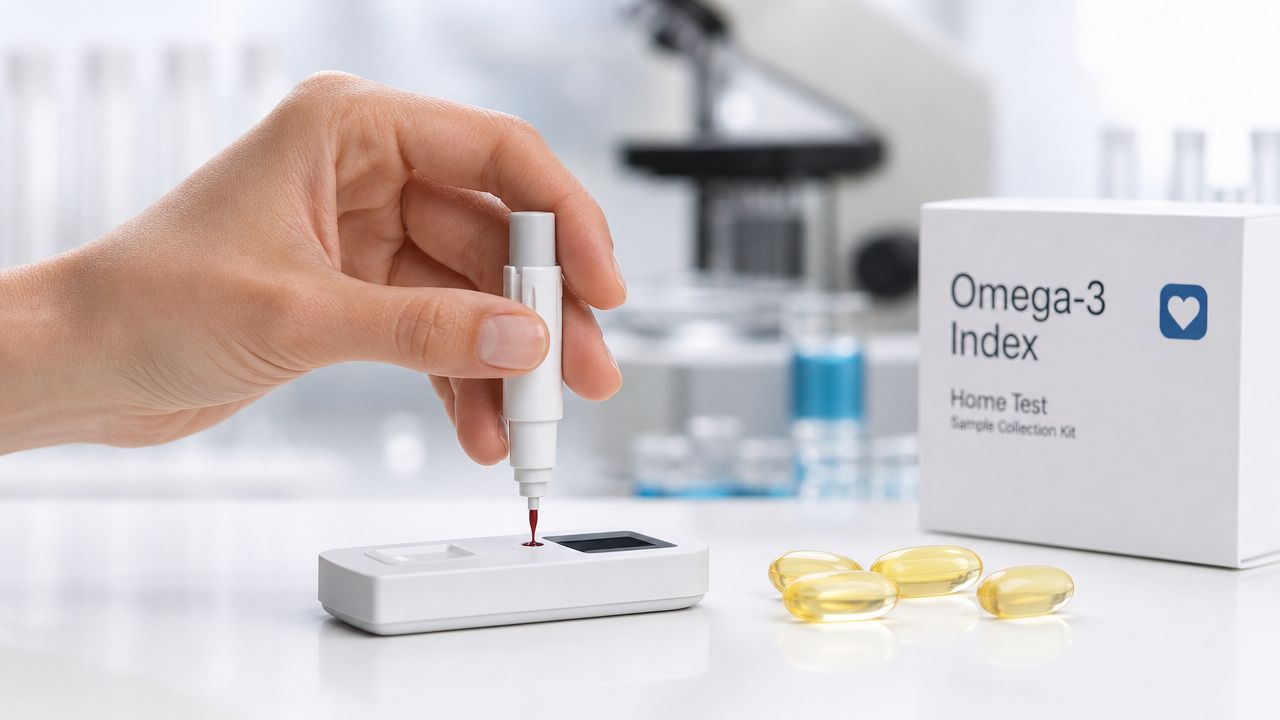
Testing for an omega-3 deficiency: Your guide to the result
You may be at exactly this point right now: You feel sluggish more often, your concentration is not what it used to be, and your skin seems drier than usual. At the same time, you do not want to simply take anything just because “omega-3 is probably good for you.”
That is sensible. Especially when it comes to testing for an omega-3 deficiency, the goal is not to guess at symptoms, but to measure your status accurately, interpret it correctly, and then make smart decisions.
Why an omega-3 deficiency is about more than just fatigue
Many people start with a suspicion. They notice that they do not feel fully capable, that something feels “not quite right” internally, or that minor everyday complaints simply do not go away. Fatigue, concentration problems, or dry skin may initially seem harmless. That is precisely what makes the issue so insidious.
The problem is that such complaints are nonspecific. They can be consistent with stress, poor sleep, other nutrient deficiencies, or inadequate omega-3 intake. If you recognize yourself in this, an overview of typical omega-3 deficiency symptoms can help, but it does not replace a test.
Why symptoms alone do not provide a clear answer
Omega-3 fatty acids play a role in areas you notice directly in everyday life. Among other things, they are relevant to the brain, heart, and regulation of inflammatory processes. If your intake has been inadequate for a longer period, this can become noticeable on several levels.
An everyday example: Someone works a lot, sleeps moderately well, and eats “pretty well, actually.” Then dry skin, an irritable mood, and the feeling of not really getting going in the morning are added to the mix. Stress is often the obvious explanation. That may be true. But it is also possible that their nutrient status is playing a role in the background.
Symptoms can be a clue. Clarity only comes when you measure instead of guessing.
The crucial difference between suspicion and certainty
If you rely only on how you feel, you can quickly fall into two traps. Either you ignore the issue for too long. Or you start taking supplements prematurely, without knowing whether a deficiency actually exists.
Neither is ideal. A test provides an objective basis here. That is precisely why it is worth moving from “maybe” to a measurable value. Not because every vague symptom automatically means an omega-3 deficiency, but because only an objective result allows you to make a meaningful decision about what is right for you next.
What an omega-3 deficiency really means
An omega-3 deficiency does not simply mean “too little good fat.” More precisely, it means an inadequate supply of the important omega-3 fatty acids EPA and DHA. These fatty acids are building blocks of cell membranes and are therefore involved in many of your body’s basic functions.
If you want to keep it simple, think of your cells as small workspaces with flexible walls. EPA and DHA help keep these walls mobile and functional. When they are lacking, communication between cells is less effective, and processes related to inflammation can more easily become unbalanced.

EPA and DHA as a team
You can think of EPA and DHA as a well-coordinated team. They belong together, but they do not have exactly the same role. For diagnostics, it is important that the Omega-3 Index measures precisely these two fatty acids in the erythrocytes, thereby reflecting your status over the past 90 to 120 days. In practice, a value below 4% is considered low, while 8 to 11% indicates good status, as FormMed explains regarding the Omega-3 Index.
That is why symptoms are less informative than a laboratory value. A bad day says little. The fatty acids in your red blood cells reveal much more about your long-term status.
Why the topic is also easy to understand beyond humans
The basic principle of essential fatty acids is relevant not only to human nutrition. Anyone who wants to become familiar with the topic in general will also find an accessible explanation in essential fatty acids for dogs of why fatty acids are so important for cell function, skin, and overall balance.
If you want to better assess your nutritional status, it is also worth taking a look at an overview of omega-3 fatty acids. It makes clear why individual nutrients should never be considered in isolation.
In some cases, a blood test may reveal abnormalities not only in your omega-3 status. If a confirmed deficiency in other nutrients is present at the same time, the Vitamin D3 K2 Complex | Shield, for example, may be appropriate. According to the product description, it combines high-dose D3 with K2 to support calcium utilization, bone health, and the immune system and is intended for situations following DNA or blood testing when a deficiency has been confirmed.
How easy it is to test your omega-3 status
If you want to test for an omega-3 deficiency, you generally have several options. What matters less is whether blood is measured and more what is measured. For a longer-term assessment, the Omega-3 Index is the key value.
In Germany, the index is determined from the erythrocyte membrane. The target range is 8 to 11%, and values below 8% are associated with risks such as cardiovascular disease. A German laboratory provider typically reports the results after 10 to 14 working days, as described in the IMD Berlin patient information on the Omega-3 Index.

Which testing methods make sense
Not every measurement answers the same question. This is often where confusion arises.
- Short-term snapshot: Some blood values can fluctuate considerably and tend to show what you have eaten recently. This is less helpful for assessing a longer-term omega-3 status.
- Omega-3 Index in erythrocytes: This value is practical because it reflects your status over a period of weeks to months.
- Home dried blood spot test: For many people, this is the simplest option if they do not want to visit a medical practice specifically for this purpose.
How a home test works
Collecting the sample may seem more technical at first than it actually is. Usually, it involves a few drops of blood from the fingertip applied to a test medium.
The typical process looks like this:
-
Preparing the test kit
You prepare the lancet, test card, and instructions, and make sure your hands are warm and clean. -
Collecting a blood sample
With a small prick to the fingertip, you collect a few drops of blood. This is usually quick and easy to do. -
Dry and send the sample correctly
The sample is then packaged according to the instructions and sent to the laboratory. -
Interpreting the result
The laboratory value is the most important part. Even more important, however, is what you conclude from it.
Practical rule: A good test answers not only “How high is my level?” but also “Is this a meaningful reason for me to take action?”
Anyone who wants to understand the process in more detail can find relevant information on test approaches and background under Omega-3 testing.
In this context, a mybody x blood test may be an option for use at home. According to the provider, mybody®x works with ISO-certified laboratories in Germany and offers self-tests in which the sample is conveniently collected at home and then analyzed in the laboratory.
For people who want to take a more personalized approach to their overall health, the DNA Metabolism Analysis may also be of interest. According to the product description, it identifies genetically determined metabolic types as well as fat and carbohydrate utilization, and serves as the basis for an individual nutrition and training plan.
Understanding and interpreting your test result correctly
A percentage is only useful once you know how to interpret it. This is exactly where many people struggle. They see a number, but not what it means.
For Germany, the classification is fairly clear. A specialist article reports that 76% of the people examined in hundreds of thousands of analyses were deficient. It also states that 4 to 6% is considered suboptimal, below 4% critically low, and 8 to 11% optimal, as SpringerMedizin presents the classification of the Omega-3 Index.
How to interpret the value in practice
The number does not describe how you are feeling today. It shows your longer-term status. That is why the value is so useful for making decisions.
| Omega-3 Index (%) | Assessment | Recommendation |
|---|---|---|
| below 4% | critically low | have the result assessed by a doctor or nutrition specialist and take targeted action |
| 4 to 6% | suboptimal | review your diet and establish a structured improvement plan |
| 8 to 11% | optimal | maintain the current level and monitor only when needed |
What the ranges mean in everyday life
A critically low level is more than just “not ideal.” It indicates that the supply of EPA and DHA is significantly too low.
A suboptimal range is the gray area where many people fall. You are not automatically facing an acute problem, but your status is also not where it would be most favorable in the long term.
The optimal range does not mean that everything else becomes unimportant. Rather, it indicates that your intake is within a range described as favorable. The main goal then is to maintain your habits instead of making unnecessary changes.
A laboratory value is not a verdict. It is a point of navigation.
If you want to think about your health more broadly and over the long term, the Longevity | ALL IN ONE DNA Test may also be relevant. According to the product description, it analyzes genetic risk factors related to aging, inflammation, nutrient utilization, and metabolism. This can help put an omega-3 value into a broader prevention context.
Your personal plan after the result
A test result is only the beginning. The real question is: What will you do with it now?
Many people make a mistake at this point. They see a low result and immediately reach for high-dose supplements. That may seem decisive, but it is not automatically wise. A sensible plan is data-driven, practical for everyday life, and cautious enough to take potential risks into account.

What you can do specifically if your level is low
The first place to start is usually your diet. Depending on your lifestyle, fatty fish sources or suitable alternatives for a plant-based diet may be options. The important thing is not to simply aim for “somehow more omega-3,” but to take an honest look at your habits.
This sequence is often helpful:
-
Take an honest look at your diet
Do you eat omega-3-rich foods regularly, or only rarely? -
Take a measured approach to supplements
Supplements can be useful, but not as an automatic response and not independently of your test result. -
Pay attention to special risks
If you have cardiovascular issues or take blood-thinning medication, the decision should be considered particularly carefully.
More background on laboratory values and their place in a broader blood nutrient analysis can help if you want to understand not just an individual value but the bigger picture of your health.
When a follow-up test really makes sense
Impatience is often unnecessary here. Many people want to test again after only a short time. That is of limited value for the omega-3 index.
The reason is simple: Fatty acids are measured in erythrocytes, which have a lifespan of about 3 months. Therefore, repeat testing after a dietary change or supplementation is only truly meaningful after that period, as explained in the WeightWorld article on the right time to retest.
Anyone who retests too soon is often measuring impatience rather than a stable change in status.
Why Uncontrolled High Doses Are Not a Good Idea
A low result does not automatically mean that more will help more. Especially when it comes to supplements, the right amount matters. Anyone who wants to improve their level should follow a tailored plan rather than act impulsively.
This is especially important because the question that follows the test is not only about benefits but also about safety. A smart strategy is therefore: know your level, interpret the result, choose an appropriate diet and any suitable supplements, then calmly test again after an appropriate period.
Conclusion: Take control of your health
If you want to test for an omega-3 deficiency, you are ultimately not looking for theory but for clarity. Nonspecific symptoms may be a reason to take a closer look. But you should not rely on them alone.
The most sensible approach is a measurable result that you can interpret. Only then does a vague suspicion become a reliable basis for decisions. The step afterward is just as important: Not every low result calls for blind action, and not every product is automatically harmless.
German authorities such as the BfR point out that high doses of omega-3 supplements may increase the risk of atrial fibrillation and affect bleeding tendency. Therefore, taking supplements indiscriminately after a test without consulting a doctor is risky, as emphasized by the BfR in its FAQ on omega-3 fatty acids.
The best thing about a test is not the number itself. It is the ability to take action that comes from it. You can eat more strategically, supplement more mindfully, and choose the next testing time sensibly. That is how an interest in health becomes genuine self-management.
If you no longer want to estimate your omega-3 status but understand it concretely, a mybody x blood test can be a practical next step. You collect the sample at home, receive a laboratory result, and can then decide whether dietary changes, follow-up testing, or supplementation under medical supervision is the right path for you.



Share now:
Progesterone deficiency symptoms: Recognize the signs and take action
Vitamin D Deficiency: Causes, Symptoms & Simple Home Test