
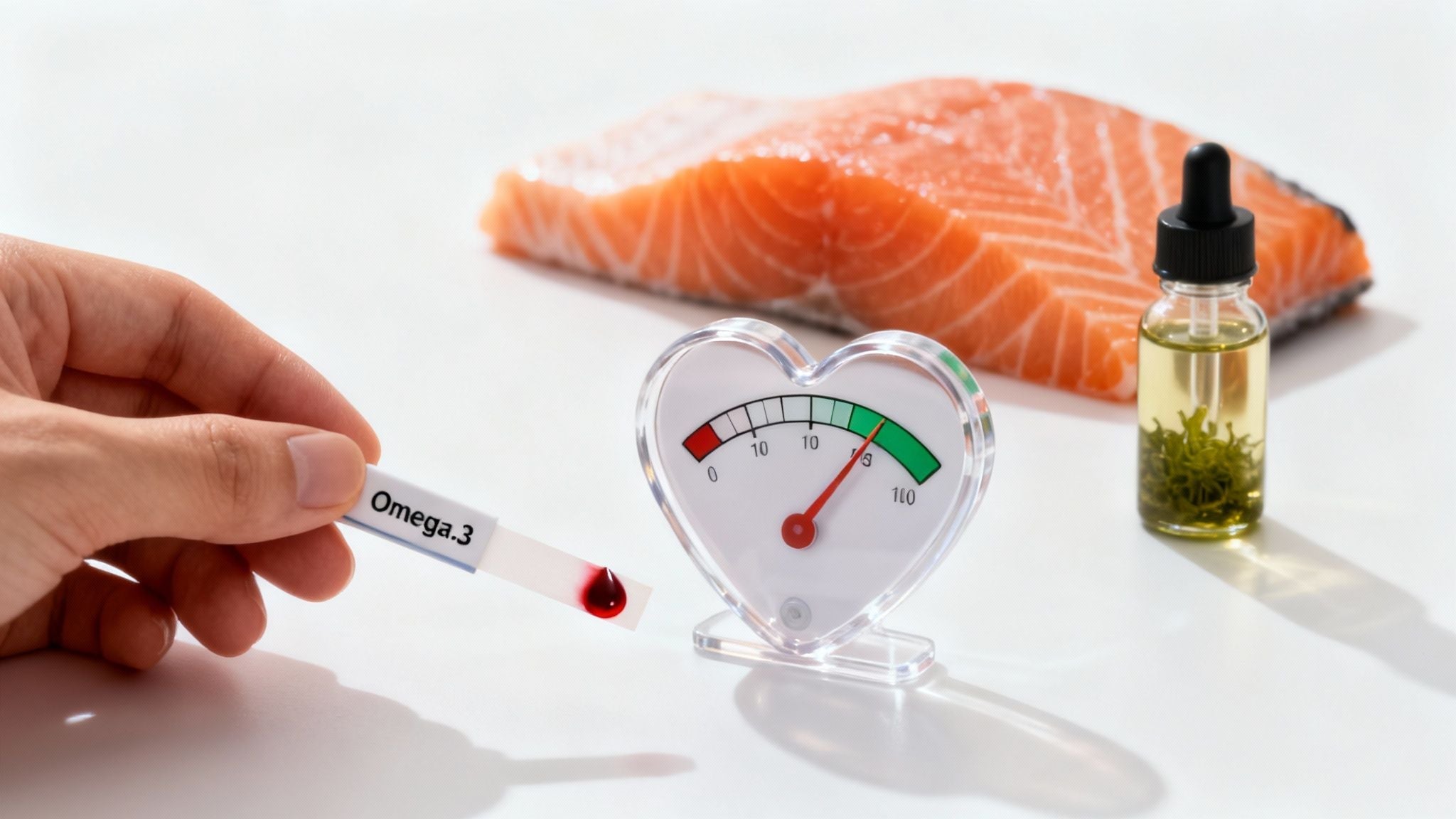
The Omega-3 Index Test for your heart health
An Omega-3 Index Test is much more than just another blood value. It measures the exact proportion of the important omega-3 fatty acids EPA and DHA directly in your red blood cells. This gives you a clear, unbiased picture of your long-term supply and is a decisive factor in your heart health.
What your Omega-3 Index really means
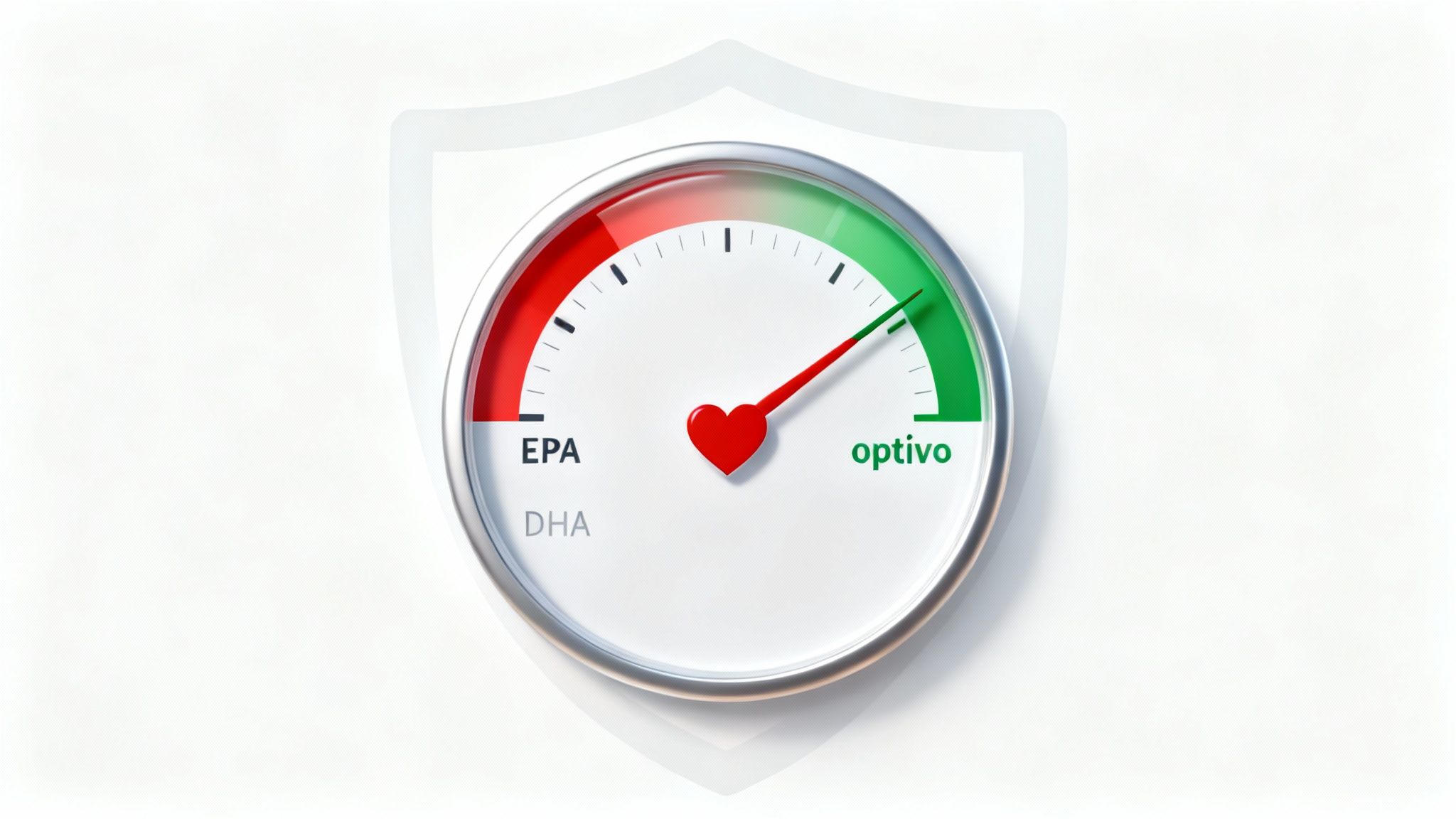
Think of the Omega-3 Index as a speedometer for your heart health. A quick glance is enough to know how well your body is supplied with the vital fatty acids eicosapentaenoic acid (EPA) and docosahexaenoic acid (DHA). These two are true all-rounders for your body.
Since your body cannot produce them in sufficient quantities on its own, you rely on obtaining them through food or targeted supplements. They are a fundamental building block of every cell membrane in your body and keep them flexible and functional.
The protective shield for your cells
An optimal omega-3 status is like a strong protective shield around your heart and brain. The fatty acids EPA and DHA play a key role in regulating inflammatory processes, maintaining healthy blood pressure, and balancing blood lipid levels.
A high index value means that your cells are well protected and resilient. A low value, on the other hand, is a weak point in your defenses and is associated with an increased risk of cardiovascular disease.
The Omega-3 Index is therefore much more than just a laboratory value—it is a direct measure of the health of your cell membranes and an early warning system for your long-term vitality. It gives you a clear, measurable basis for taking an active role in your own health.
The hidden supply gap
The insidious thing about an omega-3 deficiency is that it often goes unnoticed for a long time. Studies show that a large proportion of people in Germany, often over 75 %, an Omega-3 Index below the recommended target range of 8 % has. So many people unknowingly live with inadequate protection, even though they may think they eat healthily.
The reason is our modern dietary habits. Pro-inflammatory omega-6 fatty acids often predominate, while fatty cold-water fish—the best source of EPA and DHA—ends up on our plates far too rarely. Without targeted testing, you're completely in the dark.
Clarity through a simple blood test
And this is exactly where the Omega-3 Index Test from mybody-x comes in. Instead of guessing whether your diet is sufficient, a simple blood test finally gives you certainty. With mybody-x's nutrient test, you can conveniently determine this crucial value from home.
You receive a precise analysis showing you where you stand. This is the data foundation you need to specifically improve your intake. It is the first and most important step toward taking control of this essential component of your health and actively strengthening your protective shield.
If you’d like to delve deeper into the fascinating world of these nutrients, you can learn more about the many functions of omega-3 fatty acids in our article. This test is your personal compass on the path to a healthier heart and greater well-being.
How the at-home test works
Forget complicated doctor’s appointments and long waits in the consultation room. The path to your personal omega-3 level is now easier and more direct than ever. With the mybody-x Omega-3 Index Test, you bring the laboratory virtually into your own living room—discreetly, quickly, and with absolute precision.
We’ll now show you step by step how straightforward the entire process is. You’ll see: Modern preventive healthcare isn’t rocket science, but a smart tool that enables you to take an active role in managing your well-being.
Your path to your results in 3 clear steps
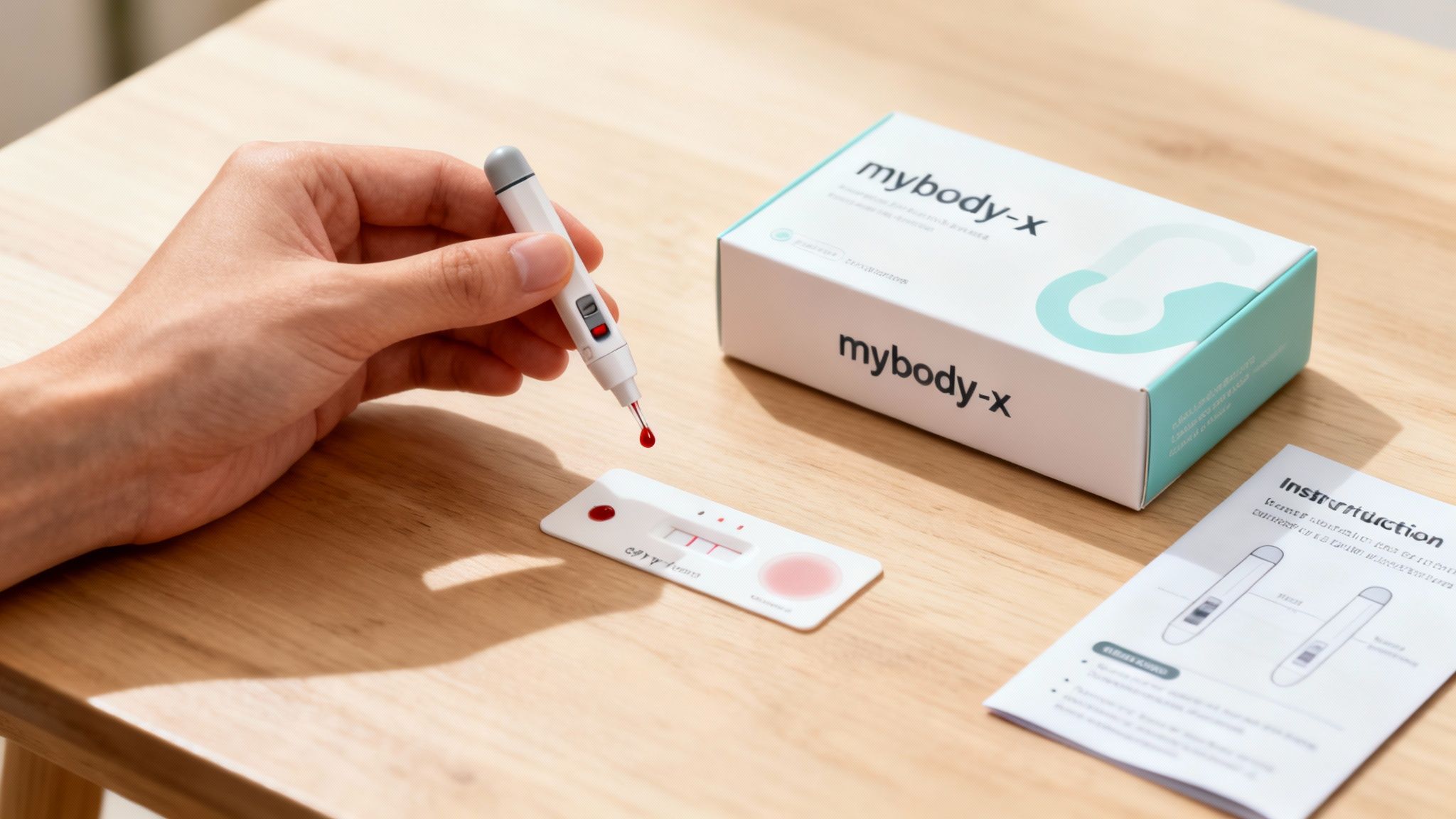
The entire process is designed to be so simple that you can carry it out safely even without prior experience. Your mybody-x test kit contains everything you need—including super-clear instructions.
-
Activate and prepare: First, activate your test kit online using your personal test ID. This is important so that your sample can later be anonymized in the laboratory while still being correctly matched to you. Then lay everything out, wash your hands thoroughly with warm water, and dry them well.
-
Painless blood collection: Using the small, automatic lancet included in the kit, gently prick your fingertip. Just a few drops of blood are enough; let them drip onto the enclosed test card. The process is lightning-fast and barely noticeable—you could almost compare it to a mosquito bite.
-
Ship it securely: Let the drops of blood on the card air-dry for a short while. Then place everything in the included, prepaid return envelope and drop it in the nearest mailbox. We’ll take care of the rest.
As you can see, the process is deliberately kept simple. It’s about giving you control without requiring you to interrupt your daily routine or coordinate time-consuming appointments.
The dried blood spot method: Precision meets convenience
Perhaps you’re wondering whether a fingertip sample is just as reliable as a blood draw at the doctor’s office? The clear answer is: Yes, absolutely. The mybody-x test uses the proven dried blood spot method.
This method is an established procedure in medical diagnostics and has been used successfully for decades, for example in newborn screening. The fatty acids in your red blood cells are extremely stable when dried, making highly precise laboratory analysis possible in the first place.
- Accuracy: The measurements are scientifically validated and are just as reliable as those from a venous blood sample.
- Stability: Your sample remains stable during transport, ensuring the quality of your results at all times.
- Convenience: You save yourself a trip to the doctor’s office and can collect the sample whenever it suits you best.
This modern approach makes it incredibly easy to check important health parameters such as the Omega-3 Index simply and regularly. If you’d like to learn more about how convenient at-home blood tests can be, we’ve compiled all the important information on doing a blood test yourself. This turns self-care into a simple, established part of your healthy lifestyle.
Understanding and interpreting your test results correctly
You’re holding your test result in your hands—and now what? Curiosity is often mixed with a slight sense of apprehension. But don’t worry: your result isn’t a complicated code; it’s your personal guide to better health. We’ll help you decipher the numbers.
Your Omega-3 Index Test result is provided as a simple percentage. This value shows the proportion of the two important omega-3 fatty acids, EPA and DHA, in the membranes of your red blood cells. Think of it like a fuel gauge: The fuller the tank, the better protected you are.
The three zones of your heart health
To make the classification as simple as possible, the Omega-3 Index is divided into three zones. Each zone represents a specific risk to your cardiovascular health and gives you clear guidance.
- The risk zone (below 4%): A result in this range is a clear warning sign. It indicates a significant deficiency. The risk of cardiovascular problems, especially sudden cardiac death, is highest in this range. Urgent action is needed.
- The moderate range (4 % to 8 %): This is a gray area. Some protection is present, but it is far from optimal. See it as a good starting point from which you should take targeted measures to reach the green zone.
- The target range (above 8 %): Congratulations! A value above 8 % is scientifically considered a safe protection range. Your risk of cardiovascular disease is therefore significantly lower. The goal now is to maintain this value over the long term.
The range between 8 % and 11 % is considered optimal. It provides the best possible protection for your heart and blood vessels. This is the stated goal for anyone who wants to take an active role in their health.
Unfortunately, the reality in Germany looks different. The average Omega-3 Index is a sobering 4–5 %. This means that the majority of people are in the moderate or even high-risk range. An analysis of more than 40,000 tests by the Omegametrix laboratory shows that three out of four people in Germany do not reach the protective level of 8 %. Particularly alarming: With an index below 4 %, the risk of sudden cardiac death is at least 10 times higher than with a value above 8 %. You can find more about these alarming findings on the Omega-3 Index at health-supp.com.
Your value at a glance
To help you put everything into context even better, we have summarized the most important reference values and their significance for you in a clear table.
This table helps you classify your personal Omega-3 Index value and understand the associated risk to your heart health.
Reference values for the Omega-3 Index and their significance
| Omega-3 Index value (%) | Assessment | Significance for your cardiovascular risk |
|---|---|---|
| < 4 % | High risk | Insufficient supply; the risk of cardiovascular events is significantly increased. |
| 4 % - 8 % | Moderate risk | Suboptimal supply; basic protection is present, but insufficient. |
| > 8 % | Low risk (target) | Optimal supply provides the best protection for the heart and blood vessels. |
So your mybody-x test result is much more than just a number. It is your personal starting point and an extremely useful tool. It shows you exactly where you stand and gives you the motivation for the next steps. Don’t see it as a judgment, but as what it is: an opportunity to actively do something for your health and specifically strengthen your protective shield.
The most common causes of a low omega-3 index
Do you actually eat fairly well, have fish from time to time, and are still shocked by your low omega-3 level? Don’t worry—you are absolutely not alone. Many people are surprised when their Omega-3 Index Test shows that they are miles away from the green zone. Let’s take a look at what is really behind it.
The main cause is almost always found in our typically German eating habits. Even when fish is on the menu, the quantity or type is often simply not enough. Because when it comes to valuable omega-3 fatty acids, not all fish is created equal.
The myth of occasional fish consumption
Honestly, a small portion of salmon on the weekend will not be enough. To reach the optimal target range of over 8 % To reach and maintain it, you would have to really load up several times a week—specifically on fatty cold-water fish such as salmon, herring, or mackerel. That is the only way to sustainably replenish the reserves in your cell membranes.
This graphic gets to the heart of the matter and shows where most of us in Germany unfortunately stand.

You can see it immediately: the average value in Germany is well below the protective range. This is not an isolated case but a widespread deficiency.
Our eating habits are to blame. On average, men in Germany eat just 105 grams of fish per week, while women eat only 91 grams. And a full 16% of the population avoids it completely. A major European study classified the German figures as “low”—optimal levels were found only among population groups in Alaska, Japan, and South Korea. You can find more details in the findings of the Technical University of Munich.
The imbalance between omega-6 and omega-3
But there is another often-overlooked opponent: omega-6 fatty acids. They are found in many vegetable oils such as sunflower oil, in processed foods, and in meat from intensive livestock farming—in other words, virtually everywhere in our modern diet.
Imagine that omega-3 and omega-6 compete for the same place in your body. An excess of omega-6 blocks the absorption and utilization of omega-3. Even if you eat enough fish, too much omega-6 can simply reduce its positive effects.
A healthy ratio is around 3:1 (omega-6 to omega-3). In reality, however, things often look very different, with ratios of 15:1 or even worse. This silent saboteur can quickly undo your efforts to improve your index.
Your body, your rules: Individual factors
In addition to diet, highly personal factors also play a role in how your body uses omega-3. It simply isn’t the same for everyone.
- Your metabolism: Each of us processes fats at a different speed and with varying efficiency.
- Age and stage of life: The need can increase significantly with age or during special periods such as pregnancy.
- Genetic predisposition: Your genes have a say in how well your body can convert and store fatty acids.
- Illnesses: Chronic inflammation or certain diseases can dramatically increase the body’s omega-3 consumption.
A low level therefore rarely has just one cause. Usually, it’s a mix of diet, lifestyle, and your individual biology. If you suspect you may have a deficiency, take a look at the typical omega-3 deficiency symptoms. In the end, though, a test is the only way to obtain real clarity.
Improve your omega-3 level in a targeted and sustainable way
A low omega-3 level is no reason to worry—it’s your personal starting signal to take action. See the result of your Omega-3 Index Test as a compass that will point you in the right direction from now on. With a clear plan, you can strategically increase your index and noticeably strengthen your heart and brain’s protective shield.
The path to an optimal level is not a sprint but more of a marathon. It’s about sustainable changes to your diet and lifestyle that will pay off in the long term.

Strategy 1: Choose the right foods
The most effective way to raise your omega-3 level leads straight through your plate. Here are the superstars among the EPA and DHA sources that directly contribute to your index:
- Fatty cold-water fish: Salmon, mackerel, herring, and sardines are the undisputed front-runners here. Just two to three portions of 150–200 grams per week can significantly improve your level. A small tip: Look for wild-caught quality, as this fish often has a higher omega-3 content than farmed fish.
- Plant-based power from the sea: For anyone who follows a plant-based diet or does not like fish, algae oil is the perfect alternative. It is obtained from microalgae—the original source from which fish also get their omega-3. Algae oil provides the valuable fatty acids EPA and DHA directly and is therefore far superior to plant oils such as flaxseed oil, which contains only the inefficient precursor ALA.
Strategy 2: Supplement your diet in a targeted way
Let’s be honest: In the hectic pace of everyday life, it is often difficult to meet your needs through diet alone. High-quality dietary supplements can be a very practical and effective way to help you reach a target level of over 8 % to reach and maintain.
The right dosage is crucial. To effectively raise a low index, 2,000 to 4,000 mg of EPA and DHA per day are often needed over several months. Once you have reached your target level, a maintenance dose of 1,000 to 2,000 mg daily is usually sufficient to maintain your status.
Quality is paramount here. When choosing fish or algae oil capsules, look for a high degree of purity, a low oxidation value (TOTOX value), and certificates guaranteeing that they contain no heavy metals or contaminants.
Choosing the right supplement can be quite challenging. In our guide, you’ll learn what to look for in a reputable dietary supplement test to find the best quality for your health.
How quickly will you see results?
Improving your Omega-3 Index is a process that takes some time. The fatty acids first need to gradually become incorporated into the cell membranes of your red blood cells. And these cells are renewed only about every three to four months.
What this means for you: After consistently adjusting your diet and/or starting supplementation, you can measure a significant change after about 3–4 months with another Omega-3 Index Test. Patience and consistency are your best friends here.
The long-term effects are impressive and well documented scientifically. One documented case study shows how the index, after just ten days of targeted intake, rose to 9,8 % increased and thereby reached the optimal range. Long-term studies confirm that a continuous intake can keep the level stable within the protective range. This is enormously important when you consider that around 353,000 people in Germany die each year as a result of cardiovascular disease.
This section is intended to be your personal toolkit. Use it to actively manage your level and take control of this important component of your heart health.
Frequently asked questions about the Omega-3 Index Test
By now, you have a good overview of the Omega-3 Index. However, specific questions often arise. Here, we have answered the most important ones for you—briefly, clearly, and directly.
How often should I have my Omega-3 Index tested?
This is one of the most important questions for anyone who wants to actively improve their levels. The answer depends entirely on where you currently stand.
If you are just starting to optimize your omega-3 status—whether by eating more fish or taking targeted supplements—a follow-up test after three to four months is ideal. Why wait that long? Your red blood cells, in which the index is measured, renew themselves approximately every 120 days. Only then can the test truly show what effect your changed habits have had.
Have you reached your target level in the optimal range of above 8 % have reached it and are maintaining it steadily? Great—then you do not need to test as often. In general, an annual check is completely sufficient. Such a check-up gives you peace of mind that everything is within the healthy range and that your protective shield for your heart and brain remains in place.
Can I meet my needs entirely through plant-based sources?
Of course, all vegans, vegetarians, and people who do not like fish ask themselves this question. The short answer is: Yes, but there is one crucial catch.
Plant-based sources such as flaxseed oil, chia seeds, and walnuts do contain an omega-3 fatty acid called alpha-linolenic acid (ALA). The problem is that your body cannot use ALA directly. It first has to convert it into the valuable fatty acids EPA and DHA—and unfortunately, this process is extremely inefficient. The conversion rate is often less than 5%.
This means that anyone who relies solely on flaxseed oil and the like will almost always end up with a nutritional gap without realizing it.
The best plant-based alternative, therefore, is specialized algae oil. Microalgae are the original source from which fish also obtain their omega-3. With algae oil, you provide your body with EPA and DHA directly, without the inefficient detour. Especially for people who follow a plant-based diet, an Omega-3 Index Test is therefore worth its weight in gold for knowing their own status and, if necessary, making targeted adjustments with a high-quality algae oil.
Does the omega-6-to-omega-3 ratio matter?
Yes—an extremely important one! Imagine omega-3 and omega-6 fatty acids as two competitors vying for the same processing pathways in the body. In our typical Western diet, omega-6 has a huge head start.
Omega-6 fatty acids are abundant in sunflower oil, safflower oil, many ready-made products, and meat from factory farming. In large quantities, they promote inflammation. The ideal omega-6-to-omega-3 ratio is approximately 3:1. But the sad reality in Germany often looks different: Levels of 15:1 or even 20:1 are not uncommon.
Such an excess of omega-6 can block the positive, anti-inflammatory effect of omega-3. Even if you consume enough omega-3, the effect goes to waste. The good news is that deliberately increasing your omega-3 index automatically improves this important ratio as well. So make sure to consume more omega-3 while reducing your intake of highly processed foods and oils rich in omega-6.
Who should consider the test particularly important?
In fact, the Omega-3 Index Test is a powerful tool for anyone who cares about their health. It simply means taking a little more responsibility for your own health. However, it is especially recommended for certain groups:
- People with cardiovascular risks: Those dealing with high blood pressure, unfavorable blood lipid levels, or a family history of cardiovascular disease are given a concrete way to actively reduce their risk.
- Pregnant and breastfeeding women: EPA and DHA are essential for the development of a child’s brain and eyes. A good maternal status is crucial here.
- Athletes and active people: Omega-3 supports recovery, can reduce exercise-induced inflammation, and thus support performance.
- People with chronic inflammatory conditions: Since omega-3 has a strong inflammation-regulating effect, an optimal level is particularly relevant here.
- Vegetarians and vegans: As explained above, it is particularly difficult for this group to meet their needs. A test provides clarity and reassurance.
Are you ready to finally gain clarity about your personal omega-3 status and take control of your health? At mybody-x, you’ll find the right nutrient test, which you can easily and conveniently carry out at home.



Share now:
Estrogen Dominance Test: Find your hormonal balance again
Perform a blood test at home: Instructions for accurate results