

Losing Weight During Menopause: What Your Body Needs Now
The Most Important Points at a Glance
Losing weight is harder during menopause for understandable reasons: hormone levels change, muscle mass tends to decline, and energy needs therefore decrease while habits remain the same. Some weight gain during this stage is common, and it is not a personal failure.
This article explains what actually changes in the body, which three approaches follow from that, and how to recognize when measuring your levels can help—and when a medical practice is the right place to go.
First, you’ll read why your weight behaves differently now, followed by a comparison of the three approaches, the background information, an everyday example, and the limits of any advice during this stage of life.
What to Expect in This Article
1. Why Your Weight Behaves Differently Now
2. Three Approaches Compared
3. What Happens in the Body During Menopause
4. The Nutrition Lever: Protein and Energy Needs
5. What This Might Look Like in Everyday Life
6. When Measuring Can Help
7. Which Measurement Will Give You Clarity
8. The Limits of Any Advice During This Stage
9. What You’ll Take Away from This Article
Frequently asked questions
Sources
Why Your Weight Behaves Differently Now
First, a clarification of terms, because many searches fail at this point: Menopause is not a single date but a transition lasting several years, from the first menstrual-cycle changes through the period after the final menstrual bleeding. Everything this article describes develops gradually as well, which is precisely why it is so often noticed only late.
Many women experience the same mystery during menopause: Their diet has not changed, their daily routine has not either, and yet the scales slowly creep upward over the years. The obvious explanation—that they have simply become less disciplined—is usually wrong, and above all, it is unfair.
In fact, several factors shift at the same time during this stage of life. Estrogen levels gradually decline, muscle mass decreases without deliberate countermeasures, and sleep becomes more restless for many people. Each of these shifts is small on its own, but together they noticeably change the energy balance.
There is another observation that many women describe: their weight is distributed differently than before. Where it used to show up on the hips and thighs, it now tends to accumulate around the midsection. This, too, is related to the changed hormonal balance and is one reason why this phase feels different even when the scales show barely any change.
Important for everything that follows: None of these points means that losing weight is now impossible. It means that the tools that worked in the past are less effective, and that it is worth understanding why first. This article follows exactly that order.
A warning sign belongs at the beginning, not the end: Rapid, unintentional weight changes over a short period are not a menopause issue but a matter for a medical practice, as are persistent severe symptoms. Everything else in this article applies to the slow, gradual change that often accompanies this phase.
Key message
Losing weight becomes more difficult during menopause because hormonal status, muscle mass, and energy needs all shift at the same time—not because discipline declines.
For clarity: What individual hormone levels mean and how hormone testing works is covered in the related article Menopause Hormone Test; symptoms are overviewed in the article Menopause Symptoms. This article addresses the one question left open there: what all of this means for losing weight.
Three starting points compared
These shifts give rise to three starting points, and they are not mutually exclusive. The table places them side by side according to the same criteria, so you can see where you want to start.
| Criterion | Adjust your diet | Maintain muscle | Know your own values |
|---|---|---|---|
| What it addresses | reduced energy needs and protein intake | the gradual loss of muscle mass | the question of what has specifically shifted for you |
| What it can achieve | energy balance is aligned with your stage of life again | supports resting metabolism and everyday strength | replaces assumptions with numbers, including for discussions with your doctor |
| Effort | daily, through small decisions | two to three scheduled sessions per week | measure once and repeat after a few months if needed |
| What it cannot do | no quick results, not a substitute for exercise | does not replace a tailored diet | no diagnosis, no treatment decision |
The honest reading of the table: The first two columns are the work, and the third is the roadmap for it. Combining all three means working with your stage of life rather than against it.
What stands out is what the table leaves out: a miracle cure. That is no accident. Preparations, treatments, and special diets specifically advertised for menopause are held to the same standard as everything else in this article: anything that does not address reduced energy needs and muscle loss cannot solve the underlying problem, no matter how appealing it sounds.
The following chapters address the three columns in this order: first, understanding what happens in the body; then nutrition and exercise as the two practical levers; and finally, the question of when measuring your own values makes a difference.
What Happens in the Body During Menopause
Before discussing measures, the most important context should come first, and it comes from an independent source:
Documented source
“Menopause is not an illness: It is normal for hormone levels to fall in middle age.”
Institute for Quality and Efficiency in Health Care (IQWiG)
Menopausal symptoms, as of 02/01/2023
The same guide notes that from around the mid-forties onward, the body gradually reduces its production of the sex hormone estrogen, and that many women gain some weight during menopause (IQWiG, 2023). Together, these are a matter-of-fact description of what many experience as a personal failure.
This perspective is about more than appearances. If you view menopause as an illness, you look for a cure and end up disappointed. If you view it as a changed set of conditions, you look for a suitable strategy and regain the ability to take action. The difference between these two attitudes often determines whether the coming months are frustrating or empowering.
For weight management, muscle mass is particularly important alongside hormones. It is the largest contributor to resting metabolism, and it gradually declines from middle age onward without targeted stimulation. Less muscle mass means the body burns fewer calories at rest, creating a subtle surplus if eating habits remain unchanged.
Sleep is another factor. Restless nights are common companions during this phase, and people who sleep poorly over a prolonged period tend to eat differently: more, sweeter foods, and later. That, too, is physiology, not a character flaw.
Why the Scale Tells Only Half the Story
These changes lead to a practical piece of advice that is often overlooked: During this phase, the scale alone is a poor judge. If you build muscle while losing fat, the number on the scale may stay the same for weeks, even though a lot is changing in your body.
More informative is the combination of several observations: how your clothes fit, how your strength develops in everyday life, and, as a measurable addition, your waist circumference. Waist circumference is used in the medical assessment of overweight in addition to BMI because fat distribution plays an independent role (IQWiG, 2022). For you, this simply means: During menopause, a tape measure often tells you more than the scale.
And one more point for context: The body changing is the normal course of this phase of life, not a defect. The question is never how to restore the condition you had fifteen years ago, but how to work well with the body you have today.
The reassuring conclusion from all this is that when the circumstances have shifted, the answer is an adapted strategy, not a harsher version of the old one. Starving yourself more strictly does not address any of the three points mentioned.
The nutrition lever: Protein and energy requirements
The first part of the nutrition lever is uncomfortable and honest: During this phase of life, energy requirements are usually lower than in the preceding decades. Portions and habits that used to work therefore no longer add up mathematically, without any question of blame.
The second part is constructive: Protein now takes on greater importance. It supports the preservation of muscle mass, which is the focus of the next step, and it is highly satiating. The article Protein Requirements for Women shows you how to meet your needs in practical terms.
The third part is pace. For sustainable weight loss, doctors recommend losing 5 to 10 percent of your starting weight within 6 to 12 months, depending on your initial weight (IQWiG, 2022). That is significantly slower than most plans promise, and precisely why it can withstand real life with work, family, and restless nights.
What works particularly poorly during this phase are crash approaches. Anyone who falls significantly below their already reduced energy requirement will preferentially lose even more muscle mass, thereby worsening the original problem. Slower is measurably wiser here.
What a plate can look like now, specifically
The protein recommendation remains abstract until it ends up on your plate. In practice, this means that every main meal contains a clearly identifiable source of protein. This could be quark or skyr in the morning, legumes or fish at lunchtime, and eggs or poultry in the evening. Those following a plant-based diet can use lentils, beans, tofu, and nuts, while paying a little more conscious attention to combining them.
The second building block is volume without much energy: vegetables, salad, and soups fill the plate and the stomach without weighing on the calorie balance. It may sound banal, but it is the most reliable way to feel full on a lower calorie requirement instead of enduring hunger. Hunger is not a strategy that will get you through a tiring Tuesday.
And a third building block is often underestimated: drinking. Sugary drinks, juices, and alcohol provide energy that barely satisfies and does not appear in any felt tally. Those who clean things up here first gain room to maneuver without making a single meal smaller. Alcohol in the evening in particular comes with a second cost: for many people, it further worsens already restless sleep.
What you will not find on this plate: prohibitions. A diet that eliminates an entire food group has to defend that gap for years. A diet that shifts the emphasis does not.
That leaves the question of rhythm. Whether you eat three meals or two with a longer break, what matters less is the model than whether you can maintain it for months and whether it fits your nights. If you already sleep restlessly, an early, lighter dinner often works better than late, heavy food. That is an observation about your own body, not a doctrine.
And because this question often comes up during this phase: snacking is not a moral problem but a mathematical one. When energy needs have decreased, small decisions between meals carry more weight than they used to. Those who have set mealtimes simply have to make these decisions less often, and that is the real advantage on tiring days.
Chapter at a glance
During menopause, energy needs decrease, while protein becomes more important for maintaining muscle. A medically recommended target is a weight loss of 5 to 10 percent over 6 to 12 months (IQWiG, 2022). Severe crash diets are particularly unsuitable during this phase because they preferentially cost muscle mass, thereby further lowering the resting metabolic rate.
What this can look like in everyday life
The difference between a plan and a resolution rarely shows up on the weekend; it usually appears on a tired Tuesday. So here is not an ideal program, but a realistic picture.
Fictional scenario for illustration
Example: Petra, 52
Petra has been eating the same way for years and has still gained six kilograms over four years. Instead of starting a new diet, she changes three key variables: she includes a source of protein in every main meal, attends beginner strength-training sessions twice a week, and has her hormone levels tested once so she can enter the conversation with her doctor using numbers rather than assumptions. After six months, the scale shows two kilograms less, but more importantly, her strength and energy remain stable. No one promised her that, and that is precisely why she sticks with it: her expectations were realistic from the outset.
The underlying pattern is transferable: a few key variables, a realistic pace, and one measurement as an anchor against the feeling of working in the fog. A beginning needs no more than that, and a full calendar rarely leaves room for more.
Strength training: the point at which many women underestimate themselves
The example includes the element that creates the greatest barrier for many people: strength training. Many women associate it with an image that has nothing to do with their lives. What is meant is something else: two or three sessions per week during which the muscles work against resistance. This can take place at a gym, with bands and your own body weight in the living room, or in a guided class.
Why strength training specifically, rather than a purely endurance-based program? Because the underlying problem during this phase is gradual muscle loss. Endurance exercise burns energy while it is taking place. Preserving muscle affects energy expenditure at rest—that is, during the many hours when you are not training. Together, both are ideal, but if you have to choose where to start, in this stage of life you should begin with resistance training.
Everyday movement also matters more than its unremarkable reputation suggests: walking places, taking the stairs, shopping without a car. It does not replace training, but it keeps daily energy expenditure at a level that noticeably eases the changed balance, without requiring reserves of willpower at eight in the evening.
Sleep and stress: the quiet contributors
Two factors rarely appear in weight-loss plans, yet still play a decisive role: sleep and ongoing stress. People who repeatedly lie awake at night tend to reach for quick, sweet solutions more often the next day and have less energy for exercise. During menopause, when restless nights become more common, this is not a minor issue.
The practical approach is simple and effective: keep regular times, make the bedroom cool and dark, reduce caffeine and alcohol in the evening, and get daytime exercise that increases sleep pressure. If sleep problems persist and affect daily life, they belong in medical practice, not under self-optimization.
Stress follows a similarly unremarkable pattern: ongoing strain leads many people to eat in ways that have little to do with hunger, and it drains the energy that training and cooking would require. That is why an honest assessment also includes asking what kind of relief is realistically possible in your schedule before a new plan adds more appointments. A plan built on top of an already full life loses out to that life.
When measuring helps
Between “something is different” and a smart decision, there is usually just one piece of information: your own status. That is exactly what the third column of the table is for. Understanding comes before changing.
Understanding comes before changing.
Hormone testing answers a limited but useful question: Where do levels such as estradiol, FSH, or TSH currently stand for you? It does not replace a diagnosis or a treatment decision; both belong in medical practice. It replaces something else: guesswork, and it makes your next conversation with your doctor more specific.
The test is particularly useful if you are about to start a change and want to know what you are working with, or if your symptoms and weight are changing and you would like to bring figures to your consultation. It is not useful as a substitute for that consultation.
To understand which perspective is appropriate when: A blood test shows your status today, meaning your current hormone levels at the time of sampling. A DNA analysis answers a different question—how your metabolism is predisposed—and this result does not change. In short: DNA explains the why; blood shows the now. For the specific menopause-related question discussed in this article, the blood test is the more relevant first step.
Managing expectations also means considering timing: Hormone levels fluctuate depending on the phase of your cycle and the time of day. A single measurement is therefore a snapshot, not a verdict. If something changes in your situation, repeating the test after a few months can show how the levels are developing, and this trend is often more valuable for a medical consultation than any individual result.
Which test can give you clarity
For an overview of hormone levels during this stage of life, mybody®x (MYBODY Lab GmbH) offers a test tailored specifically to this purpose, analyzed in an ISO-certified laboratory in Germany. You can read how other women experienced their testing on the customer reviews page.
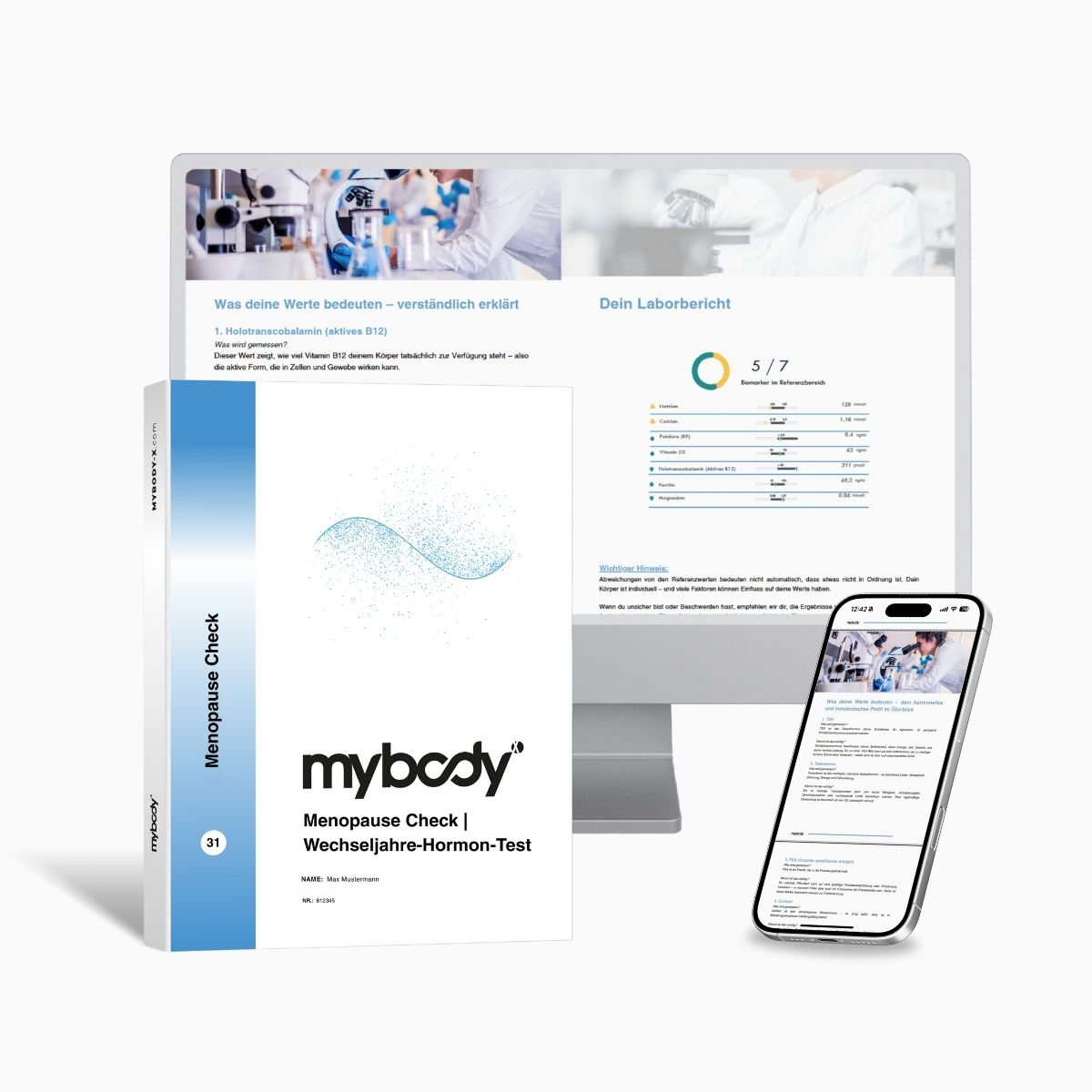
Capillary blood test
Menopause Check | Menopause Hormone Test
8 hormone levels from capillary blood, including estradiol, progesterone, FSH, LH, and TSH, providing a snapshot at the time of sampling. What the test does not do: It does not provide a diagnosis, make treatment decisions, or replace a consultation with a doctor.
Laboratory evaluation within 3–5 business days after receipt of the sample
Product page information, accessed on 24 August 2026
The process is deliberately practical for everyday life: The kit arrives at your home, the sample is collected from a few drops of capillary blood from your fingertip and sent to the laboratory by mail. You do not need an appointment or time in a waiting room, and the result is available digitally, so you can take it directly with you to your doctor’s office.
You can read what the individual values mean before and after testing in the Biomarker Lexicon with 67 explained blood values. And anyone who also wants to understand how their metabolism is structured can find the answer in the related article DNA test or blood test the right order.
The limits of every piece of advice during this phase
The first boundary is the most important: No article and no self-test can promise that you will lose weight. Anyone who promises quick results during this stage of life is ignoring the physiology discussed throughout this article. This honesty is uncomfortable, but it protects you from the most costly mistake of this phase: moving from one promise to the next, ultimately losing trust above all in your own body.
The second boundary concerns hormones. Whether and how your hormone levels should be treated is a medical decision based on an examination and consultation. An at-home test provides a basis for discussion with eight values measured at the time the sample was taken—nothing more and nothing less.
The second boundary also includes the question of hormone therapy, which concerns many people during this stage of life. Whether it is an option for you depends on your symptoms, medical history, and a doctor’s assessment of the benefits and risks. This article deliberately does not evaluate it, and a self-test cannot perform that assessment. It can only provide what every good assessment requires: up-to-date data.
The third boundary concerns symptoms. Many things during menopause are normal and temporary, and at the same time, persistent severe symptoms, unintended rapid weight changes, or new symptoms belong in a doctor’s office, not in a guide. This phase is not something you simply have to endure, and the right place to turn for help is a medical professional.
What you’ll take away from this article
If you remember one thing, let it be this order: first understand what has shifted, then choose a few key factors to focus on, and then think in months rather than weeks. Protein and muscle preservation are the two levers that address the underlying cause directly.
And set yourself the standard that medicine uses: losing 5 to 10 percent over 6 to 12 months is a success, not a consolation prize. Anything that promises significantly faster results has not understood menopause.
Perhaps the most important shift is not on the scales at all, but in the goal: During this stage of life, it is worth taking strength, energy, and well-being at least as seriously as weight. A body that moves through menopause strong and resilient is a better outcome than a number reached at any cost.
At the beginning was the mystery of the scales despite no change in daily life. By the end, it is no longer a mystery: Your body has changed the rules, and you can work with the new rules. If you first want to see your levels, the consultation is free, and it does not sell you anything.
Frequently asked questions
Why am I gaining weight during menopause even though I eat the same way?
Because your body’s needs have shifted, not your behavior: From around the mid-forties, estrogen production gradually declines (IQWiG, 2023), muscle mass decreases without countermeasures, and the body consequently uses less energy at rest. The same diet can therefore create a small surplus over the years. Some weight gain during this phase is common and is not a personal failure.
How quickly can I realistically lose weight during menopause?
A realistic benchmark is the medical target of losing 5 to 10 percent of your initial weight within 6 to 12 months (IQWiG, 2022). During menopause, this moderate pace is particularly sensible because extreme crash approaches tend to cost muscle mass and thereby further reduce the resting metabolic rate, which has already declined. No one can promise you this pace, but you can plan around it very well.
What role do hormones play in weight?
Declining estrogen production is one of the changes that affect weight during this phase, along with muscle mass, sleep, and daily life (IQWiG, 2023). A single hormone level can therefore never explain weight on its own. Measuring 8 hormone levels shows you where you currently stand and makes the medical conversation more specific; interpretation and any treatment decisions belong in a medical practice.
Does all of this also apply to losing weight after 40?
Essentially yes, in a milder form: The gradual loss of muscle mass and declining energy requirements usually begin before menopause itself. That is why the three approaches in this article—adjusting your diet, maintaining muscle, and knowing your own levels—apply from around age 40 as well; the hormonal changes are generally still smaller then.
When should I bring this up with a doctor?
In three cases, skip tests and guides and go straight to a doctor: if your weight changes rapidly and unintentionally over a short period, if you have persistent severe symptoms, and whenever treatment affecting your hormone levels is being considered. An at-home measurement can help prepare for that conversation, but it cannot replace it. Menopause is not an illness, but it is also not something you simply have to endure.
Next step
If you first want to see where you stand
The Menopause Check measures 8 hormone levels from capillary blood, providing a basis for your next steps and for your conversation at the doctor's office. The Biomarker Lexicon explains what the results mean.
Go to Menopause Check Go to Biomarker LexiconRead more
You might also be interested in
The hormonal side of this phase of life in detail.
The most important nutritional lever from this article to put into practice.
Sources
- Institute for Quality and Efficiency in Health Care (IQWiG): Menopausal symptoms (as of 2 January 2023) – gesundheitsinformation.de
- Institute for Quality and Efficiency in Health Care (IQWiG): Severe overweight (obesity) (as of 2022) – gesundheitsinformation.de
The verbatim quote about menopause, the information about declining estrogen production from around the mid-forties, and the statement that many women gain some weight during menopause come from [1]. The target range of 5 to 10 percent over 6 to 12 months comes from [2]. Information about the price, sample type, biomarkers, and laboratory comes from the mybody®x product page, accessed on 24 August 2026; processing times follow the central specification for each test type. All sources were accessed and reviewed on 24 August 2026.

mybody®x Editorial & Specialist Team
Blood analysis interpretation Nutritional science Laboratory diagnostics
This article was created by the mybody®x editorial and specialist team. The team combines blood analysis interpretation, nutritional science, and laboratory diagnostics. Everyone who contributes to it is listed on the authors page.
Published on 24 August 2026 · Last updated on 24 August 2026
The content is for general information and does not replace medical advice, diagnosis, or treatment. Reference ranges depend on the laboratory, method, and age; the information on your test report is always authoritative.




Share now:
Twenty-two values show your amino acid status
Lab Test Abbreviations: What Your Report Really Says