
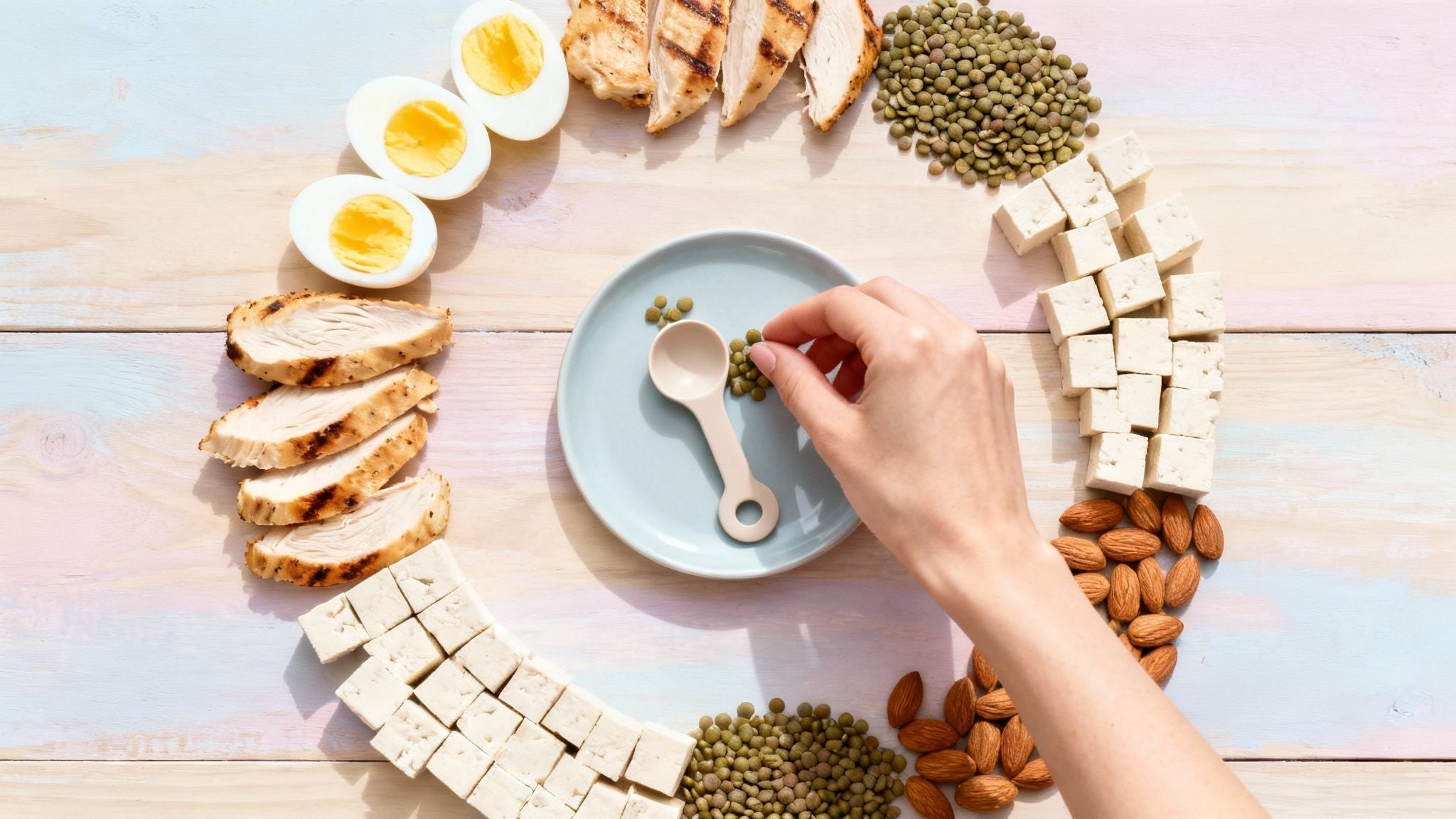
Protein needs for women: How to meet them optimally
How much protein do you really need as a woman? Your optimal protein intake is between 0.8 g and 2.0 g per kilogram of body weight—depending on your age, how active you are, and what stage of life you are currently in. So there is no one-size-fits-all answer, because your needs are as individual as you are.
Why your protein needs as a woman are unique
Have you ever wondered why protein recommendations vary so widely? That's because women's protein needs are not a fixed concept. Rather, they are a dynamic process that changes with you and your life. Factors such as your age, how often you exercise, and even hormonal phases such as menopause play a decisive role.
Proteins are much more than just fuel for your muscles. They are the fundamental building blocks of almost everything in your body:
- Energy and satiety: They help keep your blood sugar levels stable and provide a pleasantly long-lasting feeling of fullness that helps prevent cravings.
- Immune system: Without proteins, there is no powerful defense—antibodies that fight pathogens are made of them.
- Structure and strength: They are essential for firm skin, strong hair, and healthy nails.
- Hormonal balance: Many hormones that regulate important bodily functions are essentially nothing more than proteins.
Precisely because these tasks are so diverse, it is extremely important to provide your body with the right amount of high-quality protein. An insufficient intake quickly becomes noticeable—often through fatigue, constant cravings, or a weakened immune system.
Your personal compass
To get a first idea, it helps to know the most important influencing factors. Think about your daily routine: Do you mostly work in an office, or are you constantly on your feet? Do you enjoy relaxing yoga, or do you prefer strength training? Each of these choices directly affects how much “building material” your body needs every day.
The following graphic gives you an overview of how your activity level alone changes your daily protein needs as a woman—from moderate to more than double.
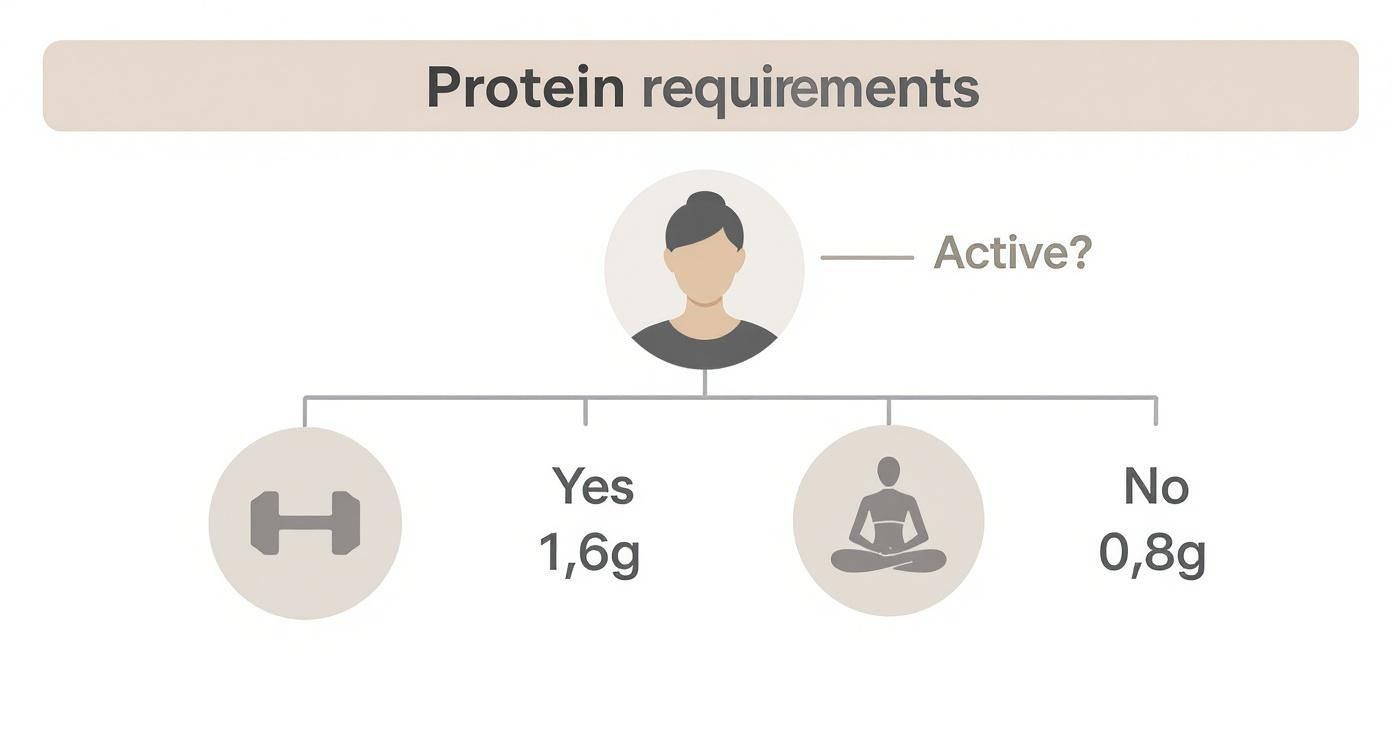
As you can see, the recommended amount for an active lifestyle already jumps from 0.8 g to 1.6 g per kilogram of body weight. That's double!
Hormones as a decisive factor
Your hormonal health in particular plays a central role in metabolism and therefore also in your protein needs. Changes in estrogen and progesterone levels, such as during your cycle or menopause, can influence how efficiently your body uses proteins for muscle building or recovery.
If you want to better understand how your hormones control your well-being, taking a closer look can be invaluable. Learn more about how you can check your hormonal balance with a hormone test for women. This article is intended to serve as your personal compass for finding your individual needs and optimally supporting your body.
What proteins really do in your body
Before we calculate how much protein you really need as a woman, let's take a quick look at what these little powerhouses actually do in your body all day long. Imagine them as a highly qualified team of specialists working around the clock for you. Proteins are much more than just fuel for your muscles—they are the fundamental building blocks of life.
Every single cell, tissue, and organ needs proteins to function, repair itself, and grow. If the supply falters, the entire operation suffers. You may notice this as fatigue, cravings, or a slower recovery after exercise.
The all-rounders in your body
To make the whole thing a little more tangible, you can assign different jobs to proteins. Each of these roles is crucial to your health and how you feel.
- The construction workers: Proteins are the number one building material for your muscles, bones, skin, and hair. When you exercise, tiny tears form in your muscle fibers. Proteins rush to the site immediately to repair the damage and rebuild the tissue stronger than before.
- The security team: Your immune system relies entirely on proteins. The antibodies that keep viruses and bacteria at bay are nothing more than specialized proteins. A deficiency therefore quickly makes you more susceptible to the next infection.
- The couriers: They transport everything important throughout your body. Hemoglobin, a protein in red blood cells, for example carries oxygen from your lungs to every cell. Other proteins, in turn, deliver vitamins and minerals exactly where they are needed.
- The communication managers: Many hormones and enzymes that control countless metabolic processes are made of proteins. They regulate everything from your blood sugar level to your sense of appetite.
Amino acids: the true heroes
When we talk about proteins, we actually mean long chains made up of smaller building blocks: amino acids. There are 20 different ones, nine of which are considered essential. This means that your body cannot produce them itself—you must obtain them through your diet.
A varied diet is the key to covering the full spectrum of essential amino acids. Every protein source, whether animal- or plant-based, has its own unique amino acid profile.
The good news: Protein intake in Germany is generally very good. Statistics show that women consume around 64 grams per day on average, often meeting their basic requirements. A normal, balanced diet is usually quite sufficient for this.
The role of the three macronutrients
Proteins do not work alone, of course. They are part of the major trio of macronutrients, which also includes fats and carbohydrates. Each of these nutrients has its own tasks, but they strongly influence one another.
For example, a protein-rich meal keeps you feeling full for a long time and can help moderate the rise in blood sugar after eating carbohydrates. This helps you avoid the typical energy highs and lows. If you would like to explore the interaction between these nutrients in more depth, our article on fats, carbohydrates, and protein offers an easy-to-understand explanation of their roles.
In short: An adequate protein intake is the foundation of your physical and mental strength. It is the foundation on which your energy, radiance, and health are built.
Your protein needs during menopause and after 40
Your body is a masterpiece of change—and you feel this particularly strongly during the stage of life after 40. As your hormone balance readjusts, the rules of the game for your diet also change. One of the most important adjustments concerns your protein needs as a woman, which now noticeably increase.

You may already have noticed that it is becoming harder to maintain your weight, or that your muscles no longer recover as quickly after exercise as they used to. This is completely normal and has a lot to do with the hormonal changes of perimenopause and menopause. This is exactly where protein comes in as one of your strongest allies.
Adequate protein intake during this time is not just a nice extra—it is absolutely essential. It helps you move through this transition with energy and protect your quality of life in the long term.
Why more protein is so important after 40
As estrogen levels decline, two processes begin to take hold in your body that you can directly slow down with a protein-rich diet: natural muscle loss and declining bone density.
1. Fighting muscle loss (sarcopenia)
As early as age 40, the body tends to lose muscle mass—a process known medically as sarcopenia. The problem is that muscles are your body’s largest metabolic engine. Less muscle means a lower basal metabolic rate. In other words, your body burns fewer calories at rest.
Protein provides the essential amino acids your body needs as building blocks to maintain and build muscle. Combining a higher protein intake with regular strength training sends your body a clear signal to preserve valuable muscle mass.
2. Strong bones for the future
Estrogen also plays an important role in protecting your bones. When estrogen levels fall, bone density can decrease, increasing the risk of osteoporosis. Protein is a major component of the bone structure and supports calcium absorption. This helps keep your bones strong and resilient.
During menopause, protein is your protective shield. It helps you maintain muscle mass, keep your metabolism active, and strengthen your bones—three crucial factors for a healthy and active life.
Your adjusted protein needs during menopause
While an intake of 0.8 grams of protein per kilogram of body weight is often recommended for younger women, this recommendation changes significantly when menopause begins. Your body is now less efficient at processing protein, which is why you simply need to give it more to achieve the same effect.
Specifically, this means: While the German Nutrition Society (DGE) recommends 0.8 grams per kilogram of body weight for women up to age 65 (that is, around 48 grams for a woman weighing 60 kilograms), protein requirements increase during menopause to approximately 1.0 to 1.2 grams per kilogram of body weight daily. At 60 kilograms, that already amounts to 60 to 72 grams. This adjustment is necessary to counteract hormonally induced muscle loss.
If you would like to explore the specific needs during menopause in greater depth, you will find further valuable information and support in the article on Menoelle.
Practical benefits of a protein-rich diet
Increasing your protein intake during this stage of life offers very tangible, noticeable benefits in everyday life:
-
Better weight management
Protein keeps you fuller for longer than carbohydrates or fats. This helps you get cravings under control and manage your overall calorie intake more effectively. -
Stable blood sugar levels
A protein-rich meal slows the absorption of sugar into the bloodstream. This prevents the dreaded blood sugar fluctuations that often lead to fatigue, irritability, and renewed hunger. -
More energy and vitality
By maintaining your muscles and keeping your metabolism active, you ensure higher energy levels and more power for your everyday life.
Adjusting your diet is an incredibly powerful step toward actively addressing the physical changes that begin after 40. It is about giving your body exactly what it needs now to stay strong, healthy, and full of vitality.
How exercise affects your protein needs
If you are regularly active, you give your body far more than just an energy boost—you challenge it to adapt and become stronger. Every workout is like a starting signal for remodeling processes in the body. Imagine your muscles as a construction site: After every exertion, tiny tears must be repaired and the tissue strengthened. The most important building material for this? Protein.
Without this building material, the entire construction project comes to a standstill. The result: You recover more slowly, your performance stagnates, and in the worst case, you may even lose muscle instead of building it. Your protein needs as a woman are therefore not a minor detail, but the foundation of your athletic success.
Your protein needs depending on your sport
There is a huge difference between doing relaxed yoga three times a week, jogging regularly, or lifting heavy weights at the gym. Every sport places different demands on your body—and therefore also on your protein needs.
- Endurance sports (e.g., running, cycling, swimming): The main focus here is repairing the muscle fibers strained by prolonged exertion and accelerating recovery.
- Strength training (e.g., weightlifting, bodybuilding, CrossFit): The goal is clear: building muscle (hypertrophy). To do this, your body needs significantly more protein building blocks to build new muscle tissue.
- Mixed activities (e.g., HIIT, dancing, team sports): These sports combine strength and endurance training. Your protein requirements are also elevated, but usually fall somewhere in between.
While the German Nutrition Society (DGE) generally recommends 0.8 grams of protein per kilogram of body weight for low activity levels, this figure is long outdated for women who exercise. Studies show that female endurance athletes in particular have much higher requirements—1.6 to 2.2 grams per kilogram of body weight are often recommended to optimize recovery and maintain performance. You can find more interesting details on this topic in the article about protein for female endurance athletes.
Calculate your personal requirements
To determine your individual protein requirements as an active woman, simple formulas are all you need. They provide a good guideline for the amount you should aim for each day:
-
Light exercise & moderately active (2–3 times per week):
Your body weight in kg x 1.2 to 1.4 g
Example for 65 kg: 78 g to 91 g of protein per day -
Intensive strength training & muscle building (3–5 times per week):
Your body weight in kg x 1.6 to 2.0 g
Example for 65 kg: 104 g to 130 g of protein per day
These figures are naturally only a guideline. Your individual needs also depend on the intensity and duration of your training—and even on your genetics. How efficiently you build muscle is also genetically determined. If you’re curious about what your genes reveal about your training success, take a look at our article on muscle building and DNA testing.
The following table gives you a quick overview to help you better estimate your needs.
Recommended daily protein requirements for women by activity level
This table shows recommended values for daily protein intake in grams per kilogram of body weight, depending on physical activity. It helps you quickly estimate your personal requirements.
| Activity level | Protein requirements (g/kg body weight) | Example for a body weight of 65 kg |
|---|---|---|
| Not very active / Sedentary work | 0,8 – 1,0 g | 52 – 65 g |
| Moderately active (light exercise 2–3 times/week) | 1,2 – 1,4 g | 78 – 91 g |
| Very active (endurance training 4–5 times/week) | 1,4 – 1,6 g | 91 – 104 g |
| Intensive strength training (muscle building) | 1,6 – 2,2 g | 104 – 143 g |
As you can see, your needs increase significantly with the intensity of your training. Use these values as a starting point and adjust them as needed based on how you feel and your results.
Timing: The secret ingredient for your success
It’s not only about how much protein you eat, but also when. Right after training, your body is particularly receptive to nutrients. During this phase, often known as the “anabolic window,” your muscles are practically crying out for building blocks to start the recovery process.
The “anabolic window” describes the period from about 30 minutes to two hours after training. A protein-rich meal or shake during this time can maximize muscle protein synthesis and accelerate your recovery.
A post-workout shake is a highly practical solution for supplying your muscles with the necessary amino acids right away. Ideally, combine quickly digestible protein (such as whey protein) with carbohydrates (for example, from a banana). This not only replenishes your depleted energy stores but also gets the repair processes started right away.
When you adapt your protein intake to your athletic goals and pay attention to the right timing, you give your body exactly what it needs to become stronger, faster, and fitter.
The best protein sources for your everyday life
So now you know your personal needs—great! But how do you fit all this into a busy schedule without spending hours in the kitchen? Don’t worry, this section is your practical guide to the supermarket. It’s about making smart choices that are not only healthy but also taste really good and keep you feeling full for a long time.
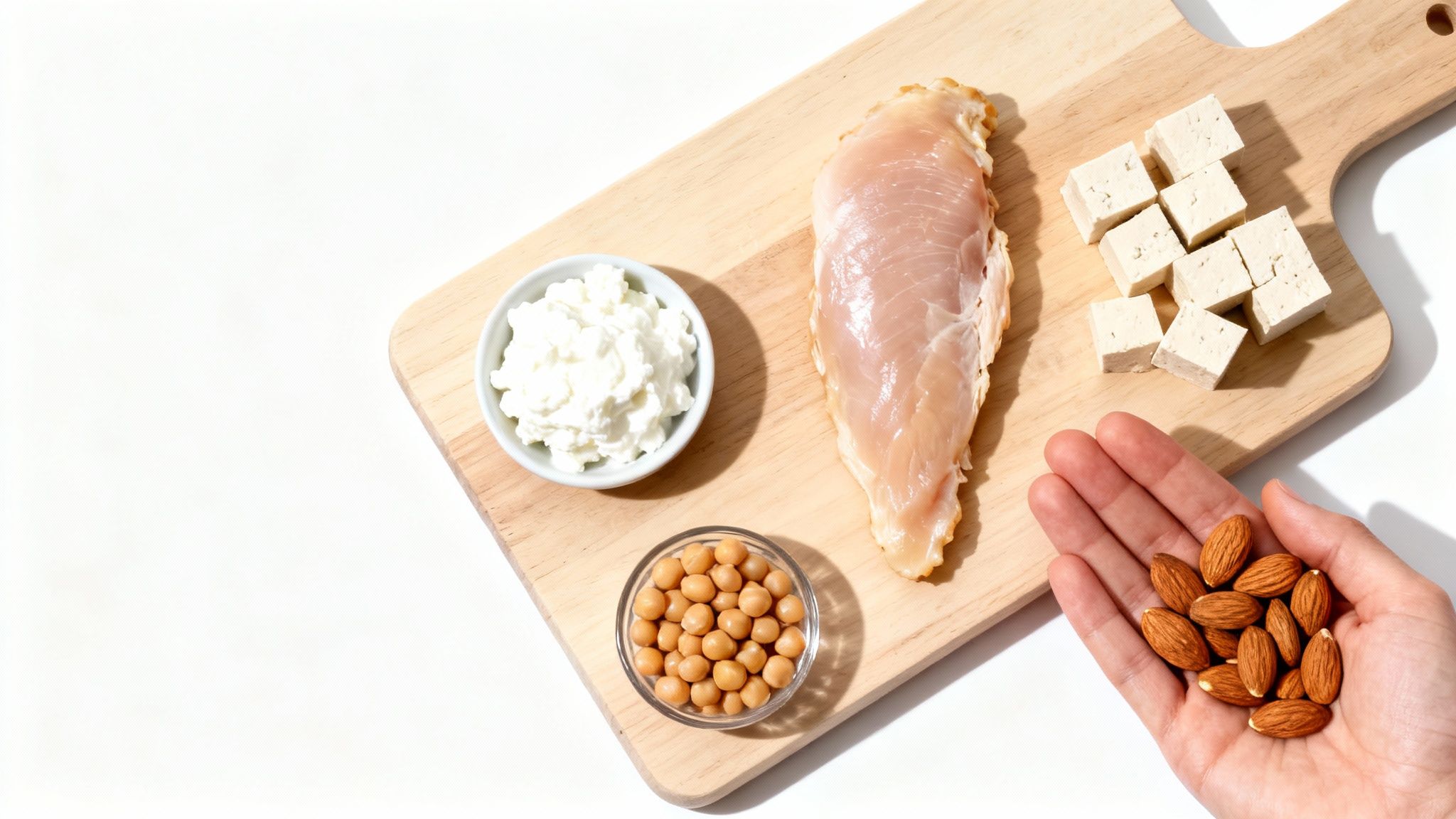
The good news first: protein-rich foods are everywhere, both animal-based and plant-based. So your meal plan can be as colorful and varied as you like. Forget the cliché of dry chicken with rice. It’s about making the most of the full variety nature offers us.
Let’s take a look at which foods are true protein champions and how you can effortlessly incorporate them into your meals. Along the way, we’ll encounter an important concept: “biological value.”
Protein quality
Not all protein is created equal. Imagine you’re building a house out of LEGO bricks. Your body needs very specific bricks (amino acids) to build muscles, hormones, and enzymes. Biological value tells you how well the LEGO bricks from your food match those your body needs. The more similar a food’s amino acid profile is to your body’s, the higher its biological value.
Animal products such as eggs, meat, and dairy products naturally have a very high biological value. They provide virtually the perfect set of building blocks because they contain all nine essential amino acids in a ratio that is optimal for us.
Plant-based proteins often have a slightly lower biological value because they sometimes lack one building block or another. But don’t worry—there’s a brilliant trick for that: the right combination!
Plant-based power through clever combinations
When you cleverly combine different plant-based foods, they compensate for each other’s weaknesses. Their amino acid profiles complement each other perfectly, and in the end, you have a meal that can easily hold its own against any animal-based protein source.
The absolute classic is “rice and beans.” Not only is it delicious, but it is also nutritionally brilliant. Rice lacks the amino acid lysine, which beans contain in abundance. In return, rice provides methionine, which is scarce in beans. Together, they are an unbeatable team and make a complete protein source.
Other power duos you should remember:
- Lentil soup with a slice of whole-grain bread: Legumes and grains are simply the best of friends.
- Chickpea hummus with pita bread: Another delicious combination that provides all the essential amino acids.
- Oatmeal with a handful of nuts or seeds: The perfect breakfast to start the day feeling full and energized.
This strategy is the key to optimally meeting your protein needs, even with a vegetarian or vegan diet. Simple, right?
Top 10 animal and plant-based protein sources compared
To help you make targeted choices on your next shopping trip, we have compiled the best protein sources in a clear table. This way, you can see at a glance which foods are best suited to you.
A direct comparison of popular protein sources, showing the protein content per 100 g and practical tips for incorporating them into your everyday life. This way, you can see at a glance which foods are best suited to you.
| Food | Protein content per 100 g | Special feature / tip |
|---|---|---|
| Harz cheese | approx. 30 g | The ultimate protein king, almost fat-free. Perfect for those who are watching their figure. |
| Chicken breast fillet | approx. 23 g | Lean, versatile, and a true all-rounder in the kitchen. |
| Almonds | approx. 21 g | The ideal snack, in muesli, or as almond butter. Also provides healthy fats. |
| Salmon fillet | approx. 20 g | A top protein source with valuable omega-3 fatty acids. |
| Low-fat quark | approx. 13 g | Great as a base for dips, for breakfast, or as a protein-rich snack. |
| Eggs (size M) | approx. 12 g | One egg contains approx. 6–7 g of protein. Quick to prepare and packed with nutrients. |
| Tofu | approx. 10–15 g | The classic of vegetarian cuisine. It tastes best when marinated. |
| Lentils (cooked) | approx. 9 g | Affordable, healthy, and a great base for soups, salads, and curries. |
| Chickpeas (cooked) | approx. 8 g | The stars of hummus or delicious roasted as a crunchy snack. |
| Quinoa (cooked) | approx. 4 g | This “pseudocereal” provides all the essential amino acids. |
As you can see, reaching your protein needs is not difficult at all. One serving of low-fat quark (250 g) already provides you with over 30 g Protein and a handful of almonds (approx. 25 g) provide another 5 g with. With this knowledge, ensuring your body is optimally nourished becomes child's play.
What you have always wondered
Finally, we will answer the questions that may already be burning on your tongue. There are many myths and uncertainties surrounding women's protein needs. Here you will find clear, practical answers to give you confidence in your nutrition choices.
We clear up the most common misconceptions so that you know exactly what really matters for you.
Do I absolutely need protein shakes as a woman?
Not necessarily. Protein shakes are an incredibly convenient way to meet your protein needs quickly and easily. They are especially helpful after exercise, when your muscles are practically crying out for nutrients, or on days when you simply do not have time to cook.
However, they should remain exactly that: a supplement, not a replacement. The foundation of your diet should always be natural, whole-food protein sources. Think low-fat quark, eggs, fish, lean meat, as well as lentils, chickpeas, and tofu. These foods provide not only protein, but also a wealth of vitamins, minerals, and fiber.
Think of protein shakes as your clever helper during stressful moments or as a quick recovery boost after training. They are a tool in your nutrition toolkit, but not the foundation everything is built on.
If you use them, look for high-quality products without unnecessary sugar or fillers. This ensures that you are actually doing something good for your body.
Can too much protein be harmful?
Many people are wondering about this, and the answer is clear for most healthy women: no. As long as you have healthy kidneys, a high protein intake within the usual recommendations—up to 2.0 grams per kilogram of body weight—is normally harmless.
One thing is especially important: drink enough. Your body needs fluids to excrete the metabolic byproducts produced during protein breakdown, such as urea, through the kidneys. So, if you consume more protein, you should also adjust your water intake accordingly.
There is one important exception, however: women with pre-existing kidney disease should be very cautious here. In this case, it is essential to discuss individual protein intake with a doctor to avoid placing additional strain on the kidneys.
How do I meet my protein needs as a vegan woman?
As a vegan woman, you can easily meet your protein needs—it just requires a little more planning and variety on your plate. The key is to use the full range of plant-based protein sources and combine them intelligently.
Focus on a colorful mix of these foods:
- Legumes: Lentils, chickpeas, black beans, and kidney beans are absolute powerhouses.
- Soy products: Tofu, tempeh, and edamame provide high-quality protein and are extremely versatile.
- Grains and pseudocereals: Quinoa, rolled oats, whole-grain bread, and brown rice are important staples.
- Nuts and seeds: Almonds, walnuts, chia seeds, flaxseeds, and hemp seeds are perfect additions to salads, muesli, or as a snack.
As mentioned earlier, the combination is crucial for obtaining a complete amino acid profile. A classic combination like rice and beans or hummus with whole-grain bread ensures that you get all the essential building blocks your body needs.
If you have any further questions about your diet or other health topics, you will find many more answers in our comprehensive FAQ section. There, we address numerous aspects to support you as effectively as possible on your journey toward greater well-being.
Would you rather stop guessing and know exactly what your body needs? mybody-x.com offers scientifically supported analyses, from DNA metabolism tests to nutrient checks. Use our simple at-home tests to find out how to perfectly tailor your diet and lifestyle to your individual needs—for more energy, well-being, and long-term health. Discover your personal path at mybody-x.com now.



Share now:
What are healthy carbohydrates? Your comprehensive guide to stable energy
Metabolism explained simply: 9 facts you need to know