

Twenty-two values show your amino acid status
The essentials at a glance
An amino acid profile measures individual amino acids in the blood. The panel includes nine essential, ten nonessential, and three additional values.
This three-way division is not accidental. The MSD Manual distinguishes amino acids according to whether the body can produce them itself, and the panel is structured along exactly those lines.
You will read three common statements fact-checked, the panel compared with the MSD classification, the cited source quoted verbatim, three documented details, and what an amino acid profile does not answer.
What to expect in this article
1. What an amino acid profile is
2. Three statements fact-checked
3. How many amino acids the sources identify
4. The panel compared with the classification
5. Why the classification matters at all
6. The documented source
7. What the panel contains and what is missing
8. The core in one sentence
9. The three values in their own group
10. Three documented details
11. What an amino acid profile does not answer
12. Who can benefit from an amino acid profile
13. The PerformanceCheck in detail
14. Limits: what twenty-two values leave unanswered
15. What matters in an amino acid profile
Frequently asked questions
Sources
What an amino acid profile is
Most blood values are aggregate measures. Cholesterol is a group, ferritin is a storage protein, and CRP is a marker. An amino acid profile works differently.
It measures individual amino acids alongside one another and presents them as a profile. Instead of one number, it produces a series of numbers, and the comparison within that series is the actual content.
Amino acids are the building blocks of proteins. The MSD Manual describes proteins as complex organic molecules that are necessary for the maintenance, replacement, function, and growth of body tissue (Bhupathiraju and Hu, as of November 2025).
This article explains how such a panel is structured and where its limits lie. It does not tell anyone whether they should have an amino acid profile performed, nor does it derive a dietary recommendation from any value.
Three statements fact-checked
These three statements come up almost every time amino acids are discussed.
Verified against the available evidence
Widespread
“There are twenty amino acids.”
Documented
The MSD Manual lists nine essential and eleven nonessential amino acids, making twenty in total. A panel may also include additional values (Bhupathiraju and Hu, as of November 2025).
Widespread
“Nonessential means unimportant.”
Documented
It is said that the body can produce them itself. The MSD Manual states: The 11 nonessential amino acids can be synthesized by the body itself (as of November 2025). The term says nothing about their importance.
Widespread
“Anyone who exercises needs amino acids as supplements.”
Documented
The German Nutrition Society states in its position paper: In the everyday diet of athletes, there is no physiological reason to supplement protein intake with supplements (DGE, 2020).
How many amino acids the sources recognize
The number in this article’s title is twenty-two. The number in the specialist sources is twenty. Both are correct, and the difference requires explanation.
The MSD Manual divides twenty amino acids into two groups. The body cannot produce nine of them itself, but can produce the other eleven (Bhupathiraju and Hu, as of November 2025).
The German Nutrition Society also counts nine indispensable amino acids in its list, but explicitly identifies histidine there as being for infants (as of 2025).
The panel includes twenty-two values. Nineteen of them appear in the MSD list, and three do not. Chapters 7 and 9 explain how this difference arises.
Why the sources differ on histidine
One detail merits a second look because it shows how carefully such lists need to be read.
The MSD Manual lists histidine without qualification among the nine essential amino acids (as of November 2025). The DGE lists eight names and adds histidine with the explicit qualification “for infants” (as of 2025).
Both statements appear this way in the sources, and we present both rather than choosing between them. For interpreting a test result, the difference makes no difference: histidine is included in the panel, and the value appears with a reference range on the laboratory report.
The difference reveals something fundamental. Even with seemingly fixed numbers such as “nine essential amino acids,” the classification depends on the source and the stage of life to which it applies.
The panel compared with the classification
The table compares what the MSD Manual lists with what the product page names. It provides context and is not a diagnosis.
| Group | MSD Manual, as of November 2025 | Panel according to the product page | Difference |
|---|---|---|---|
| Essential | 9: Histidine, isoleucine, leucine, lysine, methionine, phenylalanine, threonine, tryptophan, valine | 9: the same nine | None. The group is fully covered |
| Nonessential | 11: Alanine, arginine, asparagine, aspartic acid, cysteine, glutamic acid, glutamine, glycine, proline, serine, tyrosine | 10: Glycine, alanine, serine, arginine, tyrosine, proline, glutamic acid, glutamine, aspartic acid, asparagine | Cysteine appears in the MSD list but is not mentioned on the product page |
| Additional values | Not included in the list of twenty | 3: Taurine, ornithine, citrulline | The product page therefore lists them as a separate group |
| Total | 20 amino acids | 22 values | 19 matches, 1 gap, 3 additional values |
The second line is the most interesting. It contains a gap, and we name it rather than overlooking it.
The third line does not describe a gap but an expansion. The product page itself does not classify these three values as amino acids, but lists them as a separate category.
Why the classification matters at all
The distinction between essential and nonessential is not an academic classification. It determines what a measured value can mean in the first place.
An essential amino acid has exactly one source: food. Whatever reaches the blood must have been eaten beforehand.
A nonessential amino acid has two sources: food and the body's own production. A measurement then reflects the sum of both and leaves open which share came from where.
This yields a reading rule for every amino acid profile: The values of the two groups are not equally informative. Values in the first group are more closely related to intake than values in the second.
What this rule does not permit
Nevertheless, a low value for an essential amino acid does not imply anything about the diet. Between the plate and the blood value lie digestion, absorption, distribution, and utilization.
And certainly no recommendation follows from it. IQWiG states in general terms: A single laboratory value is always only one component of an overall diagnosis (as of 02.04.2025).
What the rule permits is a weighting when reading. It indicates which values may be given greater explanatory power and which less.
The documented source
The sentence that explains the classification names all nine amino acids at once.
Documented source
“The nine essential amino acids (EAAs), which cannot be synthesized by the body—histidine, isoleucine, leucine, lysine, methionine, phenylalanine, threonine, tryptophan, and valine—must be obtained through food.”
MSD Manual, professional edition
Nutrient overview, Shilpa N. Bhupathiraju and Frank Hu, as of November 2025
Almost everyone in the fitness world knows three of these nine names: leucine, isoleucine, and valine. They are grouped there as branched-chain amino acids, and all three are included in the panel.
What is noteworthy about the quotation is the wording “must be obtained through food.” It describes a necessity for the body, not a recommendation for a supplement. The DGE has a separate sentence on this, which appears in Chapter 2.
What the panel contains and what is missing
There is nothing to criticize about the nine essential amino acids: The panel lists all nine named by the MSD Manual.
The nonessential ones are a different story. The MSD Manual lists eleven, while the product page names ten. Cysteine is not mentioned.
We include this here because it belongs in an article about a panel. Anyone interested in amino acid status who places the MSD list alongside it would otherwise notice the discrepancy themselves and wonder why it was not mentioned.
What we do not write: what consequences this gap has. To do so, we would need to know what information a cysteine value provides in relation to the others, and the reviewed sources do not provide that classification.
What ultimately matters is the individual report. It states which values were actually measured, along with the laboratory’s unit and reference range.
The key point in one sentence
This is where the subject can be brought together.
An aminogram shows a profile, not a balance sheet. It indicates how the values relate to one another, not what was eaten.
This difference is the most common source of confusion with this test. An aminogram is not an assessment of the diet by other means.
What it is: a snapshot of several concentrations at the time the sample was taken. And because it is a snapshot, it depends on the conditions under which the sample was obtained.
The three values in their own group
Taurine, ornithine, and citrulline do not appear under amino acids on the product page, but under “additional values.” This distinction is consistent.
None of the three names appears in the MSD list of the nine essential and eleven nonessential amino acids (Bhupathiraju and Hu, as of November 2025). They therefore do not belong to the twenty listed by that source.
We do not state here exactly what they are instead. We lack a verified specialist source for a sound classification of these three values, and a description from memory has no place in this text.
What can be said: The product page does not claim that these are amino acids in the sense of the list of twenty. It presents them as a separate group, and that is exactly how we reproduce them.
Three documented pieces of information
Three pieces of information from the sources reviewed. They provide context and do not constitute a diagnosis.
Documented information
9 of 20
The body cannot produce nine amino acids itself; it can produce the remaining eleven (MSD Manual, as of November 2025)
0.8 g/kg
The DGE recommends this amount of protein per kilogram of body weight per day for adults under 65; from age 65 onward, the recommendation is 1.0 g/kg (as of 2025)
22 values
According to the product page, the PerformanceCheck assigns [them] to three groups (mybody®x, accessed August 19, 2026)
The middle figure is deliberately included here. It is a reference value for intake, not a statement about the blood level that results from it. Several steps lie between intake and blood level.
What an aminogram does not answer
The most honest information this test provides concerns the questions it leaves unanswered.
It does not answer whether someone is eating enough protein. The DGE provides a reference value for this based on body weight, not on a blood value.
It does not answer whether a supplement would be useful. In its position paper on protein intake in sports, the DGE states that there is no physiological reason for this in everyday nutrition and that a balanced diet is generally superior to supplements (2020).
It does not answer whether a symptom is related to one of the values. That question belongs in a medical practice, where a laboratory result is one of several pieces of information (IQWiG, as of April 2, 2025).
What it answers is narrowly defined: How do these twenty-two concentrations relate to one another at the time of sampling and to the laboratory's reference ranges? Nothing more—and that is already a great deal of information.
Why fasting matters more here than usual
For most blood values, the question of the last meal is a minor detail. For an amino acid profile, it is central.
The reason lies in the nature of the matter itself. Amino acids are the building blocks of proteins, and protein is part of almost every meal. What was eaten therefore appears directly in the same measurements being taken.
A long-term blood sugar value is different: According to the MSD Manual, it reflects glucose control over the previous three months (as of December 2025) and therefore does not respond to a single meal. An amino acid profile has no such buffer period.
That is why the instructions for this test are not a formality. Two samples from the same person—one fasting and one two hours after eating—are simply not the same result, and comparing them can be misleading.
Who can benefit from an amino acid profile
The comparison addresses the question of whether an amino acid profile adds value in your situation.
Useful for you if …
You have changed your diet and want to document a profile.
You want to bring dated figures to a conversation at a medical practice or with a nutrition professional.
You know the difference between essential and non-essential amino acids and will weight the values accordingly.
You want to establish a baseline so you can identify a trend later.
Probably not if …
You want to know whether you are eating enough protein. A reference value based on body weight—not a blood value—answers that question.
You want to determine from the numbers whether a supplement would be useful. That decision belongs in a medical practice.
You have symptoms. In that case, the focus is on an evaluation, not a profile.
You are already undergoing an evaluation. In that case, follow the practice that initiated it.
The PerformanceCheck in detail
A capillary blood self-test does not provide a diagnosis and does not replace medical evaluation. What it provides is documented figures dated from a laboratory.
One point is particularly important for this test: the mybody®x product page (MYBODY Lab GmbH) refers to a fasting requirement in the instructions. Anyone who does not follow it will largely be measuring their last meal.
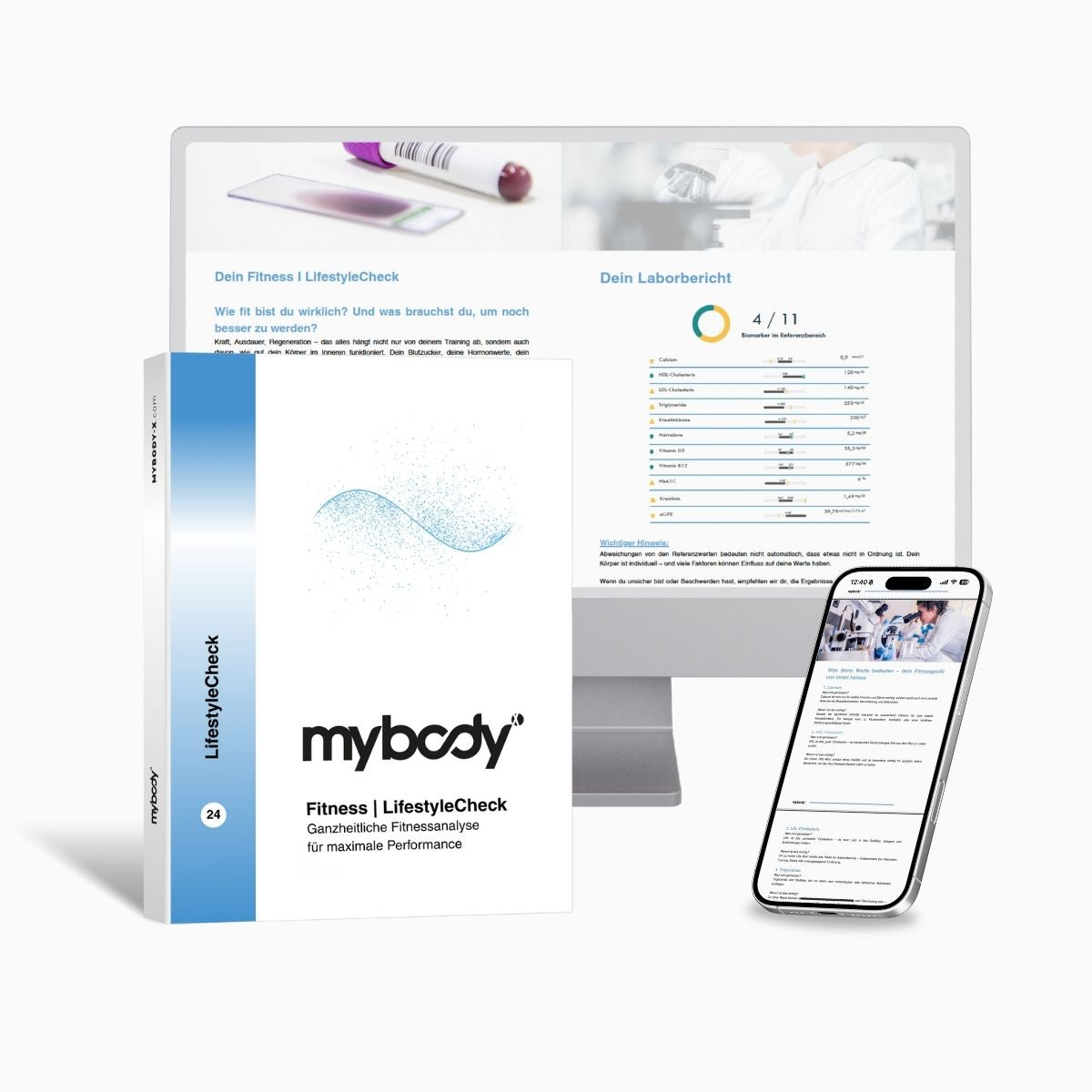
Capillary blood test
PerformanceCheck | Amino acid test
Lists 22 values from the same sample: nine essential amino acids (leucine, isoleucine, valine, threonine, lysine, methionine, phenylalanine, tryptophan, histidine), ten nonessential amino acids (glycine, alanine, serine, arginine, tyrosine, proline, glutamic acid, glutamine, aspartic acid, asparagine), and three additional values (taurine, ornithine, citrulline). What the test does not do: It does not answer whether you eat enough protein, does not list cysteine, and does not provide a diagnosis. The instructions' fasting requirement must be followed.
Laboratory analysis 3–5 business days after sample receipt
Product page information, accessed 19 August 2026
Chapter at a glance
The panel lists 22 values in three groups and covers all nine essential amino acids on the MSD list. Cysteine, from the list of eleven, is not mentioned on the product page. The test does not answer whether someone eats enough protein and does not provide a diagnosis. The instructions' fasting requirement determines whether the sample can be meaningfully interpreted.
Boundaries: what twenty-two values leave unresolved
The first boundary is timing. An amino acid profile is a snapshot, and the fasting requirement determines what is measured.
The second boundary is attribution. For nonessential amino acids, the value reflects the sum of intake and the body's own production, because these eleven can be synthesized by the body itself (MSD Manual, as of November 2025).
The third boundary is completeness. Cysteine appears on the MSD list of eleven but is not mentioned on the product page.
The fourth boundary is deriving recommendations. No value alone leads to a recommendation for intake. For adults under 65, the DGE recommends an intake of 0.8 g of protein per kilogram of body weight per day (as of 2025), and this value refers to body weight, not a laboratory result.
The fifth boundary is diagnosis. All classifications in this article provide context and do not constitute a diagnosis. A diagnosis is made in a medical practice based on several components.
What matters in an amino acid profile
If you take only one thing away from this article, let it be this: Read an amino acid profile according to its classification, not its order.
The body cannot produce nine amino acids itself; according to the MSD Manual, they must be obtained through food (Bhupathiraju and Hu, as of November 2025). It can produce eleven itself, so their values reflect two sources at once.
And the sentence that captures all expectations of this test: A profile is not a balance sheet. It shows how numbers relate to one another, not what was on the plate.
Frequently asked questions
Which twenty-two values does the PerformanceCheck contain?
According to the product page: nine essential amino acids (leucine, isoleucine, valine, threonine, lysine, methionine, phenylalanine, tryptophan, histidine), ten nonessential amino acids (glycine, alanine, serine, arginine, tyrosine, proline, glutamic acid, glutamine, aspartic acid, asparagine), and three additional values (taurine, ornithine, citrulline), accessed on 08/19/2026.
Why is cysteine not on the list?
The MSD Manual lists eleven nonessential amino acids, including cysteine (as of November 2025). The product page lists ten and does not mention cysteine. The reviewed sources do not indicate the implications of this omission, and we do not speculate about it. What matters is your own report, which states what was actually measured.
Does an amino acid profile show whether I eat enough protein?
No. The DGE provides a reference value based on body weight: 0.8 g per kilogram of body weight per day for adults under 65 and 1.0 g/kg from age 65 onward (as of 2025). A blood value, by contrast, reflects a concentration at the time of sampling, with digestion, absorption, distribution, and utilization occurring in between.
Do I need to fast for the test?
The product page refers to a fasting requirement in the instructions. The instructions included with the kit always take precedence. If you do not follow them, the measurement largely reflects your last meal, making the result difficult to interpret.
What does “nonessential” mean?
It means that the body can produce these amino acids itself. The MSD Manual states: The 11 nonessential amino acids can be synthesized by the body itself (as of November 2025). The term says nothing about their importance to the body—it only describes where they can come from.
Next step
Twenty-two values from one sample
The PerformanceCheck analyzes 22 values from capillary blood in three groups and covers all nine essential amino acids on the MSD list. It does not answer whether you eat enough protein, replace a medical evaluation, or provide a diagnosis.
Go to PerformanceCheckRead more
You might also be interested in
Why following the instructions determines the result.
How the numbers next to your values are calculated.
Sources
- MSD Manual, Professional Edition: Nutrient overview, Bhupathiraju SN, Hu F (as of November 2025) – msdmanuals.com
- German Nutrition Society (DGE): Selected questions and answers about protein and indispensable amino acids, as of 2025 – dge.de
- DGE: Position paper on protein intake in sports, press release 13/2020 – dge.de
- Institute for Quality and Efficiency in Health Care (IQWiG): Understanding laboratory values correctly, as of 2 April 2025 – gesundheitsinformation.de
- MSD Manual, Professional Edition: Diabetes mellitus, Brutsaert EF (as of December 2025) – msdmanuals.com
The verbatim quotation about the nine essential amino acids, the list of the eleven non-essential amino acids including cysteine, the statement about the body’s own synthesis, and the description of proteins are taken from source [1]. The information on the nine indispensable amino acids according to DGE, the addition concerning histidine, and the reference values of 0.8 and 1.0 g of protein per kilogram of body weight are taken from [2]. The verbatim quotation about the lack of a physiological basis for supplements and the note on the superiority of a balanced diet are taken from [3]. The statement about being a component of an overall diagnosis is taken from [4]. The information on the three-month period covered by long-term blood glucose is taken from [5]. The list of the twenty-two values, their grouping, the note about the fasting requirement, and information on price, sample type, and laboratory are taken from the mybody®x product page, accessed on 19 August 2026; processing times follow the central requirements for blood tests. All sources were accessed and reviewed on 19 August 2026.

mybody®x Editorial & Expert Team
Laboratory diagnostics Blood analysis interpretation Nutritional science Nutrigenetics
This article was created by the mybody®x editorial and expert team. The team combines laboratory diagnostics, nutritional science, and the interpretation of blood analyses. Everyone involved can be found on the authors page.
Published on 19 August 2026 · Last updated on 19 August 2026
The content is for general information only and does not replace medical advice, diagnosis, or treatment. Reference ranges depend on the laboratory, method, and age; the information on your report is always authoritative.



Share now:
Men’s health is reflected in seventeen values
Losing weight during menopause: what your body needs now