

Find the ideal test for your health: A guide to individual symptoms!
The essentials at a glance
You will not find the right test based on symptoms alone, but by asking what you want to know. If it is about your current nutritional status, choose a blood analysis. If it is about digestion, choose a gut microbiome analysis. If it is about reactions to foods, choose an antibody analysis. If it is about a lasting predisposition, choose a genetic analysis.
This page asks three questions you should answer before choosing any test, matches the most common symptoms to the four types of tests, and identifies where the informative value of each ends. The reverse case is just as important: there are symptoms for which no analysis is the right next step.
Chapter 1 addresses the three questions, Chapter 2 the warning signs, and Chapter 3 provides an overview of the appropriate assignments. Chapter 4 presents four specific analyses, and Chapter 5 their limitations. If you want to make a decision right away, skip to Chapter 6.
What to expect on this page
1. Three questions to ask before choosing a test
2. When no test is the right answer
3. Which test is right for which symptoms?
4. Four analyses in detail
5. What a self-test cannot do
6. Decision guide
Conclusion
Frequently asked questions
Sources
Three questions to ask before choosing a test
Most bad purchases happen because a test is chosen based on symptoms rather than the question being asked. “I’m constantly tired” is a symptom, not a question. The question behind it might be: Am I low in iron? Is something upsetting my gut? Am I not getting enough sleep? Each of these questions leads to a different test—or to no test at all.
Question 1: Do you want to know your current state or a predisposition?
Blood and stool analyses show a state that can change and can therefore be repeated. A genetic analysis shows a predisposition that does not change and therefore is measured exactly once in a lifetime. This is the most fundamental difference in the entire testing market—and it already determines whether repeating a test would make sense at all.
Question 2: Is the symptom new, severe, or accompanied by other symptoms?
Symptoms that appear suddenly, are severe, or are accompanied by fever, blood, or weight loss should be medically evaluated—before ordering any self-test. In such cases, a test only delays clarification. For recurring symptoms that have already been evaluated, the situation is different: an analysis can provide an objective starting point.
Question 3: What would you do with the result?
If you cannot think of a concrete action to take based on this question, the test is probably the wrong one. A ferritin result leads to a change in diet or a visit to the doctor. A bacterial profile leads to greater fiber diversity. A result that leads to nothing costs money and, in the worst case, causes unnecessary anxiety.
There is another point that many people underestimate: No test is error-free in both directions. The Institute for Quality and Efficiency in Health Care (IQWiG) describes the relevant measure as follows:
“
“An examination that identifies people who have a disease as ill (‘positive’) with a high degree of reliability has high ‘sensitivity’.”
Institute for Quality and Efficiency in Health Care (IQWiG)
gesundheitsinformation.de, “Sensitivity and specificity,” as of August 26, 2022
The counterpart is specificity: According to IQWiG, a test that reliably classifies healthy people as healthy has high specificity. No method achieves 100% in both respects, which is why false-positive and false-negative results always occur.
Key message: Choose the test based on the question you want to answer, not the symptom that bothers you. And decide in advance what you would do with each possible result.
When no test is the right answer
There are symptoms for which a self-test is the wrong next step, no matter how well it is conducted. IQWiG explicitly identifies “significant weight loss, blood in the stool, fever, or pallor” as signs that are more likely to indicate a serious bowel disease (as of 2023). Regarding blood in the stool, the institute writes that it “should generally be medically examined to clarify the cause.”
The same caution applies to tests taken without a specific reason. According to the IQWiG guide on screening examinations (as of 2022), a positive screening result is not a diagnosis, and most abnormal findings turn out to be false positives upon further examination. This statement comes from the context of cancer screening, but it describes a general pattern: The less likely the condition being sought, the more false alarms a test produces.
Key message: If you experience significant weight loss, blood in your stool, fever, pallor, persistent vomiting, or sudden severe pain, you should seek medical evaluation. No self-test can replace it, and none should delay it.
Which test is right for which symptom profile?
The four types of tests differ not only in price but fundamentally in what they measure. The table compares them using the same criteria—including the limitations of each one.
| Criterion | Nutrient blood test | Gut flora analysis | IgG blood test | DNA analysis |
|---|---|---|---|---|
| Typical symptom profile | Fatigue, exhaustion, pallor, reduced performance | Bloating, irregularity, recurrent digestive problems | Symptoms after certain meals | Diet and weight remain unaffected despite efforts |
| What is measured | Current levels of vitamins, minerals, and blood lipids | Composition and diversity of gut bacteria | IgG antibodies against foods | Genetic predisposition |
| Sample type | Capillary blood | Stool sample | Capillary blood | Saliva |
| Is repetition advisable? | Yes, the value changes | Yes, for example to monitor progress | Only if the question changes | No, one-time only |
| Processing time | approx. 3–5 business days | approx. 5–10 business days | approx. 3–5 business days | approx. 15–25 business days |
| Key limitation | An abnormal result is not a diagnosis; thyroid values are not included | Does not detect inflammatory bowel disease, an infection, or a tumor | Does not detect lactose intolerance or a classic allergy | Does not provide a diagnosis or predict weight-loss success |
Why the sample type determines the question
The sample type is not a minor detail; it follows logically from the question being asked. Blood transports nutrients and antibodies throughout the body, so it shows how well you are currently supplied and what your immune system is reacting to. A stool sample contains the gut’s bacterial community and answers questions that would not be visible in blood at all.
Saliva, on the other hand, contains cells from your body with your genetic material. It says nothing about your current condition, but it does reveal something that never changes. So anyone who provides a saliva sample and expects a result for their current iron level has chosen the wrong analysis—not because the test is poor, but because the sample cannot answer that question.
This page does not cover hormone, thyroid, or cardiovascular analyses or celiac disease testing. If your question concerns one of these areas, you can find the relevant categories in the overview of all tests.
Four analyses in detail
The following four analyses from mybody® (MYBODY Lab GmbH) cover the four questions in the table. Each one explains who it is intended for—and what it explicitly does not answer.
1. For fatigue and exhaustion: the nutrient analysis
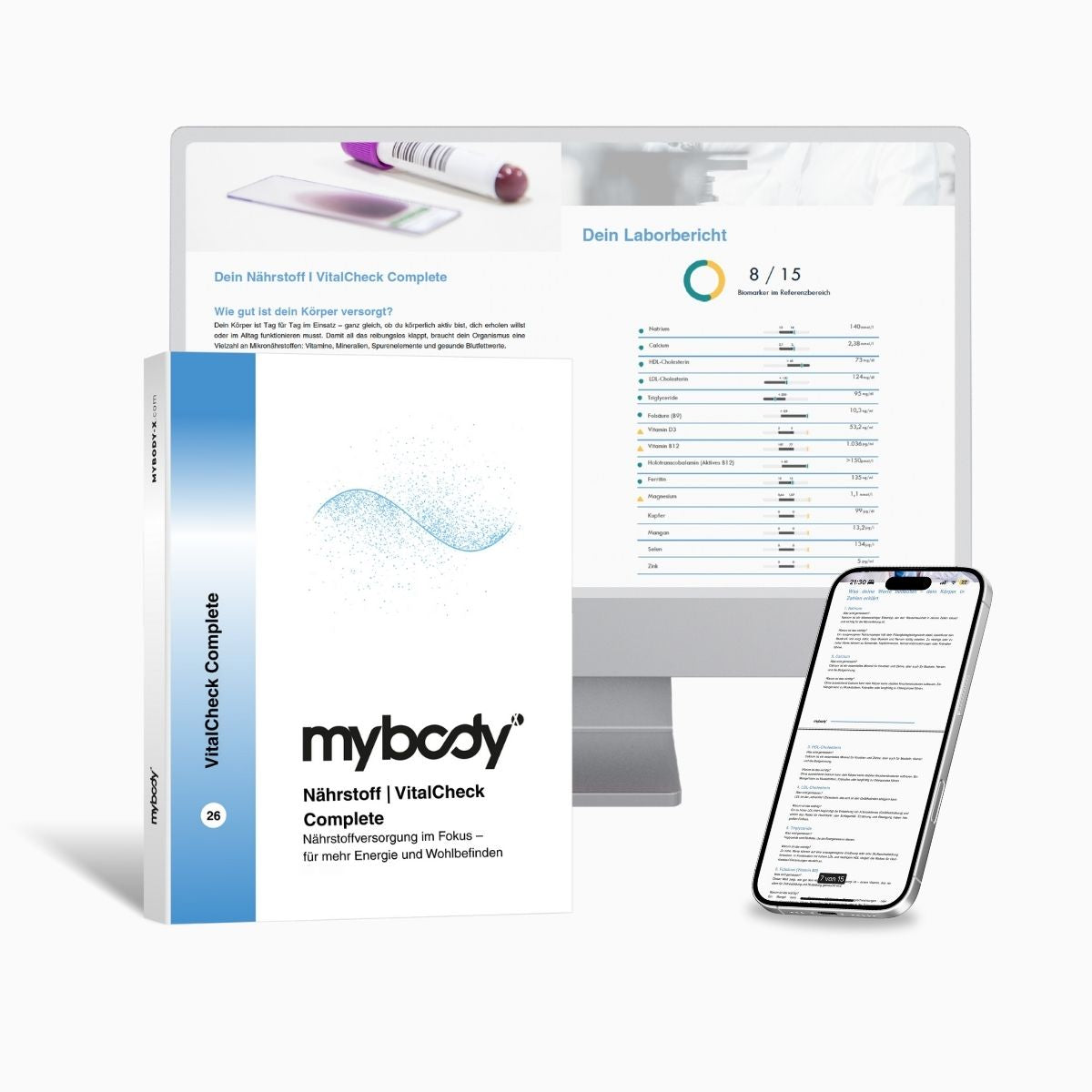
Nutrient | VitalCheck Complete
Determines 15 biomarkers from capillary blood, including ferritin, 25-OH vitamin D3, vitamin B12, folic acid, magnesium, selenium, and zinc. This analysis covers the most common suspected causes of persistent fatigue. Potassium and thyroid values are not included—yet the thyroid is one of the most important causes of exhaustion and requires separate evaluation.
Price: €169.00 (instead of €199.00) · Sample type: Capillary blood · Processing time: approx. 3–5 working days · Laboratory: ISO-certified laboratory in Germany
To the VitalCheck CompleteBest for People with persistent fatigue who want to know whether their iron, vitamin D, or B12 levels are within range.
✓ Broad selection of markers, including ferritin and blood lipid values.
✗ Without thyroid values, one of the most common causes remains unchecked.
You can check in advance whether the value you are interested in is included: the biomarker encyclopedia with all 67 blood values explains each individual marker—from ferritin and vitamin D to inflammation markers such as CRP and hormone levels such as TSH.
2. For digestive symptoms: the gut flora analysis
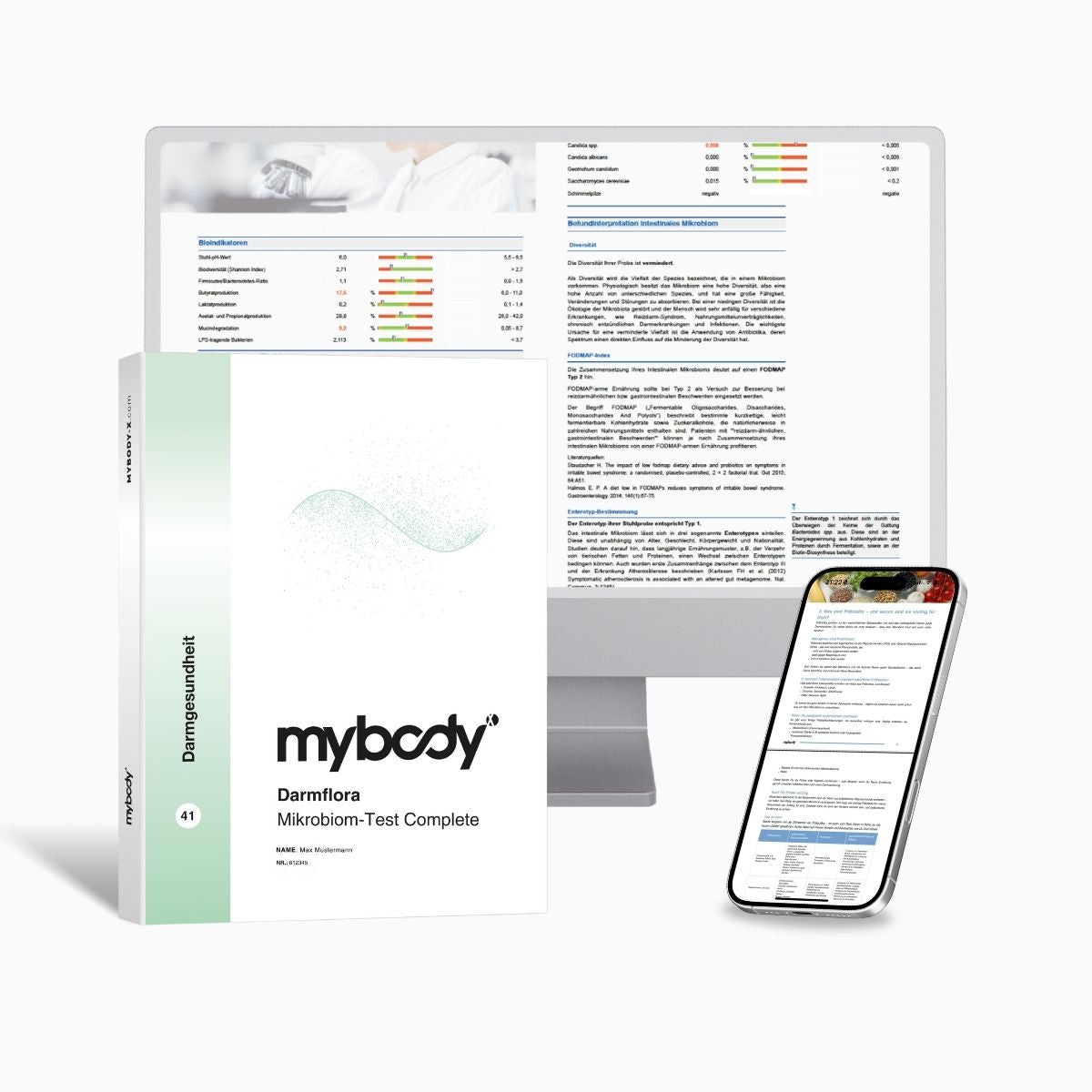
Gut Flora MIKROBIOM Test Complete
Analyzes more than 1,500 bacterial species using DNA sequencing and adds enterotype determination and a FODMAP index. The report is approximately 15 pages long and includes personalized recommendations. Not a diagnostic procedure: The analysis does not detect chronic inflammatory bowel diseases, celiac disease, infections, or tumors.
Price: €189.00 (instead of €219.00) · Sample type: Stool sample · Processing time: approx. 5–10 working days · Laboratory: ISO-certified laboratory analysis, ISO 27001
To the MIKROBIOM Test CompleteBest for People with recurring digestive symptoms that have already been medically evaluated and who are looking for a starting point for their diet.
✓ The FODMAP index and enterotype provide concrete starting points for dietary decisions.
✗ A finding describes a condition, not a cause—and does not replace further investigation.
You can find detailed information on what to look out for with this test category on our page about gut flora tests with recommendations for action. You can find which bacteria and markers are evaluated individually in the gut encyclopedia.
3. For symptoms after eating: the antibody analysis

NutriCheck | Intolerance Test
Measures specific IgG antibodies against up to 300 foods in 13 categories from capillary blood. Important for context: The test does not detect lactose intolerance, which is caused by an enzyme deficiency rather than an antibody reaction. The hydrogen breath test is the medical standard for lactose and fructose intolerance. A classic immediate-type allergy is not detected either.
Price: €169.00 (instead of €199.00) · Sample type: Capillary blood · Processing time: approx. 3–5 business days · Laboratory: ISO-certified laboratory analysis
To NutriCheckBest for people who regularly experience discomfort after certain meals and want to organize their observations.
✓ Very broad coverage of up to 300 foods in 13 categories.
✗ An IgG result is an indication, not proof of an intolerance—and it replaces neither a breath test nor a food diary.
4. For nutrition and metabolism: the genetic analysis

NutriCare | INFINITY DNA test
Analyzes more than 140 genetic variations from a saliva sample and provides 54 analysis reports in 8 chapters spanning around 200 pages. Clearly limited: A DNA test does not provide a diagnosis or predict weight-loss success. It does not include a report on protein, dietary protein, or protein requirements. Its relevance is supported for alcohol, caffeine, and lactose metabolism, as well as gluten intolerance.
Price: €269.00 · Sample type: Saliva · Processing time: approx. 15–25 business days · Laboratory: ISO-certified laboratory, ISO 27001
To NutriCare | INFINITYBest for people who want to shape their diet for the long term and are looking for a one-time foundation that remains valid permanently.
✓ Very comprehensive report that only needs to be compiled once in a lifetime.
✗ Longest waiting time and highest price of the four analyses, with no information about your current condition.
Precisely because a genetic analysis is performed only once, it is worth taking a look beforehand: In the Lexicon of 170 Genetic Variations, you can search which analyses relating to nutrition, fat metabolism, sports, sleep, stress, hormones, skin, intolerances, and vitamin requirements are actually included—and whether your topic is covered.
All prices and performance details are current as of July 30, 2026. The stated processing times refer to laboratory analysis after the sample has been received. Prices and processing times may change.
In brief
Fatigue leads to a nutrient analysis from blood, digestive problems to a gut microbiome analysis from a stool sample, symptoms after eating to an antibody analysis, and questions about long-term dietary direction to a genetic analysis from saliva. The first three show a modifiable current state and can be repeated; the genetic analysis is performed once. None of the four provides a diagnosis.
What a self-test cannot do
A self-test provides measurements and an interpretation. What it does not provide is the context of your medical history, your medications, and your other findings. That context is precisely what turns a value into a meaningful statement.
For laboratory values in general, IQWiG states that reference ranges can vary from one laboratory to another because different equipment and methods are used. A value outside the reference range therefore does not automatically mean that a disease is present. A measurement is a data point, not an answer.
The time factor also matters. Blood and stool analyses capture a moment in time. If you ate, slept, or exercised differently on the day the sample was taken than you usually do, you will get a different result. This is not a flaw in the analysis, but a characteristic of what is being measured—and a reason not to draw major conclusions from a single result.
A measurement is a data point, not an answer.
What should you do if everything is unremarkable?
An unremarkable result often feels like a disappointment, especially when the symptoms persist. But it is genuine information: It rules out one possible explanation and shifts the search in another direction. If your ferritin, vitamin D, and B12 levels are within range, you need to look elsewhere for the cause of your fatigue—in the thyroid, your sleep, or the demands of everyday life.
The wrong reaction would be to immediately order the next test. The more values you measure without a specific suspicion, the more likely you are to get a randomly abnormal finding that means nothing but still weighs on your mind. The more sensible approach is the opposite: take the unremarkable result to your doctor’s office and discuss what should be checked next.
And if a result is abnormal, the same applies in the other direction: A single finding is a reason to seek clarification, not a reason to self-treat. Taking high-dose supplements on your own initiative can do more harm than good.
Decision aid
If you are still unsure after the three questions in Chapter 1, the following comparison can help. It does not answer which test is best, but whether any test is the right next step at all.
A test makes sense when …
… your symptoms have persisted for some time, have been medically evaluated, and you are looking for an objective starting point.
… you have thought in advance about what you would specifically change for each possible result.
… you are planning to make changes anyway and want to track the progress with a before-and-after measurement.
Probably not if …
… the symptoms are new, severe, or accompanied by fever, blood, or weight loss—in that case, the evaluation should come first at your doctor’s office.
… you are hoping for a diagnosis. None of the four analyses provides one, and an abnormal result alone does not prove that you have a disease.
… you can’t think of an answer to the question “What would I do with the result?” Then the test has no purpose.
Conclusion
You can find the right health test by answering three questions: Do you want to know your current status or a predisposition, is the symptom acute or something you have had for longer, and what would you do with the result? The answers almost determine the type of test by themselves—blood for nutrient status, stool for the gut microbiome, blood for antibodies, saliva for predisposition.
And for anything that is new, severe, or accompanied by other symptoms, the simplest rule on this page applies: get it checked first, then test. A self-test is a tool for open questions, not urgent ones.
Frequently asked questions
How do I find the right health test for my symptoms?
Don’t start with the symptom; start with the question behind it. If you want to know your current levels of iron, vitamin D, or B12, a capillary blood nutrient analysis is suitable. If you have recurring digestive problems, a stool-based gut microbiome analysis is suitable. If symptoms occur after certain meals, an IgG antibody analysis may be worth considering. And if you want to shape your diet for the long term, a genetic analysis from saliva provides a one-time foundation. For acute symptoms or symptoms accompanied by other warning signs, medical evaluation should come before any test.
Which test can help with persistent fatigue?
A blood nutrient analysis is the obvious first step because it covers ferritin, vitamin D, vitamin B12, and folate. It is important to know that the VitalCheck Complete does not include thyroid values, even though a thyroid disorder is one of the most common causes of fatigue. If the nutrient levels are unremarkable, the thyroid should be checked next—either with a dedicated test or at your doctor’s office.
Can an IgG test detect lactose intolerance?
No. Lactose intolerance is caused by a deficiency of the enzyme lactase, not an antibody reaction—so an IgG test fundamentally cannot detect it. For lactose and fructose intolerance, the hydrogen breath test is the medical standard. mybody® does not offer a dedicated test product for this; for this question, your doctor’s office is the right place to go.
Can a self-test replace a diagnosis?
No. None of the four analyses presented provides a diagnosis. According to IQWiG, an abnormal laboratory value alone cannot be used to conclude that a disease is present, because a value may fall outside the reference range without an illness being present. In addition, no test is error-free in both directions: There are always false-positive and false-negative results. A test result must therefore be considered together with symptoms, medical history, and other findings.
First the question, then the test
Once you know which question you want to answer, you can find the right analysis in just a few minutes.
Overview of all tests View nutrient testsYou might also be interested in
→ ISO-certified health laboratory tests: Checking providers
How to recognize whether a test is backed by a certified laboratory and an expert team.
→ Gut flora tests with recommendations for action
The digestive symptoms test category in detail.
→ Biomarker encyclopedia: 67 blood values explained simply
Reference guide to every individual blood value before you decide on an analysis.
Sources
- Institute for Quality and Efficiency in Health Care (IQWiG): Sensitivity and specificity, as of August 26, 2022 — gesundheitsinformation.de
- IQWiG: Understanding laboratory values correctly, as of April 2, 2025 — gesundheitsinformation.de
- IQWiG: Advantages and disadvantages of screening examinations, as of April 20, 2022 — gesundheitsinformation.de
- IQWiG: Irritable bowel syndrome, as of February 22, 2023 — gesundheitsinformation.de
Sensitivity and specificity, including the quotation, are taken from [1]. The statements on reference ranges and the interpretation of individual laboratory values are taken from [2]. The statement on abnormal findings has been reproduced in substance from [3]. The warning signs are quoted verbatim from [4]. All product information comes from the mybody® product pages, accessed on July 30, 2026.

mybody® Editorial & Expert Team
Laboratory diagnostics Nutrient analysis Microbiome Nutritional science
This page was created and medically reviewed by the mybody® Editorial and Expert Team. The team brings together expertise in laboratory diagnostics, nutritional science, and health editorial work.
Last updated on July 30, 2026
Medical notice: This page is intended for general information and does not replace medical advice, diagnosis, or treatment. None of the tests presented here provides a diagnosis. If you experience new, severe, or accompanying symptoms, please contact a medical practice first.
