

Which weight-loss method is right for me? Eight approaches and the available evidence
The essentials at a glance
There is no method that is right for everyone. Concrete figures from German institutions are available for three of the eight approaches discussed here, two have been explicitly assessed, and for three we found no reliable information in the sources reviewed. That distribution is the key finding.
What all approaches have in common is that they work by reducing energy intake. The differences lie in the support provided, the time frame, and how well the approach fits into everyday life, which does not always go according to plan.
You will first read about what a method must be measured against, followed by an overview and the eight approaches individually. At the end, the question is which starting point suits which approach, along with the limits of this comparison.
What to expect in this article
1. What a weight-loss method must be measured against
2. The eight approaches at a glance
3. What is actually documented about effectiveness
4. A moderate calorie deficit over several months
5. A supported weight-loss program
6. Formula food as a time-limited starting point
7. Intermittent fasting
8. A carbohydrate-reduced diet
9. More exercise as the sole lever
10. Detox and cleansing programs
11. Nutritional counseling and nutrition therapy
12. Which starting point suits which approach
13. What a DNA test contributes to choosing a method
14. Limits of this comparison
15. What you take away from the comparison
Frequently asked questions
Sources
What a weight-loss method must be measured against
The usual question is which method works fastest. It is misleading, because almost every method works during the first few weeks once energy intake decreases.
Three other questions are more useful. Is there a documented figure showing what the method delivers over six to twelve months? Does it require support that you have access to? And can you continue with it when a week falls apart?
The overview below is organized around these questions. It does not assess which method is better, but what information is actually available about each one.
What “a good fit for me” means in practice
The wording sounds like a matter of taste. What it means is more practical: A method is a good fit if it is compatible with your weekly routine, your budget, and your resilience.
Your weekly routine determines whether rules with fixed times will work. Anyone who works shifts or is frequently on the move fails because of a time window, not a lack of consistency.
The budget determines whether supported approaches are feasible. Programs with appointments and formula foods cost money, and these are precisely the approaches backed by the most concrete figures.
Resilience determines the gap between what is needed and what is supplied. During a period of high strain, a small gap carries you further than a large one because it gets you through the first difficult week.
For distinction: Two older articles cover the same topic with a different focus. The Best Weight-Loss Method 2026 compares methods based on the question of individuality, while Best Weight-Loss Method: Which Diet Is Right for You starts from the type of diet. This article sorts them exclusively according to the strength of the evidence.
The eight approaches at a glance
| Criterion | Approaches with a documented figure | Approaches with classification but no figure of their own | Approaches without reliable figures |
|---|---|---|---|
| What these approaches are | Supported weight-loss program, formula diet, exercise as an add-on | Moderate calorie deficit, detox and cleansing programs | Intermittent fasting, low-carbohydrate diet, dietary counseling |
| What the sources say | Specific weight-loss figures in kilograms over 6 to 12 months (IQWiG, 2022) | A medical target range or an explicit assessment of the study evidence | No figure is available in the sources reviewed for this article |
| Support required | Yes, that is part of the method | No for the deficit, no for the program | No for the two dietary patterns, yes for the counseling |
| Behavior after a broken week | The support absorbs the setback | The section is repeated, or the program starts over | The rules continue to apply from the next meal |
The table is organized by the availability of information, not by effectiveness. The fact that no figure is available for an approach is not a statement against it, but a statement about the sources reviewed.
What is actually documented about effectiveness
The general recommendation comes before the individual approaches because it sets the framework within which every method must be classified.
It is remarkably plainly worded and does not name a method, but rather two components.
Documented source
“To lose weight, a combination of more physical activity and a change in diet is generally recommended.”
Institute for Quality and Efficiency in Health Care (IQWiG)
Severe overweight (obesity), as of 2022
This sentence does not name a type of diet. It describes a combination, and each of the eight methods below is a particular way of implementing that combination.
Key message
The methods differ not in whether they work, but in how much support they require and how well they cope with an interrupted week.
Why there is no figure for so many approaches
What stands out in the research for this article is less what the institutions say than what they remain silent about. For three of the eight approaches, we found no substantiated information on weight change over six to twelve months.
This has a methodological reason. Studying a dietary pattern over several months requires people to follow it for several months and someone to record what they actually eat. Both are difficult to control in everyday life.
The DGE explicitly identifies this problem in its overview of detox diets. It refers to an analysis according to which, in the diets studied, reduced energy intake alone was responsible for the weight loss, while the overall evidence was weak and not very informative (DGEinfo, 2018).
The implication for choosing a method is not a warning, but a shift in focus. Where figures for the method are lacking, the deciding question is whether you can stick to it—and only you can answer that.
1. Moderate calorie deficit over several months
The reference approach. Energy intake remains slightly below requirements over the long term, without eliminating any food group. Depending on starting weight, doctors recommend losing five to ten percent within six to twelve months (IQWiG, 2022).
Best for
People who can plan over several months and do not need support to stay on track.
Arguments in favor
It aligns with the medical target range, requires no elimination of entire food groups, and can continue unchanged after a week that did not go as planned.
Arguments against
The change is barely visible from week to week, and without tracking, there is no feedback of the kind other methods provide through rules.
The facts in brief: no fixed time frame, no food group eliminated, a target range of five to ten percent over six to twelve months, guidance not required.
Verdict: the benchmark against which the other seven approaches are measured.
2. Guided weight-loss program
This refers to structured programs with guidance, fixed appointments, and feedback. They have the most specific figures in this article.
What studies show over 6 to 12 months
5–6 kg
average weight loss in structured weight-loss programs, with a range of around 3 to 8 kg
10–15 kg
in programs where formula diets replace meals
2 kg
roughly this much more weight physically active participants lost after twelve months
Source: Institute for Quality and Efficiency in Health Care (IQWiG), Weight-Loss Programs and Medications, as of 2022
Best for
People who have repeatedly given up on their own and for whom fixed appointments make the decisive difference.
Arguments in favor
The only group of methods for which documented weight-loss figures are available over a defined period.
Arguments against
Costs and appointments create obligations. The average of five to six kilograms is less than many people expect.
Verdict: the approach with the most comprehensive evidence and the most sober results.
3. Formula diet as a time-limited starting point
Powders or shakes replace meals for a limited time. Programs of this kind led to greater weight loss of around ten to fifteen kilograms over six to twelve months in studies (IQWiG, 2022).
Best for
People under medical supervision for whom a significant initial weight loss is medically justified.
Arguments in favor
The greatest documented weight loss of all the approaches discussed here, with a clear structure and few daily decisions.
Arguments against
The eating behavior itself is not practiced. What happens after the phase ends determines the outcome, and there is no figure available for that here.
Verdict: effective over the measured period, with what happens afterward still unclear. Should be undertaken with medical supervision.
4. Intermittent fasting
Food is eaten within a fixed window, often eight hours a day. For intermittent fasting, the sources reviewed for this article provide no substantiated kilogram figure, so none is given here.
What can be said is this: A narrow eating window reduces energy intake for most people because one meal is omitted. The lever is therefore the same as with a moderate deficit, only achieved through a different rule.
Best for
People who find a simple rule easier than estimating portions.
Arguments in favor
A single rule instead of daily calculations, without banning individual foods, and easy to combine with a fixed work schedule.
Arguments against
The time window alone does not necessarily reduce energy intake. If you eat more during the window, nothing changes, and it is difficult to follow with shift work.
It is also practically relevant which meal is skipped. If breakfast is skipped, hunger shifts to the afternoon; if dinner is skipped, it usually affects the social part of the day. Both matter more for adherence than the length of the window.
Why the scale may remain unchanged despite the eating window is explained in detail in Why am I not losing weight with intermittent fasting?.
Verdict: a rule, not a mechanism of its own. It works when it reduces intake.
5. Carbohydrate-reduced diet
Bread, pasta, rice, and sugar are drastically reduced. Here too, the sources we reviewed provide no substantiated figure for weight change over six to twelve months.
Part of the early change is due to fluid loss. When glycogen stores, the short-term carbohydrate reserve, decline, the water bound to them declines as well, and both appear together on the scale.
Best for
People who already eat a lot of carbohydrates and are looking for a visible starting point.
Arguments in favor
The starting point is specific, and reducing free sugars is consistent with the recommendation of three professional societies to consume less than ten percent of daily energy from them (2018).
Arguments against
The early success is overestimated because some of it is fluid. Invitations and the cafeteria become more difficult, and entire food groups are eliminated.
Verdict: a useful starting point for high baseline consumption, with a starting value that looks too optimistic.
6. More exercise as the sole lever
Physical activity works, but on a scale that surprises many people. IQWiG notes that exercise helps with weight loss and offers additional health benefits, but generally is not enough to achieve greater weight loss without adjusting the diet (2022).
Physical activity is the best way to maintain weight that has been reached, and the weakest way to achieve it.
Physical activity is the best way to maintain weight that has been reached, and the weakest way to achieve it. In studies, physically active participants lost just under two kilograms more after twelve months than those who changed only their diet (IQWiG, 2022).
Best for
People who have already reduced their weight and want to maintain it.
Arguments in favor
The benefits extend beyond weight, and physical activity supports muscle mass, on which the resting metabolic rate primarily depends, according to IQWiG.
Arguments against
As the sole approach to weight loss, it is generally not enough. Losing just under two kilograms over a year is disappointing for anyone who expected more.
Verdict: Essential as a complement, unsuitable as the sole lever.
7. Detox and cleansing programs
The only option on this list for which a professional association has explicitly assessed the evidence. In its overview, the German Nutrition Society refers to a study concluding that the effects of detox programs have not been proven and that clinical human studies on the subject are lacking (DGEinfo, 2018).
To explain the visible effect, the DGE states clearly: It is questionable whether such a diet stimulates the metabolism, and the rapid weight loss is very likely attributable solely to the reduced energy intake (2018).
When people say they want to detox, they usually mean something real. They feel heavy, tired, or bloated, and that need is legitimate. The explanation, however, does not hold up.
Best for
Based on the evidence reviewed, no group can be identified for whom this approach would be suitable.
Arguments in favor
The clear beginning and clear end provide structure, and many people use the program as an opportunity to make any change at all.
Arguments against
Its effectiveness is considered unproven. The DGE also points out that a severely reduced energy intake can lower the basal metabolic rate and thereby promote the yo-yo effect (2018).
Verdict: The underlying need should be taken seriously, but the reasoning does not withstand scrutiny.
8. Nutritional counseling and nutritional therapy
The only option on the list backed by a regulated qualification. According to IQWiG, nutritional counseling is aimed primarily at healthy people, while nutritional therapy is intended for people with illnesses and is meant to complement the treatment of diet-related diseases (as of 2021).
When it comes to costs, there is a distinction that surprises many people. For preventive counseling by qualified providers, the health insurance fund contributes, and a doctor’s recommendation is not required. Nutritional therapy, by contrast, is not covered by health insurance, except in a few specified diseases (IQWiG, 2021).
Best for
People with pre-existing conditions, a difficult relationship with food, or several unsuccessful attempts to go it alone.
Arguments in favor
Qualified professionals are clearly defined, counseling is partially covered as preventive care, and this is the only approach tailored to an individual rather than a rule.
Arguments against
Appointments and waiting times cost time, the treatment is generally not covered by statutory health insurance, and we do not have a figure here for the achievable weight change.
Chapter at a glance
Eight approaches, three levels of information. For supported programs, meal replacements, and the contribution of exercise, IQWiG provides specific figures in kilograms over six to twelve months (2022). For a moderate deficit, there is a medical target range; for detox cleanses, the DGE (2018) provides an explicit assessment of the evidence. For intermittent fasting, a reduced-carbohydrate diet, and nutritional counseling, we found no figure for weight change in the sources reviewed.
This comparison does not cover the medical route involving prescription medication or surgery. Both are medical decisions and are neither assessed nor compared here.
Which starting situation suits which approach
The eight approaches above can be reduced to three starting situations. If you have never managed to stick with an attempt on your own for several months, the difference usually lies in the support, not the type of diet.
People who have started several times and quit after a few weeks generally have a pacing problem. In such cases, the approach with the smallest gap between needs and intake is likely to work best, even if it feels too slow.
And anyone who has already lost weight and wants to maintain it faces a different task than losing weight in the first place. For that, exercise is the evidence-based contribution—not the next type of diet.
Going your own way makes sense if …
you have worked without a set framework so far and are looking for a benchmark against which you can measure progress.
you know that rules are easier for you than estimates, or vice versa.
you accept a period of six to twelve months rather than a deadline six weeks from now.
Going it alone is probably not the right choice if …
you are unintentionally losing or gaining weight without having changed anything. In that case, medical evaluation takes priority over choosing a method.
Food is associated with control or shame for you. None of the approaches on this list will resolve that; several may make it worse.
you have a condition or take medication that affects your weight or appetite.
What a DNA test contributes to choosing a method
All eight approaches above are group-based rules. A mybody®x DNA test (MYBODY Lab GmbH) describes traits that do not change and thus offers clues as to why a particular rule has been harder for you to follow so far.
It does not choose the method. It provides context, and that is the honest scope of this statement.
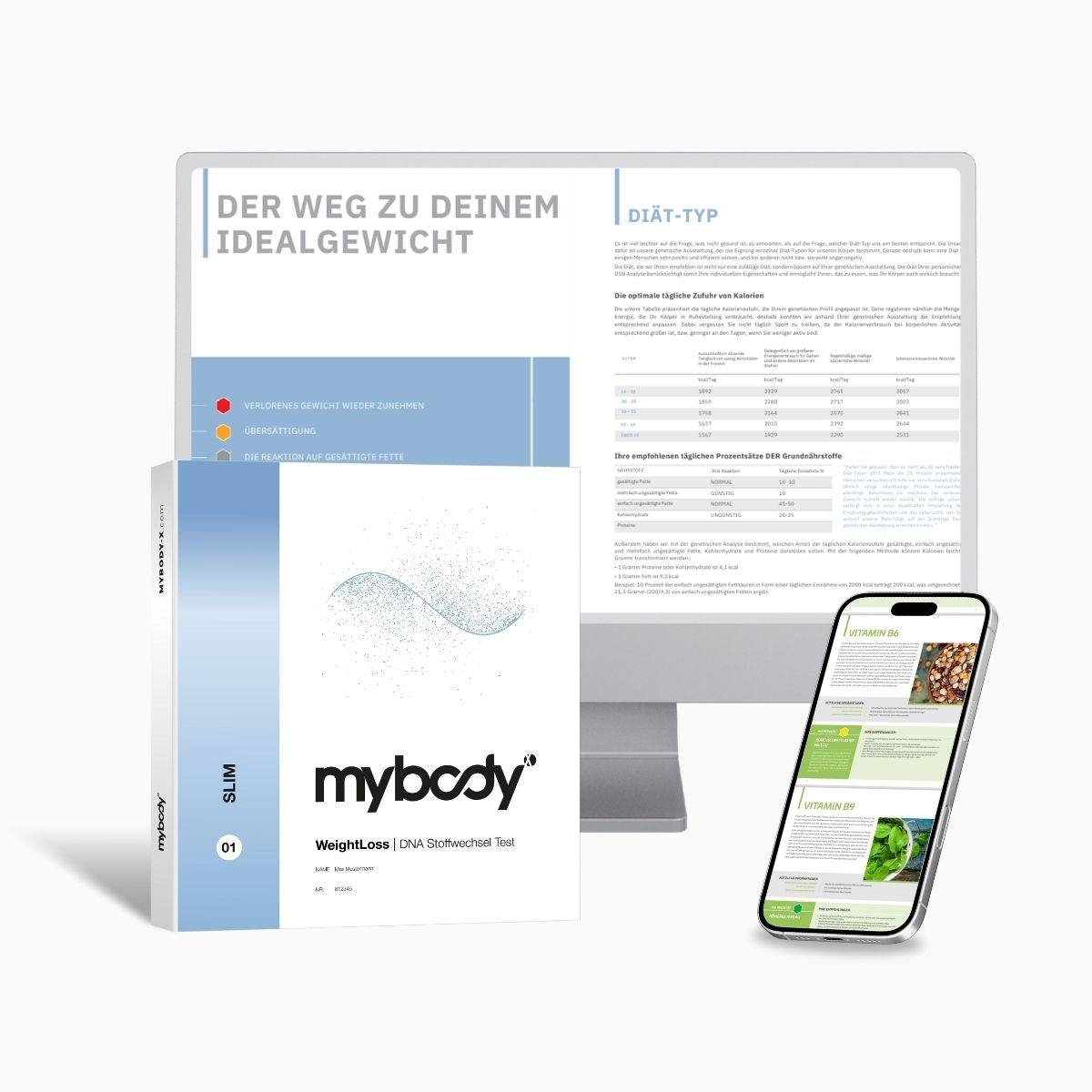
DNA test from saliva
WeightLoss | SLIM DNA Test
Analysis of more than 80 genetic variants, presented as 24 reports in five chapters, including nutrition and diet characteristics. What the test does not do: It does not identify one method as the right one, provide a diagnosis, or predict weight-loss success. The result is not a prescription.
Laboratory analysis 15–25 working days after receipt of the sample
Information from the product page, accessed 07/08/2026
Limitations of this comparison
This article compares the availability of information, not success rates. The fact that no figure is given for three approaches does not mean they do not work, but that the sources reviewed for this article provide no information on them.
The figures from [2] come from studies with support. They describe groups over six to twelve months and say nothing about an individual person or the period afterward.
Also not included are all medical approaches. Prescription medicines and surgeries are deliberately neither assessed nor compared here, because both belong to a medical decision.
Another limitation lies in the selection itself. Eight approaches are not a complete overview of everything offered under the term weight-loss method. Included were what is widespread and what a German institution makes any statement about.
And the test has the limitation stated in the product information. It describes predisposition and does not determine a choice of method.
What you take away from the comparison
If you take away one thing, let it be this: Do not assess a method by what it promises in four weeks, but by whether it gives a figure for six to twelve months. For five of the eight approaches above, this figure is not available.
The second test is even simpler. Ask yourself what happens to the method when one week falls apart. Approaches that withstand this differ from approaches that end at that point.
At the beginning was the question of which method suits you. After eight approaches, an uncomfortable answer remains: The method matters less than the amount of time you give it.
Frequently asked questions
Which weight-loss method is the most effective?
The highest documented weight loss was achieved by programs using formula foods, at around ten to fifteen kilograms within six to twelve months (IQWiG, 2022). Structured weight-loss programs without formula foods achieved around three to eight kilograms, averaging five to six. Both figures come from studies with support and say nothing about the period afterward.
Does intermittent fasting offer more than a normal calorie deficit?
We have no substantiated information on this question from the sources reviewed for this article, so no figure is given here. Objectively, a narrow eating window lowers energy intake in most people because one meal is omitted. The mechanism is therefore the same as with a moderate calorie deficit, achieved through a different rule.
Do detox or cleansing cures help with weight loss?
The German Nutrition Society refers in its overview to a study according to which the effects of detox cures have not been proven and clinical human studies are lacking (DGEinfo, 2018). The DGE attributes the rapid weight loss very likely solely to reduced energy intake and points out that a severely reduced intake can lower the basal metabolic rate and promote the yo-yo effect.
Is exercise alone enough to lose weight?
Generally, no. IQWiG states that exercise helps with weight loss and has additional health benefits, but usually is not sufficient for substantial weight loss without dietary adjustments (2022). In studies, physically active participants had lost just under two kilograms more after twelve months than those who only changed their diet. Its contribution is significantly greater for maintaining weight.
Does health insurance cover nutritional counseling?
For preventive counseling provided by qualified professionals, health insurance funds contribute to the cost, and a doctor's recommendation is not required (IQWiG, 2021). Nutritional therapy for people who are already ill, on the other hand, is generally not covered, apart from a few specified conditions; for other illnesses, the insurance fund decides upon application. Qualified professionals include dietitians with a state-recognized qualification.
Next step
When the method is clear but the rationale is missing
The WeightLoss | The SLIM DNA Test provides insights into predispositions that can support the rationale for a chosen method. It does not make the choice and does not replace medical advice.
Go to the WeightLoss | SLIM DNA Test Go to the guide for creating the planRead more
You might also be interested in
What a genetic approach to weight loss can and cannot achieve.
The most common reasons why the time window is in place but the scale still does not respond.
Sources
- Institute for Quality and Efficiency in Health Care (IQWiG): Severe Overweight (Obesity) (as of 2022) – gesundheitsinformation.de
- Institute for Quality and Efficiency in Health Care (IQWiG): Weight-Loss Programs and Medications (as of 2022) – gesundheitsinformation.de
- Institute for Quality and Efficiency in Health Care (IQWiG): Nutritional Counseling and Nutritional Therapy (as of 2021) – gesundheitsinformation.de
- German Nutrition Society (DGE): Detox Diets, DGEinfo 3/2018 – dge.de
- German Obesity Society, German Diabetes Association, and German Nutrition Society: Quantitative Recommendation for Sugar Intake in Germany (2018) – dge.de
The verbatim quote on the recommended combination comes from source [1], as does the target range of five to ten percent. All kilogram figures for programs, formula foods, and the contribution of physical activity, as well as the statement on the importance of sport, come from [2]. The information on nutritional counseling, nutritional therapy, and cost coverage comes from [3]. The assessment of the evidence on detox cures, the attribution of weight loss to reduced energy intake, and the note on basal metabolic rate come from [4]; the reviews cited there are identified in the source by author and year. The recommendation on free sugars comes from [5]. Information on price, sample type, scope of analysis, and laboratory comes from the mybody®x product page, accessed on 7 August 2026; processing times follow the central specification for each test type. All sources were accessed and reviewed on 7 August 2026.

mybody®x Editorial & Expert Team
Nutritional science Nutrigenetics Laboratory diagnostics Blood analysis interpretation
This article was created by the mybody®x editorial and expert team. The team combines nutritional science, nutrigenetics, and the interpretation of blood analyses. Contributors are listed on the author page.
Published on 19 August 2026 · Last updated on 19 August 2026
The content is provided for general information and does not replace medical advice, diagnosis, or treatment. Reference ranges depend on the laboratory, method, and age; the information on your test report is always authoritative.




Share now:
How many chromosomes do humans have: 46 and what follows from this
Sodium–potassium ratio in the blood: what the number doesn’t show