

Create a weight-loss diet plan: how to build it
The key points at a glance
A diet plan is created in four steps: determine your energy needs, set the deficit, build a daily structure, and adapt the plan format to everyday life. Your needs are the only factor you really have to estimate. All further decisions follow from them, which is precisely why the order is not arbitrary.
This article does not provide a ready-made weekly plan. It shows the instructions behind it so that you can adjust a plan instead of starting over at the first setback. Wherever an institution provides a figure, it is named here along with the year. Where no such figure exists, that is stated as well.
First, you will learn why plans regularly fail and what a plan can actually achieve. Then come the four building steps individually, the question of choosing the right plan format, adjusting it after four weeks, and finally its limitations. If you prefer to get started right away, jump to Step 1.
What to expect in this article
1. Why most diet plans get abandoned in week three
2. What a diet plan can and cannot do
3. Step 1: How to determine your energy needs
4. Step 2: Which deficit you can really stick to
5. Step 3: How to structure your day instead of counting calories
6. Step 4: Which plan format fits your everyday life
7. How to adjust the plan after four weeks
8. What your predisposition reveals about your plan
9. Who benefits from a data-driven plan—and who does not
10. Limitations: what a diet plan cannot do
11. What to start with in the first week
Frequently asked questions
Sources
Why most diet plans get abandoned in week three
The usual routine is always the same. You download a plan, do your grocery shopping on Sunday, and stick to it for ten days. Then an evening appointment comes up that is not in the plan, and after that the plan never comes back.
The problem is rarely a lack of discipline. It is that a ready-made plan is calculated for an average that does not exist. It knows neither your energy needs nor your working hours nor who does the cooking in your household.
That is why this is about something else. A plan you build yourself can be repaired. If you know what four parts your plan consists of, you can replace one part instead of throwing the whole thing away.
Determine your needs
The only number you have to estimate. Everything else depends on it.
Set the deficit
Not the biggest one, but the one you can still follow in week eight.
Structure the day
Meals, satiety, drinks. Structure beats counting.
Choose a plan format
Rigid weekly schedule, modular system, or set of rules. Everyday life decides.
To clarify this article’s role: Anyone looking for a ready-made weekly plan can find it under Weight-Loss Nutrition Plan. Anyone who wants a four-week structure will find the right resource in the Healthy Weight-Loss Plan. This is the blueprint behind it, nothing more.
What a nutrition plan can and cannot do
A plan does not change your body. It changes the number of decisions you have to make in a day—and therefore the probability that one of them will go wrong.
Key point
A nutrition plan does not reduce your weight; it reduces the number of decisions you have to make anew every day.
Why your needs differ from those of your friend
Two people with the same weight and height need different amounts of energy. The main reason is well documented and has nothing to do with willpower.
Documented source
“A person’s resting metabolism depends primarily on the proportion of muscle mass in their body weight.”
Institute for Quality and Efficiency in Health Care (IQWiG)
Causes of obesity, as of 2022
Resting metabolism is the energy your body uses for your heartbeat, breathing, and body temperature without you moving. According to IQWiG (2022), it accounts for around 70 percent of total calorie needs on average.
This means that the largest component of your needs is something you can hardly change in the short term. That is precisely why a plan begins by estimating this number, not by choosing recipes.
When a plan is the wrong answer
There are situations in which a self-created nutrition plan is not the next step. They are deliberately placed here at the beginning, not at the end.
If you lose weight unintentionally without having changed anything, this should be medically evaluated. The same applies to persistent exhaustion lasting several weeks, newly diagnosed high blood pressure, and medications that affect your appetite or blood sugar.
And if eating is associated with control, shame, or compulsive counting for you, a calorie plan is the wrong approach. In that case, a nutritional counseling service or a medical practice is the right place to turn—not a table.
Step 1: How to determine your energy needs
Your daily needs consist of three parts. In 2022, IQWiG estimated them at around 70 percent for resting metabolism, around 20 percent for activity-related energy expenditure from movement and work, and the remaining around 10 percent for digestion itself.
This breakdown explains why additional movement shifts your needs less than many people expect. The part you can influence is the smaller of the two.
From the reference value to your own number
Assessing your activity level honestly
The German Nutrition Society uses the PAL value, a factor for physical activity throughout the day. Sedentary work with little compensatory activity is around 1.4, while a daily routine involving a lot of walking is around 1.6 to 1.8.
Read off the appropriate reference value
For adults aged 25 to under 51, the DGE gives reference values of 1,800, 2,100, and 2,400 kilocalories per day for women, and 2,300, 2,700, and 3,000 kilocalories for men, respectively, at PAL values of 1.4, 1.6, and 1.8 (basis of the calculation as of 2015).
Check it over two weeks
Eat roughly at this level for two weeks and weigh yourself twice a week at the same time of day. If your weight remains stable, the reference value was suitable for you.
Only then make adjustments
If your weight changes significantly even though you have not changed anything, adjust the baseline value by around 200 kilocalories. No more, otherwise you will not know what caused the change next time.
The order matters. Anyone who calculates a deficit immediately without checking the baseline value is building on a number that no one has verified.
Why every estimate of your needs remains an estimate
Reference values are averages for population groups. They describe what an average person needs, not what your body uses.
That is precisely why step 3 of the calculation process includes an observation phase. Your weight over two weeks is a more accurate measuring tool than any formula because it measures your number, not someone else’s.
What the activity factor does not capture
The PAL value describes an average over the day. It does not distinguish between a week with four training sessions and a week with four evening appointments, even though the two may feel very different.
For planning purposes, choose the factor that fits your quietest week, not your best one. A plan based on an active week will provide too much in every normal week.
People who work shifts or are frequently on the move face this problem in an intensified form. Here, the weekly average is more informative than the daily figure, and monitoring over two weeks matters more than the accuracy of the initial number.
Resting energy expenditure itself changes slowly. Because, according to IQWiG, it depends primarily on the proportion of muscle mass, it changes over months with your training status, not over weeks with your eating plan.
Step 2: The deficit you can actually maintain
A deficit is the difference between what you need and what you eat. The temptation is to set it as high as possible. Experience with abandoned plans argues against that.
IQWiG demonstrates how small deviations can have an effect over time with a calculation in the opposite direction: If someone consumes 50 more kilocalories than they burn every day, this could theoretically mean around 2 kilograms of weight gain over a year (2022).
The number is small and the period is long. Together, that is the real point: A moderate deficit maintained for a year achieves more than a large one maintained for six weeks.
How to tell that your deficit is too large
The signs do not show up on the scales. You think about food noticeably often during the day, have more trouble falling asleep, and plan your week around where you can get around the plan.
If these points occur, it is not a character flaw but feedback. The right response is to reduce the deficit, not tighten the rules.
In practical terms: Set the deficit so that you feel full on a normal workday. If you have to calculate how many hours remain until the next meal, it is too large.
Chapter at a glance
A deficit should not be chosen based on the desired speed, but on how long you can maintain it. IQWiG calculates that even a deviation of 50 kilocalories per day over a year theoretically amounts to around 2 kilograms (2022). Small differences over long periods are more effective than large ones over short periods. Hunger, poor sleep, and constantly thinking about food are signs that the gap has been set too wide.
Step 3: How to fill your day instead of counting calories
Now there is a number. Translating it into meals is the step at which most plans become unnecessarily complicated.
The key is structure instead of counting. If you have three regular meals and know what each one consists of, you will end up close to your target without doing any calculations.
The structure of a meal
A filling meal contains a source of protein, a source of fiber, and a source of carbohydrates. Fiber consists of indigestible plant components that add bulk in the intestines and prolong the feeling of fullness.
For specific choices, the German Nutrition Society (2024) gives quantities that can be used as a weekly guideline: no more than 300 grams of meat and sausage per week, fish once or twice, legumes at least once, and a small handful of nuts every day.
Fluid intake also matters. The German Nutrition Society recommends around 1.5 liters a day, preferably water or other calorie-free drinks (2024). Anyone who meets this amount with sweetened drinks significantly shifts their daily total without feeling full.
Where sugar really counts in the plan
The German Obesity Society, the German Diabetes Association, and the German Nutrition Society jointly recommend a maximum intake of free sugars of less than 10% of total energy intake (2018, based on the WHO recommendation from 2015).
Free sugars are all sugars added to a food, as well as the sugar in honey, syrup, and fruit juice. The sugar in a whole apple does not count.
With a daily requirement of 2,000 kilocalories, the recommendation amounts to less than 200 kilocalories from free sugars. That is a limit you can reach with a single soft drink, which is why it belongs in beverage planning, not dessert planning.
How to make the plan shopping-ready
A plan rarely fails because of the cooking. It fails because an ingredient is missing on Wednesday evening, causing the meal to be replaced with something else.
That is why the shopping list is organized by category rather than by recipe. Protein sources, sources of fiber, sources of carbohydrates, plus oil, spices, and drinks: when you shop this way, you can make three dishes from the same ingredients.
Some of it should be shelf-stable. Jarred legumes, frozen vegetables, and whole-grain products maintain the structure even during a week when you don't get around to shopping.
And the plan needs an answer for days spent away from home. If you decide in advance what you will choose in the cafeteria or while out, you make that decision once instead of making it anew each time under time pressure.
Step 4: Which type of plan suits your everyday life
There are three ways to write a meal plan. They differ not in content, but in what happens when a day goes differently than planned.
| Criterion | Fixed weekly plan | Modular plan of fixed meals | Rules without fixed dishes |
|---|---|---|---|
| Effort required to create it | High: 21 meals per week are specified individually | Medium: around six to eight meals are created once and repeated | Low: only the rules are defined, not the dishes |
| What happens when there is a deviation | The rest of the week shifts, while the groceries already purchased remain unused | The meal is swapped, while the rest remains unchanged | Nothing; the rule continues to apply to the next meal |
| Shopping | An exact list with little flexibility | Recurring basic list plus fresh additions | Stocking up by category rather than by recipe |
| Suitable for | Predictable weeks, fixed working hours, cooking at home | Variable days with a few fixed points | Shift work, travel, frequent meals out |
The table compares plan types, not success rates. We have no substantiated information on which of these three types is followed for longer on average, so none is provided here.
In practice, the modular approach is the useful middle ground for most people. It requires work once and accommodates an evening appointment without throwing off the whole week.
How to adjust the plan after four weeks
After four weeks, you know two things you could not have known beforehand: whether your estimated needs were roughly accurate and which meals you actually ate.
A plan that you don't need to adjust after four weeks was never adapted to your everyday life.
A plan that you don't need to adjust after four weeks was never adapted to your everyday life. Adjusting it is not a sign of failure, but the actual purpose of the first four weeks.
First, remove the meals you planned three times but ate none of. They cost money and attention and give nothing back.
Then check the figure. If your weight has not changed in four weeks even though you largely followed the plan, the estimated requirement was probably set too high.
The objection is valid: Weight fluctuates over the course of days, simply because of water and digestion. That is why what matters here is comparing two weekly averages, not two mornings.
When the plan was not the problem
Before you adjust the calorie count, examine the week itself. A week spent moving house, the flu, or a period with five hours of sleep says little about whether your plan is suitable.
More precisely: The plan did not fail; the conditions changed. In this case, repeat the section unchanged instead of revising it.
Only when two calm periods in a row produce the same result is it time to adjust the number. Two data points under comparable conditions are worth more than four under arbitrary ones.
What your predisposition reveals about your plan
Up to this point, you have been working with reference values that apply to groups. Two test types from mybody®x (MYBODY Lab GmbH) approach things from a different angle: one looks at predisposition, the other at your current nutritional status.
The difference is timing. Your DNA does not change and explains patterns you have noticed for years. Blood values describe your current status and shift over the course of months.
Neither replaces the four steps above. It answers why certain recommendations have not worked for you so far and provides the plan with a starting point rather than a guess.

DNA test from saliva
WeightLoss | SLIM DNA Test
Analysis of more than 80 genetic variations, presented as 24 reports in five chapters, including nutritional and dietary traits as well as vitamin and mineral requirements. What the test does not do: It does not provide a diagnosis, predict weight-loss success, or deliver a ready-made nutrition plan. The predisposition is not a fixed determination.
Laboratory analysis 15–25 business days after receipt of the sample
Product page information, accessed 07/08/2026
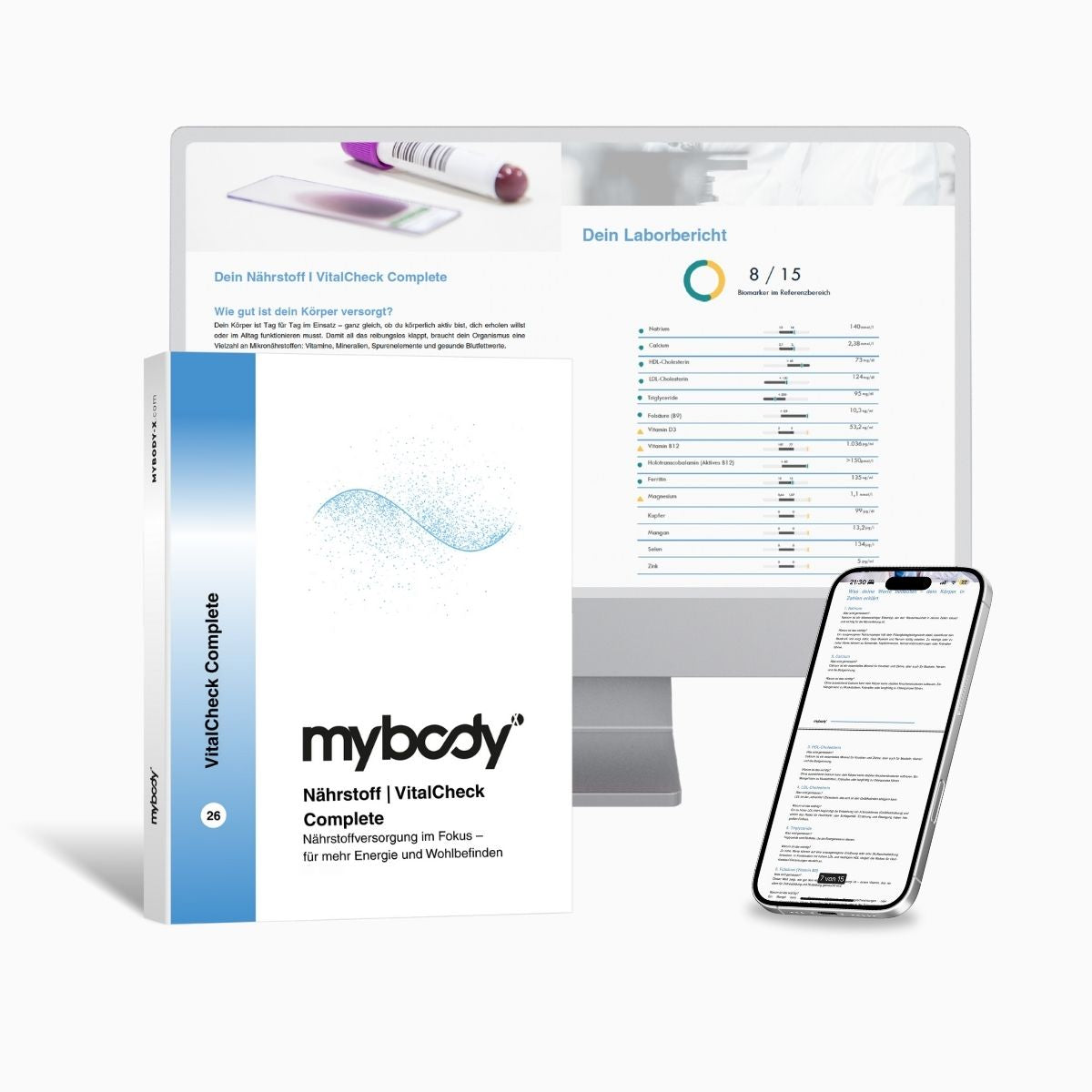
Blood test from capillary blood
Nutrient | VitalCheck Complete
Fifteen values from capillary blood, including vitamin D, vitamin B12, folate, iron as ferritin, magnesium, zinc, selenium, and blood lipids. What the test does not do: It neither determines your calorie needs nor your protein needs, does not provide a diagnosis, and any abnormal value should be medically assessed.
Laboratory analysis 3–5 business days after receipt of the sample
Product page information, accessed 07/08/2026
Both reports provide guidance and recommendations, not a prescription. They do not tell you how many kilocalories to eat, but rather where to start when choosing foods.
Who a data-driven plan is suitable for—and who it is not
Right for you if …
you have already tried several plans and want to know what keeps getting in the way for you.
you are planning to make a change anyway and want to track your progress with one measurement before and one afterward.
you have recurring symptoms such as fatigue and are looking for a starting point for a conversation at your doctor's office.
Probably not if …
you have not yet implemented any of the four steps. A test result does not replace estimating your requirements; it comes afterward.
you notice one of the warning signs from Chapter 2 in yourself. In that case, making an appointment is the right next step, not taking the test.
you expect a result to make the decisions for you. It provides guidance that you must apply yourself.
Limitations: what a nutrition plan cannot do
A plan is not a substitute for treatment. If you have conditions that affect metabolism or appetite, or take medication with a corresponding effect, planning should be handled by a doctor or nutrition therapist.
The figures also have limitations. The DGE guideline values describe groups, not individuals, and dividing requirements into 70, 20, and 10 percent is an average. None of these tables tells you how far your own value deviates from it.
Exercise alone contributes less than many people hope. IQWiG notes that exercise helps with weight loss and offers additional health benefits, but is generally not enough for substantial weight loss without adjusting the diet (2022).
The two tests above also have a limitation stated in the product card: They provide indications of predisposition and nutritional status. Neither one calculates how much you should eat.
Finally, a limitation on our part. We do not have reliable data on which of the three plan formats is followed for the longest on average. This article therefore includes no figure on the subject, because an estimate would be the worse error.
What to start with in the first week
Don't start with the plan; start with the baseline. Check the DGE guideline value for your activity level, eat roughly at that level for two weeks, and weigh yourself twice a week at the same time of day. Only then decide on the deficit.
The reason for this order is unremarkable. Anyone who subtracts their deficit from an unchecked number will not know after four weeks whether the plan was too strict, too lenient, or simply calculated incorrectly.
It began with the observation that plans get abandoned in the third week. That is precisely why you build your own: A plan whose four parts you know can be repaired. A downloaded plan can only be replaced.
Frequently asked questions
How many calories can a weight-loss nutrition plan contain?
It depends on your starting point, not on a general number. The German Nutrition Society gives reference values for adults aged 25 to under 51 of 1,800 to 2,400 kilocalories per day for women and 2,300 to 3,000 for men, depending on physical activity (basis of the calculation as of 2015). Subtract your deficit from this value after checking it against the scale for two weeks.
Do I have to count calories for a nutrition plan?
No, at least not permanently. Counting is a measurement tool for the first two to four weeks, to develop a sense of portion sizes. After that, structure takes over: three regular meals, each containing a source of protein, a source of fiber, and a source of carbohydrates. If you maintain this structure, you will end up close to your target without doing the math.
How much sugar is acceptable in a weight-loss plan?
The German Obesity Society, the German Diabetes Society, and the German Nutrition Society jointly recommend that less than 10% of total energy intake come from free sugars (2018). At 2,000 kilocalories a day, that is less than 200 kilocalories. Free sugars are added sugars as well as the sugar in honey, syrup, and fruit juice—not the sugar in a whole apple.
How long should I follow a nutrition plan before changing it?
Four weeks is a useful initial period. After that, compare two weekly weight averages rather than two individual mornings, because your weight fluctuates over several days simply due to water and digestion. First remove the meals you planned but did not eat, and only then adjust the calorie count, in increments of around 200 kilocalories.
Can a DNA test help with my nutrition plan?
It provides clues about predisposition, not a ready-made plan or a diagnosis. The WeightLoss | The SLIM DNA test analyzes more than 80 genetic variations and presents them in 24 reports across five chapters, including nutrition and diet traits. It does not calculate your calorie needs or predict weight-loss success. It makes sense if the four building blocks are in place and you want to know what you keep getting stuck on.
Next step
A starting point instead of a guess
Once the four building blocks are in place and you want to know what predisposition and nutritional status lie behind them, these two tests provide a starting point for your own observations. They are not a substitute for medical advice.
WeightLoss | SLIM DNA Test Nutrient | VitalCheck CompleteRead more
You might also be interested in
The finished plan with recipes, if you don’t want to create your own but simply follow the recipes.
The four-week structure, if you’re less interested in the setup and more interested in the process.
Sources
- Institute for Quality and Efficiency in Health Care (IQWiG): Causes of Obesity (as of 2022) – gesundheitsinformation.de
- German Nutrition Society (DGE): Reference Values for Energy Intake (basis of derivation as of 2015) – dge.de
- German Nutrition Society (DGE): DGE Recommendations for a Health-Promoting Diet (as of 2024) – dge.de
- German Obesity Society, German Diabetes Association, and German Nutrition Society: Quantitative Recommendation for Sugar Intake in Germany (2018) – dge.de
The direct quotation on resting metabolic rate comes from source [1], as does the breakdown of calorie requirements into approximately 70, 20, and 10 percent, the calculation involving 50 kilocalories over one year, and the assessment of the role of exercise. The recommended energy intake values come from [2], the quantities for meat, fish, legumes, nuts, and beverages from [3], and the recommendation regarding free sugars from [4]. Information on price, sample type, scope of analysis, and laboratory comes from mybody®x product pages, accessed on 7 August 2026; processing times follow the central guideline for each test type. All sources were accessed and reviewed on 7 August 2026.

mybody®x Editorial & Expert Team
Nutritional Science Nutrigenetics Laboratory Diagnostics Blood Analysis Interpretation
This article was created by the mybody®x editorial and expert team. The team combines nutritional science, nutrigenetics, and the interpretation of blood analyses. Those who contribute to it are listed on the authors’ page.
Published on 17 August 2026 · Last updated on 17 August 2026
The content is intended for general information and does not replace medical advice, diagnosis, or treatment. Reference ranges depend on the laboratory, method, and age; the information on your report is always authoritative.




Share now:
Lose 5 kilos: a realistic timeline instead of a wishful number
Nighttime calf cramps: Causes and what the values indicate