

Progesterone level: what determines it and what does not raise it
The essentials at a glance
“Raise progesterone” is one of the most frequently searched phrases related to hormones. Online answers range from herbs and vitamins to creams. What is usually missing is the question that comes before it: What does this level actually depend on?
This article answers exactly that question. It explains, with supporting evidence, when progesterone is produced, why the timing of the measurement is almost everything, and which of the recommendations circulating online stand up to scrutiny.
Here is the conclusion up front, so no one has to read to the end: We have no documented source supporting a recommendation for any of the widely circulated approaches.
What to expect in this article
1. Why “raising” is the wrong question
2. What progesterone is and when it is produced
3. What actually determines the level
4. Online recommendations, examined
5. What a low level may mean
6. The level across the stages of life
7. When measurement makes sense
8. What you will take away from this article
Frequently asked questions
Sources
Why “raising” is the wrong question
The question assumes that the progesterone level is a control knob that can be adjusted, just as one can eat more iron when ferritin is low. This analogy does not hold, and that is due to the hormone's origin.
Progesterone is not absorbed from food and is not stored for later use. It is produced at a specific point in the cycle, in a specific structure, and if that point does not occur, it is not produced in any significant amount. The level is therefore less a quantity that can be replenished than an indicator of whether a process took place.
This leads to the actual question, which is a different one: Did the process that produces progesterone take place? If so, the level is as expected. If not, the question is not how to raise the level, but why the process did not occur. That is a medical question, not one that can be answered with a product.
This article is therefore primarily an assessment and secondarily a rejection. It states what is documented and explicitly says where nothing is documented. That is more uncomfortable than a list of five tips and the only version that does justice to this topic.
What progesterone is and when it is produced
The Institute for Quality and Efficiency in Health Care describes it so concisely in its glossary that the entire essence fits into two sentences:
Documented source
“Progesterone is a sex hormone that belongs to the group of progestogens (corpus luteum hormones). It is produced in increased amounts in a woman's ovaries after ovulation.”
Institute for Quality and Efficiency in Health Care (IQWiG)
Glossary: Progesterone, accessed on August 26, 2026
The second sentence is the most important in the entire article: after ovulation. The corpus luteum, which forms from the emptied follicle, is the structure that produces progesterone. Without ovulation, there is no corpus luteum; without a corpus luteum, there is no significant progesterone.
Key message
The progesterone level is an indicator, not an adjustment knob. It shows whether ovulation has occurred and cannot be increased independently of it.
The same source lists the functions: The hormone plays an especially important role in preparing for and maintaining a pregnancy and ensures that the uterine lining becomes looser, so that a fertilized egg can implant more easily. During pregnancy, its concentration is greatly elevated because it is then produced in the placenta and continues to be produced in the ovary, and it prevents new eggs from maturing there. In addition, progesterone promotes, among other things, bone and muscle development (IQWiG, accessed 2026).
The final half-sentence explains why this topic matters beyond the desire to have children. Progesterone acts in several places, and that is why the question of its level is more than a fertility question for many people.
Where the corpus luteum comes from
The process around which everything revolves lasts only a few days. After ovulation, a structure remains at the site of the ruptured follicle; it undergoes changes and then produces progesterone. It is called the corpus luteum, or Gelbkörper in German, which is also the origin of the German term for the hormone, Gelbkörperhormon.
This structure is temporary. If no pregnancy occurs, it regresses, progesterone production ends, and bleeding begins. If pregnancy occurs, it initially remains in place and is later replaced by the placenta.
This explains why the level is so closely tied to a specific point in time. It does not describe a permanent state, but a phase. Anyone who measures the level outside this phase is measuring a state in which the producing structure does not exist at all.
What actually determines the level
Three factors determine which number appears on your test result. None of them is a food or a supplement.
First, the day of the cycle. The level is low before ovulation, then rises, and falls again toward the end of the second half of the cycle. A low level on the seventh day of the cycle is the expected state and not an abnormal finding. Anyone who interprets it as a deficiency is interpreting a normal state as an illness.
Secondly, whether ovulation has occurred. Cycles without ovulation do occur, and by no means only in cases of illness: during the first years after the first period, during the transition phase from around the mid-forties onward, under severe physical or emotional stress, and with significant weight loss. In such cycles, the rise in progesterone does not occur, even though the cycle appears to proceed normally.
Third, the stage of life. Before the first menstrual bleeding, after the last, and during pregnancy, completely different ranges apply. A value that is expected in one phase would be abnormal in another.
There is also a fourth factor that is not a physical characteristic but nevertheless changes the numerical value: the laboratory and its measurement method. Reference ranges always apply to the method used by the respective laboratory. Values from two laboratories are therefore not directly comparable, even when the same unit is shown.
What is recommended online, examined
Four recommendations have become established around the search question. The table places them side by side, together with the reasoning given for each and what can be stated based on the evidence.
| Criterion | Herbal preparations | Individual nutrients | Topical creams | Sleep, strain, weight |
|---|---|---|---|---|
| What is claimed | they regulated the cycle and thereby raised the value | they were building blocks of hormone production | the hormone would be absorbed through the skin | they influenced whether ovulation occurred |
| What can be stated based on the evidence | we have no source that would support a recommendation | we have no source documenting an effect on the value | preparations with hormonal effects are medicinal products and require a prescription | the connection with absent ovulation is recognized in the list of causes |
| Risk | Interactions are possible, and the composition is often unclear | Overdosing with high-dose preparations | uncontrolled interference with a regulated cycle | none, apart from the expectation of a quick result |
| Conclusion for this column | not recommended without medical supervision | useful in cases of a proven deficiency, not as a hormonal lever | belongs exclusively in medical hands | the only area in which taking action oneself is plausible |
The fourth column is the only one that stands up to scrutiny in this article, and even it comes with a qualification: It is recognized that prolonged strain, significant weight loss, and intense physical exertion can be associated with absent ovulation. However, this does not mean that making a change will raise the value. At most, it removes one possible cause.
The third column calls for a clear warning. Preparations with hormonal effects are not cosmetics, even when they are sold as such. They interfere with a self-regulating cycle, and uncontrolled intake can disrupt the body's own regulation. This is not an area for self-experimentation.
Why the number alone is rarely enough
In many test results, progesterone appears alongside estradiol, FSH, and LH, and there is a practical reason for this. A low progesterone level with high FSH tells a different story from the same level with unremarkable FSH. Only the combination provides context.
There is also the dimension of time. A single finding is a snapshot from a process that unfolds over weeks. Two measurements taken during the same phase of the cycle over several months say considerably more than a single measurement, and they are also the only way to distinguish a change from a fluctuation.
And finally, your own observations matter too. Cycle length, the length of the second half of the cycle, and the heaviness of bleeding: None of this appears in a laboratory report, and it is often more important for interpretation than the third decimal place. Anyone who records these details over two or three cycles brings something to the conversation that no blood test can reveal.
What a low level can mean
If the level was measured in the second half of the cycle and is low, there are several possible explanations. None of them can be inferred from the number alone.
A low level is a question, not an answer.
The first and most common explanation is incorrect timing of the measurement. Before considering anything else, check which day of the cycle the measurement was taken and how long the cycle actually is. A value from day eighteen means something different in a 26-day cycle than in a 34-day cycle.
The second is a cycle without ovulation. This can happen even when the rest of the cycle appears unremarkable, and one such cycle is not yet a pattern. Only when it occurs repeatedly does it become something to investigate.
The third is illnesses and medications that affect the cycle. These include thyroid disorders and elevated prolactin, as well as several groups of active ingredients. That is precisely why these levels are measured as part of hormone profiles rather than omitted.
And the fourth is the stage of life. During the transition phase from around the mid-forties onward, cycles without ovulation become more common, and a low progesterone level is less a defect than an indicator of the phase you are in.
How to recognize a reliable statement on this topic
A great deal is claimed about hormones, and the distinction is difficult when you are personally affected. Three questions can help, and they require no specialist knowledge.
First: Is a source cited, and can it be accessed? A statement without a source is an opinion, regardless of how convincingly it is presented. Second: Is a distinction made between an observation and an explanation? “I felt better after the change” is an observation. “The change raises progesterone levels” is a claim about a mechanism, and there is a long way between the two.
Third: Does it say what the approach cannot achieve? Anyone who lists only advantages is selling. Anyone who names the limitations is explaining. This third question distinguishes them most reliably, and it applies to guides just as much as to products—including this offering explicitly.
There is a fourth question on this topic: Is a distinction made between a laboratory value and a symptom? A low level and feeling unwell often occur together without one explaining the other. Anyone who equates the two skips precisely the step for which a medical practice is responsible.
The level across the different life stages
Anyone who wants to interpret their own level needs to consider the life stage alongside the cycle day. Four can be distinguished, and the same number means something different in each one.
The years after the first period
In the first few years after the first period, anovulatory cycles are common, and progesterone is correspondingly low. This is a transition and not a finding. A measurement during this phase rarely answers a question that could not also be clarified in another way.
The years with regular cycles
This is when the level is most meaningful, because there is a pattern against which it can be measured. That is precisely why progesterone is also measured during this phase when trying to conceive: It answers the question of whether ovulation has occurred better than any external observation.
The transition phase
From around the mid-forties onward, the pattern becomes irregular. Anovulatory cycles become more frequent, the second half of the cycle becomes shorter, and progesterone correspondingly falls lower, while estradiol can fluctuate considerably. During this phase, a single measurement is particularly difficult to interpret, and a trend reveals much more. Which levels shift first is described in the article Perimenopause.
After the last period
Without ovulation, no corpus luteum forms, so progesterone remains consistently low. This is the expected state during this phase and not a deficiency in the sense of a correctable deficit. Anyone considering treatment here is doing so for other reasons and always under medical supervision.
For men, the entire section does not apply in the same way: Progesterone is produced in small amounts, but it does not follow a cycle and is not measured in standard profiles for men. The question of increasing it does not arise in this form.
What cycle tracking can do
Before every measurement comes an observation that costs nothing. Anyone who records the start and length of their cycle over several months can see for themselves whether a regular pattern exists. This is the basis for determining a meaningful day for measurement at all.
A short second half of the cycle, a cycle that varies greatly from month to month, or a missed period are observations that matter. They should be mentioned and recorded because they are regularly recalled inaccurately from memory.
What tracking does not do: It does not indicate ovulation. Methods that attempt to do so measure other parameters and have their own limitations. To determine whether ovulation has occurred, the progesterone level in the second half of the cycle is the established method, which is precisely why it is measured then.
When a measurement makes sense
A brief answer follows from everything above: A measurement makes sense when there is a question behind it and the timing fits that question. Without both, the numbers have no meaning.
It therefore makes sense in the second half of the cycle, together with estradiol, FSH, and LH, and with the cycle day recorded. At mybody®x (MYBODY Lab GmbH), the Menopause Check covers this combination, analyzed in an ISO-certified laboratory in Germany. No other test in the range measures progesterone.
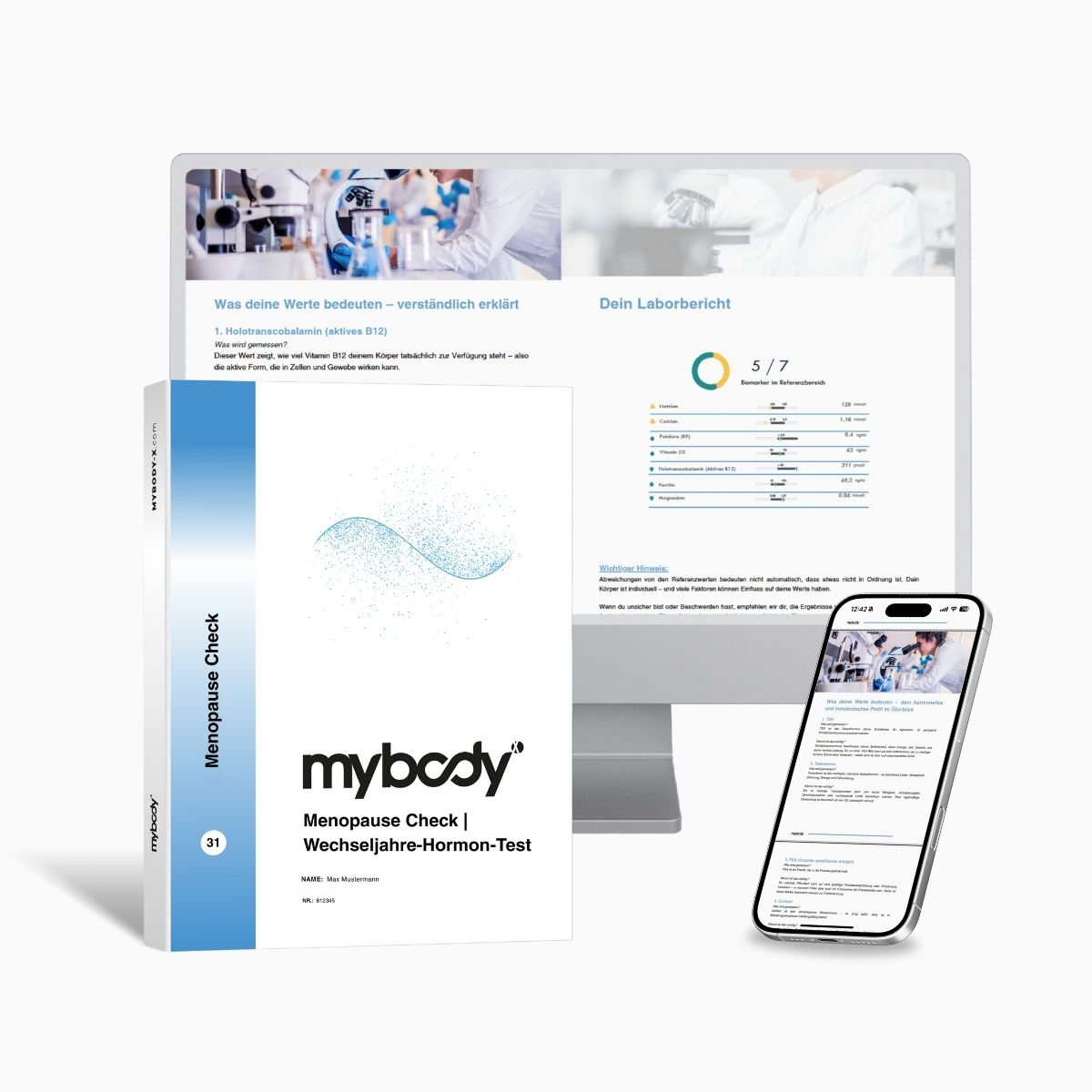
Hormone profile from a blood sample
Menopause Check | Perimenopause Hormone Test
Progesterone and estradiol, plus FSH and LH as regulatory hormones, as well as testosterone, DHEA-S, SHBG, and TSH. What the test does not do: It does not change any value, provide a diagnosis, or replace medical advice. It shows where your body stands at the time the sample is taken.
Laboratory analysis 3–5 business days after receipt of the sample
Product page information, accessed 26.08.2026
The article Estrogen and Progesterone explains why the two values are read together and what the term estrogen dominance has to do with it. The biomarker glossary with 67 explained blood values explains what the individual values mean. The comparison honestly answers in both directions whether a measurement is worthwhile for you:
It makes sense for you if …
you can measure in the second half of your cycle and want to record the cycle day.
your cycle has changed and you want to know where you are in this phase.
you have collected observations over several cycles and want to add numbers to them.
Probably not if …
you expect a measurement to change the value. It only shows it, nothing more.
you use hormonal contraception. Then the result measures something other than a natural cycle.
you want to clarify whether you wish to have children. This should be addressed in a gynecological practice from the outset.
Next step
If you first want to see where you stand
The Menopause Check combines progesterone with estradiol, FSH, and LH. The Biomarker Glossary explains what the individual values mean and what matters when it comes to the timing of sample collection.
Go to the Menopause Check Go to the Biomarker GlossaryWhat you will take away from this article
If you remember one thing, let it be the sentence from the glossary: progesterone is produced in greater quantities after ovulation. Almost everything else follows from this, including the uncomfortable answer to the original question. The level is an indicator of a process, not something to replenish.
And keep in mind what is deliberately not included here: a list of tips for increasing it. We have not found a verified source for any of the common approaches that would support a recommendation, and hormone-active preparations belong in the hands of a doctor without exception.
It began with a search query containing an embedded assumption. What remains is a better question and a clear way forward: measure in the second half of the cycle, note the cycle day, and interpret the result with someone who can put it into context. If you want to know what your body is currently working with: the consultation is free, and it does not sell you anything.
Frequently asked questions
How can I naturally increase progesterone?
We have not found a verified source for this question that would support a recommendation. The reason lies in the mechanism: progesterone is produced in greater quantities after ovulation (IQWiG, accessed 2026). Without ovulation, it is not produced in any significant amount, and a preparation cannot make this process occur.
When is progesterone measured?
Ideally, in the second half of the cycle, because the level is expected to be low beforehand. Which day is right in your case depends on the length of your cycle and should be coordinated with the practice issuing the test order. Without the recorded cycle day, the result is difficult to interpret.
What does a low progesterone level mean?
Four explanations are possible: the measurement was taken at the wrong time, a cycle without ovulation, an illness or medication affecting the cycle, or simply the stage of life. Which applies cannot be determined from the number alone and should be assessed by a doctor.
Are progesterone creams an alternative?
Preparations with hormonal effects are not cosmetics, even when marketed as such. They interfere with a self-regulating cycle and should be used only under medical supervision. This article expressly does not recommend using them without medical guidance.
What does progesterone do in the body?
It plays a particularly important role in preparing for and maintaining a pregnancy and ensures that the uterine lining becomes more relaxed. During pregnancy, its concentration increases significantly and prevents further eggs from maturing. It also promotes, among other things, bone and muscle development (IQWiG, accessed 2026).
Read more
You may also be interested in
Why the two values should be read together.
The timing of sample collection, explained in detail.
Sources
- Institute for Quality and Efficiency in Health Care (IQWiG): “Progesterone” glossary, accessed on 26 August 2026 – gesundheitsinformation.de
The verbatim quotation concerning its classification as a progestogen and its production after ovulation, as well as the information on its role in pregnancy and implantation, its increased concentration during pregnancy, its production in the placenta, the prevention of further egg maturation, and bone and muscle development, comes from [1]. The glossary page does not include a date; therefore, the access date is provided. No statements are deliberately made about ways to increase progesterone levels through diet, nutrients, herbal preparations, or creams because there is no documented source for this. Information on price, sample type, scope of services, and laboratory comes from the mybody®x product page, accessed on 26 August 2026; processing times follow the central requirement for each test type. The source was accessed and reviewed on 26 August 2026.

mybody®x Editorial & Expert Team
Blood analysis interpretation Nutritional science Laboratory diagnostics
This article was created by the mybody®x editorial and expert team. The team combines the interpretation of blood analyses, nutritional science, and laboratory diagnostics. Anyone who contributes to it is listed on the authors’ page.
Published on 26 August 2026 · Last updated on 26 August 2026
The content is intended for general information and does not replace medical advice, diagnosis, or treatment. Reference ranges depend on the laboratory, method, and age—what always matters is the information on your test report.




Share now:
Boosting metabolism: what’s actually proven
Lipopolysaccharide explained simply: what LPS means in the gut