
Hormone levels and the correct cycle day
The essentials at a glance
For hormone values, the cycle day is part of the result. The MSD Manual, professional edition, gives an FSH level above 25 IU/L for the late menopausal transition phase and explicitly relates this figure to cycle days 2 to 5 (as of January 2024).
The reason is the same as for any fluctuating value. The Institute for Quality and Efficiency in Health Care explains it generally: Many hormone levels change significantly over the course of the day, and when blood is drawn matters (as of April 2, 2025). With the menstrual cycle, the day of the month is an additional factor.
You will first learn why the cycle day matters. Then come the counting method, sample collection in five steps, how to handle irregular cycles, the rule for a second measurement, comparing values according to cycle dependence, and the limitations of the method.
What to expect in this article
1. Why the cycle day determines the meaning of the number
2. How to count the cycle day
3. Collecting the sample in five steps
4. What applies to irregular cycles
5. Why the second measurement needs to be taken on the same day
6. Who can benefit from planning
7. What else can shift the value
8. Which values depend on the cycle and which do not
9. What a capillary blood test can show here
10. Limitations: what the correct day does not solve
11. What matters about the cycle day
Frequently asked questions
Sources
Why the cycle day determines the meaning of the number
For most blood values, the date is a formality. For cycle-dependent hormones, it is the condition under which the number can be interpreted at all.
This can be demonstrated with a single entry. For the late menopausal transition phase, the MSD Manual, professional edition, gives an FSH level above 25 IU/L on cycle days 2 to 5 (as of January 2024). The cycle days are not an added detail there, but part of the information itself.
Documented source
“Follicle-stimulating hormone (ovarian insufficiency); if the level is high, it should be remeasured at least twice a month”
MSD Manual, professional edition
Amenorrhea, “Blood tests” section, as of September 2025
The sentence says two things. First, a single high FSH value is not enough. Second, the repeat measurement is taken monthly, in line with the cycle, not at an arbitrary interval.
This puts timing at the center—not as a detail for perfectionists, but as the condition that makes two values meaningfully comparable.
How to count the cycle day
The counting method is simple, yet it is often done incorrectly. Cycle day 1 is the first day of bleeding—not the following day and not the last day of the previous period.
This refers to a proper period, not spotting. If you are unsure, record both separately and bring the note to the conversation.
This counting method automatically determines the window for FSH. Cycle days 2 to 5 means the second through fifth day from the first day of bleeding, generally still during or shortly after the bleeding.
This surprises many people because the timing seems impractical. It is nevertheless the correct time because the reference values are based on it.
Why precisely the beginning of the cycle
The reason lies in the period of rest. At the beginning of a cycle, no follicle has yet matured very far, so feedback from the ovary is correspondingly limited.
During this phase, FSH shows most clearly how much the pituitary gland needs to increase its activity. Later in the cycle, the processes surrounding ovulation obscure this picture.
In other words, cycle days 2 to 5 are the time with the least noise. That is why this window has become the established reference point, rather than a time that fits the calendar better.
For you, when reading a result, this means that an FSH value from cycle day 18 cannot meaningfully be compared with a value for days 2 to 5. It is not an incorrect measurement—just one for which the appropriate benchmark is missing.
Collecting the sample in five steps
The following sequence describes a sample collected at home. The order is not arbitrary, because each step prepares for the next.
The process from planning to return shipment
Beforehand: Have the kit ready and know the window
Have the kit ready before bleeding starts. Anyone who waits to order it until afterward will miss the window because several business days may pass between ordering and delivery. Read the instructions all the way through once.
Record day 1
Record the first day of bleeding, including the date. The clock starts here. This single date determines the entire subsequent procedure.
Collect the sample on days 2 to 5
This is the period to which the FSH reference in the specialist literature applies (MSD Manual, professional edition, as of January 2024). Collect the sample in the morning because many hormone levels change significantly throughout the day. The kit instructions contain the specific steps.
Write down five lines
Collection date, cycle day, time, all medications and supplements taken in recent weeks, and the length of the last three cycles. These five lines will later determine whether two results can be compared.
Send it on its way the same day
The sample should be sent back without delay. The shorter the time between collection and arrival at the laboratory, the fewer questions will arise later about the sample's stability.
Step one is where most planning fails. A kit ordered after bleeding begins will generally arrive too late for that same window.
What applies with an irregular cycle
This is the practical contradiction at the heart of the issue. Those who want to measure because of an irregular cycle have the hardest time hitting the right day.
The early transition phase is defined by exactly this irregularity: a sustained difference of at least seven days in the length of consecutive cycles (MSD Manual, professional edition, current as of January 2024). In the late phase, it states that amenorrhea lasts at least 60 days.
The solution is to use an event instead of a calendar
Because the window is measured from the first day of bleeding, no prediction is needed. The cycle day is tied to an event that occurs, not to a planned date.
In practical terms: keep the kit on hand, and when the bleeding starts, measure within the next few days. This sequence also works with highly fluctuating cycle lengths.
If the bleeding remains absent for a longer period, the window no longer applies. The timing of the sample is then a question for the doctor’s office anyway, and it is answered there together with the progression.
What remains in both cases is the record. A value annotated to say that the last period was 74 days ago is more useful than a value with no information at all.
The cycle calendar is the real groundwork
Anyone who records the first day of every period for six months gains two things at once. First, the basis for planning the next window.
Second, there is something no blood test provides: the progression. The early transition phase is described by a sustained difference of at least seven days between consecutive cycles, and this observation comes exclusively from a calendar.
This list is therefore more valuable for a conversation at the doctor’s office than most people assume. Six dates on a piece of paper say more about the phase than a single FSH value without context.
Why the second measurement needs to be taken on the same day
A single hormone value describes one day in one cycle. It becomes meaningful only when a second value is placed alongside it, and that comparison has one condition.
Two values taken on different cycle days compare two cycle phases, not two points in life.
If the first sample was taken on cycle day 3 and the second on cycle day 14, you are measuring the difference between two phases of the same cycle, not the change over a year.
The same cycle day is therefore the most important rule for repeating the test, followed closely by the same time of day and the same preparations. And because reference ranges can vary from one laboratory to another (IQWiG, current as of April 2, 2025), using the same provider is the simpler choice.
What interval makes sense between two measurements
For evaluating ovarian insufficiency, the medical literature recommends a monthly interval with at least two repeat tests (MSD Manual, professional edition, current as of September 2025). The cycle sets the pace.
For the question of how something changes over the years, a longer interval is more appropriate. A process that typically takes four to eight years rarely shows anything new in four weeks.
The appropriate interval for your question is determined in medical practice. What remains the same in both cases is the requirement: the same cycle day, comparable conditions, and preferably the same laboratory.
Without these three conditions, a second measurement is not a repeat test but a new one-off measurement. The difference costs nothing, yet it determines whether a trend can ultimately be established.
Who benefits from planning
Not every question about hormone balance requires a precisely planned window. The comparison explains both sides.
It makes sense for you if …
FSH, LH, or estradiol are on your wish list. For these three, the cycle day is crucial.
You are planning a second measurement and want to make the first result comparable.
You can keep a kit on hand so that the window does not fail because of shipping time.
You want to bring results to an appointment that can be properly interpreted.
Probably not, if …
You are testing TSH, ferritin, or HbA1c. These values do not depend on the cycle day.
Your period has been absent for some time. In that case, the window does not apply, and you should discuss the issue with a medical practice.
You use hormonal contraception. It overrides the cycle you want to measure.
You expect the result to tell you something about fertility or ovulation. A single time-point measurement cannot provide that information.
What else can shift the result
The cycle day is the most important, but not the only, requirement. Two others belong on the same list.
The time of day
Many hormone levels change considerably over the course of the day, so the time of day when blood is drawn matters (IQWiG, as of April 2, 2025). With the menstrual cycle, this condition is added to the time-of-day requirement; it does not replace it.
In practical terms, this means measuring in the morning and recording the time to the exact minute. Our companion article Cortisol blood test: which time matters explains how narrow such time windows can be.
Medications and hormonal preparations
Hormonal contraception interferes with the regulatory cycle that the test is meant to reflect. The same applies to ongoing hormone therapy.
Other medications also play a role. For prolactin, for example, a level between 50 and 100 ng/ml is considered mildly elevated and is generally attributable to the use of a medication (MSD Manual, professional edition, as of September 2025).
That’s why every preparation belongs on the list, including one you assume has nothing to do with hormones. Your medical practice will determine how it should be classified.
Which values are affected by the menstrual cycle and which are not
Not every value in a female hormone test requires a specific time window. The table compares three groups based on the same four criteria.
| Criterion | FSH, LH, estradiol | Progesterone | TSH, ferritin, long-term blood sugar |
|---|---|---|---|
| Cycle-dependent | Yes, strongly | Yes, with a different window than FSH | No |
| Documented association | FSH above 25 IU/L on cycle days 2 to 5 in the late menopausal transition | No information about the cycle day in the sources reviewed | No connection to the menstrual cycle in the sources reviewed |
| What needs to be planned | The window from the first day of bleeding and the time of day | The timing should be discussed in practice because it depends on the question being investigated | Nothing cycle-related; some values have other requirements, such as fasting |
| With an irregular cycle | Measure from the start of bleeding; the event replaces the calendar | Difficult to plan without a reference point; should be discussed with a healthcare professional | Can be scheduled unchanged, regardless of the menstrual cycle |
The second row contains two blanks, and that is intentional. We found no information about progesterone or the cycle day in the sources reviewed, so no number is shown instead of an estimate.
The last column is the relieving one. Anyone having TSH, ferritin, or long-term blood sugar measured does not need to pay attention to the menstrual cycle and can measure at any time.
What this means for choosing the test
The table suggests a practical order. First clarify the question, then choose the test, and only afterward plan the appointment.
Anyone who wants to know where they are in the menopausal transition needs FSH and therefore the window. Anyone who wants to check the obvious alternative explanations—thyroid function, iron stores, and glucose metabolism—does not need a window.
This distinction avoids unnecessary planning. A profile without cycle-dependent values can be collected on any morning, which makes a real difference in everyday life.
If you need both, plan according to the more restrictive one. The FSH window then determines the appointment, and the other values can be measured at the same time without any disadvantage.
What a capillary blood test can show here
A capillary blood self-test does not provide a diagnosis. For cycle-dependent values, its advantage is that you choose the day yourself instead of waiting for an appointment at a medical practice.
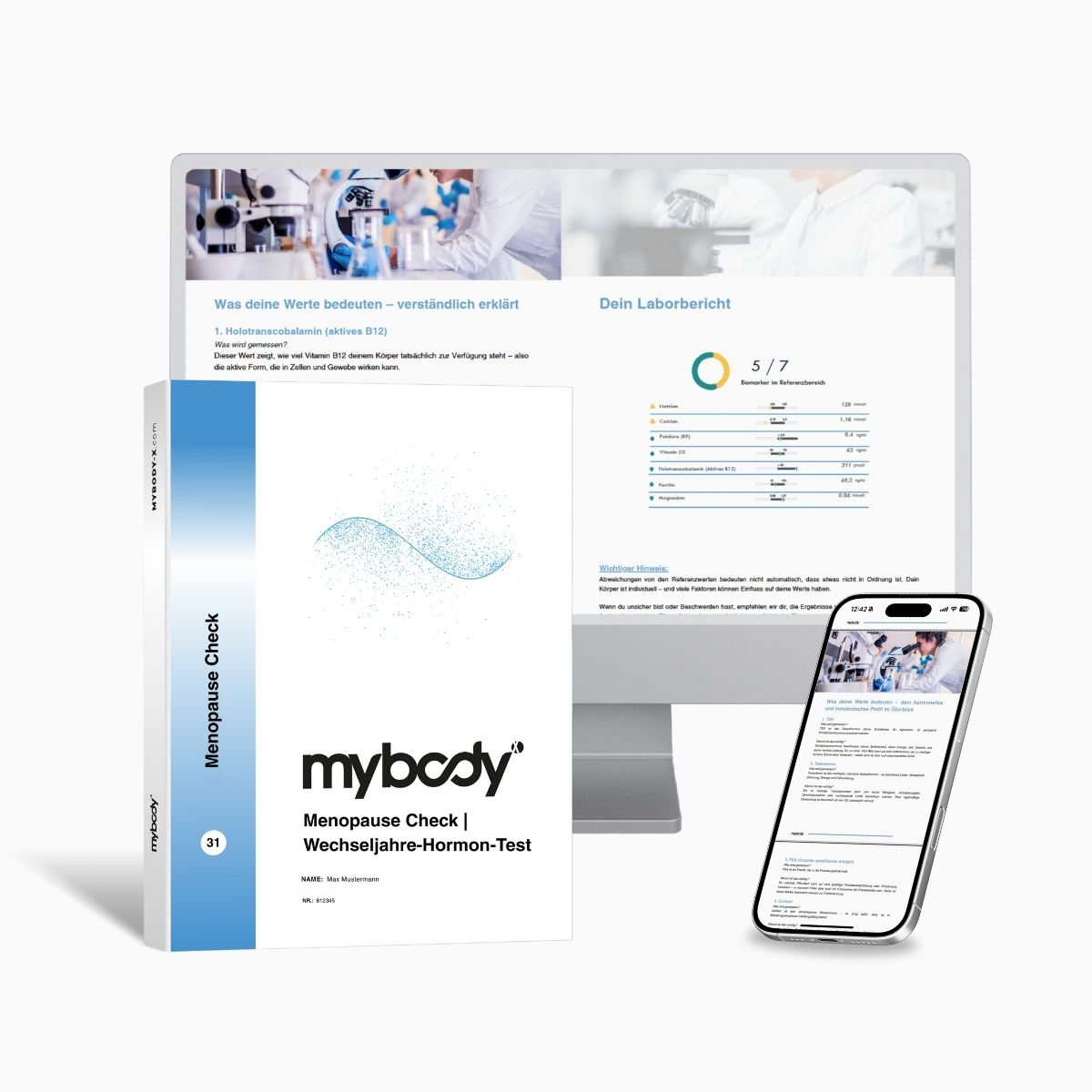
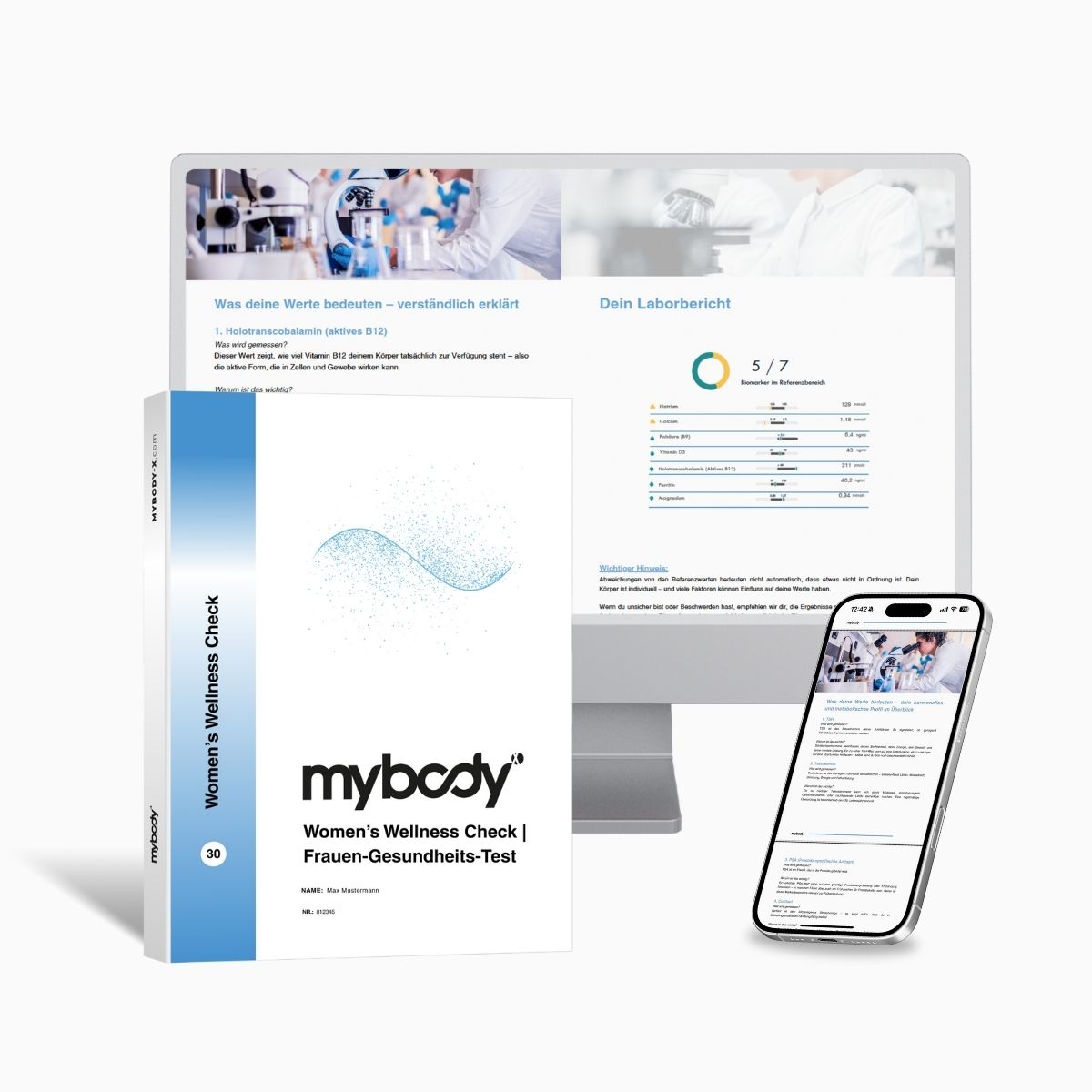
Two mybody®x tests (MYBODY Lab GmbH) behave differently in relation to the menstrual cycle. What they can and cannot do is shown in the cards.
Capillary blood test
Menopause Check | Menopause Hormone Test
Measures 8 values: estradiol, FSH, LH, progesterone, SHBG, TSH, testosterone, and DHEA-S. Four of these depend on the menstrual cycle, so the timing of the sample is crucial here. What the test does not provide: it gives values at a specific point in time, not a progression, and it says nothing about ovulation or fertility. It does not provide a diagnosis and does not replace a medical examination.
Laboratory analysis 3–5 business days after sample receipt
Product page information, retrieved 13 August 2026
Capillary blood test
Women’s Wellness Check | Women’s health test
Measures 18 values, including the complete thyroid profile consisting of TSH, free T3, and free T4, as well as ferritin, vitamin B12, long-term blood sugar, the cholesterol profile, prolactin, SHBG, and cortisol. Most of these are not dependent on the cycle day and can therefore be scheduled freely. What the test does not provide: it measures neither FSH nor LH nor estradiol and therefore cannot answer questions about the cycle phase. It does not provide a diagnosis.
Laboratory analysis 3–5 business days after sample receipt
Product page information, retrieved 13 August 2026
Four points determine whether a measurement becomes useful information.
Have the kit ready beforehand
Anyone who orders after bleeding begins misses the window.
Count from day 1
Cycle day 1 is the first day of bleeding; everything else follows from that.
Write down five lines
Date, cycle day, time, medications and supplements, and the lengths of the last three cycles.
Plan the repeat test
A high FSH level should be remeasured at least twice per month.
Chapter at a glance
A capillary blood self-test allows you to choose the cycle day yourself instead of waiting for an appointment. For FSH, LH, and estradiol, this day determines how interpretable the result is; for TSH, ferritin, and long-term blood sugar, it makes no difference. Four points are decisive: have the kit ready beforehand, count from day 1, write down five lines, and plan the repeat test.
Limitations: what the right day does not solve
The first limitation is the most important. Choosing the correct cycle day does not turn a single time-point measurement into a trend. It ensures that the number matches the reference standard, and nothing more.
The second limitation is repetition. A high FSH level should be remeasured at least twice per month (MSD Manual, professional edition, current as of September 2025). Correct timing does not replace this repetition; it is what makes the repetition meaningful.
The third limitation is a gap in the sources. We found no reliable information on the appropriate cycle day for progesterone. That is why the text contains no number on this point, and why the question belongs in medical practice.
The fourth limitation concerns the statement itself. This article addresses the comparability of measurements. It cannot be used to draw conclusions about ovulation, fertility, or the timing of conception.
Why the cycle day matters
If you take away one action from this article, let it be this: Write down the first day of every bleed, and have the test kit ready before you need it.
The reason is unremarkable yet still determines everything. The window for FSH opens on the second day after an event that cannot be planned and closes on the fifth.
The initial question was which cycle day counts. For FSH, the answer is days 2 to 5, counted from the first day of bleeding. More important than the answer is developing the habit of recording the day at all.
It may seem excessive to do so much planning for a single laboratory value. However, the effort consists of two things: keeping a kit in the cupboard and adding one line to the calendar.
This contrasts with the difference between a number that can be interpreted and one that cannot. This difference cannot be established later, which is why planning comes first.
Frequently asked questions
On which cycle day are hormone levels measured?
For FSH, the MSD Manual, Professional Edition, specifies cycle days 2 to 5 and relates to these the value of over 25 IU/L for the late menopausal transition (as of January 2024). Cycle day 1 is the first day of bleeding. The cycle day does not matter for TSH, ferritin, or HbA1c.
How do I count the cycle day correctly?
Cycle day 1 is the first day of actual bleeding, not the following day and not any preceding spotting. Count from that day onward. This counting method gives a window from day 2 to 5, which therefore usually falls during or shortly after the bleeding.
What should I do if my cycle is irregular?
The window is calculated from the first day of bleeding and therefore requires no prediction. In practice, this means keeping the kit in stock and measuring as soon as bleeding starts. If bleeding does not occur for an extended period, the window does not apply, and the timing should be discussed with a doctor. In any case, note how long ago the last bleeding occurred.
Does the time of day also matter?
Yes. IQWiG notes that many hormone levels change considerably over the course of the day, which means that the time of day when blood is drawn matters (as of April 2, 2025). With the female cycle, this condition is added to the time-of-day requirement. In practice, this means measuring in the morning and recording the time.
Can I measure meaningfully while taking the pill?
Hormonal contraception affects the same regulatory cycle that the measurement is intended to reflect, while also overriding the cycle on which the window is based. A hormone result then describes the situation while using the product. This is not a reason to avoid measuring, but it is a reason to record the product and not interpret the result on your own.
Next step
Have the kit ready by the window
If you want to measure FSH, LH, and estradiol within the right window, the Menopause Check measures these values together with five others from capillary blood. It does not provide a diagnosis and does not replace medical evaluation.
Go to the Menopause Check Go to the Women’s Wellness CheckRead more
You may also be interested in
What the values show when the sample is taken at the right time.
The same question for the second condition: the time of day.
Sources
- MSD Manual, Professional Edition: Amenorrhea (as of September 2025) – msdmanuals.com
- MSD Manual, Professional Edition: Menopause, Pinkerton JV (as of January 2024) – msdmanuals.com
- Institute for Quality and Efficiency in Health Care (IQWiG): Understanding Laboratory Values Correctly, as of 04/02/2025 – gesundheitsinformation.de
The verbatim quote regarding the repetition of a high FSH value at least twice a month and the information on mildly elevated prolactin between 50 and 100 ng/ml come from source [1]. The reference to FSH on cycle days 2 to 5 at over 25 IU/l, the definition of the early transition phase as a difference of at least seven days, and amenorrhea lasting at least 60 days come from [2]. The statement about daily fluctuations in hormone levels, the note on the importance of the collection time, and the information on variations between laboratories come from [3]. We found no reliable information in the sources reviewed on the appropriate cycle day for progesterone; therefore, no number is given in the text. Information on prices, values, sample type, and laboratory comes from the mybody®x product pages, accessed on 08/13/2026; processing times follow the central guidelines for blood tests. All sources were accessed and reviewed on 08/13/2026.

mybody®x Editorial & Medical Team
Laboratory diagnostics Blood analysis interpretation Nutritional science Nutrigenetics
This article was created by the mybody®x editorial and medical team. The team combines laboratory diagnostics, nutritional science, and the interpretation of blood analyses. Contributors are listed on the authors page.
Published on 08/13/2026 · Last updated on 08/13/2026
The content is for general information only and does not replace medical advice, diagnosis, or treatment. Reference ranges depend on the laboratory, method, and age—your test report always takes precedence.




Share now:
Free Androgen Index: how it is calculated and what it indicates
HbA1c: the period represented by the value