

Estrogen and progesterone: why the ratio matters
The most important points at a glance
A hormone test report contains numbers, and the first question is almost always: Is this too much or too little? With estrogen and progesterone, that is the wrong question. Both fluctuate so much over the cycle that an individual value says little without the cycle day.
This article explains what the two hormones do, why their relationship says more than any individual value, what lies behind the term “too much estrogen,” and what matters when collecting the sample.
What you will not find here: a way to change your levels. There is no evidence-based source for that here, and hormone treatments belong in the hands of a doctor without exception.
What to expect in this article
1. Why a number alone says little
2. The four values compared
3. What estrogen does
4. What progesterone does
5. The ratio and what makes it difficult
6. “Too much estrogen”: what the term means
7. When and how measurements are taken
8. What you will take away from this article
Frequently asked questions
Sources
Why a number alone says little
For most blood values, the usual logic works: There is a reference range, your value either falls within it or does not, and that provides an initial assessment. With cycle hormones, this logic fails, for a simple reason.
Estrogen and progesterone do not have a fixed target level that the body maintains. They follow a pattern. In the first half of the cycle, one rises; after ovulation, the other does, and both fall again if pregnancy does not occur. A value that is completely unremarkable on cycle day five would be an abnormal finding on day twenty-one, and vice versa.
That is why good lab reports include a reference range for each cycle phase alongside the number. And that is why stating the cycle day is not a formality, but the condition that makes the number readable in the first place. Without it, an estradiol value is a number without a benchmark.
The second point of this article follows from the same cause: Because both hormones jointly regulate a process, their relationship to each other often says more than either value alone. That is precisely what follows.
The four values compared
When people talk about cycle hormones, they mean four values. The table places them side by side according to the same criteria, making it clear which one answers which question.
| Criterion | Estradiol | Progesterone | FSH | LH |
|---|---|---|---|---|
| What it is | the most important estrogen in the blood | the corpus luteum hormone after ovulation | regulatory hormone from the pituitary gland | second regulatory hormone of the same axis |
| When it is high | toward the end of the first half of the cycle | in the second half of the cycle | at the beginning of the cycle, and continuously during the transition phase | as a peak shortly before ovulation |
| Which question it answers | how much estrogen is currently in the blood | whether the second half of the cycle has occurred | which phase you are in | whether and when ovulation was triggered |
| What it cannot show | practically uninterpretable without the cycle day | measured on the wrong day, it says almost nothing | a single value does not replace a trend | the peak is brief and easy to miss |
The final line stands out: For all four values, it contains a variation of the same sentence. Timing also matters. This is not a weakness of the measurement, but a characteristic of what is being measured, and knowing this changes how you read your report.
The second observation: Estradiol and progesterone describe the state, while FSH and LH describe the regulation. That is why they are generally measured together. High FSH with low estradiol tells a different story than high FSH with high estradiol, and neither can be inferred from a single value.
What estrogen does
The shortest reliable description comes from the glossary of the Institute for Quality and Efficiency in Health Care:
Documented source
“Estrogens are female sex hormones that are produced mainly in the ovaries. They regulate the female menstrual cycle and the maturation of egg cells.”
Institute for Quality and Efficiency in Health Care (IQWiG)
Glossary: Estrogen, accessed August 26, 2026
The entry goes on to explain what estrogens do individually: During the first half of the cycle, they promote the development of the uterine muscle and uterine lining, and they also strengthen subcutaneous fatty tissue and bones (IQWiG, accessed 2026). This explains why estrogen has effects extending far beyond the cycle.
Key point
Estrogen is not solely a cycle hormone. It acts on the bones, tissues, and several areas at once. That is why a shift is rarely noticeable in just one place.
Two further points from the same source put the stages of life into perspective: When puberty begins, the female body starts producing larger amounts of estrogen, and during menopause hormone production gradually declines. The male body also produces small amounts of estrogen (IQWiG, accessed 2026).
The last half-sentence surprises many people and is why estradiol is also included in hormone profiles for men. It is not an error in the report, but part of the overall picture.
Why it is called estradiol rather than estrogen
The report rarely uses the word estrogen. It says estradiol, sometimes Östradiol or the abbreviation E2. This is not a different subject, but a clarification: estrogens are a group, and estradiol is the most potent one and the one measured in the blood.
The three spellings mean the same thing. Östradiol is the Germanized form, Estradiol the internationally common form, and E2 the laboratory abbreviation. Anyone searching online will find varying amounts of information under all three, and that is the only practical difference.
In addition to estradiol, there are estrone and estriol. They play a greater role during other stages of life and are usually not measured in standard profiles. For the question at hand, estradiol is the value that matters.
What progesterone does
Progesterone is a sex hormone belonging to the group of progestogens, or corpus luteum hormones. It is produced in greater amounts in a woman’s ovaries after ovulation (IQWiG, accessed 2026). This single sentence already contains the most important practical consequence: without ovulation, there is no significant rise in progesterone.
The same source lists the following functions: The hormone plays an especially important role in preparing for and maintaining pregnancy; it ensures that the uterine lining becomes looser, allowing a fertilized egg to implant more easily. During pregnancy, its concentration rises sharply, and it prevents additional eggs from maturing. Progesterone also promotes bone and muscle development, among other functions (IQWiG, accessed 2026).
This leads to a clear rule for testing: progesterone should ideally be measured in the second half of the cycle because it is barely present before then. A low level on the seventh day of the cycle is not a finding but the expected state. Interpreting it as a deficiency means mistaking a normal state for a problem.
And this leads to the second point: a low progesterone level in the second half of the cycle may mean that ovulation did not occur. This is significant information that should be assessed by a doctor, not interpreted on your own.
What changes during the transition
Around the mid-forties, a phase begins in which the process becomes irregular. Not every cycle includes ovulation, and without ovulation there is no progesterone rise in the second half. During this time, estradiol can fluctuate considerably, with levels that are sometimes much higher and sometimes much lower than before.
That is precisely what makes interpretation difficult during this phase, and it is the source of much of the confusion online. A single measurement captures a state that can change within weeks. Anyone who derives a permanent conclusion from it is overinterpreting the result.
During this phase, the regulatory hormone FSH is more informative because a persistently elevated level is a clearer indication of which phase you are in. The same applies here: one value is a snapshot; a trend is meaningful. The article Perimenopause explains which value shifts first.
The ratio and what makes it difficult
Because both hormones control the same process while working against each other, it seems reasonable to relate them to one another. Some findings do exactly that, and that is precisely where misunderstandings begin.
A ratio of two fluctuating values fluctuates twice as much.
That is the mathematical core of the problem. When both quantities fluctuate significantly throughout the cycle, their quotient fluctuates even more, and a single quotient without the cycle day is correspondingly not very meaningful. Anyone comparing two such values from different cycle phases is comparing nothing.
What the concept nevertheless captures correctly is this: In the second half of the cycle, both hormones are part of a specific interplay. If this interplay shifts, for example because ovulation does not occur or because the second half of the cycle becomes shorter, the effect is different from an even change in both values.
The honest assessment is therefore this: The ratio is a useful concept, not a measurement that should be interpreted on its own. It does not replace medical assessment, nor is it suitable for self-diagnosis. What it does provide is an explanation of why a single number so often is not helpful.
Why Two Reports Are Rarely Comparable
Anyone placing two hormone reports side by side should check three things before considering a difference real. First, the cycle day, for the reasons mentioned above. Second, the laboratory: hormone levels are measured using different methods, and reference ranges always apply to the method used by the respective laboratory. Two numbers from two different facilities are therefore not necessarily the same.
Third, the unit. Depending on the laboratory, estradiol is reported in different units, and anyone who overlooks this is comparing numbers that represent different quantities. This may sound trivial, but it is one of the most common reasons for unnecessary alarm about an apparently crashed value.
What can be compared well, by contrast, is a trend from the same laboratory, on the same cycle day, over several months. This is the situation in which a change actually means something. The article How to Compare Two Blood Values Correctly explains how to compare values in general.
Saliva, blood, or urine
Hormone levels can be measured in different samples, and the methods are not interchangeable. Reference ranges each apply to a specific method, and a number from a saliva sample cannot be compared with one from blood, even if the same hormone is listed.
For cycle hormones, the blood sample is the established method, and the reference ranges shown on reports are based on it. Anyone who places values from different sample types side by side is comparing scales, not values.
In practical terms: Choose one method and stick with it if you want to track a trend. And take the sample type stated on the report seriously; it is not listed for formal reasons.
“Too much estrogen”: what the term means
Several terms for the same concept circulate online: too much estrogen, estrogen excess, estrogen dominance. Usually, this does not mean an estradiol level above the reference range, but a ratio in which progesterone is relatively low.
That is why many people who use these terms have an unremarkable estradiol level in their test results and are nevertheless convinced that they have too much of it. Both can be true, and neither can be assessed without knowing the cycle day and the progesterone level alongside it.
What can be said is this: These terms describe a concept, not a recognized diagnosis. They are therefore not a reason for concern, nor a reason to begin self-treatment. They are a useful reason to have a conversation and, in the process, have the right levels measured on the right day.
An important boundary is needed here: We do not have a substantiated source that could support a recommendation on whether and how estrogen or progesterone levels can be changed through diet, supplements, or lifestyle. Where one appears online, caution is warranted. Hormone-active preparations interfere with a regulated system, and this intervention should be medically supervised.
What symptoms do and do not indicate
The symptoms assigned to these terms are almost entirely nonspecific: feelings of tension, mood swings, water retention, sleep problems, and headaches before menstruation. Nonspecific means that they occur with many different causes, and the cause cannot be inferred from them alone.
That does not invalidate the observation. It merely shifts its role: It is the reason to investigate further, not the result of that investigation. Anyone who records which symptoms occur and when over two or three cycles brings something to the conversation that cannot be seen from a single blood test.
And one point that is rarely stated explicitly: Even a completely unremarkable hormone result does not rule out symptoms. Blood levels and effects in the tissue are two different things, and the gap between them is particularly wide with hormones. A result provides context; it does not disprove someone’s experience.
How to count your cycle day correctly
The first day of the cycle is the first day of bleeding, not the last day before it and not the day when it properly begins. Spotting beforehand does not count. This sounds like a minor detail, but in practice it regularly shifts everything by two or three days.
For progesterone testing, a point in the second half of the cycle is often chosen because that is when a rise is expected. Which day is right in your case depends on the length of your cycle and should therefore be coordinated with the practice issuing the request.
If your cycle is irregular or stops altogether, this calculation does not apply. In that case, the key information is how long it has been since your last period, and this belongs in the result just as the cycle day normally would.
And one point many people overlook: Anyone using hormonal contraception does not have a natural cycle in terms of these values. A hormone profile while using hormonal contraception measures something different from one without it, and this information must be reported.
When and how testing is done
Three practical rules for testing follow from everything above. First: As long as a cycle continues, the cycle day should be included in the result. Second: Progesterone is measured in the second half of the cycle; otherwise, it says little. Third: Estradiol, progesterone, FSH, and LH should ideally be considered together, not individually.
At mybody®x (MYBODY Lab GmbH), the Menopause Check covers exactly this combination, analyzed in an ISO-certified laboratory in Germany. The product page itself points out that estradiol, progesterone, FSH, and LH fluctuate greatly throughout the cycle and that, as long as a cycle continues, the cycle day should be recorded.
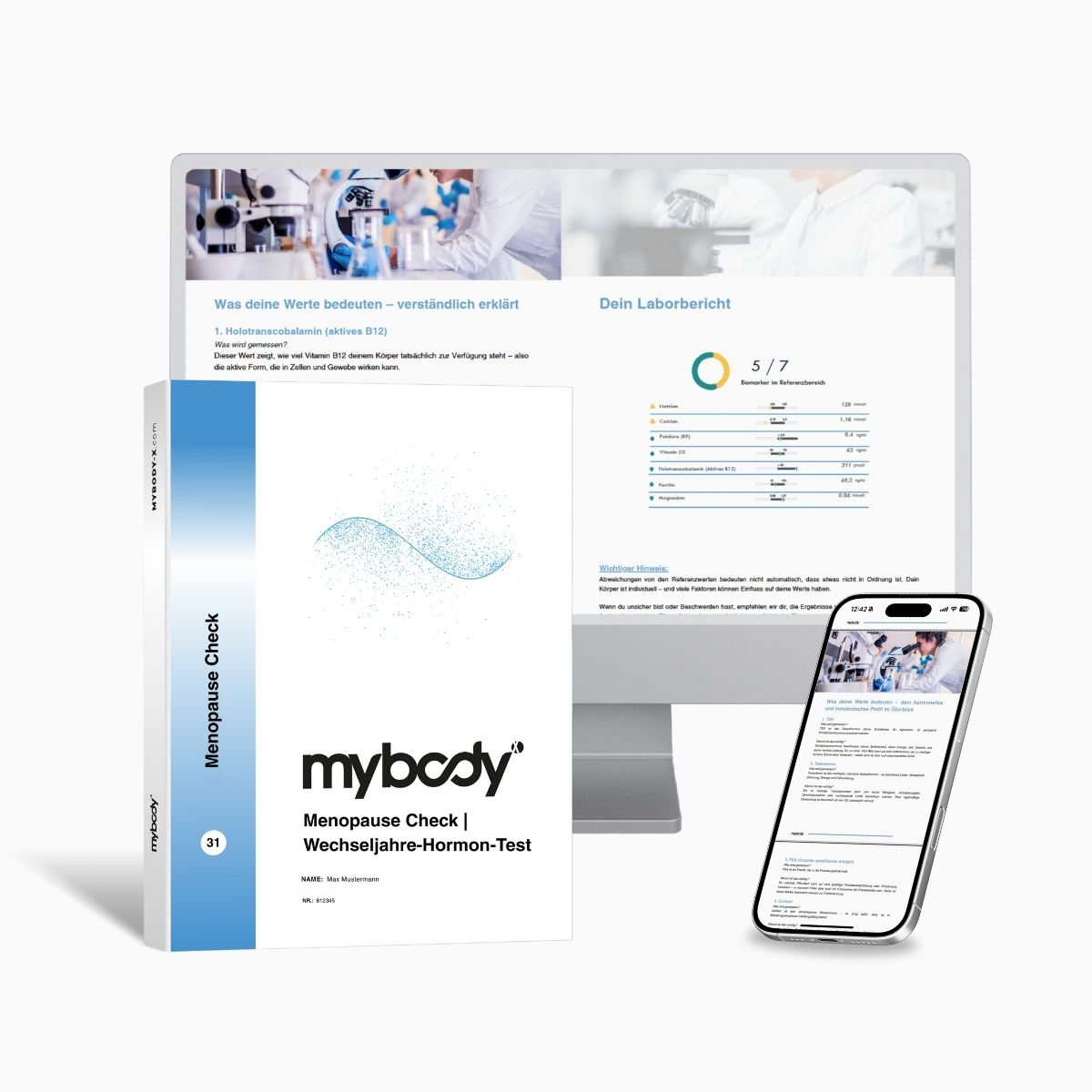
Hormone profile from a blood sample
Menopause Check | Menopause Hormone Test
Progesterone and estradiol, along with FSH and LH as regulatory hormones, plus testosterone, DHEA-S, SHBG, and TSH. No other test in the range includes progesterone. What the test does not do: it does not provide a diagnosis, replace medical advice, or tell you how you feel; it shows where your body stands.
Laboratory analysis within 3–5 business days of sample receipt
Product page information, accessed 26 August 2026
You can read about what the individual values mean before and after testing in the Biomarker Lexicon with 67 explained blood values. You can find out how others experienced their test on the Customer Reviews page. The comparison honestly answers both sides of the question of whether testing is worthwhile for you:
Useful for you if …
your cycle has changed and you want to know where you stand during this phase.
you have recorded symptoms over several cycles and want to bring numbers to the conversation.
you can record the cycle day on which the sample was taken, because otherwise the result is difficult to interpret.
Probably not, if …
you are looking for a diagnosis. A hormone profile helps put things into context; it does not provide a diagnosis.
you are already receiving medical treatment and have your hormone levels measured regularly there.
you have unusual bleeding. This should be addressed directly with a gynecological practice.
Next step
If you first want to see where you stand
The Menopause Check combines estradiol, progesterone, FSH, and LH with four additional values. The Biomarker Glossary explains what each value means and the range in which it falls.
Go to the Menopause Check Go to the Biomarker GlossaryWhat you should take away from this article
If you remember one thing, let it be this: The cycle day is part of the result. Without it, an estradiol or progesterone level is a number without a benchmark, and any interpretation based on it is on shaky ground. Note it down before you see the result.
And keep the second insight in mind: Terms such as estrogen dominance describe an idea, not a diagnosis. They can be a starting point for a conversation, but not a basis for self-treatment. A medical practice decides whether values can be changed and whether that is necessary at all.
It began with the question of whether a number is too high or too low. The honest answer is: It depends on when it was measured and what appears alongside it. If you want to know what your body is currently working with: The consultation is free, and it will not sell you anything.
Frequently asked questions
What are normal estradiol levels?
There is no universally applicable number because the reference range depends on the phase of the cycle and also on the laboratory and method used. The information on your own test result, together with the cycle day on which the sample was taken, is always decisive.
When should I have my estrogen and progesterone measured?
Progesterone is best measured in the second half of the cycle because it is produced in greater amounts only after ovulation (IQWiG, accessed 2026). Estradiol is measured at different times depending on the question. The practice issuing the order will tell you which day is right in your case.
Is “too much estrogen” a diagnosis?
The terms estrogen excess and estrogen dominance describe the idea of a shifted balance, not a recognized diagnosis. They usually do not mean that the estradiol level is too high, but that progesterone is too low in comparison. This can only be assessed using both values and the cycle day.
Can I influence my hormone levels myself?
We do not have a substantiated source for this question that could support a recommendation. Hormone-active preparations interfere with a regulated cycle; their use belongs exclusively under medical supervision. This article therefore deliberately does not name any way to change levels.
Why do my levels differ from those of a friend?
Because four things can differ: the cycle day, the laboratory, the measurement method, and the unit used. Values are comparable only under the same conditions. A trend from the same laboratory on the same cycle day tells you more than any comparison with another person.
Read more
You might also be interested in
What happens when the cycle pattern shifts permanently.
The timing of sample collection, explained in detail.
Sources
- Institute for Quality and Efficiency in Health Care (IQWiG): “Estrogen” glossary, accessed on 26/08/2026 – gesundheitsinformation.de
- Institute for Quality and Efficiency in Health Care (IQWiG): “Progesterone” glossary, accessed on 26/08/2026 – gesundheitsinformation.de
The verbatim quotation on estrogens, as well as the information on the development of uterine muscle and lining, subcutaneous fat tissue and bones, puberty, menopause, and the production of small amounts in the male body, comes from [1]. The information on progesterone as the corpus luteum hormone, its increased production after ovulation, its role in pregnancy and implantation, and bone and muscle development comes from [2]. Neither glossary page includes a date; therefore, the access date is provided. No statements are deliberately made about ways to influence hormone levels because there is no substantiated source for this. Information on price, sample type, scope of services, and laboratory comes from the mybody®x product page, accessed on 26/08/2026; processing times follow the central specification for each test type. All sources were accessed and reviewed on 26/08/2026.

mybody®x editorial & specialist team
Blood analysis interpretation Nutritional science Laboratory diagnostics
This article was created by the mybody®x editorial and specialist team. The team combines blood analysis interpretation, nutritional science, and laboratory diagnostics. Everyone involved can be found on the authors page.
Published on 26/08/2026 · Last updated on 26/08/2026
The content is for general information and does not replace medical advice, diagnosis, or treatment. Reference ranges depend on the laboratory, method, and age—what always matters is the information on your report.




Share now:
Lab Test Abbreviations: What Your Report Really Says
Lose Weight Without Losing Muscle: What Matters in a Calorie Deficit