
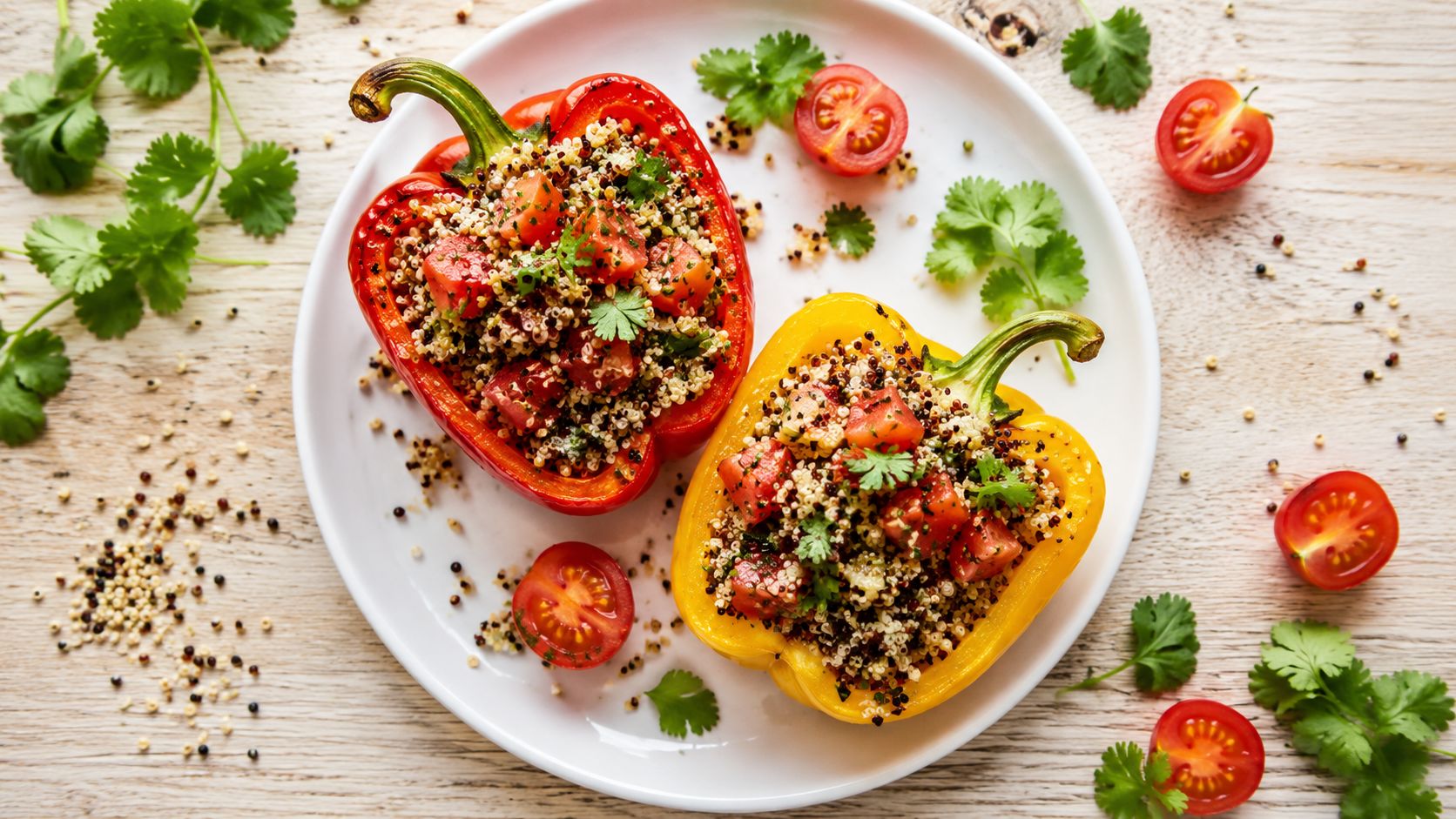
Quinoa-stuffed peppers: Your healthy favorite recipe
You may know the feeling. You want to cook something warm, filling, and healthy, but after a long day, you want it to be neither complicated nor heavy on your stomach. That is exactly where quinoa-stuffed peppers work so well.
At first glance, the dish looks like a classic “healthy recipe.” In practice, though, it is much more useful than that. It can be adapted to your daily routine, training, digestion, and satiety goals. When prepared well, you get an oven-baked dish that stays pleasantly juicy, can be prepared in advance, and does not taste like deprivation.
Your new favorite recipe for healthy indulgence
Some dishes look good, taste solid, and then disappear from the weekly meal plan. For many people, quinoa-stuffed peppers are not one of them. They stick around because they solve a real everyday problem. You get vegetables, a satisfying filling, and plenty of room for your own taste preferences in a dish that feels uncomplicated while still looking like “real food.”

In my work as a nutrition coach, these are often the recipes that really stick. Not because they are spectacular, but because they work. You can make them lighter, heartier, higher in protein, or easier to digest if you are sensitive to certain ingredients.
Why this dish works so often
Quinoa-stuffed peppers combine several benefits:
- Satiety with structure: The peppers provide volume, quinoa adds substance, and additions such as feta, beans, or nuts make the meal satisfying.
- Easy to plan: The filling can be prepared in advance, and the peppers practically bake themselves in the oven.
- Flexible and easy to adapt: You can adjust the spice level, onion, garlic, cheese, or legumes without ruining the dish.
You can quickly tell whether a recipe only looks good on the screen or actually works in everyday life. This one does.
Not just healthy, but strategic
The most interesting point is not whether the dish is “healthy.” That question is too broad. More important is what purpose it serves for you. Do you want to stay full longer, improve your protein intake, eat something lighter in the evening, or have a vegetarian main meal that does not feel like a side dish? Then this recipe is a strong foundation.
That is exactly why it is worth taking a closer look. Not every version of quinoa-stuffed peppers is equally well suited to every goal. The details make the difference.
The ingredient list for perfect quinoa-stuffed peppers
The foundation is simple. That is precisely what makes the dish so effective. You do not need a long list of ingredients, just a few components that work well together in terms of flavor and nutrition.

The dish has long since become part of everyday German cooking. Typical quantities from major providers are often 4 peppers, around 150 to 200 g of quinoa, and an oven time of 30 to 40 minutes, which clearly shows how standardized and accessible the preparation has become, as in REWE's recipe for stuffed peppers with quinoa.
My basic ingredients per serving
For a satisfying portion, this guideline has proven effective:
- One large bell pepper weighing around 200 g. It is not just a container but a genuine part of the meal.
- Uncooked quinoa at around 60 to 70 g per serving. This makes a filling that is satisfying without being too heavy.
- Fresh tomatoes and red onion for juiciness and depth.
- Olive oil and salt as a base.
- Optional feta, pine nuts, parsley, or mint for more protein, texture, and freshness.
If you want to tailor your dish more specifically toward protein, it also helps to take a look at this overview of protein-rich foods and their sources.
The spice blend that really works
Many fillings fail not because of the main ingredients, but because of flat seasoning. In kitchen tests, one combination clearly came out on top:
- Ground cumin for warmth and depth
- Smoked paprika for a roasted aroma
- Garlic for savoriness
- Fresh cilantro for freshness and balance
This blend does not dominate but supports the dish. Quinoa benefits from this in particular because it is rather neutral on its own.
From the kitchen: Good spices do not turn quinoa into a disguised ingredient, but into a filling with its own character.
Ingredients that often do not work as well
Three things unnecessarily slow down the recipe:
- Too many watery ingredients: The filling then becomes soft and loses its structure.
- Too many raw vegetables in the filling: Peppers cook differently in the oven than quinoa. If too much remains raw inside, the texture does not come together.
- Overloaded mixtures: When beans, corn, cheese, nuts, olives, and sauce all go in at once, nothing often tastes distinct anymore.
A clear base is better. Then you can consciously decide whether you want more freshness, more protein, or more melt.
How to make stuffed peppers with quinoa effortlessly
You come home hungry, want something warm from the oven, but not a meal that leaves you feeling sluggish later or sends your blood sugar on a roller coaster. That is exactly why this recipe works so well. Stuffed peppers with quinoa are easy to customize. More protein, more fiber, gentler on the stomach, or a little more substantial after training.
In the kitchen, the deciding factor here is not the level of difficulty but the technique. If quinoa is poorly prepared, the filling can quickly seem dry, bitter, or dense. If you pay attention to the few critical points, you get a dish that is practical for everyday cooking while still being precisely adaptable to your own goals.
The step that makes quinoa much better
Quinoa should be rinsed thoroughly before cooking. This reduces bitter residue on the surface. It is then best cooked in stock and left to rest briefly with the lid on so the grains become fluffy, as described in Marisa's table featuring oven-baked stuffed peppers with quinoa.
This step makes a bigger difference than many people think. A well-prepared quinoa base tastes nuttier, absorbs spices better, and is often easier on the stomach. Especially if your goal with this dish is satiety and steady energy rather than simply maximizing calories, this care is worthwhile.
This keeps the filling juicy and clear in flavor
The order in the pan is simple and proven:
- Cook the quinoa and let it steam briefly.
- Sauté the onion and tomatoes until they taste sweeter and release less water.
- Briefly toast the spices so they develop a rounder, deeper flavor.
- Incorporate the quinoa and check the consistency.
- Add herbs, feta, or nuts at the end to preserve freshness and texture.
This helps you avoid two common mistakes at once. The filling does not become soggy, and the flavors do not taste flat.
The baking dish needs some liquid
A small splash of stock or water in the dish is not a minor detail but a practical safeguard. It helps the peppers cook more evenly, prevents them from drying out as much on the outside, and keeps them juicy inside. At around 180 to 200 °C and for 25 to 30 minutes, they become tender without collapsing.
I press the filling down only lightly. If it is packed too tightly, it becomes dense. If it is too loosely filled, it falls apart when sliced.
Good stuffed peppers need structure, but no pressure.
My method for days when time is short
With pre-cooked quinoa, the meal goes into the oven very quickly. Then the process is simply:
- Halve and deseed the peppers
- Briefly cook the aromatic base of onion and tomatoes
- Mix in the quinoa and spices
- Place the filling in the peppers
- Add a little stock to the dish
- Bake until the peppers are soft and lightly browned on top
The result fits surprisingly well with various dietary goals. If you need more protein, mix in lentils, feta, or tofu. If your gut is sensitive to large amounts of onion or garlic, reduce both and rely more on herbs, cumin, and a little lemon juice.
How to adapt the recipe to your body
For most people, this meal works well in its basic version. But it becomes truly interesting through customization. More beans or tofu increase protein and fiber. Less cheese and oil make the dish lighter. A smaller portion of quinoa with more vegetables can be useful if you want to manage your carbohydrate intake more consciously.
If you are unsure how to distribute fat, carbohydrates, and protein sensibly in your everyday life, this overview of macronutrients and their function in the body can help.
That is precisely why this recipe is more than just a healthy oven-baked dish. It is a good foundation if you choose food not according to trends, but according to what suits your everyday life, digestion, and goals.
Nutritional values in detail and what they mean for you
With this dish, it is worth taking an objective look at the nutritional values. Not to reduce food to numbers, but to better understand what role it can play in your everyday life.
A reference recipe from a German recipe database for stuffed peppers with quinoa and walnuts lists 725 kcal, 18.8 g protein, 47.8 g carbohydrates, and 48 g fat per serving, clearly classifying the dish as a filling main meal, as documented in the walnut recipe for stuffed peppers with quinoa.
Nutritional values per serving, approx.
| Nutrient | Amount |
|---|---|
| Calories | 725 kcal |
| Protein | 18,8 g |
| Carbohydrates | 47,8 g |
| Fat | 48 g |
What these values mean in practice
These figures mainly show one thing: The dish is not automatically “light.” Depending on your choice of ingredients, it can be very substantial. Nuts, cheese, and oil in particular can quickly make the meal energy-dense and highly filling.
For many people, this works well. If you are looking for a balanced main meal that sustains you and does not leave you hungry again after two hours, this kind of combination can be a good choice. If your goal is a lighter dinner, you need a different version of the same basic idea.
Important for context: It is not the recipe name that determines whether a dish suits you, but the specific combination of ingredients.
Which goals the recipe suits
Depending on how it is prepared, stuffed peppers with quinoa can serve different purposes:
- Fullness in everyday life: If you often snack between meals, a substantial main meal is often more helpful than a “light” dish that does not really satisfy you.
- Mindful macronutrient planning: With quinoa, cheese, beans, or nuts, you can deliberately adjust the ratio of protein, fat, and carbohydrates.
- Eat in a blood-sugar-friendly way: Many people tolerate a meal with vegetables, grains, and an additional protein source more steadily than sides that digest very quickly.
If you want to better understand macronutrients and put them into perspective for yourself, this explanation of fats, carbohydrates, and protein can help.
Why personalization matters more here than labels
“Healthy” says little about whether a recipe suits your body. Some people do very well with quinoa, vegetables, and feta. Others notice that although they feel full after eating, they are not truly energetic. Still others benefit from increasing their protein intake or leaving out hard-to-digest additions.
At this point, general tips have their limits. Anyone who wants to know more precisely about their nutrient status, intolerances, or individual metabolic characteristics can also explore these questions with a home test and then make targeted dietary adjustments.
Variations for every taste and diet plan
The basic recipe is reliable. Its real strength, however, lies in its adaptability. With a few changes, you can create a completely different effect without having to learn a new dish.

If you want more protein
Then enhance the filling deliberately. A little feta on top works very well in terms of flavor. Tofu or legumes can also be a good fit. The only important thing is that the filling does not become too dense. Protein-rich additions make the dish more filling, but they need moisture and seasoning.
If your stomach is sensitive
A simplified version is often worthwhile here:
- Reduce or omit the onion
- Use garlic very sparingly or replace it with infused oil
- Add fresh herbs at the end instead of relying on a lot of heat
Many people tolerate the combination much better this way. Parsley and mint in particular add freshness without making the filling heavier.
If you want more texture and flavor
Roasted pine nuts are a small upgrade with a big impact. They add crunch and a warm, nutty aroma. Olives or sun-dried tomatoes also work if you want a Mediterranean direction. In that case, you should reduce other ingredients so the filling does not feel overloaded.
Some variations sound exciting on paper. In practice, the ones that add just one clear accent are usually the most enjoyable.
If you want to cook gluten-free
Quinoa is often used in German recipes as a gluten-free base for savory fillings. That makes stuffed peppers with quinoa a natural option if you want to replace classic fillings with couscous or other gluten-containing side dishes. As always, though, what matters is not only whether it is gluten-free, but also how well you tolerate the overall combination.
Meal prep and storage for everyday life
It is especially in a stressful daily routine that you see whether a recipe is truly practical. Stuffed peppers with quinoa perform well here because you can do most of the work in advance.

How to meal-prep without frustration
The most efficient approach is to prepare the filling and store it separately. Then, on a busy day, all you have to do is fill the peppers and bake them. Anyone who regularly meal-preps will often find exactly the structure needed to make dishes like these practical in the long term in a healthy weekly meal plan.
What to keep in mind when storing
A common mistake is not the storage itself, but the condition of the filling before baking. To avoid a dense, dry filling, the quinoa should be fully cooked and fluffy before it goes into the peppers. Gently pressing down the filling and adding a topping, such as cheese, also help prevent a dry surface, as described by WeightWatchers for stuffed peppers with quinoa.
In practice, that means:
- Do not pack away the filling while it is hot and steaming, or the texture will suffer.
- Only bake the peppers once the filling has been seasoned to taste; adjusting the seasoning at the end is more difficult.
- Add a little moisture when reheating so the surface does not become tough.
What works particularly well in everyday life
I especially like this dish because it can serve two purposes. Fresh from the oven, it is a comforting, filling main course. The next day, it can often be eaten again without much effort, with some yogurt or a simple salad on the side.
That is the real advantage. You do not have to decide every day from scratch what would be “healthy.” You have something prepared that tastes good, keeps you satisfied, and can be adapted to your goals.
If you want to decide about dishes like these based not only on the recipe but also on your body, a data-driven approach can be helpful. On mybody x Gesundheit, you can find self-tests for nutrient status, intolerances, hormones, metabolism, and the microbiome. This can help you better understand why certain meals agree with you, why others make you tired, or which adjustments to protein, fat, carbohydrates, and tolerability make sense for you.



Share now:
Beetroot carpaccio with feta and walnuts: easy
Healthy Vegetarian Recipes for Every Day: 10 Dishes with Numbers