

How much protein does an egg contain? The figure and what it really means
The essentials at a glance
According to the German Nutrition Society, a cooked 60-gram egg provides 7 grams of protein. That answers the question—and is also only the smaller half of the information. The same source lists 19 grams for 150 grams of quark and 16 grams for 100 grams of tofu. The egg is therefore a solid, but by no means exceptional, source of protein.
The figure becomes more meaningful in relation to daily requirements. The DGE reference value is 0.8 grams of protein per kilogram of body weight per day, or 1.0 grams from age 65 onward. For a person weighing 68 kilograms, that amounts to 54 grams per day. One egg covers around one eighth of that.
This article puts the figure into context. First, where it comes from and what daily requirements have to do with it. Then it looks at egg white and yolk, compares eggs with other foods, discusses the role of plant-based sources, and examines three persistent misconceptions. Finally, it explains what a DNA test can—and explicitly cannot—contribute to this topic.
What to expect in this article
1. The figure and where it comes from
2. What this means for your daily requirements
3. Egg white or yolk—which contains the protein?
4. Eggs compared with other foods
5. Plant-based sources and the question of combining them
6. Three misconceptions about protein
7. What a DNA test can contribute
8. What no test can answer
9. What ultimately matters
Frequently asked questions
Sources
The figure and where it comes from
In its protein information, the German Nutrition Society provides a list of foods with their protein content per serving. For an egg, it states: 60 grams cooked, 7 grams of protein (as of 2025).
The serving size is not incidental here. Sixty grams corresponds roughly to a medium-sized egg without its shell. Anyone calculating with values per 100 grams arrives at a different figure—for the same food.
Why the figure varies by source
Anyone searching online will find figures ranging from six to just under eight grams per egg. This is not a contradiction, but the result of three factors: the egg size used as a basis, whether the calculation is for raw or cooked eggs, and the particular nutritional database.
In practice, this variation makes no difference. Whether an egg provides 6.5 or 7.2 grams does not change any dietary decision. What matters more is the general range—and that is around seven grams.
Something else is noteworthy. The question about the number is usually just the starting point. In most cases, anyone asking it wants to know whether they are getting enough protein. And the DGE has an answer that surprises many people.
“
“From a nutritional perspective, high-protein products are unnecessary.”
German Nutrition Society (DGE)
Press release 30/2021
Key takeaway
According to the DGE, a cooked 60-gram egg provides 7 grams of protein—around one eighth of the daily requirement for a person weighing 68 kilograms.
What this means for your daily requirement
The DGE reference value is a calculation, not a fixed amount. It is based on body weight.
Source: German Nutrition Society (DGE), 2021 and 2025
How to calculate your own value
The calculation is simple: body weight in kilograms multiplied by 0.8. At 60 kilograms, that is 48 grams; at 80 kilograms, 64 grams; and at 95 kilograms, 76 grams.
From age 65 onward, the DGE reference value rises to 1.0 grams per kilogram of body weight per day. For a person weighing 70 kilograms, that means 70 rather than 56 grams—a difference of one quarter.
Why the value is linked to body weight
Protein is the building material the body uses to produce muscles, enzymes, hormones, and immune substances. How much of it needs to be continually replaced depends on how much body there is—hence the link to body weight.
The higher value from age 65 onward has a different reason. As people age, the body uses consumed protein less efficiently, and maintaining muscle mass becomes more important. The DGE accounts for this by increasing the value from 0.8 to 1.0 grams.
What is notable in this calculation is what it does not include: sex. Unlike with iron, the DGE does not distinguish between women and men for protein—the difference arises solely from body weight.
Most people are already above that level
The DGE states that average protein intake exceeds the estimated requirement in all age groups (as of 2025). This is the statement that dispels the most common concern behind the original question.
At the same time, the same source identifies percentages that fall below this level: 11 percent of men and 15 percent of women, based on data from 2008. So this is not a blanket all-clear, but it does represent a significant shift in perspective.
For the vast majority of people, this means the question is not how much protein an egg contains, but whether there is any reason to worry about protein intake at all.
In brief
The DGE reference value for adults is 0.8 grams of protein per kilogram of body weight per day, rising to 1.0 grams from age 65 onward. For a person weighing 68 kilograms, that amounts to 54 grams per day. According to the DGE, average protein intake exceeds the estimated requirement in all age groups—so an egg with 7 grams makes a useful contribution, but is rarely the missing piece.
Egg white or yolk—which contains the protein?
The question arises from a linguistic trap. In German, egg white is colloquially called “Eiweiß,” and the nutrient protein is also called “Eiweiß.” This leads to the conclusion that the protein is in the egg white and the yolk is just fat.
That is not correct. Both components contain protein, and the yolk also provides fat, vitamins, and minerals. Anyone who eats only the egg white leaves some of the protein and a substantial share of the other nutrients to go down the drain.
The source material used here does not provide a precise breakdown of the protein content between the egg white and yolk. The DGE gives the value for the whole egg. Estimating a breakdown would be worse here than acknowledging the gap.
In practice, the statement is sufficient anyway: There is no reason to leave out the egg yolk for protein intake. Those who do so for other reasons should know that they are not removing just fat.
Where the recommendation to eat only egg whites originally came from
The practice of eating only egg whites comes from two different lines of reasoning that are rarely distinguished. One is calorie counting: the yolk contains the fat and therefore most of the energy.
The other is the older cholesterol debate. Eggs were long considered problematic because they are high in cholesterol. According to the current presentation by IQWiG, saturated and trans fatty acids are the relevant factors for blood cholesterol levels – not the cholesterol in the food itself.
So anyone who leaves out the egg yolk because of its cholesterol is following a rationale that no longer holds up. Those who do so because of the calories have a valid reason – but should know that removing the fat also removes vitamins and minerals.
The egg compared with other foods
The number alone says little. It only becomes meaningful in comparison – specifically per serving, not per 100 grams, because no one eats food in 100-gram increments.
| Criterion | Egg | Quark | Tofu |
|---|---|---|---|
| Serving size in the DGE data | 60 g, cooked | 150 g | 100 g |
| Protein per serving | 7 g | 19 g | 16 g |
| Share of the 54 g daily requirement | around one-eighth | around one-third | just under one-third |
| Source | animal-based | animal-based | plant-based |
| Amino acid profile | Contains all essential amino acids in sufficient quantities | Contains all essential amino acids in sufficient quantities | Benefits from targeted combinations, such as grains with legumes |
Serving sizes and protein content: German Nutrition Society (DGE), 2025. The percentages of the daily requirement are based on 54 g and rounded.
The other values from the same table
Protein per serving according to DGE figures
- ✓ 150 g cooked pork: 42 g – the highest value in the table.
- ✓ 150 g cooked trout: 35 g – the second-highest value, also animal-based.
- ✓ 200 g cooked whole-grain pasta: 12 g—considerably more than most people expect.
- ✓ 120 g cooked lentils: 11 g and 150 g cooked peas: 10.5 g—the legumes.
- ✓ 30 g Emmental: 10 g—a slice of cheese, more than an egg.
- ✓ 60 g oats: 8 g and 50 g whole-grain bread: 3.5 g—the grain products.
Two observations from this list are worth noting. First, a 30-gram slice of Emmental provides 10 grams of protein—more than a whole egg. Second, cooked whole-grain pasta contains 12 grams in a typical serving; pasta is not generally considered a protein source, but it makes a measurable contribution.
What a normal day provides
The individual amounts seem small until you add them up. A calculation using the DGE figures shows how quickly 54 grams can add up.
Breakfast: 60 grams of oats with 8 grams, plus two slices of whole-grain bread providing 7 grams combined and one slice of Emmental with 10 grams. That is 25 grams before the morning has even begun.
Lunch: 200 grams of cooked whole-grain pasta with 12 grams. Dinner: 120 grams of cooked lentils with 11 grams. A boiled egg as a snack with 7 grams. Total: 55 grams—and not a single piece of meat is included.
In the same list, the DGE gives even more protein-dense examples: two slices of whole-grain bread with peanut butter provide 15 grams, while 250 grams of baked potatoes with 150 grams of quark provide 25 grams at once. Anyone who eats 150 grams of meat or fish gets 42 or 35 grams, respectively, in one meal—almost the entire daily requirement.
That is precisely why the DGE states that average intake is above the estimated value. It takes no effort to reach that level—it happens automatically with a typical diet.
Plant-based sources and the question of combinations
The DGE describes a difference between animal and plant proteins, but formulates it more cautiously than the widespread notion of biological value. According to the DGE, animal proteins contain all essential amino acids in sufficient quantities, while plant proteins benefit from targeted combinations.
The question is rarely how much protein an egg contains, but whether there is any reason for concern at all.
As an example of such a combination, the DGE cites grains with legumes, such as lentil vegetables with rice. This is remarkably unspectacular—it consists of dishes that traditionally belong together in many cuisines anyway.
In practice, this means that anyone who eats a plant-based diet does not need to calculate amino acid profiles. They need variety throughout the day and the classic combinations that already exist.
Why portion size matters more than origin
A look back at the table shows it: 100 grams of tofu provide 16 grams of protein, while one egg provides 7 grams. The plant-based portion is therefore more than twice as high as the animal-based one.
This does not refute what the DGE says about amino acid profiles—it merely shows that, in everyday life, the question of quantity often carries more weight than the question of quality. Anyone who eats enough and varies their diet reaches the goal either way.
Who should actually take a closer look
The reassurance applies to the average person, not everyone. Four groups warrant closer attention, and none of them is the person who wants to know how much protein an egg contains.
The first group is older people. From age 65, the reference value rises to 1.0 grams per kilogram of body weight, while appetite and food intake often decline during this stage of life. Together, these are the circumstances in which a shortfall arises.
The second group is people with a greatly reduced energy intake, for example during a diet. Those who eat less overall generally also consume less protein—the percentage may be correct, but the absolute amount decreases.
The third group is people with a very one-sided diet, regardless of whether it is plant-based or animal-based. The DGE recommendation on combining foods presupposes variety; anyone who eats the same thing every day does not have that.
The fourth group is people with increased requirements due to athletic activity. For them too, however, the DGE states that their needs can be met through common protein-rich foods such as legumes, meat, fish, and dairy products—specialty products are not necessary.
What the DGE says about biological value—and what it does not
Many guides state that the egg has the highest biological value of all foods and is therefore the standard against which everything else is measured. This claim does not appear in the DGE information reviewed here.
Instead, the DGE describes amino acid composition and bioavailability—two terms that address the same topic in a more nuanced way. The difference is not merely academic: referring to a single metric suggests a ranking that poorly reflects everyday life.
Because ranking individual foods helps no one who eats entire meals. What matters is what ends up on the plate together—and that is exactly what the DGE recommendation to combine grains with legumes is aimed at.
That is why we are not adopting the metric. It can be substantiated that, according to the DGE, animal proteins contain all essential amino acids in sufficient amounts, while plant proteins benefit from targeted combinations. Nothing more can be inferred from the material reviewed, and nothing more is needed.
Three misconceptions about dietary protein
What a DNA test can contribute
A clear statement belongs here before naming a product: No mybody®x test determines your protein requirements. The reference value is calculated from body weight and age, and you do not need to have that measured.
What a DNA test from mybody®x (MYBODY Lab GmbH) provides is beside the point: information about genetically determined predispositions in areas such as metabolic type, vitamin and mineral requirements, and individual responses to foods.
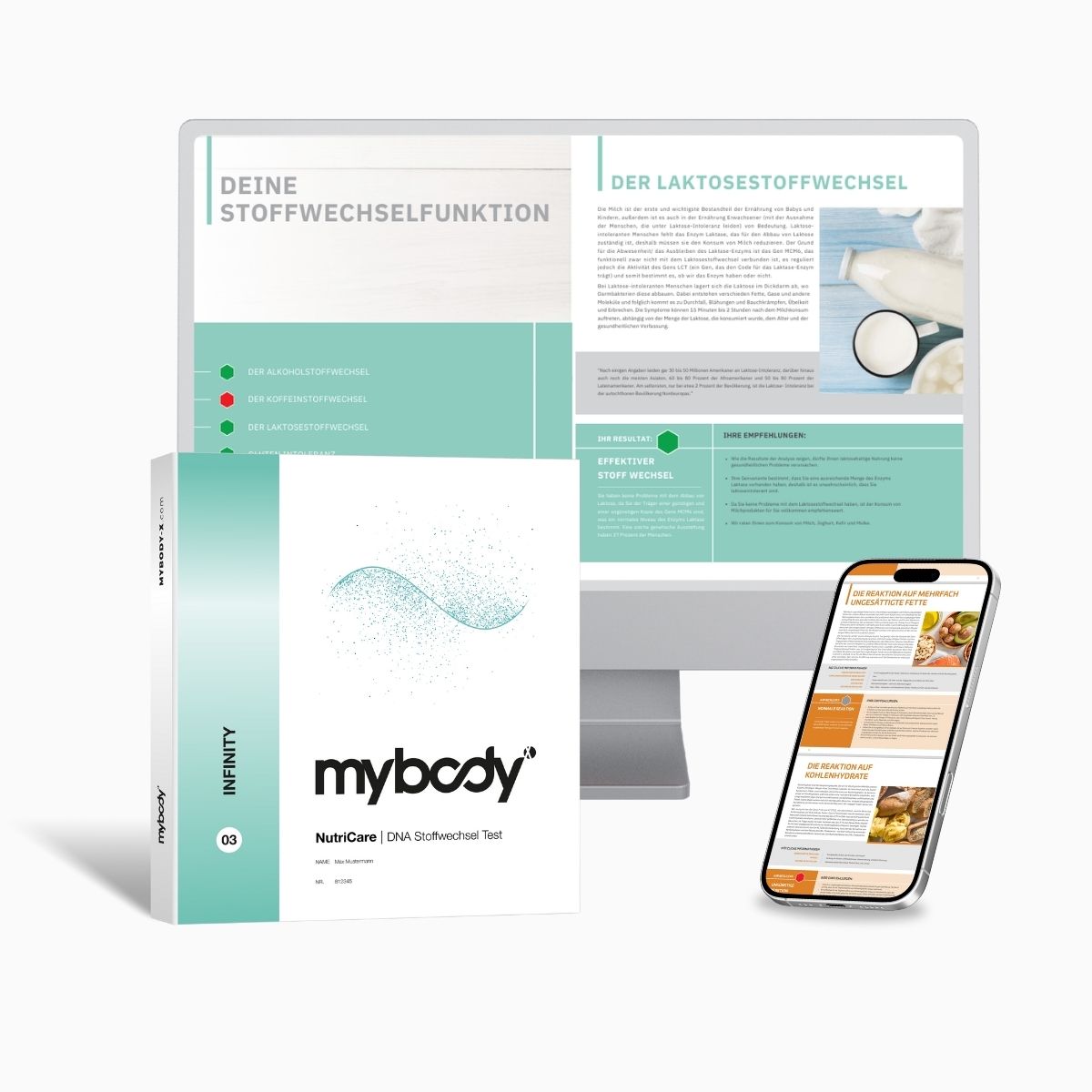
NutriCare | INFINITY DNA Test
Analyzes more than 140 genetic variations and provides 54 reports in eight chapters, including vitamin and mineral requirements, metabolic type, and an analysis of food tables covering more than 1,000 foods. What the test does not do: It contains no report on protein, dietary protein, macronutrients, or protein requirements—so it does not answer the question addressed in this article. The food table describes the genetically determined response to foods, not their protein content. The test does not provide a diagnosis or predict success. Method: SNP genotyping with more than 700,000 SNPs; not whole-genome sequencing.
Price: €269.00 · Sample type: Saliva sample · Processing time: Kit shipment 1–3 business days, laboratory analysis 15–25 business days after receipt of the sample · Laboratory: ISO-certified laboratory analysis in Germany
To NutriCare INFINITYWe would rather state this gap openly than manufacture a connection. Anyone who wants to look up the protein content of individual foods can find it in the DGE's freely accessible information—no test is needed for that.
All price and performance information is current as of August 5, 2026. Prices and the scope of services may change; the respective product page is always authoritative.
What no test can answer
The first limitation is already stated above: Protein requirements are calculated, not measured. Body weight multiplied by 0.8, or by 1.0 from age 65 onward—that is all it takes for the reference value.
The second limitation concerns actual intake. Whether you are meeting your needs is shown not by a laboratory, but by recording a typical week. It is unremarkable, costs nothing, and is the only method that truly answers the question.
The third limitation concerns the approach itself. A DNA test reads predisposition, not current behavior. It therefore fundamentally cannot tell you whether you ate enough yesterday—regardless of what reports it contains.
And a fourth: If you have kidney disease, separate guidelines apply to protein intake, and these are determined by a doctor. The DGE's general reference values are then not the right benchmark.
How to check your intake without a test
The method is unremarkable and costs an afternoon of attention. On a completely normal day, write down what you eat, with approximate quantities. Not on an especially good day and not on one when you feel observed.
Then assign the values from the DGE table to the items as well as you can. For anything not listed, a rough classification by food group is sufficient—it is the order of magnitude that matters, not the second decimal place.
If you are close to your calculated value, the matter is settled. If you are significantly below it, you also immediately know where: usually, it is a meal that contains almost no protein source—typically a breakfast of white bread with jam or a lunch of pasta with tomato sauce.
The advantage of this method over any test is that it shows not only whether there is a gap, but also when during the day it occurs. That is exactly what you need to close it.
What matters in the end
According to the DGE, a cooked 60-gram egg provides 7 grams of protein. That is the answer, and it can be given in ten seconds. The more interesting information is next to it: A slice of Emmental provides 10 grams, 100 grams of tofu 16 grams, and 150 grams of quark 19 grams.
For nutritional adequacy, it is not the individual food that matters, but what adds up over the course of the day. And according to the DGE, the average intake is above the estimate in all age groups—the concern behind the question does not apply to most people.
Your specific next step: Multiply your body weight by 0.8 and write down the number. Then record what you eat on one ordinary day. If you come close to that amount, the issue is settled for you—and the question about the egg was the answer to a concern you never needed to have.
Frequently asked questions
How much protein does an egg contain exactly?
The German Nutrition Society gives a protein content of 7 grams for a cooked 60-gram egg. Other sources cite values between approximately six and eight grams—the difference is explained by the egg size used as the basis, the preparation method, and the respective nutritional database. For any practical decision, approximately seven grams is a sufficient estimate.
How much protein do I need per day?
The DGE reference value for adults aged 19 to 64 is 0.8 grams of protein per kilogram of body weight per day, and 1.0 grams from age 65 onward. For a person weighing 68 kilograms, that equals 54 grams per day. Different, medically determined guidelines apply in the case of kidney disease.
Is the protein in the egg white or the yolk?
Both. The confusion arises from the language: Egg white is colloquially called “Eiweiß” in German, and the nutrient protein is also called “Eiweiß.” Both parts of the egg contain protein; the yolk additionally provides fat, vitamins, and minerals. The source material used here does not specify the exact distribution of protein between the two—at any rate, there is no reason to leave out the yolk for nutritional purposes.
Is an egg a particularly good source of protein?
It’s a solid source, but not an outstanding one. In the same DGE table, 150 grams of quark provide 19 grams, 100 grams of tofu 16 grams, 200 grams of cooked whole-wheat pasta 12 grams, and a 30-gram slice of Emmental 10 grams of protein—all more than an egg. What speaks in favor of eggs is their amino acid profile: according to the DGE, animal proteins contain all essential amino acids in sufficient amounts.
Can a DNA test determine my protein requirements?
No, and that explicitly applies to the mybody®x tests as well. NutriCare INFINITY does not include a report on protein, dietary protein, macronutrients, or protein requirements. The reference value is not measured anyway but calculated: body weight multiplied by 0.8, or by 1.0 from age 65 onward. What a DNA test provides concerns other areas—for example, vitamin and mineral requirements or metabolic type.
If you’re interested in your predisposition
You calculate your protein requirements yourself. Where DNA analysis can contribute is in other areas: vitamin and mineral requirements, metabolic type, and your individual response to foods.
View NutriCare INFINITY Nutrient VitalCheck CompleteYou might also be interested in
→ High-Protein Foods: Top Sources for Fitness and Health
An overview of food groups when the question is not about a single egg.
→ How Much Protein Per Day?
A detailed look at protein requirements, including the special cases of age and athletic activity.
Sources
- German Nutrition Society (DGE): Selected Questions and Answers on Protein and Essential Amino Acids, as of 2025 — dge.de
- German Nutrition Society (DGE): High-Protein Products Are Unnecessary, Press Release 30/2021 — dge.de
- German Nutrition Society (DGE): Reference Values for Nutrient Intake – Protein — dge.de
All protein amounts per serving, statements about the amino acid profile, the combination of plant-based proteins, and information on average protein intake are based on source [1]. The quotation about high-protein products and the calculation example for a body weight of 68 kilograms are taken from source [2]. The reference values of 0.8 and 1.0 grams per kilogram of body weight come from source [3]. Product information is taken from the mybody®x product pages, accessed on August 5, 2026. The percentages of the daily requirement in the comparison table were calculated by rounding the stated values.

mybody®x Editorial & Expert Team
Macronutrients Nutrigenetics Nutritional science
This article was created and medically reviewed by the mybody®x Editorial and Expert Team. The team combines expertise in nutrigenetics, microbiome and gut science, blood analysis interpretation, nutritional science, and laboratory diagnostics.
Published on August 5, 2026 · Last updated on August 5, 2026
Medical notice: This article is for general information only and does not replace medical advice, diagnosis, or treatment. If you have kidney disease, specific medically determined requirements apply to protein intake; the reference values stated here are therefore not the appropriate benchmark.




Share now:
Fruit High in Iron: Why the Question Is Misleading
How many calories a day to lose weight: here's how to find your number