
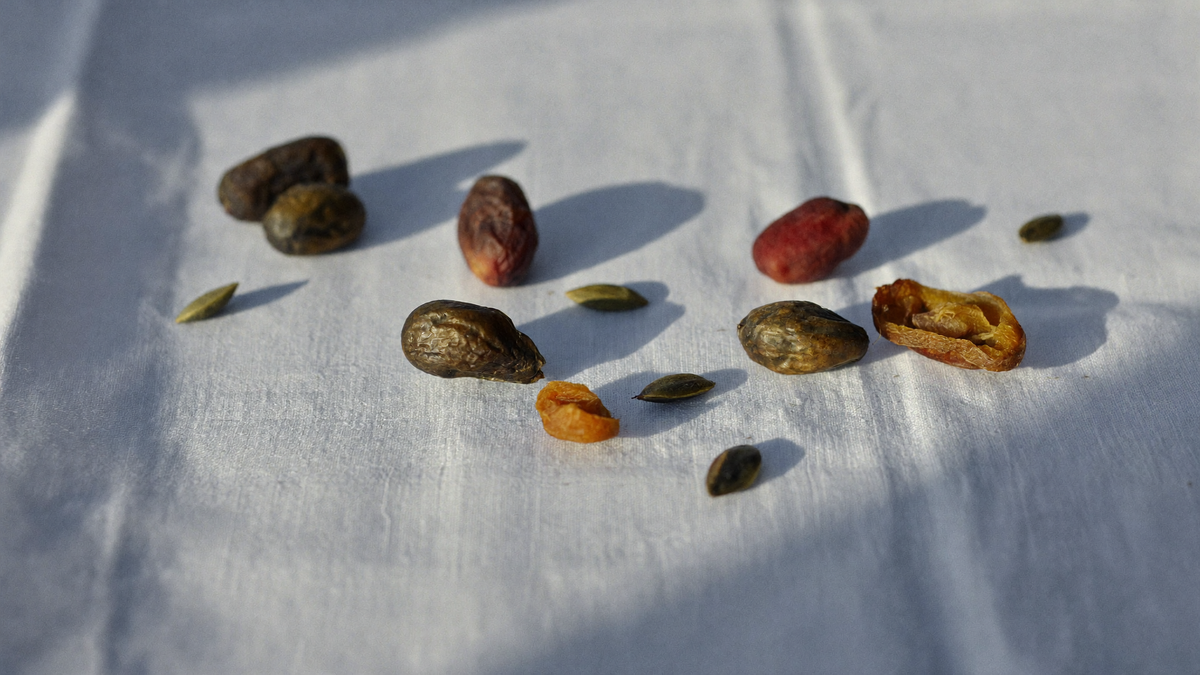
Fruit high in iron: why the question is misleading
The essentials at a glance
Fruit does not appear on the German Nutrition Society’s list of iron-rich foods. The list includes organ meats and red meat, oatmeal, whole-grain bread, sunflower seeds, chanterelles, green leafy vegetables, legumes, and dark chocolate. Anyone trying to meet their iron intake through fruit has chosen the wrong food group.
Even so, fruit does play a role in your iron supply—just elsewhere. Varieties rich in vitamin C significantly improve the absorption of iron from plant-based sources. The DGE explicitly names blackcurrants and citrus fruits. This makes fruit a booster for the meal rather than its source of iron.
This article presents everything in order. First, the difference between the two forms of iron and what it means for a plant-based diet. Then, the daily requirement, the foods that actually provide iron, and which combinations work in everyday life. Finally, it covers what inhibits absorption and how to find out your actual iron status.
What to expect in this article
1. Two forms of iron, two levels of availability
2. Where fruit actually stands in the iron debate
3. How much iron you need per day
4. What actually provides iron
5. The combinations that work in everyday life
6. What slows absorption
7. How to find out your iron status
8. What a value does not answer
9. What matters in the end
Frequently asked questions
Sources
Two forms of iron, two levels of availability
Iron is not all the same. The German Nutrition Society distinguishes between two forms, and this difference determines how much of what is on the plate actually reaches the body.
According to the DGE, heme iron is found primarily in meat, fish, and foods made from them. Non-heme iron comes mainly from foods of plant origin (as of 2025).
“
“Heme iron is more readily available to the human body than non-heme iron.”
German Nutrition Society (DGE)
Selected questions and answers about iron, as of 2025
This leads to the sentence that underpins the entire article: With plant-based foods, it is not only how much iron they contain that matters, but also what else is on the plate. The absorption of non-heme iron can be influenced—both positively and negatively.
Key takeaway
Fruit is not a source of iron but a booster: varieties rich in vitamin C improve the absorption of iron from plant-based sources.
Where fruit actually stands in the iron debate
The DGE maintains two lists, and fruit appears on exactly one of them. It is not on the list of iron-rich foods. It is, however, on the list of foods rich in vitamin C that should be eaten with meals—blackcurrants and citrus fruits are explicitly mentioned there (as of 2025).
| Criterion | Meat and fish | Plant-based iron sources | Fruit |
|---|---|---|---|
| Form of iron | Predominantly heme iron | Non-heme iron | Non-heme iron |
| Bioavailability for the body | More readily available | Less available, can be influenced | Less available, can be influenced |
| Listed by the DGE as an iron source | Yes – organ meats such as liver and kidney, red meat | Yes – oatmeal, whole-grain bread, sunflower seeds, chanterelle mushrooms, green leafy vegetables, legumes, dark chocolate | No |
| Listed by the DGE as helping with absorption | No | Partly – potatoes, bell peppers, broccoli, cabbage | Yes – blackcurrants, citrus fruits |
| Role in iron intake | Source with high absorption | Source whose absorption depends on the meal | Enhancer, not a source |
Classification according to the information provided by the German Nutrition Society (DGE), 2025
Why the misconception persists
The idea that fruit is rich in iron has an understandable origin. Fruit is considered healthy, iron is considered important, so they must belong together—that is how everyday logic works, and how the circulating lists arise.
There is also a translation error. Because certain types of fruit really do contribute to iron intake, they end up on the lists—but a contribution is turned into a content value. “Helps with absorption” becomes “contains a lot.” The difference is crucial and is the first thing to be lost when the claim is passed on.
In practice, the misconception has consequences. Anyone who believes that eating a handful of berries has helped their iron status may forgo measures that actually work—and then wonder why their level is unchanged at the next test.
What about dried fruit?
Dried apricots and prunes appear on almost every list of iron-rich fruit. The reason is purely mathematical: when fruit is dried, water evaporates, so all the remaining components become more concentrated per 100 grams.
This increases the content per 100 grams, but does not change the form of iron. It remains non-heme iron, with correspondingly lower bioavailability. The serving size changes too: 100 grams of dried apricots is a significantly larger amount of fruit than 100 grams of fresh apricots.
Dried fruit does not appear on the German Nutrition Society (DGE) list of iron-rich foods. Comparing the iron content of individual types of fruit would be interesting here, but it cannot be substantiated by the source material used—and estimated values do not belong in this text.
How much iron you need each day
The DGE provides different reference values for adults, and the difference between the groups is considerable.
The reference values at a glance
Recommended daily iron intake in milligrams
Reference values from the German Nutrition Society (DGE), as of 2023. The bar length corresponds to the stated value in milligrams.
The difference between the 16 milligrams for premenopausal women and the 11 milligrams for men is explained by monthly blood loss. For pregnant women, the figure rises to 27 milligrams; for breastfeeding women, it is 16 milligrams, to compensate for losses during pregnancy and childbirth.
The DGE also identifies those who should pay particular attention to their intake: pregnant women, menstruating women, and vegetarians and vegans. The latter two groups are included because they obtain their iron exclusively in the less readily absorbed form.
In brief
The DGE recommends 16 milligrams of iron per day for premenopausal women aged 19 to 51, 11 milligrams for men aged 19 and older, 27 milligrams for pregnant women, and 16 milligrams for breastfeeding women. Fruit does not appear on the list of iron-rich foods—what is listed are offal, red meat, rolled oats, whole-grain bread, sunflower seeds, chanterelle mushrooms, green leafy vegetables, legumes, and dark chocolate. Fruit plays a different role: vitamin C from blackcurrants and citrus fruits improves the absorption of plant-based iron.
What actually provides iron
The DGE lists example portions along with their iron content. Three of them illustrate the order of magnitude involved.
Example portions from the DGE data
- ✓ 20 g dark chocolate: 3.4 mg – the highest value of the three examples, in the smallest portion.
- ✓ 125 g cooked lentils: 3.3 mg – the classic legume, easy to combine with other foods.
- ✓ 65 g rolled oats: 2.9 mg – a typical breakfast portion.
- ✓ Whole grain clearly beats refined flour – according to the DGE, the iron content of whole-grain flour is more than five times that of refined flour.
- ✓ For comparison, the requirement – 16 mg per day for premenopausal women and 11 mg for men.
The sources mentioned in detail
In addition to the three example portions, the DGE list includes other foods that vary in how easy they are to incorporate into everyday life. A brief overview is worthwhile because the differences are practically significant.
Offal such as liver and kidney ranks first among animal sources. It provides heme iron, the more readily absorbed form—but many people do not eat it for taste reasons. Red meat is the more practical everyday option from the same group.
Oatmeal and whole-grain bread are the two sources with the greatest everyday reach because they are already regularly on the table. That is precisely why paying attention to their preparation and accompaniments is most worthwhile.
Sunflower seeds can be spread across salads, muesli, and bread without requiring any changes. Chanterelle mushrooms are seasonal and therefore not a year-round contribution.
Green leafy vegetables and legumes are the main sources for anyone who does not eat meat. With legumes, there is also the soaking effect, which lowers the phytate content—so two levers work at the same time here.
Dark chocolate is the outlier on the list and, at 3.4 milligrams per 20 grams, provides the highest of the three example values. It is still not a dietary plan but a footnote—one that shows, however, that the distribution of iron in foods does not follow intuition.
The whole-grain specification is the most practical point on the entire list. Switching to whole-grain bread and flour changes iron intake without adding anything new to the shopping cart—the DGE explicitly recommends whole-grain options for grain products.
Why portion size counts
The three example portions illustrate something that gets lost in nutrition tables per 100 grams: The content per 100 grams says little if no one eats 100 grams of it.
Dark chocolate is the best example. Twenty grams is a realistic portion and provides 3.4 milligrams. Scaled up to 100 grams, the figure would look impressive—but hardly anyone eats an entire bar as a source of iron.
The same applies, conversely, to foods with a moderate content that are served in larger quantities. For actual nutritional adequacy, what matters is the total consumed over the course of the day, not the peak value of a single ingredient.
Why vegetarians and vegans are mentioned specifically
The DGE explicitly highlights vegetarians and vegans as a group that should pay attention to getting enough iron. The reason lies not in the quantity but in the form.
Anyone who does not eat meat or fish obtains iron exclusively as non-heme iron—that is, in the form that the DGE says is less readily available. So, purely mathematically, intake may be adequate while the amount actually absorbed is lower.
This is not an argument against a plant-based diet. It means that, for this group, the combination on the plate is not a fine-tuning detail but the key lever—and that is precisely why the next section is the most important part of the article.
The combinations that work in everyday life
This is where fruit comes back into the picture—as a side, not the main attraction. The DGE recommends consuming foods rich in vitamin C with meals and lists potatoes, bell peppers, blackcurrants, broccoli, citrus fruits, and cabbage.
When it comes to iron, fruit is not a source but an enhancer.
The key word is with. It is not about eating an orange at some point during the day, but about eating it with the iron-containing meal. Absorption is affected during digestion, not averaged out over the course of the day.
Three everyday examples
Oatmeal with blackcurrants instead of banana. The iron content of the serving remains the same, while the vitamin C component is added.
Lentil dish with bell pepper or a splash of lemon. Both appear on the DGE list of foods rich in vitamin C, and both pair well with legumes.
Whole-grain bread with a glass of orange juice instead of coffee. This simultaneously adds an enhancer and removes an inhibitor—more on that shortly.
Vegetables belong in this group too
The DGE list of foods rich in vitamin C consists of more than just fruit. Potatoes, bell peppers, broccoli, and cabbage are also included—and they go better with hot meals than an orange does.
This greatly expands the possibilities. A lentil dish with bell pepper, potatoes as a side dish with a vegetable meal, broccoli with whole-wheat pasta: All combinations that no one would perceive as a nutrient strategy, yet that achieve exactly this.
The source does not include a preparation note, so none is claimed here either: The extent to which heating affects the vitamin C content and therefore the effect is not quantified in the source material used.
A breakfast that follows the rules
All the recommendations in this chapter can be incorporated into a single meal—specifically, the one that most people already eat every day.
Oatmeal is one of the plant-based sources of iron named by the DGE; a 65-gram serving provides 2.9 milligrams. Soaked overnight, its phytate content decreases—soaking is explicitly named by the DGE as one of the methods for this.
Add blackcurrants or citrus fruits as a source of vitamin C; both are specifically listed in the DGE list. And move the coffee back by an hour instead of having it alongside the meal.
This fulfills three of the four levers in a single meal, without putting anything unfamiliar on the table. That is the real reason this topic is worthwhile: It is not about new foods, but about arranging the ones already available.
What slows absorption
The other half of the equation consists of substances that inhibit iron absorption. The DGE names two groups.
Polyphenols from coffee, black tea, and red wine
The DGE recommendation is unusually specific at this point: Because polyphenols can inhibit iron absorption, it recommends not drinking coffee or black tea during meals or shortly before or after them (as of 2025).
This is a habit that is firmly part of breakfast in many households—and therefore, ironically, part of the meal that is often the richest in iron of the day because of oats and whole-grain bread.
Phytates from whole grains and legumes
Here is an apparent contradiction: The same foods that provide iron also contain phytates, which inhibit its absorption. The DGE resolves this not through abstinence, but through preparation—grinding, soaking, or fermenting reduces the phytate content.
In practice, this means soaking lentils overnight and discarding the soaking water. Sourdough bread instead of yeast bread. Leave oats to soak in liquid overnight. All methods that are already widespread—just rarely for this reason.
The contradiction is resolved through sequencing
When you place the recommendations side by side, a conflict appears at first glance: Eat whole grains and legumes, but pay attention to the phytates they contain. Drink coffee, but not with your meal.
This is resolved not through abstinence, but through timing and preparation. Iron-rich foods remain on the menu—they are simply prepared and combined differently.
In concrete terms, this means three things. First: soak legumes and oats, and prefer sourdough over yeast dough. Second: include a source of vitamin C with the meal, not at some point during the day. Third: separate coffee and black tea from the meal in time.
None of these points requires a new food. All three merely change when and how the foods already being eaten are consumed—and that is precisely what makes them sustainable in everyday life.
What the sources do not establish
There are two points where a figure would be helpful, and it is missing in both cases from the source material used. The percentage by which vitamin C improves the absorption of non-heme iron has not been quantified. Nor has the extent to which coffee consumed with a meal reduces it.
What is established in each case is the direction, not the magnitude of the effect. That is less satisfying than a percentage, but it is what can be said—and for deciding whether to drink your coffee an hour later, the direction is entirely sufficient.
How to find out your iron status
All considerations about intake are futile if it is unclear where you stand. The relevant storage marker is called ferritin, and it can be measured.
Why ferritin rather than iron itself? Because the iron level in the blood fluctuates in the short term and says little about how well the stores are filled. Ferritin reflects iron stores and is therefore the more informative measure when it comes to nutritional status over a longer period.
The regular route is through a general practitioner’s practice. For an interim check, mybody®x (MYBODY Lab GmbH) offers two options: a rapid at-home test and a laboratory analysis that measures ferritin together with additional markers.
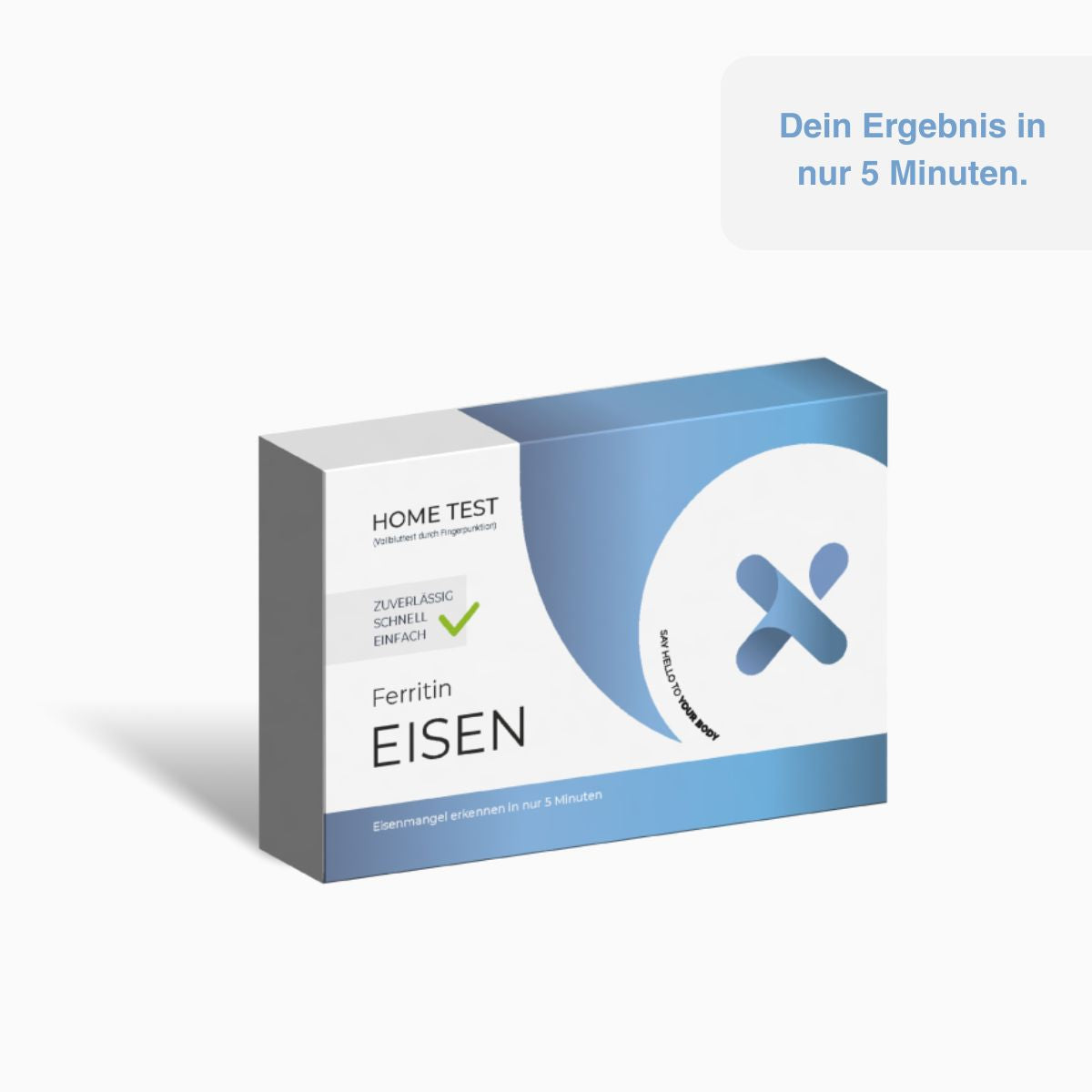
Iron-Ferritin Self-Test
Determines the ferritin level from capillary blood and indicates when it is below 30 ng/ml. What the test does not do: It does not provide an exact numerical value, but rather indicates whether the result is above or below this single threshold. Nor does it explain why iron stores are low—iron deficiency has causes that should be investigated and is not solely a dietary issue.
Price: €14.50 · Sample type: capillary blood · Processing time: result in 5–10 minutes · Laboratory: no laboratory processing, evaluation at home
About the Iron-Ferritin Self-TestIf you want a numerical value interpreted in conjunction with other nutrients rather than a single threshold, a laboratory analysis is the better option.
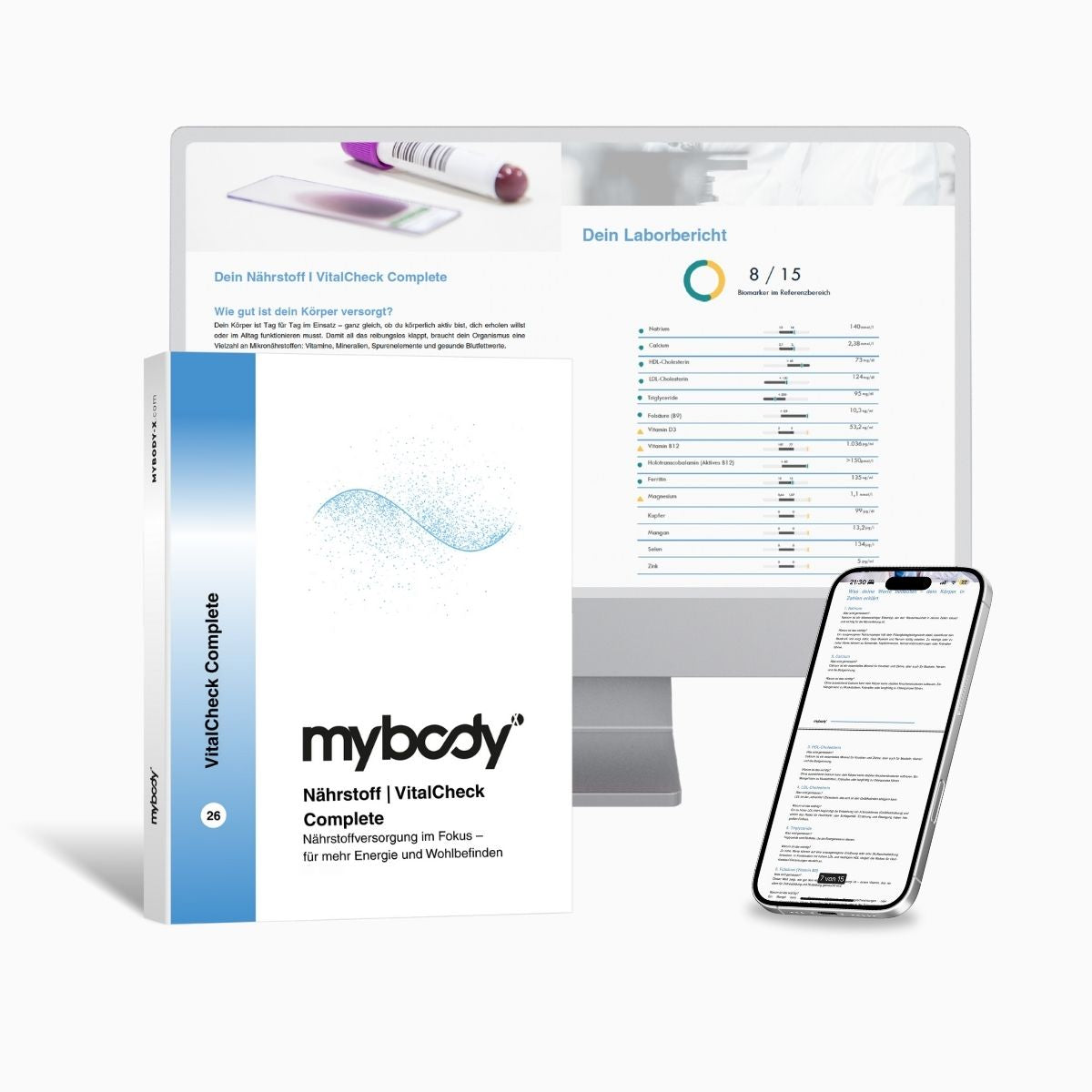
Nutrient | VitalCheck Complete
Determines 15 biomarkers from capillary blood, including ferritin, as well as vitamin B12, 25-OH vitamin D3, folic acid, zinc, selenium, magnesium, and calcium. What the test does not do: It does not include thyroid values and does not clarify the cause of a low ferritin level. An abnormal result is a reason to discuss the findings with a doctor, not a diagnosis.
Price: €169.00 (instead of €199.00) · Sample type: capillary blood · Processing time: kit shipping 1–3 business days, laboratory analysis 3–5 business days after sample receipt · Laboratory: ISO-certified laboratory analysis in Germany
About the Nährstoff VitalCheck CompleteAll price and service information is current as of August 5, 2026. Prices and the scope of services may change; the relevant product page always applies.
Who could benefit from a measurement
Useful for you if …
… you follow a vegetarian or vegan diet and want to know what your nutritional status actually looks like.
… you menstruate and want to keep the increased requirement of 16 milligrams in mind.
… you have changed your diet and want to check the effect after several months.
Probably not if …
… you are already taking iron supplements—the follow-up monitoring should then be handled by your treating practice.
… you are due to have blood drawn soon anyway; in that case, the measurement would be redundant.
… you hope the result will reveal the cause—a low iron store does not say why it is low.
What a result does not answer
The most important limitation first: A low ferritin level is a finding, not an explanation. Iron deficiency may be due to inadequate intake, but it can just as easily result from blood loss or impaired absorption in the intestine. No test can make this distinction; it requires medical evaluation.
The second limitation concerns the reverse conclusion. A normal ferritin level does not rule out a deficiency of another nutrient—symptoms such as fatigue or pallor have numerous possible causes, and iron is only one of them.
The third limitation is practical: Iron supplements should not be taken without good reason. Excess iron is possible, and the right time to start supplementation is after clarification, not before.
The fourth limitation concerns when the measurement is taken. Ferritin does not change from one day to the next. If you have changed your diet and want to see the effect, test no earlier than after several months—before that, the result mainly shows where you started.
And a fifth point that is central to this topic: No test can tell you whether your fruit was the right variety. The path from combining foods at a meal to a laboratory result takes months and depends on everything else you have eaten during that time. What you can influence is the overall direction—not the individual meal.
What ultimately matters
The search for the most iron-rich fruit leads to a dead end, because fruit simply does not appear on the list of iron-rich foods. If you want to make a difference through your diet, focus on oatmeal, whole-grain products, legumes, green leafy vegetables, and sunflower seeds.
The fruit still has a place—as an accompaniment. Black currants and citrus fruits with an iron-rich meal improve absorption, while having coffee an hour later instead of with the meal prevents the opposite effect.
Your specific next step: Take a look at your breakfast. If oatmeal or whole-grain bread is combined with coffee, you have paired an iron-rich meal with an inhibitor. Changing this costs nothing and is the only point from this article you can put into practice tomorrow morning.
Frequently asked questions
Which fruit contains the most iron?
The question is misleading because fruit does not appear at all on the DGE's list of iron-rich foods. The list includes organ meats such as liver and kidney, red meat, oatmeal, whole-grain bread, sunflower seeds, chanterelle mushrooms, green leafy vegetables, legumes, and dark chocolate. Fruit plays a different role when it comes to iron: Vitamin C-rich varieties such as blackcurrants and citrus fruits improve the absorption of plant-based iron from the meal.
Are dried apricots a good source of iron?
Dried fruit does not appear on the DGE's list of iron-rich foods. Its higher content per 100 grams compared with fresh fruit results from water loss during drying—the form of iron remains the same, namely the less readily available non-heme iron. The source material used here does not provide a documented comparison of the iron content of individual types of fruit.
How much iron do I need per day?
The DGE recommends 16 milligrams per day for premenopausal women aged 19 to 51 and 11 milligrams for men aged 19 and over. The figure is 27 milligrams for pregnant women and 16 milligrams for breastfeeding women, to compensate for losses during pregnancy and childbirth. According to the DGE, pregnant women, menstruating women, vegetarians, and vegans should pay particular attention to their intake.
Why shouldn't I drink coffee with my meal?
Because polyphenols can inhibit iron absorption. According to the DGE, they are found in black tea, coffee, and red wine, among other things, and the recommendation is not to drink coffee or black tea during meals or shortly before or after them. This particularly affects breakfast, because oatmeal or whole-grain bread often makes it the meal richest in iron of the day.
How do I know whether I am deficient in iron?
This cannot be determined from symptoms alone, because fatigue, paleness, and concentration problems can have numerous causes. The ferritin storage value, which can be determined through a blood test, is informative. Important: A low value does not indicate why iron stores are low—besides insufficient intake, blood loss and impaired absorption are also possible causes. Iron supplements should therefore not be taken on suspicion, but after medical evaluation.
First establish the baseline, then make the change
Whether your iron status is actually an issue is shown by the storage value ferritin. Whether as a quick threshold indication or as a numerical value in relation to other nutrients—in both cases, it serves as a guide for a discussion with your doctor, not as a substitute for one.
View Iron-Ferritin Self-Test Nutrient VitalCheck CompleteYou might also be interested in
→ What to Eat for Iron Deficiency for More Energy in Everyday Life
An overview of meal planning as a whole when a deficiency has already been diagnosed.
→ Recognizing Symptoms of Iron Deficiency
Which symptoms may indicate low iron stores and which may not.
Sources
- German Nutrition Society (DGE): Selected Questions and Answers About Iron, as of 2025 — dge.de
- German Nutrition Society (DGE): Reference Values for Nutrient Intake – Iron, as of 2023 — dge.de
The distinction between heme and non-heme iron, the list of iron-rich foods, the example portions with milligram amounts, the whole-grain information, and all statements about vitamin C, polyphenols, and phytates are based on source [1]. The reference values for women, men, pregnant women, and breastfeeding women, as well as the mention of the groups requiring particular attention, are taken from source [2]. Product information is taken from the mybody®x product pages, accessed on August 5, 2026.

mybody®x Editorial & Expert Team
Micronutrients Blood values Nutritional science
This article was created and medically reviewed by the mybody®x Editorial and Expert Team. The team combines expertise in nutrigenetics, microbiome and gut science, blood test interpretation, nutritional science, and laboratory diagnostics.
Published on August 5, 2026 · Last updated on August 5, 2026
Medical information: This article is intended for general information and does not replace medical advice, diagnosis, or treatment. Iron deficiency has causes that require medical evaluation; iron supplements should not be taken without medical indication, as excess iron is also possible.



Share now:
Foods to Avoid with High Cholesterol: The List That Doesn’t Exist
How much protein does an egg contain: the number and what it really means