

How much protein per day? Reference values, calculation, and good protein sources
The essentials at a glance
According to the German Nutrition Society (DGE, as of 2025), adults between 19 and 65 years of age need 0.8 grams of protein per kilogram of body weight per day. In the reference value, this corresponds to about 57 grams per day for men and about 48 grams for women. From age 65 onward, the DGE gives an estimated value of 1.0 grams per kilogram of body weight per day.
These figures are reference and estimated values for a normal weight, not an individualized needs assessment. If you want to know your own value, calculate it using your body weight: kilograms times 0.8 grams, or, from age 65 onward, times 1.0 grams. This article explains where the values come from, shows how to calculate them, puts the increased need from exercise into context, and identifies where the figures no longer apply.
If you want to calculate it right away, skip to Chapter 3. The four DGE values in grams are shown as a graphic in Chapter 4, the information on exercise in Chapter 5, and the complete overview in Chapter 9.
What to expect in this article
1. How much protein do you really need per day?
2. Which foods provide good protein?
3. How do you calculate your daily protein requirement?
4. How many grams of protein do the DGE reference values specify?
5. How much protein do you need if you exercise?
6. Which misconceptions about protein persist?
7. How can you incorporate your protein intake into everyday life?
8. How does mybody® assess your personal diet?
9. Which guideline applies to whom?
10. What reference values and a DNA test cannot tell you
Conclusion
Frequently asked questions
Sources
How much protein do you really need per day?
For adults between 19 and 65 years of age, the German Nutrition Society (DGE) specifies a recommended protein intake of 0.8 grams of protein per kilogram of body weight per day in its reference values, as of 2025. This single figure is the basis for everything that follows in this article.
Converted to an average normal weight, the reference value amounts to about 57 grams of protein per day for men and about 48 grams per day for women aged 19 to 65 (DGE, as of 2025).
From age 65 onward, the value increases: For this age group, the DGE gives an estimated value of 1.0 grams of protein per kilogram of body weight per day, corresponding to about 67 grams per day for men and about 57 grams per day for women (DGE, as of 2025).
What a DGE reference value says – and what it does not
A reference value is a guideline for the population, not a measurement of your body. It describes an intake level considered sufficient according to current knowledge.
The DGE makes a very precise linguistic distinction here. For ages 19 to 65, the protein reference values specify a recommended intake; from age 65 onward, they give an estimated value (DGE, as of 2025). Both figures are guidelines, not limits that must be met exactly every day.
The stated amounts of 57, 48, 67, and 57 grams refer to a normal weight. People who are significantly heavier or lighter will arrive closer to the appropriate value by calculating based on their own body weight than by using a flat gram amount.
Why body weight is the decisive factor in the calculation
The DGE protein reference value is deliberately not expressed as a fixed daily amount, but per kilogram of body weight. This means the recommended amount increases with height and weight rather than being the same for everyone.
At 0.8 grams per kilogram, a body weight of 60 kilograms corresponds mathematically to 48 grams of protein per day, 70 kilograms to 56 grams, and 80 kilograms to 64 grams. The calculation is explained in detail in Chapter 3.
For existing kidney disease, during pregnancy or breastfeeding, and in the case of other illnesses, daily protein intake should be managed by a doctor or qualified nutrition professional. These situations are not covered by a simple multiplication.
Key message: The German Nutrition Society recommends that adults aged 19 to 65 consume 0.8 grams of protein per kilogram of body weight per day and gives an estimated value of 1.0 grams per kilogram of body weight per day from age 65 onward (DGE, Protein Reference Values, as of 2025).
Which foods provide good protein?
Good sources of protein are found among both animal-based and plant-based foods. In its protein reference values, the German Nutrition Society explicitly names both groups alongside each other.
“
“Good sources of protein include meat, fish, dairy products, and eggs, as well as legumes such as soy, lentils, and peas and grain products.”
German Nutrition Society (DGE)
Protein reference values, as of 2025
This one sentence answers one of the most common questions on the subject. Protein is not tied to a single food group, nor is it tied to animal-based foods.
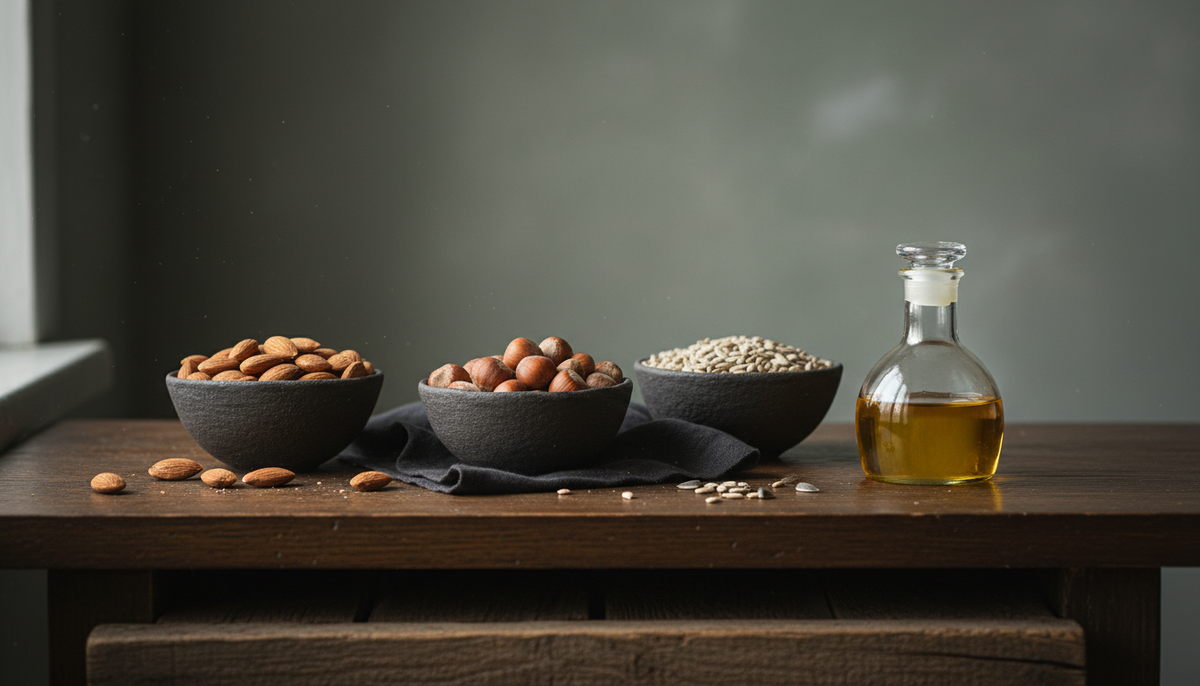
Animal protein sources: meat, fish, dairy products, eggs
Meat, fish, dairy products, and eggs are listed first among the protein sources named by the DGE (DGE, as of 2025). In a conventional mixed diet, they are why many people reach the reference value without special planning.
Für den Proteinanteil einer Mahlzeit ist es unerheblich, ob die Quelle Quark, Ei, Fisch oder Geflügel heißt. Die DGE führt die vier Gruppen gleichrangig auf, ohne eine davon hervorzuheben.
For the protein content of a meal, it does not matter whether the source is quark, eggs, fish, or poultry. The DGE lists all four groups on an equal footing without highlighting any one of them.
Plant-based protein sources: legumes and grain products
On the plant-based side, the DGE lists legumes such as soybeans, lentils, and peas, as well as grain products, as good sources of protein (DGE, as of 2025). Both groups appear in the same sentence as meat and fish.
For everyday planning, this means that lentil soup, a soy product, or a serving of whole-grain cereal are not emergency substitutes but protein sources explicitly named by the professional society.
Those following a vegetarian or vegan diet should sensibly combine these groups throughout the day instead of relying on a single food. This article deliberately does not provide specific protein amounts for individual foods because no verified source is available for them.
How do you calculate your daily protein requirement?
STEP 1
Take your body weight
Multiply by 0.8 grams
From ages 19 to 65, the DGE reference value is 0.8 grams of protein per kilogram of body weight per day (as of 2025).
From age 65, calculate using 1.0 grams
For people aged 65 and over, the DGE gives an estimated value of 1.0 grams per kilogram of body weight per day (as of 2025).
Distribute the amount across meals
Distribute the calculated daily amount across your usual meals instead of consuming it in a single portion.
Example calculation for a body weight of 70 kilograms
An adult weighing 70 kilograms between the ages of 19 and 65 arrives at 70 times 0.8 grams using the DGE reference value—that is, 56 grams of protein per day.
The same person at age 65 or older uses the estimated value of 1.0 grams and arrives at 70 grams of protein per day. The difference of 14 grams sounds small, but it amounts to a quarter of the previous amount.
At 55 kilograms, the reference value calculates to 44 grams per day, while at 90 kilograms it is 72 grams. That is precisely why the blanket statement that a person needs 60 grams of protein per day is of little value without specifying body weight.
When the simple calculation no longer applies
The DGE reference and estimated values are formulated for a normal weight. In cases of significant overweight or underweight, simple multiplication therefore does not produce a meaningful target value; it needs to be assessed from a nutritional perspective.
The same applies to kidney disease, pregnancy, breastfeeding, and existing medical conditions. In these situations, the amount of protein should be determined by a doctor or nutrition professional rather than calculated independently.
How many grams of protein do the DGE reference values specify?
In its protein reference values, the German Nutrition Society gives four gram amounts, each differentiated by age and sex. As of 2025, they range from 48 to 67 grams per day.
The highest value is for men aged 65 and over, at approximately 67 grams per day, while the lowest is for women aged 19 to 65, at approximately 48 grams per day. In between are women aged 65 and over and men aged 19 to 65, at approximately 57 grams per day each.
Protein reference values in grams per day
Source: German Nutrition Society (DGE), Protein Reference Values, as of 2025
These four values are reference or estimated values for a normal weight. Individual requirements are not read from the gram amount but calculated based on one's own body weight.
Why the values are higher from age 65 onward
From age 65 onward, the DGE increases the reference value from 0.8 to 1.0 grams per kilogram of body weight per day and lists it as an estimated value (DGE, as of 2025). This increases the absolute number of grams, even though body weight may not have changed.
In practical terms, someone who calculated 56 grams of protein per day at age 64 would need 70 grams at age 66 at the same body weight. The diet does not need to change fundamentally, but greater attention should be paid to protein-rich components in every meal.
How protein relates to total energy intake
Protein is just one of several building blocks of the daily diet. For context, the DGE's 2015 reference values for energy intake give a guideline of 2,700 kilocalories per day for men aged 25 to under 51 with a PAL value of 1.6, and 2,100 kilocalories per day for women in the same age group.
For people aged 65 and over, the DGE gives a daily intake of around 2,000 kilocalories for men and 1,600 kilocalories for women at a PAL value of 1.4 (DGE, FAQ on Energy Intake, as of 2025). Energy requirements therefore tend to decrease, while the protein reference value per kilogram of body weight increases.
This very contrast makes protein intake in older age a matter of planning: as portions become smaller, the protein content of each meal must be chosen more carefully.
How much protein do you need if you exercise?
According to the DGE (as of 2025), recreational athletes need only the recommended intake of 0.8 grams of protein per kilogram of body weight per day. The DGE defines recreational sport as exercising for 30 minutes four to five times per week.
It is only for ambitious training of around five hours or more per week that the DGE gives a flexibly adjusted protein intake of approximately 1.2 to 2.0 grams per kilogram of body weight per day. The DGE explicitly presents this range as cited from the International Society of Sports Nutrition and the American College of Sports Medicine.
What 30 minutes four to five times a week means
Thirty minutes four to five times a week amounts to two to two and a half hours of activity. This places the workload within the range that the World Health Organization (WHO) identifies in its 2020 Guidelines on Physical Activity and Sedentary Behaviour as weekly activity: 150 to 300 minutes of moderate-intensity or 75 to 150 minutes of vigorous-intensity aerobic activity per week.
The WHO (2020) also recommends muscle-strengthening activity on at least two days per week. Anyone following this guideline is exercising at a level for which the DGE continues to cite the reference value of 0.8 grams per kilogram of body weight.
Example calculation for ambitious training
Someone weighing 70 kilograms who trains for at least five hours per week would, using the range of 1.2 to 2.0 grams per kilogram cited by the DGE, consume between 84 and 140 grams of protein per day.
The range is deliberately broad because it covers the type, volume, and goal of training. The DGE therefore refers to flexibly adjusted protein intake rather than a fixed target amount.
The source material reviewed for this article contains no information about protein powders or other dietary supplements. Therefore, this article makes no recommendation on them—neither for nor against.
Key point: According to the DGE (as of 2025), recreational athletes who train for 30 minutes four to five times a week need only the recommended intake of 0.8 grams of protein per kilogram of body weight; it is only from around five hours of training per week that the DGE—citing the International Society of Sports Nutrition and the American College of Sports Medicine—gives a figure of approximately 1.2 to 2.0 grams per kilogram of body weight per day.
Which misconceptions about protein persist?
Two assumptions about protein are particularly common in everyday life. Both can be directly checked against the German Nutrition Society’s protein reference values as of 2025.
The difference, then, is not the sport itself but the amount of training. According to the DGE figures, there is a clear threshold between two and a half hours of recreational sport and five hours of ambitious training.
Both misconceptions have the same effect: they make the question of how much protein you need seem more complicated than it is. If you know your body weight, age, and training volume, you already have all the information needed for the calculation.
How can you incorporate the right amount of protein into your daily routine?
The calculated daily amount is distributed across the usual meals, rather than being consumed in a single portion. This makes the amount easier to plan and the meals more filling.
In practical terms, this means planning one of the protein sources named by the DGE into every main meal: meat, fish, dairy products, eggs, legumes such as soy, lentils, and peas, or grain products (DGE, as of 2025).
Checklist: Getting enough protein in everyday life
- ✓ Calculate your own amount once – body weight multiplied by 0.8 grams, or by 1.0 gram from age 65 onward (DGE, as of 2025).
- ✓ Spread it across your meals – include a protein source in every main meal instead of putting everything into dinner.
- ✓ Combine animal and plant sources – the DGE lists legumes and grain products on an equal footing with meat, fish, dairy products, and eggs.
- ✓ Assess your training volume honestly – according to the DGE, the higher range of 1.2 to 2.0 grams per kilogram applies only from around five hours of training per week.
- ✓ Refer special cases to a professional – in cases of kidney disease, pregnancy, breastfeeding, or existing medical conditions, the amount should be determined by a doctor or nutrition professional.
Why spreading it throughout the day helps
A daily amount of 56 grams of protein may seem abstract as a total. Divided across three main meals, it comes to around 19 grams per meal—a quantity that can be achieved with a normal portion from the food groups mentioned.
For people aged 65 and over with a daily amount of 70 grams, that works out to around 23 grams per main meal. This is not an unusual portion either, but it needs to be planned more consciously when meals are smaller.
What you don’t need for this
Meeting the DGE reference value requires neither an app nor a food diary kept for weeks. A one-time calculation and a conscious selection of meal components are sufficient as a guideline.
No verified source on protein powder supplementation is available for this article. Therefore, neither a product nor a dosage is specified here.
In brief
The daily amount of protein is calculated as body weight multiplied by 0.8 grams, or, from age 65 onward, multiplied by 1.0 gram (DGE, protein reference values, as of 2025). This amount is distributed across the usual main meals, with each meal containing one of the protein sources named by the DGE—meat, fish, dairy products, eggs, legumes, or grain products. For everyday use, a one-time calculation is sufficient as a guideline; in cases of kidney disease, pregnancy, breastfeeding, or existing medical conditions, the amount should be determined with medical or nutritional guidance.
How does mybody® classify your personal nutrition?
mybody® (MYBODY Lab GmbH) offers nutrition and metabolism analyses for use at home, which are evaluated in an ISO-certified laboratory in Germany. The samples are processed pseudonymously, and the data is transmitted using SSL encryption in compliance with the GDPR.
For the question of how much protein you need per day, one clarification is more important than any product description: A DNA test does not answer the question of how much protein you need per day.
A DNA test does not answer the question of how much protein you need per day.
What the NutriCare | What the NutriCare INFINITY DNA Test by mybody® analyzes instead are other nutrition-related topics: your response to carbohydrates and fats, your personal nutrition and diet type, your vitamin and mineral requirements, eating habits, the cardiovascular system, your sports type, and muscle cells.
Altogether, these are 54 analysis reports in eight chapters across around 200 pages, evaluated from more than 140 gene variations in a saliva sample. There is no chapter or report on protein requirements.
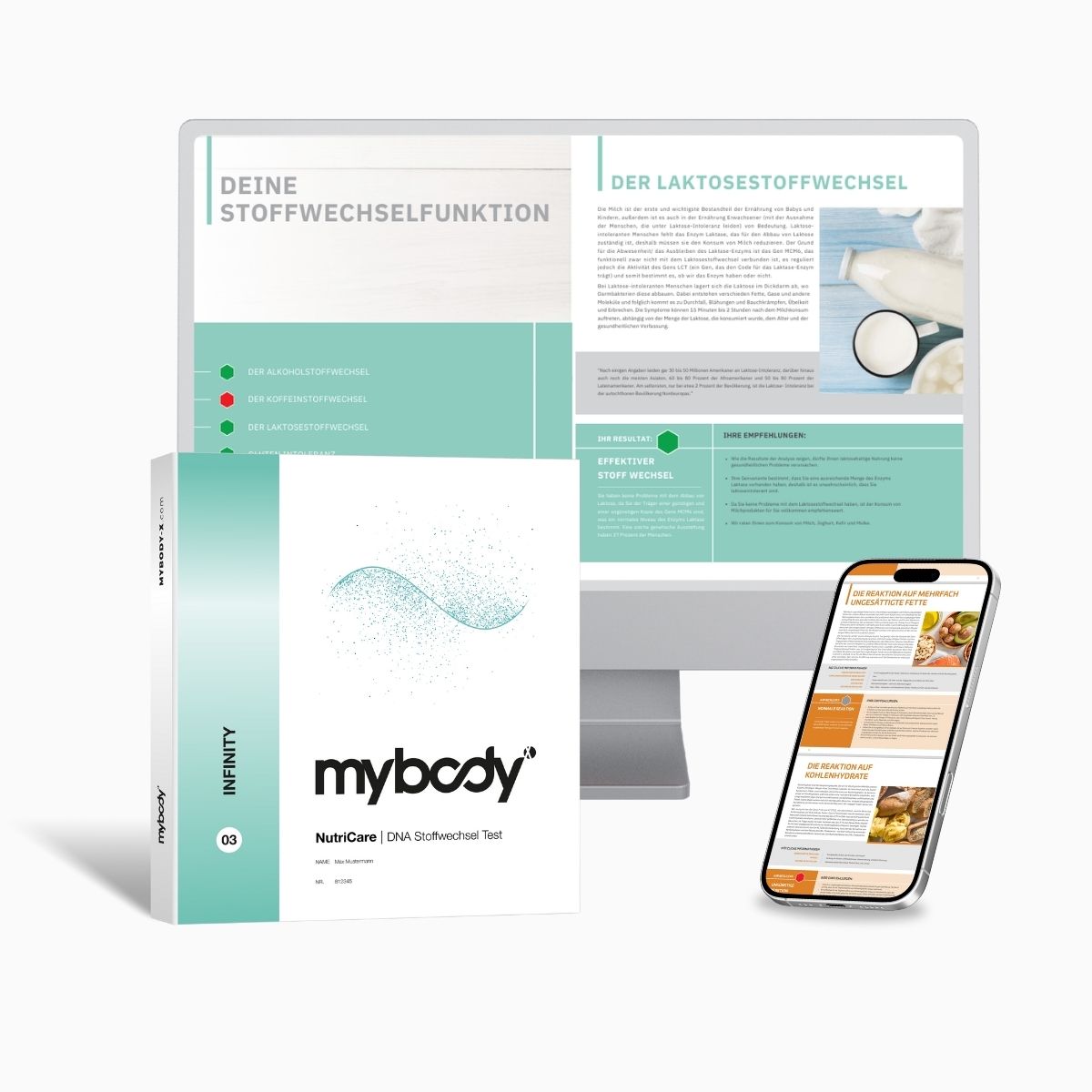
NutriCare | INFINITY DNA Test
The NutriCare | The INFINITY DNA Test analyzes more than 140 gene variations from a saliva sample and provides 54 analysis reports in eight chapters across around 200 pages, along with a food table containing more than 1,000 analyzed foods. To state it plainly and directly: The test contains no report or chapter on protein, dietary protein, or macronutrients and does not determine how much protein you need per day. For the amount of protein, the DGE reference values and your body weight remain the basis for calculation; the test covers other topics, such as vitamin and mineral requirements, your nutrition and diet type, your sports type, and muscle cells.
Price: 269.00 € · Sample type: saliva sample · Processing time: approx. 20–25 business days after receipt by the laboratory · Laboratory: ISO-certified laboratory analysis, ISO-27001
To NutriCare | INFINITY DNA TestAll price and service information is current as of July 28, 2026. Prices and processing times may change; the respective product page is always authoritative.
This kind of test is therefore a supplement to nutritional planning, not a substitute for calculating based on body weight. Anyone who wants to know how much protein they need per day does not need genetic analysis, but rather the DGE reference value and a set of scales.
Which guideline applies to whom?
The German Nutrition Society distinguishes three groups in its protein recommendations: adults aged 19 to 65, people aged 65 and over, and ambitious athletes training for around five hours or more per week. The following overview compares them according to the same criteria.
| Criterion | Adults aged 19–65 | From age 65 | Ambitious sports training from around five hours per week |
|---|---|---|---|
| Value per kilogram of body weight | 0.8 g of protein per day | 1.0 g of protein per day | 1.2 to 2.0 g of protein per day |
| Example amount per day | Reference value: approximately 57 g (men) and approximately 48 g (women); at 70 kg, mathematically 56 g | Reference value: approximately 67 g (men) and approximately 57 g (women); at 70 kg, mathematically 70 g | At 70 kg, mathematically 84 to 140 g |
| Where does the figure come from? | DGE, Protein Reference Values, as of 2025—listed there as the recommended intake | DGE, Protein Reference Values, as of 2025—listed there as an estimated value | DGE, Protein Reference Values, as of 2025—cited there according to the International Society of Sports Nutrition and the American College of Sports Medicine |
| What should you pay attention to? | The gram amounts apply to a normal weight; the calculation based on your own body weight is decisive | Energy requirements tend to decrease, while the protein value per kilogram increases—plan protein sources more consciously for each meal | For recreational sports involving four to five 30-minute sessions per week, the DGE continues to state 0.8 g per kilogram |
| Who should have medical supervision? | People with kidney disease, pregnant women, breastfeeding women, and people with pre-existing conditions | In addition, all those whose weight or appetite is noticeably declining | Anyone planning to maintain their intake at the upper end of the range over the long term should seek professional nutritional advice. |
The overview shows that the three groups do not differ in their calculation method, only in the factor. Body weight remains the reference quantity in all three cases.
What reference values and a DNA test cannot do
Reference values provide guidance for the population, not a measurement for an individual. They do not indicate how well someone is actually supplied with nutrients, and they do not replace medical assessment.
A DNA test does not measure protein requirements
The NutriCare | According to the product page accessed on July 28, 2026, the INFINITY DNA Test contains no report or chapter on protein, dietary protein, or macronutrients. It does not determine how much protein a person needs per day.
This limitation is deliberately stated not at the edge, but in the product card itself. A test that examines something else is not presented here as an answer to the protein question either.
The basic principle is this: A DNA test does not provide a diagnosis. It describes genetic predispositions, not current measurements of your metabolism.
What this article deliberately does not address
No reviewed source is available for this article on very high protein intakes far above the reference values or their possible effects on the kidneys. Therefore, this article makes no statement on the subject—neither reassuring nor cautionary.
Protein powders, shakes, and other dietary supplements are not evaluated either. The reviewed source material provides no information on this, and a recommendation without evidence does not belong in a specialist article.
When protein intake should be handled by a professional
In cases of kidney disease, pregnancy, breastfeeding, and existing medical conditions, the daily protein intake is determined by a doctor or nutrition professional. The calculation from Chapter 3 is not intended for these situations.
Unintentional weight loss, a noticeable decline in appetite, or a severely restricted selection of foods should also be addressed in a medical practice, not through self-calculation. Here, a reference value can only serve as a starting point for a discussion.
Conclusion
How much protein per day makes sense can be answered in one sentence: 0.8 grams per kilogram of body weight for adults aged 19 to 65 and 1.0 grams per kilogram from age 65 onward (DGE, Reference Values for Protein, as of 2025).
In absolute terms, this corresponds to about 57 grams per day for men and 48 grams for women aged 19 to 65, and about 67 and 57 grams from age 65 onward. Those who train ambitiously for around five hours or more per week will find a range of 1.2 to 2.0 grams per kilogram in the DGE guidelines, citing the International Society of Sports Nutrition and the American College of Sports Medicine.
The specific recommendation is therefore simple: Calculate your value once, distribute it across your main meals, and choose protein sources from the groups named by the DGE—meat, fish, dairy products, eggs, legumes, and grain products.
For everything beyond that, the following applies: A test does not replace this calculation. And whenever an illness, pregnancy, or breastfeeding is involved, protein intake should be determined by a doctor or nutrition professional.
Frequently asked questions
How much protein do adults need per day?
For adults aged 19 to 65, the German Nutrition Society recommends an intake of 0.8 grams of protein per kilogram of body weight per day (DGE, Protein Reference Values, as of 2025). According to the reference value, this corresponds to approximately 57 grams per day for men and approximately 48 grams for women.
How do I calculate my protein requirements?
Multiply your body weight in kilograms by the reference value: 0.8 grams between the ages of 19 and 65, and 1.0 gram from age 65 onward (DGE, as of 2025). At 70 kilograms, this amounts to 56 or 70 grams of protein per day, respectively. These values apply to a normal weight.
How much protein do I need when exercising?
For recreational athletes training for 30 minutes four to five times per week, the DGE (2025) says that the recommended intake of 0.8 grams per kilogram of body weight is sufficient. From around five hours of training per week, the DGE cites a flexibly adjusted intake of approximately 1.2 to 2.0 grams per kilogram per day, referencing the International Society of Sports Nutrition and the American College of Sports Medicine.
Can I meet my protein requirements with plant-based foods?
As of 2025, the DGE explicitly lists legumes such as soy, lentils, and peas, as well as grain products, as good sources of protein. People following a vegetarian or vegan diet should sensibly combine these groups throughout the day rather than relying on a single food.
Can a DNA test determine my protein requirements?
No. NutriCare | According to the product page accessed on July 28, 2026, the mybody® INFINITY DNA test contains no report or chapter on protein, dietary protein, or macronutrients, and does not determine how much protein a person needs per day. Body weight and the DGE reference value remain decisive for determining protein intake.
Do you want to understand your diet in greater detail?
Calculate your protein intake yourself using the DGE reference value. If you are also interested in how your body reacts to carbohydrates and fats or which nutrition and exercise type suits you, you will find the right analyses at mybody®.
NutriCare | View INFINITY All DNA metabolic testsYou may also be interested in
→ Macronutrients: What protein, fat, and carbohydrates do in the body
How protein fits into the bigger picture of nutrient groups.
→ Recovery: How the body recovers after exertion
Why recovery is the third pillar alongside training and nutrition.
→ Gut encyclopedia: all bacteria and markers in your gut flora
Reference work with over 6,000 microbiome biomarkers—from protective bacteria and fiber-degrading bacteria to the metrics in the report.
Sources
- German Nutrition Society (DGE): Reference Values for Protein (as of 2025) — dge.de
- German Nutrition Society (DGE): Reference Values for Energy Intake (as of 2015) — dge.de
- German Nutrition Society (DGE): FAQ Energy Intake (as of 2025) — dge.de
- World Health Organization (WHO): Guidelines on Physical Activity and Sedentary Behaviour (2020) — ncbi.nlm.nih.gov
All information on reference values, estimated values, protein sources, and relevance to sports is based on source [1]. The guidelines for energy intake in Chapter 4 are based on [2] and [3]. The information on weekly physical activity in Chapter 5 is based on [4]. Product information comes from the mybody® product pages, accessed on July 28, 2026. All other professional organizations mentioned in the text are identified by name and year directly at the relevant point.

mybody® Editorial & Expert Team
Nutritional science Protein requirements DGE reference values Nutrigenetics
This article was created and professionally reviewed by the mybody® Editorial and Expert Team. The team brings together expertise in nutrigenetics, microbiome and gut science, blood analysis interpretation, nutritional science, and laboratory diagnostics.
Published on July 28, 2026 · Last updated on July 28, 2026
Medical notice: This article is intended for general information and does not replace medical advice, diagnosis, or treatment. In the case of kidney disease, during pregnancy, while breastfeeding, or with existing medical conditions, daily protein intake should be determined with medical or nutritional guidance.



Share now:
Abdominal cramps and diarrhea: causes, immediate measures, and warning signs
Gastritis: What helps quickly and what only soothes