

Vitamins and Health: What You Really Need to Know
TL;DR:
- Many people in Switzerland suffer from vitamin D and B12 deficiency despite eating a conscientious diet. Vitamins are vital organic compounds that regulate numerous metabolic processes. Blood tests are the best way to identify individual deficiencies and treat them in a targeted manner.
Many people in Switzerland eat consciously, yet blood analyses repeatedly show the same picture: vitamin D and B12 levels are deficient. This is surprising because most people assume that a balanced diet automatically provides all vitamins. But reality and assumption often diverge considerably. Vitamins regulate hundreds of metabolic processes, from immune defense to cell regeneration, and even small deficiencies can noticeably affect energy, mood, and long-term health. This article explains what vitamins really are, where the most common mistakes occur, and how you can optimize your intake in a targeted, scientifically sound way.
Table of Contents
- Basics: What Vitamins Are and Why They Are Vital
- Types of vitamins: Fat-soluble vs. water-soluble
- The Most Important Vitamins and Their Scientifically Proven Functions
- Individual factors and synergies: What Personalization Really Means for Vitamins
- Our Perspective: What Really Matters in Everyday Life and What Is Often Forgotten
- Personalized Action Made Easy: Your Path to Optimal Nutrition
- Frequently Asked Questions About Vitamins
Key Findings
| Point | Details |
|---|---|
| Essential Micronutrients | Vitamins are indispensable for many vital bodily functions and must be supplied regularly. |
| Personalized Care Matters | Individual differences and blood values determine which vitamins and amounts you actually need. |
| Correct Dosage Matters | Both deficiency and overdose can be dangerous, so finding the middle ground is crucial. |
| Synergies Between Vitamins | Some vitamins work better together and can provide additional health benefits. |
Basics: What Vitamins Are and Why They Are Vital
Vitamins are essential organic compounds that the body cannot produce in sufficient quantities on its own and that are indispensable for numerous metabolic processes, immune function, cell formation, and energy production. This may sound like a textbook definition, but it has direct consequences for your everyday life. If you consume too little vitamin C, you will not notice it immediately. Over the course of weeks and months, however, the immune system weakens, wounds heal more slowly, and overall performance declines noticeably.
In nutritional science, the term “essential” means that the body depends on an external supply. There are few exceptions. The skin can produce vitamin D itself when exposed to sunlight, and vitamin K2 is partially produced by intestinal bacteria. But even these exceptions are often insufficient in practice, especially in northern latitudes such as Switzerland.
Key functions of vitamins at a glance:
- Immune function: Vitamins C, D, and A support defense against infections
- Energy metabolism: B vitamins are involved in converting food into energy
- Cell protection: Vitamins E and C act as antioxidants against free radicals
- Bone health: Vitamins D and K2 regulate calcium utilization
- Nervous system: B12, B6, and folate are crucial for nerve conduction and blood formation
- Vision: Vitamin A is the basis for the production of visual pigments
An overview of vitamins and minerals shows how broad the range of effects is. No single food covers everything, and no body responds to deficiencies in the same way. Anyone who wants to identify a nutrient deficiency needs more than a gut feeling.
Important to know: Vitamins are not energy sources like carbohydrates or fats. They provide no calories themselves, but without them no metabolic process functions smoothly.
Research over the past several decades has shown that suboptimal nutritional status—that is, levels that are not clinically considered deficient but are well below the optimum—can already have measurable effects on cognition, mood, and immune responses. This is the area in which most people unknowingly find themselves.
Types of vitamins: Fat-soluble vs. water-soluble
There are 13 vitamins in humans: fat-soluble (A, D, E, K) and water-soluble (B1, B2, B3, B5, B6, B7, B9, B12, C). This classification is not merely academic. It determines how the body absorbs, stores, and excretes these substances, and therefore also where risks arise.

| Characteristic | Fat-soluble vitamins (A, D, E, K) | Water-soluble vitamins (B complex, C) |
|---|---|---|
| Storage | Liver and fatty tissue | Hardly stored, needed daily |
| Excretion | Slowly, over months | Rapidly through the kidneys and urine |
| Risk of overdose | High (especially A and D) | Low (exception: B6) |
| Absorption | Only with dietary fat | Independent of fat |
| Deficiency develops | Slowly, over months | Faster with an unbalanced diet |
These differences have practical consequences. Anyone taking fat-soluble vitamins in tablet form should always take them with a meal containing fat; otherwise, absorption remains minimal. Combining vitamin D capsules with olive oil or a handful of nuts is not a recommendation but biochemistry.
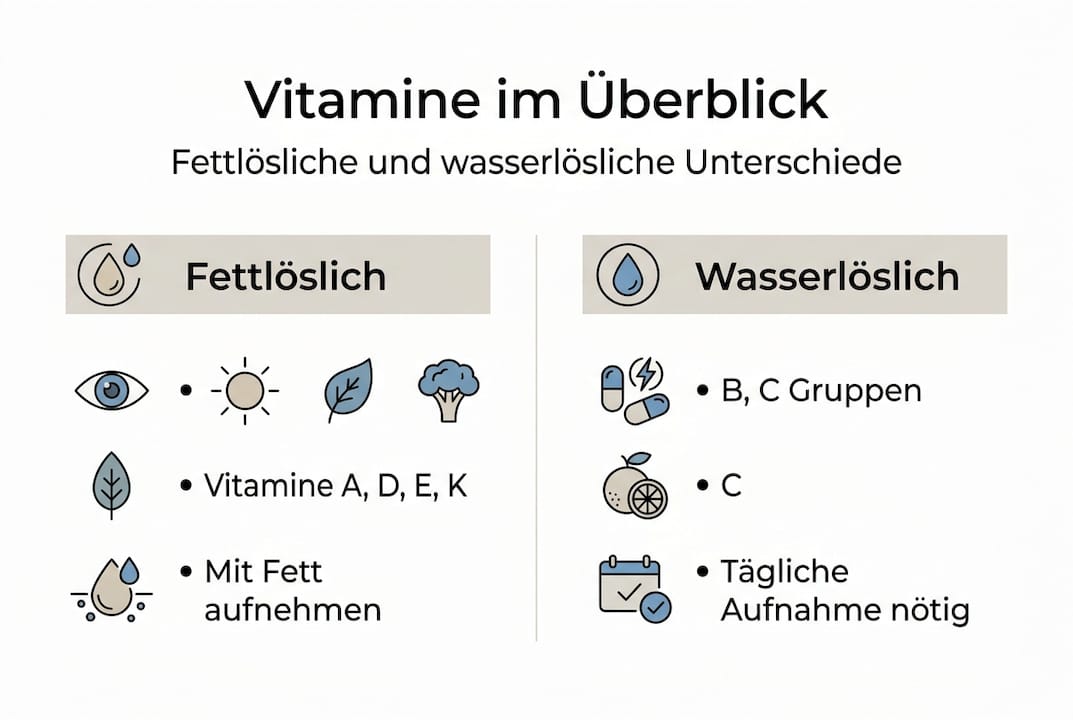
With water-soluble vitamins, the risk of overdose through a normal diet is practically nonexistent. The body simply excretes excess amounts. But this also means that anyone who eats little fruit, legumes, or whole-grain products can quickly develop a deficiency without noticing. Possible vitamin deficiency symptoms such as fatigue or concentration problems are then often attributed to other causes.
Particularly critical: Although vitamin B12 is water-soluble, it is stored in the liver. Deficiency therefore often develops only after years, making diagnosis more difficult. Anyone who wants to specifically address nutrient deficiencies should start here.
Important characteristics of fat-soluble vitamins:
- Vitamin A: Overdose through supplements is possible, but unlikely from food
- Vitamin D: Deficiency is widespread; supplementation is often advisable
- Vitamin E: Antioxidant effects; excessive intake inhibits blood clotting
- Vitamin K: Important for blood clotting and bones; interacts with blood thinners
Pro tip: If you take fat-soluble vitamins as supplements, always combine them with a meal containing healthy fats. Avocado, nuts, or high-quality vegetable oil can significantly improve absorption. For BZfE vitamins, there are clear recommendations regarding dosages and timing.
The Most Important Vitamins and Their Scientifically Proven Functions
Not all vitamins are equally critical. Some deficiencies are rare in Switzerland, while others affect a significant portion of the population. Here are the seven most important vitamins and their core functions:
- Vitamin D: Calcium absorption, bone formation, immune regulation. Deficiency is common in Switzerland and Northern Europe, especially during winter.
- Vitamin B12: Blood formation, nerve function, DNA synthesis. Critical for vegans and older adults.
- Vitamin C: Immune defense, collagen production, antioxidant protection. Current research shows benefits beyond cold prevention.
- Folate (B9): Cell division, DNA repair, particularly important during pregnancy.
- Vitamin A: Vision, immune system, skin regeneration.
- Vitamin E: Cell protection, anti-inflammatory effects, vascular health.
- Vitamin K: Blood clotting, bone health, interaction with vitamin D.
| Vitamin | Main function | Deficiency symptoms | Risk of overdose |
|---|---|---|---|
| D | Bones, immune system | Fatigue, infections, bone pain | Possible with supplements |
| B12 | Nerves, blood formation | Exhaustion, tingling, concentration problems | Very low |
| C | Immune defense, collagen | Impaired wound healing, susceptibility to infection | Low (diarrhea with megadoses) |
| Folate | Cell division, DNA | Anemia, developmental disorders | Low |
| A | Vision, skin | Night blindness, dry skin | High with supplements |
Fact check: B vitamins regulate energy metabolism, the nervous system, blood formation, and homocysteine breakdown. Vitamin B12 is particularly essential for vegans and vegetarians, as it occurs almost exclusively in animal products.
A frequently underestimated risk: Taking high doses of vitamin A as a supplement can cause hypervitaminosis, which damages the liver, bones, and nervous system. This is practically impossible from natural foods. Therefore: Supplements are not a substitute for nutrition, but a targeted addition when a need has been confirmed.
Anyone who wants to recognize signs of vitamin D deficiency early should not wait for symptoms. And anyone researching vitamin B12 nutrition will quickly realize that plant-based sources are not sufficient for reliable intake.
Individual factors and synergies: What Personalization Really Means for Vitamins
Standard recommendations such as “200 mg of vitamin C daily” or “800 IU of vitamin D” are averages. They are based on studies involving large population groups and say little about what your body actually needs. Genetic variants, gut health, medications, stress, and age can significantly alter individual requirements.
A specific example: People with a variant in the MTHFR gene may have difficulty converting folate into its active form. The standard folate recommendation is then insufficient. Those who are unaware of this may take supplements for years without any effect.
When blood tests are truly useful:
- 25-OH vitamin D: Gold standard for assessing vitamin D status, particularly in autumn and winter
- Vitamin B12 and holotranscobalamin: Early detection of a functional B12 deficiency
- Serum or red blood cell folate: Particularly relevant for women planning to have children
- Homocysteine: Indirect marker of B12, B6, and folate status
- Ferritin and complete blood count: Supplementary tests, as iron deficiency can exacerbate vitamin deficiencies
For personalized nutrition in Switzerland, experts recommend regular blood tests (25-OH-D, B12, folate). A balanced diet covers basic needs; supplements are useful when a deficiency has been confirmed, such as vitamin D in winter or B12 with a vegan diet.
Synergies between vitamins are particularly interesting: Vitamins D and K2 work together to support bone health and protect blood vessels. Vitamins B9 and B12 jointly regulate homocysteine levels, a risk factor for cardiovascular disease and dementia. Anyone who supplements only one of these vitamins is missing out on their potential.
Pro tip: Have your vitamin D level tested in October, before the winter season begins. This way, you know exactly whether and how much you need to supplement instead of taking a standard dose across the board. Anyone who wants to identify a vitamin B12 deficiency should have holotranscobalamin tested, not just their total B12 level. And anyone suffering from unexplained fatigue should also have iron and vitamin B12 deficiency assessed together, as both deficiencies can exacerbate each other.
When supplements are truly indicated: in cases of a deficiency confirmed by a blood test, for specific risk groups (vegans, pregnant women, older adults, people with malabsorption), and seasonally for vitamin D in Switzerland. Not as a precaution based on guesswork.
Our Perspective: What Really Matters in Everyday Life and What Is Often Forgotten
After years of working with thousands of health analyses, one thing becomes clear time and again: Most people know that vitamins are important. But that knowledge remains abstract. Concrete action often follows only when symptoms become noticeable, and by then valuable time has been lost.
Common dietary recommendations are too general. They were developed for population averages, not for you as an individual. Anyone with genetic differences, an altered gut, or a stressful daily routine needs a different strategy from the average person.
Another blind spot: Many people take supplements speculatively without ever having had a test. This is not only inefficient but also risky with fat-soluble vitamins. Self-medication without a data-based foundation is not health optimization; it is guesswork.
Our clear assessment: Anyone who truly wants to optimize their vitamin intake should start with a blood test, not with buying supplements. Those who recognize and understand their own signs of vitamin deficiency can act strategically instead of blindly. Seasonal, situational, and genetically tailored nutrition is not a luxury but modern health management.
Personalized Action Made Easy: Your Path to Optimal Nutrition
If you want to know where your vitamin status really stands, the mybody®x analyses provide a direct, scientifically sound answer. With ISO-certified laboratory tests using a convenient at-home sample, you receive precise results for vitamin D, B12, folate, and other micronutrients, including personalized recommendations for nutrition and supplementation. No guesswork, no one-size-fits-all approach. Especially practical: The test to detect vitamin D deficiency provides clear values and shows whether and how much you should supplement. With more than 11,300 satisfied customers and a rating of 4.77 stars, mybody®x is your reliable partner for evidence-based health optimization.
Frequently Asked Questions About Vitamins
Do You Need to Supplement Vitamin D in Switzerland in Winter?
In Switzerland, sunlight from October to March is insufficient to produce enough vitamin D. Vitamin D deficiency affects 50 to 80 percent of the population in Germany and Switzerland during winter, which is why experts recommend targeted supplementation based on a blood test.
Which Vitamins Are Particularly Critical for Vegans?
Vitamin B12 is the most critical vitamin for a vegan diet because it is found almost exclusively in animal products. B12 is essential for vegans and must be regularly supplemented or monitored through blood tests.
How Can I Detect a Vitamin Deficiency Early?
Early deficiency symptoms are often nonspecific: fatigue, susceptibility to infections, skin problems, or difficulty concentrating. Since vitamins are essential for many bodily functions, deficiency signs vary greatly depending on the vitamin affected, which is why a blood test remains the most reliable method.
Is Excessive Intake of Water-Soluble Vitamins Dangerous?
For most water-soluble vitamins, the body simply excretes excess amounts. Vitamin B6 is an exception: According to the BfR maximum level recommendations, consistently high doses of more than 200 mg per day can cause nerve damage.
How Can I Use Synergies Between Vitamins?
Vitamins D and K2 work together to support bones and blood vessels, while B9 and B12 work together to regulate homocysteine metabolism. These synergies between vitamins can be used most effectively when individual needs are known through blood tests.
Recommendation
- What Is a Nutrient? Simply Explained for Your Health – mybody®x
- Your Vitamin B Test for More Energy and Well-Being – mybody®x
- When Should You Take Vitamin D – in the Morning or Evening? – mybody®x
- Vitamins and Minerals - How They Improve My Well-Being in the Long Term – mybody®x
- Refresh Your Life | Salzkammer - Refresh Your Life



Share now:
Hormone level test types: Which method is right for you?
Determine your health type: 5 steps for nutrition & well-being