
No weight loss despite dieting: The real reasons and what actually helps
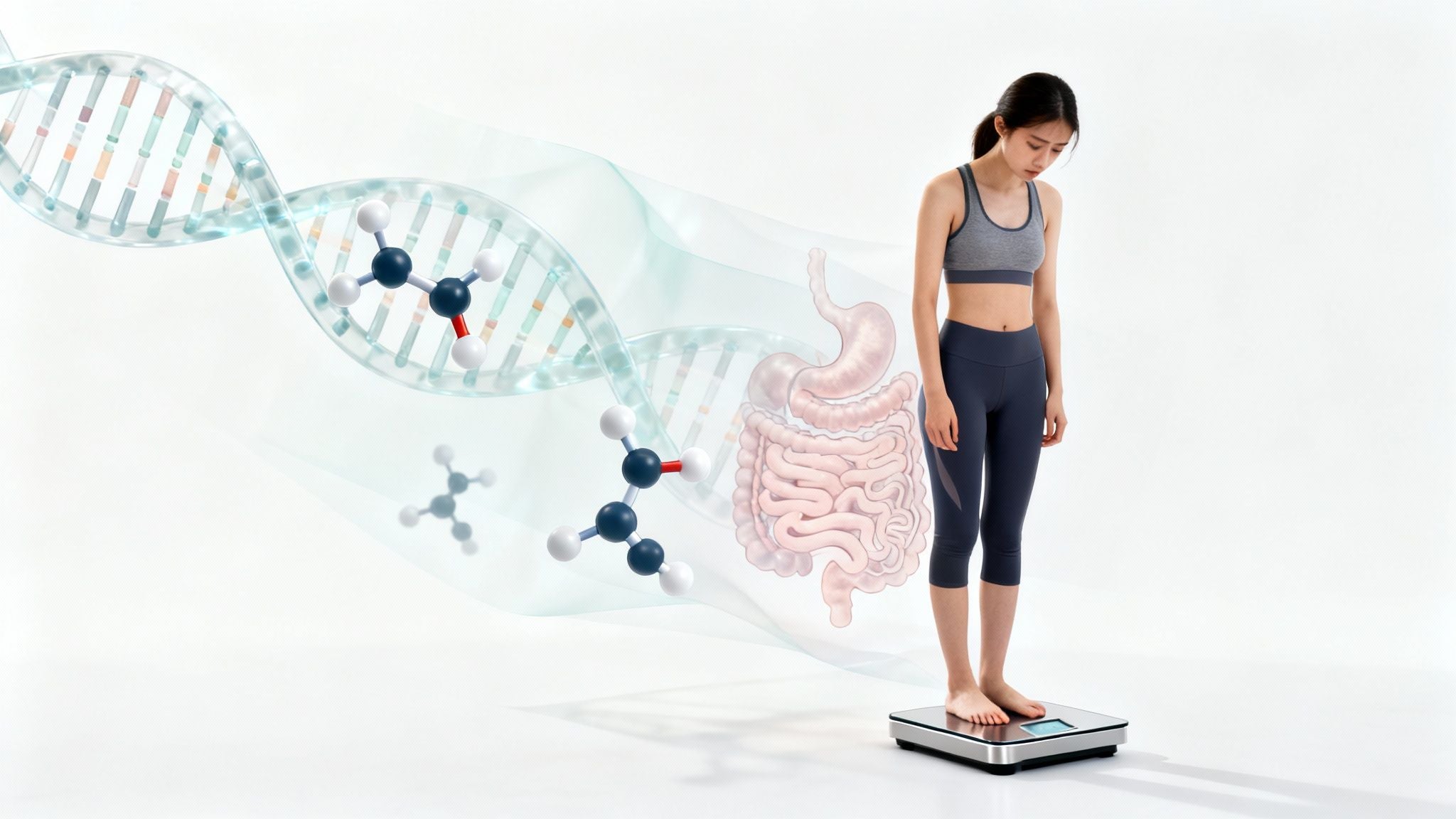
You stick rigorously to your nutrition plan, count calories, stay active regularly—and still, absolutely nothing changes on the scale. This standstill is not only maddening but also a fairly common phenomenon. Its causes often lie much deeper than you might think and rarely have anything to do with a lack of willpower. Usually, they are invisible biological processes in your body that are blocking your progress.
When the scale does not budge despite your best efforts

Almost everyone who has ever wanted to lose weight knows this feeling all too well. You give it your all, make sacrifices, work up a sweat—and the number on the scale does not budge. Such a weight-loss plateau can be extremely discouraging and quickly lead you to doubt yourself and your efforts. But the truth is: Your body is not a simple calculating machine.
The simple formula “eat less, move more” often falls short. Your body is a highly complex system that constantly tries to maintain its internal balance. It responds to reduced calorie intake with clever adaptation mechanisms that once ensured our survival.
Why your body resists weight loss
Your metabolism is a true master of efficiency. If you give it less energy than it is used to for an extended period, it switches into a kind of economy mode. In other words, it reduces energy expenditure to protect its valuable reserves. This process, known as metabolic adaptation, is one of the most common reasons why weight loss stops despite dieting.
But that is not all. Other invisible factors also play a crucial role:
- Hormonal antagonists: Stress hormones such as cortisol can specifically promote fat storage. An imbalance in thyroid or sex hormones can bring your entire metabolism to a standstill.
- The power of your gut: Your microbiome—the vast community of bacteria in your gut—has a direct influence on how efficiently you process nutrients and how your feeling of fullness is regulated.
- Hidden nutrient deficiencies: If your body lacks important vitamins or minerals such as iron or vitamin D, your metabolic engine simply cannot run smoothly.
You are not alone with this problem. Statistics show that countless people struggle with very similar challenges, and standard diets often fail to deliver the hoped-for, sustainable results. This is a clear sign that we need individualized solutions.
This table gives you a quick overview of the most common causes of a weight-loss plateau and presents initial possible solutions.
Quick check: Possible reasons for your weight-loss plateau
| Symptom or observation | Possible cause | First possible solution |
|---|---|---|
| Constant tiredness and lack of energy | Metabolic adaptation or nutrient deficiency | Slightly increase calorie intake and deliberately choose nutrient-rich foods. |
| Cravings for sweet or salty foods | Hormonal imbalance (e.g., cortisol) | Manage stress (yoga, meditation) and ensure adequate sleep. |
| Digestive problems such as bloating | Microbiome imbalance | Incorporate probiotic foods (yogurt, kefir) and fiber. |
| No muscle gain despite exercising | Insufficient protein intake | Review the protein content of your meals and adjust it if necessary. |
These points are, of course, only initial indications. Often, the solution lies in a combination of different measures tailored precisely to you.
The key lies in personalization
This insight is the first step out of the frustration trap. Instead of working even harder against your body, the goal is to understand it and cooperate with it. Once you know the real reasons for your lack of progress, you can finally take targeted, genuinely effective action.
This is precisely where modern analyses come in. A personalized approach that goes far beyond simply counting calories can provide the answers you have been looking for so long. You can also find out how to lose weight healthily without putting your body into a permanent fight-or-flight mode in our further guide.
The six most common biological obstacles to weight loss
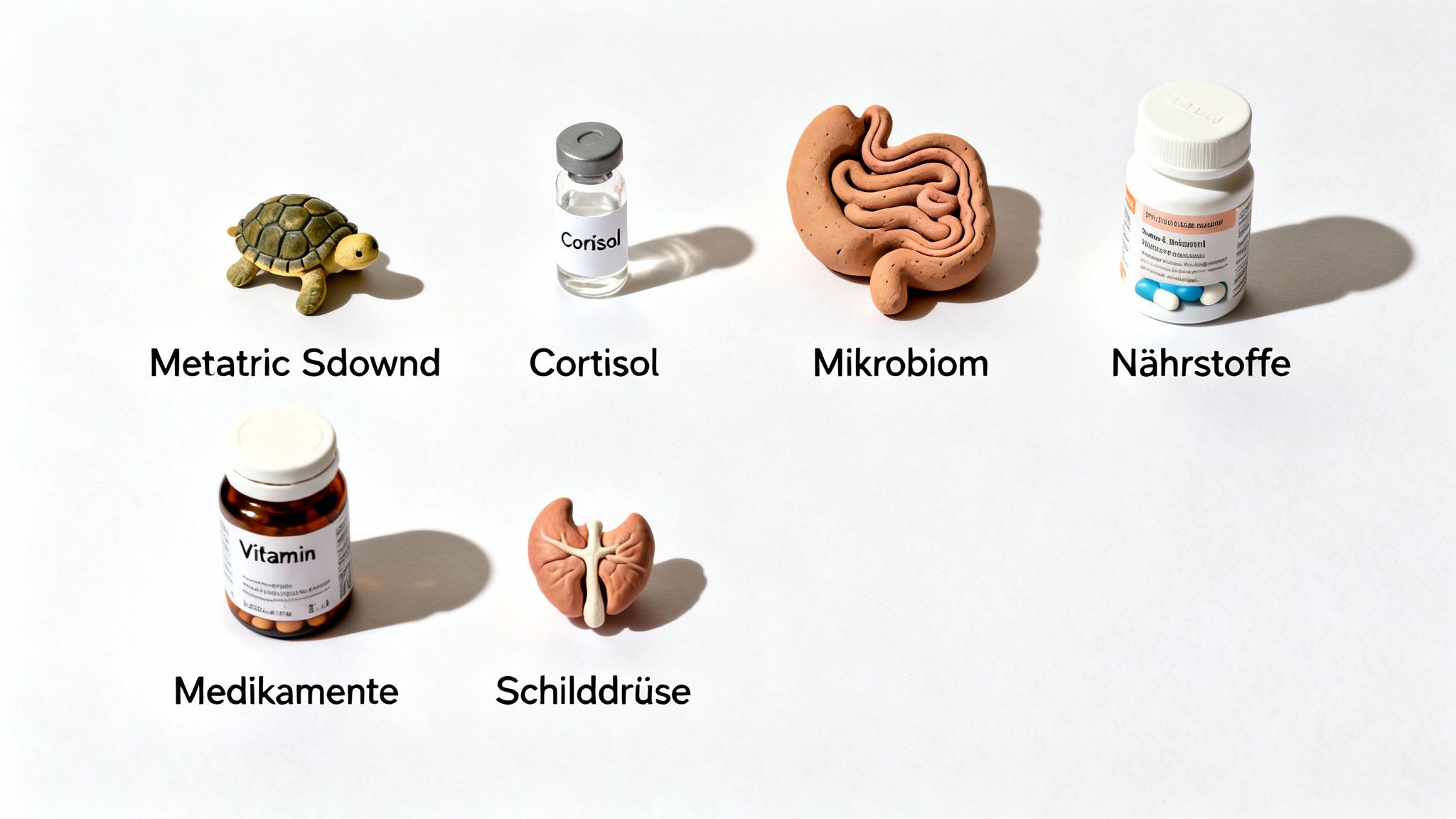 When the number on the scale stops changing despite ironclad discipline, it is rarely due to a lack of effort. Much more likely, your body is putting on the brakes for a good reason. Let’s take a closer look at these invisible obstacles, because you can only take targeted action against them once you understand them.
1. Metabolic adaptation: Your body in energy-saving mode
Think of your metabolism as a clever accountant. As soon as it notices that less energy (that is, calories) has been coming in over an extended period, it reacts immediately. It lowers your basal metabolic rate to use the available resources as efficiently as possible.
This protective mechanism, also known as adaptive thermogenesis, was vital for survival throughout evolution. Today, however, it often leads to the frustrating plateau on the scale because your body simply burns fewer calories than it did before the diet.
2. Your Hormonal Imbalance as a Weight-Loss Barrier
Hormones are the conductors of your metabolism. When they fall out of sync, fat burning also grinds to a halt. Three key players are particularly often in the spotlight:
- Cortisol: The stress hormone switches your body into “fight-or-flight” mode. Chronically elevated levels—whether due to pressure at work or personal stress—specifically promote the storage of belly fat and increase your appetite for quick, unhealthy energy.
- Insulin: This hormone regulates your blood sugar level. A diet high in sugar and processed carbohydrates can lead to insulin resistance. This means your cells no longer respond properly to insulin. The result: sugar is no longer transported efficiently into the cells and is instead increasingly stored as fat.
- Thyroid hormones: The thyroid is essentially the accelerator of your metabolism. With an underactive thyroid (hypothyroidism), the entire body runs on low power. Fatigue, sensitivity to cold, and persistent weight gain are typical signs. Learn more about the right diet for hypothyroidism in our guide.
Hormonal disorders such as PCOS in particular can completely prevent successful weight loss. Find out here which foods can help with PCOS.
3. The Role of Your Gut Microbiome
Trillions of bacteria live in your gut and have a huge impact on your weight. A healthy, diverse gut microbiome helps you make optimal use of nutrients, produces important vitamins, and even regulates your feelings of hunger and fullness.
A disrupted gut microbiome (dysbiosis), on the other hand, can have exactly the opposite effect. Certain bacterial strains are known to extract more calories from food and promote low-grade inflammation in the body—both of which make weight loss considerably more difficult.
Your body is unique. Your genetics largely determine how your metabolism responds to different nutrients, how quickly you feel full, and how efficiently you burn fat. Standard diets cannot take this individual predisposition into account.
4. Unnoticed Nutrient Deficiencies
Your metabolism depends on a whole range of vitamins and minerals to operate at full capacity. When important building blocks are missing, the engine sputters—often without you noticing it directly.
The most critical ones are:
- Iron: Essential for transporting oxygen in the blood and therefore for energy production in every single cell.
- Vitamin D: Plays a key role in hormone regulation and insulin sensitivity.
- Magnesium: Involved in more than 300 metabolic processes, including energy production.
A deficiency in these micronutrients is like driving with the handbrake on. You simply cannot get moving properly.
5. Medications as hidden drivers of weight gain
Sometimes medications also sabotage your progress on the scale without you realizing it. Certain active ingredients can slow down your metabolism, increase your appetite, or cause water retention. These include some antidepressants, corticosteroids, beta blockers, and even the birth control pill. If you suspect this may be the case, be sure to discuss it with your doctor.
6. Genetic predisposition and individual differences
Why does your friend lose weight effortlessly on the same diet while nothing happens for you? The answer often lies in your genes. Research agrees: lasting weight-loss success depends heavily on individual factors.
In fact, they fail 59 % to maintain their weight over the long term because blanket approaches completely ignore their unique biology. Standard diets simply do not take into account which genetic variants control your basal metabolic rate, fat burning, or sense of satiety.
This is exactly where modern analyses such as mybody® DNA metabolism tests come in. They decode your personal genetic predisposition and make it possible to create a plan that truly suits your body—not an average person.
Tracing the causes with modern diagnostics
When you reach a point where the scale simply refuses to budge despite all your efforts, it is time to stop guessing. Instead of continuing to speculate about why your body is not responding, you can now draw on solid, data-based insights. Modern diagnostic tests offer an in-depth look at your biology to uncover the real reasons behind your weight-loss plateau.
Instead of following blanket diet rules that may not work for you at all, you can finally understand what your body really needs. This allows you to replace frustration with facts and adjust your strategy in a targeted and effective way.
Your genetic blueprint as the key to success
Every person is unique—and this applies especially to metabolism. What produces great results for one person may be completely ineffective for you. The reason often lies deep within your DNA. A mybody® DNA metabolism test deciphers your personal genetic code and provides the crucial answers.
A test like this is simple to perform at home using a saliva sample and analyzes the genes that primarily control your metabolism. You will find out specifically:
- Your metabolic type: Does your body react more sensitively to carbohydrates or fats? The test shows you in black and white which macronutrient distribution is optimal for you to burn fat effectively.
- Your individual response to exercise: Are you genetically more of an endurance or strength type? Some people benefit much more from long-distance running, while others build muscle faster through targeted strength training.
- Your sense of hunger and fullness: Are you naturally prone to cravings, or do you have a less pronounced feeling of fullness? With this knowledge, you can finally understand and manage your eating behavior more effectively.
These insights form the basis for a diet that really suits you. You no longer waste time on approaches that are not the best fit for your body from the outset.
Your gut as a secret ally when losing weight
Your gut microbiome is an extremely powerful factor when it comes to your weight. The composition of your gut bacteria helps determine how many calories you extract from food, how strong your immune system is, and even how you are feeling.
A microbiome analysis provides you with a detailed picture of your gut flora. Using a simple stool sample, you can find out whether your gut bacteria are supporting you in losing weight or perhaps even unknowingly holding you back.
Dysbiosis—in other words, an imbalance in the gut—can promote low-grade inflammation in the body and block the absorption of important nutrients. Both are factors that can make weight loss significantly more difficult.
The test shows you exactly which bacterial strains predominate in your gut and gives you specific recommendations for rebalancing your gut flora through a targeted diet with prebiotic and probiotic foods.
Targeted nutrient and hormone checks
Sometimes the reason for being stuck is an invisible deficiency or a hormonal imbalance. But before you start taking random supplements, a targeted analysis is the only sensible approach.
- Nutrient checks: A simple blood test (often a small finger prick is sufficient) can reveal deficiencies in key metabolic helpers such as vitamin D, iron, magnesium, or B vitamins. If there is a deficiency, your metabolic engine runs only on low power.
- Hormone tests: Particularly if you experience signs such as chronic stress, sleep problems, menstrual irregularities, or extreme fatigue, a hormone test can provide clarity. For example, a daily cortisol profile from saliva can show whether your stress level is chronically elevated. Checking thyroid levels (TSH, fT3, fT4) with a doctor is also often an important step.
Each of these tests is a tool that helps you better understand your body. If you would like to learn more about how a detailed analysis works, you will find valuable information in our guide to metabolic analysis and the available tests. With this scientifically backed data, you can finally identify the blockages and put your weight-loss journey on a solid, personalized foundation.
Your strategy for breaking through the stagnation trap
With knowledge of the possible biological blockages, you are now well equipped to finally take countermeasures. Instead of blindly carrying on, you can now develop a targeted strategy tailored to your body. It is about acting smarter, not dieting harder.
We focus on four key pillars that work together and significantly influence your success: nutrition, exercise, sleep, and stress management. Each of these areas offers levers you can adjust to overcome your plateau.
Optimize your diet beyond calorie counting
Simply counting calories often leads you astray, especially when your metabolism has already adapted. Your focus should shift from quantity alone to the quality and composition of your food.
A crucial step is to tailor your diet to your individual metabolic type. As the mybody® DNA analyses show, not every body processes carbohydrates, fats, and proteins with the same efficiency. Perhaps you respond better to a diet higher in fat and protein, while a carbohydrate-heavy diet is unknowingly hindering your progress.
Practical tip: Increase the nutrient density of your meals. Focus on unprocessed foods such as vegetables, high-quality protein sources (fish, legumes, lean meat), and healthy fats (avocado, nuts, olive oil). These provide not only energy but also the vitamins and minerals your metabolism urgently needs.
This infographic visualizes the process of investigating the causes, helping you make data-driven decisions about your health.
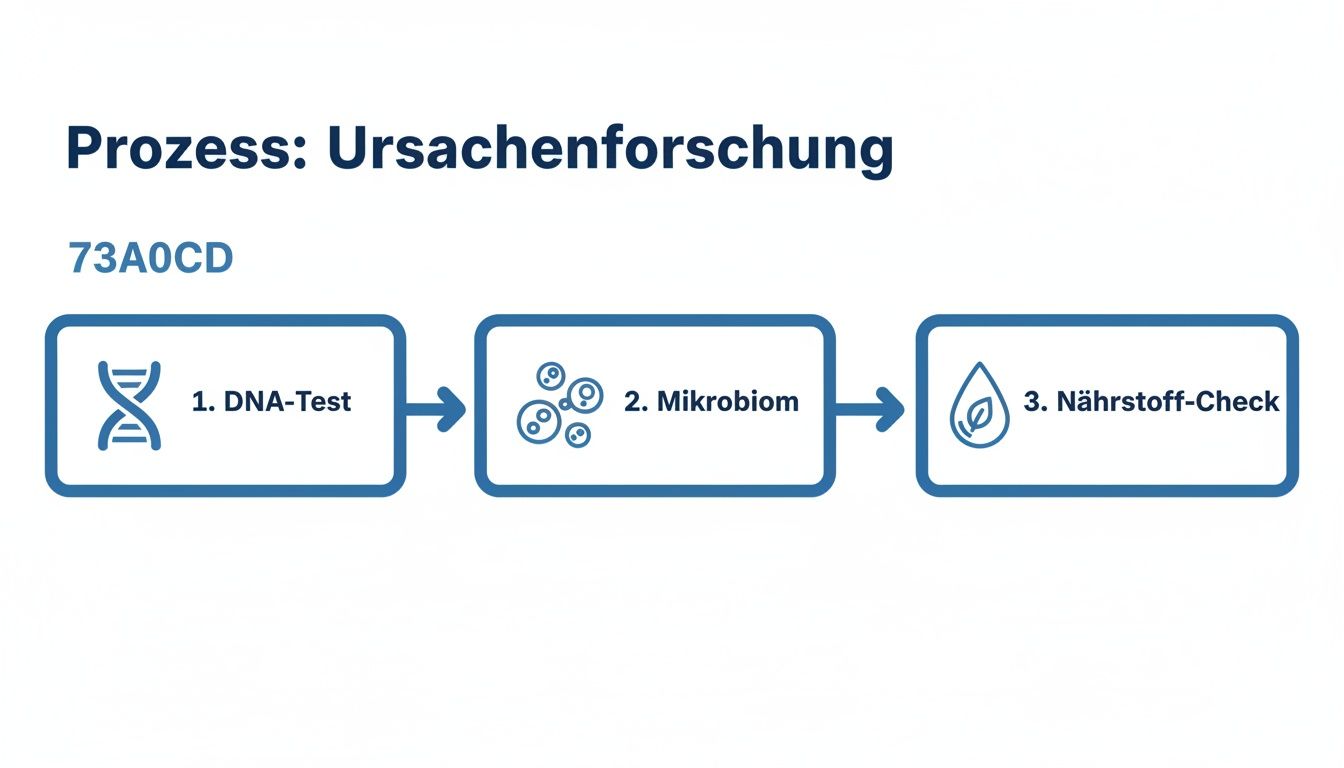
The illustration shows how modern tests such as DNA analyses, microbiome checks, and nutrient tests can give you a clear picture of your body’s internal processes. Instead of guessing, you get facts to work with.
Smart training instead of hours of cardio
Hours of endurance training can further raise cortisol levels in an already stressed body and even intensify metabolic adaptation. A smart combination of strength and endurance training is much more effective here.
Strength training is your most important ally in the fight against a plateau. Why?
- It builds muscle: More muscle means a higher basal metabolic rate. Your muscles are like small power plants that burn energy even at rest.
- It improves insulin sensitivity: Your muscles learn to absorb sugar from the blood more efficiently, which reduces fat storage.
- It shapes your body: Even if the number on the scale temporarily stalls, you can still see progress in the mirror because your body composition is improving.
Combine two to three strength-training sessions per week with short, intense cardio sessions (HIIT) or moderate activity such as brisk walking. This combination boosts your metabolism without placing additional strain on your body. To take an even more targeted approach and boost your metabolism naturally, you’ll find more valuable tips and scientific background in our guide.
The underestimated power of sleep
Sleep deprivation is a real saboteur of any weight-loss effort. When you sleep too little or poorly, your hormonal balance gets completely disrupted.
Even a single night of poor sleep can cause your body to produce more ghrelin (the hunger hormone) and less leptin (the satiety hormone) the next day. The result: You feel hungrier, especially for high-energy, unhealthy foods, and your feeling of fullness sets in later.
In addition, sleep deprivation raises cortisol levels, which in turn promotes fat storage around the abdomen. So don’t view sleep as a luxury, but as a fundamental building block of your strategy.
Tips for better sleep:
- Create a routine: Try to go to bed and get up at roughly the same time every day, including weekends.
- Optimize your sleep environment: Make sure your room is cool, dark, and quiet.
- Avoid blue light before bed: Put away your smartphone and tablet at least one hour before going to bed.
- Avoid heavy meals in the evening: Give your digestive system time to wind down.
Active stress management for cortisol control
Chronic stress is one of the most common reasons for a weight plateau, yet it is often overlooked. Persistently elevated cortisol levels signal to your body that it should save energy for hard times—in the form of fat.
Active stress management is therefore not merely a wellness measure, but a targeted tool to regulate your hormones and enable fat burning again.
You don't have to overhaul your entire life. Even small, regular practices can make a big difference:
- Breathing exercises: Take just three minutes several times a day to practice deep abdominal breathing. Inhale for four seconds, hold your breath briefly, and slowly exhale for six seconds.
- Exercise in nature: A 20-minute walk outdoors has been shown to lower cortisol levels.
- Mindfulness and meditation: Apps like Headspace or Calm offer guided meditations for beginners that take only a few minutes.
- Schedule time for yourself: Schedule dedicated time for yourself in your calendar—whether for a bath, a good book, or a hobby.
By taking a holistic approach to these four pillars—nutrition, exercise, sleep, and stress management—and adapting them to your individual needs, you can break the cycle of dieting and frustration. You finally work with your body instead of fighting against it.
When it's time to seek professional help
You've fine-tuned your diet, changed your workout routine, sleep like a baby, and have your stress levels under control—but the scale? It doesn't budge an inch. Does this sound familiar? If you've reached a point where you feel you've truly tried everything and nothing is happening, it's time to dig deeper.
Sometimes self-optimization simply isn't enough. A stubborn plateau can be a clear signal from your body that something underlying needs to be professionally assessed. Taking this step is not a failure. On the contrary, it is a sign of genuine self-care.
Listen to your body's warning signals
Your body is smarter than you think. It often sends subtle but clear signals when your internal balance is disrupted. In addition to your weight plateau, are you experiencing one or more of the following symptoms? Then you should pay close attention:
- Exhaustion: Despite getting enough sleep, you are constantly tired and simply lack energy.
- Severe mood swings: You feel irritable, anxious, or down without any apparent reason.
- Hair loss: Your hairbrush suddenly has more hair in it than usual.
- Menstrual irregularities: Your period is irregular, extremely painful, or even stops altogether.
- Persistent cold sensitivity: Even in warm rooms, your hands and feet are constantly cold.
- Skin problems: Your skin suddenly becomes dry or dull, or you develop new blemishes.
These are not minor issues that should simply be ignored. They may point to medical causes that directly slow down your metabolism and therefore prevent you from losing weight.
Possible medical causes that may be preventing you from losing weight
There are a number of conditions that can slow your metabolism so significantly that losing weight becomes a real uphill battle. If all your efforts are getting you nowhere, it makes perfect sense to discuss these possibilities with your doctor.
A doctor’s visit provides clarity and ensures that no undiagnosed condition is sabotaging your progress. This allows you to replace vague suspicions with solid facts and lays the foundation for a targeted solution.
The most common medical “weight-loss brakes” include:
-
Hypothyroidism: Think of the thyroid as the accelerator pedal of your metabolism. If it produces too few hormones, your entire body runs on low power. A simple blood test (TSH, fT3, fT4) can quickly provide clarity.
-
Insulin resistance: This is when your cells no longer respond properly to the hormone insulin. Sugar is transported into the cells less effectively and is instead increasingly stored as fat—especially around the abdomen. This is often a precursor to type 2 diabetes.
-
Polycystic ovary syndrome (PCOS): A common hormonal disorder in women of childbearing age. It is often associated with insulin resistance, irregular cycles, and an excess of male hormones—a combination that makes weight loss considerably more difficult.
-
Chronic stress and exhausted adrenal glands: Persistently elevated cortisol levels can completely disrupt your metabolism and promote fat storage, especially around the midsection.
Tests that may be useful at the doctor’s
A good doctor will take your symptoms seriously and begin a thorough diagnostic evaluation. The conversation about your lifestyle, diet, and specific symptoms is the starting point. Based on this, various tests can help shed light on the situation:
- Complete blood count: This involves more than just standard values. Important markers include thyroid hormones, blood sugar and insulin levels (the HOMA index to check for insulin resistance), inflammatory markers, and critical nutrients such as iron (ferritin), vitamin D, and B12.
- Hormone panel: Depending on your symptoms, testing your sex hormones (for women) or a daily cortisol profile may provide useful insights.
- Ultrasound: An examination of the thyroid or ovaries (if PCOS is suspected) can confirm the diagnosis.
Don’t hesitate to seek this support. A doctor or specialized therapist can help you uncover the true causes and set you on a new path. It’s about your body and your health—and you deserve the best possible help to finally achieve your goals.
Frequently asked questions about a weight-loss plateau
Here, we answer some of the most pressing questions we keep receiving about “not losing weight despite dieting.” We’ll lay out the key points and give you clear, understandable answers to help you break out of this plateau.
Why am I gaining weight even though I’m in a calorie deficit?
This phenomenon is extremely frustrating and usually has several causes that reinforce one another. An apparent calorie deficit is often an illusion—calorie information on foods and your calculated energy expenditure are unfortunately often inaccurate.
At the same time, your body adapts to the lower energy intake. Through what is known as metabolic adaptation, it lowers your basal metabolic rate to conserve energy. So you suddenly burn fewer calories than you did at the beginning of your diet.
Hormones also play a huge role. Chronic stress raises your cortisol levels, which can promote water retention. This can mask actual fat loss on the scale. At the same time, unnoticed insulin resistance can effectively block fat burning. Your body essentially becomes a master at storing energy instead of releasing it.
The crucial point: Often, it’s not your discipline but your individual biology. Your body may respond to nutrients very differently than you think—something no standard calorie calculator in the world can take into account.
Here, a mybody® DNA metabolism test can provide the crucial insight. It shows you how efficiently your body actually uses energy and which ratio of carbohydrates, fats, and proteins is genetically optimal for you. This way, you can turn a perceived deficit into a real, effective deficit.
How long can a weight-loss plateau last?
This varies greatly and can range from a few weeks to several months. The duration depends largely on what is really behind it.
Short plateaus lasting one or two weeks are often harmless. They are usually just natural fluctuations, for example due to water retention after intense training or hormonal changes during your cycle.
However, if the plateau lasts longer than four to six weeks, this usually points to deeper causes. Your metabolism may have adapted, there may be unnoticed nutrient deficiencies, or hormonal imbalances may be slowing you down. The important thing now is not to give up in frustration. See it as a signal to rethink your strategy and make targeted adjustments.
Which test is right for me if my weight has plateaued?
Choosing the right test depends entirely on your individual symptoms and your suspicions. There are various ways to get to the bottom of the causes:
- The mybody® DNA metabolism test is an ideal starting point. It reveals the genetic basis of your metabolism and gives you a clear roadmap for your optimal diet and the right training. It answers the question of how your body fundamentally works.
- A microbiome analysis is particularly informative if you also suffer from digestive problems such as bloating, a weakened immune system, or cravings. It shows whether your gut flora is supporting you or sabotaging you behind the scenes.
- A hormone test (e.g., a cortisol daily profile from saliva) makes sense if you suffer from severe stress, sleep disorders, or menstrual irregularities. It can reveal whether stress hormones are blocking your fat burning.
These tests do not replace a medical diagnosis, but they provide valuable, personalized data. This allows you to finally replace guesswork with facts and take targeted measures that really work.
Do you finally want to know why your body is resisting weight loss and which strategy is truly right for you? At mybody® Lab GmbH, you’ll find scientifically sound analyses that help you understand your body and achieve your health goals sustainably. Discover the right tests for you now at https://mybody-x.com.



Share now:
What to eat for iron deficiency – Personalized nutrition tips
Your perfect Valentine’s Day menu for an unforgettable evening