

Metabolic Type Test: Find out how your body really works
A metabolic type test is essentially an analysis that reveals how your body processes nutrients such as carbohydrates, fats, and proteins in its own unique way. Imagine finally discovering which “fuel” is best for your personal engine, helping you reach your comfortable weight and get through the day full of energy.
Why you should know your metabolic type
Do you sometimes wonder why the latest trendy diet works wonders for your friend, while the number on the scale simply refuses to budge for you? You are not alone. Many of us try one eating plan after another, count calories, and push ourselves at the gym—often with frustratingly little success.
The reason is usually simpler than you think: Your body is unique. What works for one person may not be right for you at all. Your metabolism is like a personal fingerprint—shaped by your genes, your hormones, and your lifestyle. A one-size-fits-all diet completely ignores this individuality.
Your personal blueprint for nutrition and fitness
Knowing your metabolic type is the crucial key to breaking out of this cycle of trial and error. It gives you a kind of user manual for your own body.
Imagine knowing exactly:
- Which nutrients truly give you energy and which ones tend to leave you feeling sluggish.
- Whether your body uses fats or carbohydrates more effectively as its primary energy source.
- Which type of exercise is most effective for you—long endurance training or more intense strength training?
A scientifically grounded metabolic type test provides you with exactly these answers. It analyzes how your body is “programmed” at the genetic level, creating the foundation for a targeted and truly personalized nutrition strategy. You learn not only what you should eat, but finally understand why it works for you.
Knowing your metabolic type enables you to adapt your diet so that it works in harmony with your biology instead of against it. That is the difference between a constant struggle and effortless well-being.
Instead of continuing to try diets blindly, you can make informed decisions based on facts about your own body. This leads not only to more sustainable weight-management results, but also to noticeably more energy in everyday life and a better sense of well-being. If you would like to explore the topic in greater depth, you can learn more about the benefits of personalized nutrition in our article. Ultimately, it is about taking responsibility for your health and understanding your body as a partner, not an opponent.
What methods are available for metabolic testing
People exploring metabolic tests often feel overwhelmed at first. Different terms appear everywhere, and it is not easy to figure out which test really delivers what it promises. We will shed light on the subject and introduce the most common methods—clearly, understandably, and without any technical jargon.
Imagine that each test sheds light on your metabolism from a different perspective. Some look at your genetic predisposition, while others measure your current state. To make the right choice for you, you need to understand the differences.
The following infographic gets to the point: If diets keep failing, analyzing your metabolic type may be the crucial next step.
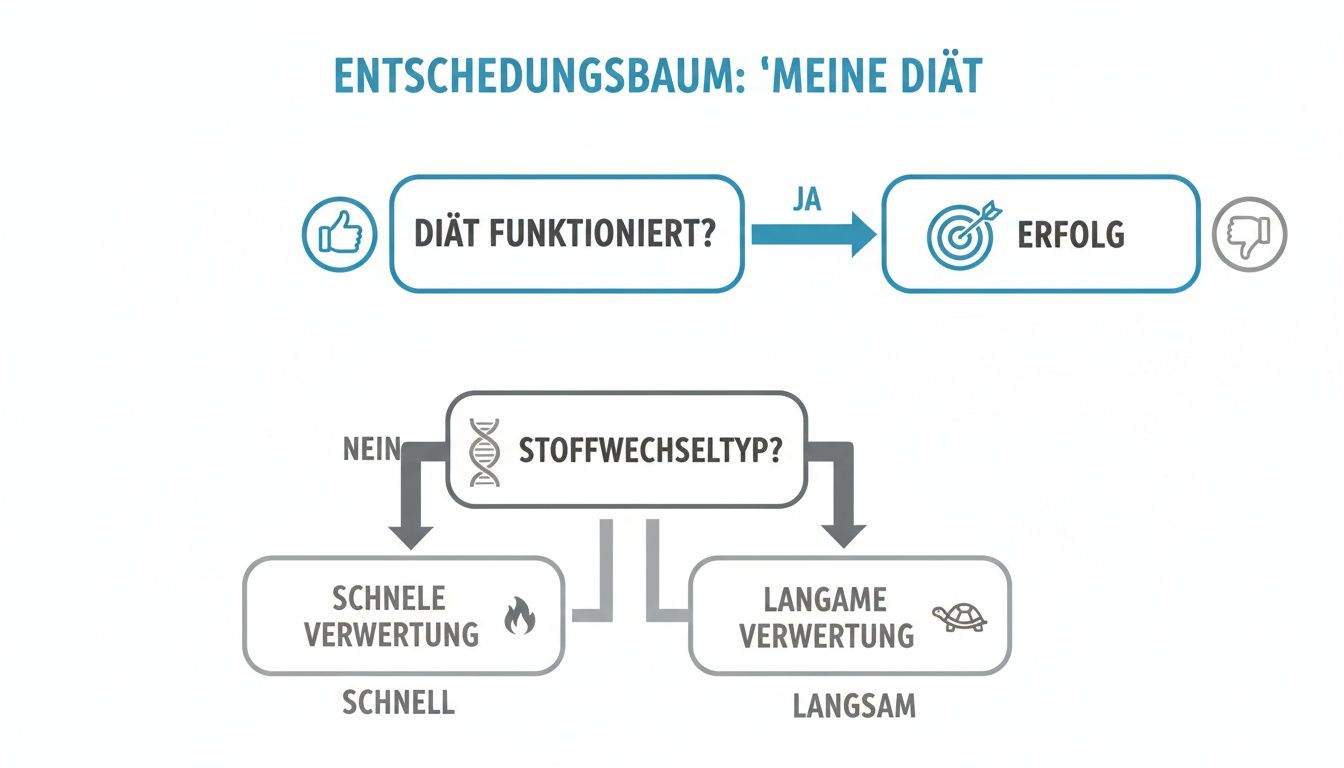
The diagram makes it clear: When a diet does not work, the solution is often not to try even harder. It is about taking a smarter approach and finally understanding your own biology.
DNA analyses: A look at your blueprint
A DNA-based metabolic type test is like looking at your body's manual. It takes a close look at specific gene variants that influence how you process fats, carbohydrates, and proteins. The result is a kind of lifelong compass for your diet.
The great thing about this method? Your genes do not change. The insights from such a test therefore give you a lasting foundation on which to build your diet and lifestyle. It is about using your genetic strengths and specifically compensating for potential weaknesses.
Blood tests: A snapshot of your body
Unlike DNA analysis, a blood test provides a snapshot of your current metabolic state. It measures biomarkers such as blood sugar, cholesterol levels, and certain hormones that play an important role in metabolism.
These tests are great for assessing how your current lifestyle affects you or for monitoring the success of a dietary change. They show what is happening in your body right now—but not what your genetic predisposition is.
Breath gas analysis: Measuring your basal metabolic rate
Breath gas analysis, also known as calorimetry, measures your exact calorie expenditure at rest. You simply breathe calmly into a special device for a few minutes, which analyzes your oxygen consumption and carbon dioxide production. This allows your individual basal metabolic rate to be determined with great precision.
The key advantage of this method is its accuracy. Instead of relying on generalized formulas, you learn your actual calorie needs—a huge help for targeted weight management.
However, this value is not set in stone. For example, if you build more muscle mass or change your habits, your basal metabolic rate can change. Therefore, repeating the measurement after some time may be useful.
Microbiome tests: The role of your gut microbiome
A newer but extremely informative method is analysis of your gut microbiome. We now know that our gut bacteria have an enormous influence on how we break down and utilize nutrients. A simple stool test can decode the composition of your gut microbiome and show whether an imbalance (dysbiosis) might be slowing down your metabolism.
You can use the results to specifically support your gut health with the right diet. This not only has a positive effect on your weight, but also on your digestion and overall well-being. It is becoming increasingly clear: A healthy gut is the foundation of a functioning metabolism.
Metabolic tests compared directly
To make your decision easier, we have compared the various methods in a table. This way, you can see at a glance which test might be best suited to your goals.
| Testing method | What is measured? | Significance | Ideal for |
|---|---|---|---|
| DNA analysis | Genetic predisposition for nutrient utilization | Lifelong foundation | Long-term, personalized nutrition strategy |
| Blood test | Current metabolic markers (sugars, fats, hormones) | Snapshot of your current condition | Monitoring lifestyle & dietary changes |
| Breath gas analysis | Oxygen consumption & CO2 output at rest | Precise, up-to-date basal metabolic rate | Targeted calorie management & weight loss |
| Microbiome test | Composition of gut bacteria | Influence of the gut microbiome on metabolism | Optimizing gut health & digestion |
So, each method has its strengths. While some provide a lifelong blueprint, others offer valuable snapshots of your body. mybody-x's holistic analyses often combine several of these approaches to give you a comprehensive picture of your health.
If you’d like to explore the topic in greater depth, take a look at our detailed guide to the different types of metabolic analyses.
The Science Behind the Metabolism Type Test
“Metabolism type”—does that sound a little like marketing hype or a passing trend to you too? That’s a perfectly valid question. The honest answer is: it depends entirely on what is meant by it. Science has advanced rapidly in recent years, and here we want to show you transparently what really lies behind it.
People used to talk about rigid body types—you’re probably familiar with the terms ectomorph, mesomorph, and endomorph. However, this classification was based solely on outward appearance and is now considered far too simplistic and outdated in science. Your metabolism isn’t a rigid system; it’s an incredibly dynamic network influenced by countless factors.
More Than Just Body Type
A modern, scientifically grounded metabolism type test goes much deeper than simply observing body shape ever could. It examines your genetic foundations—the biological “software” that controls your very personal way of processing nutrients.
This is where nutrigenetics comes in. It’s an incredibly fascinating field of research that examines precisely how your genes respond to specific nutrients. Think of it this way: your DNA contains the instructions for countless enzymes. These enzymes are the tiny workers in your body that break down and process fats, carbohydrates, and proteins.
Small variations in these genes—so-called genetic markers—can determine whether these “workers” operate particularly quickly or rather leisurely in your body. Your body may be genetically predisposed to use fats much more efficiently for energy, while carbohydrates are better fuel for someone else.
A DNA-based test analyzes precisely these genetic markers. It doesn’t put you into one of three boxes; instead, it provides a detailed profile of your individual predispositions.
These insights are worth their weight in gold. They explain why a low-carb diet is a real game-changer for some people, while others become merely tired and drained of energy. It’s not about one diet being inherently better—it’s about which one best suits your unique biological makeup. You can read more about what nutrigenetics is and how it determines our lives in our science portal.
Scientific validity and practical results
Skepticism toward rigid typologies is therefore entirely justified. Scientifically sound approaches recognize that metabolism is a complex interplay of genetics, the microbiome, and lifestyle. Professional analyses such as indirect calorimetry have been established for decades and determine calorie expenditure precisely. Modern providers like mybody-x go one step further by combining analyses of DNA, the microbiome, and nutrients into a holistic picture.
The results speak for themselves: Studies suggest that a diet adapted to your metabolic type can significantly increase the effectiveness of weight loss.
These facts make it clear: This is not about a miracle diet. It is about specifically adapting your diet to your body’s genetic requirements. Analyses in ISO-certified laboratories, such as those used by mybody-x, ensure that your genetic markers are examined according to the highest scientific standards. This means you receive not vague assumptions, but a solid, data-based foundation for your health decisions.
How a home test works
The thought of having to visit a doctor’s office for a metabolic type test may still be holding you back. Or you may be concerned about a complicated sample collection process. The good news: Those worries are a thing of the past. Modern testing methods are designed so that you can complete them conveniently and discreetly from home.
We will now take you on the journey—from clicking in the online shop to receiving your finished, personal results.

The entire process is designed to give you maximum clarity with minimal effort. You do not need any medical background knowledge, nor do you have to struggle through pages of complicated instructions. We promise.
Step 1: The straightforward process
The path to your very personal metabolic insights is essentially divided into three simple phases. Everything you need for this can be found directly in your test kit.
- Order & Activate: You can easily order your mybody-x test kit online. As soon as it arrives, activate it on the website using a personal code. This step is extremely important so that your sample can later be clearly assigned and your data remain protected.
- Collect your sample: Depending on the type of test, this is really easy. For a DNA test, a simple swab of the inside of your cheek with a cotton swab is often all that’s needed—completely painless and done in just a few seconds. A detailed, illustrated guide is of course included with every kit.
- Return free of charge: Then place your sample securely in the enclosed return envelope. The postage is already paid, so all you have to do is drop it in the nearest mailbox or hand it in at the post office. That’s your part done.
This streamlined process ensures that you can easily integrate the test into your everyday life without much effort.
Step 2: What happens in the laboratory
As soon as your sample arrives at the ISO-certified specialist laboratory, the actual analysis begins. Experts examine your sample according to the highest scientific standards. But what happens to your data?
Data protection is our top priority. Your sample is pseudonymized immediately after receipt. This means it is separated from your name and personal data and is thereafter identified only by the activation code. No one in the laboratory knows who the sample belongs to.
All processes are subject to the strict requirements of the General Data Protection Regulation (GDPR). Your sensitive health data is therefore transmitted in encrypted form and treated with the utmost confidentiality.
Step 3: Your personal results report
After the analysis is complete, which usually takes only a few weeks, you’ll receive an email notification. You can then log in to your secure online customer account and access your comprehensive results report.
Instead of dry laboratory values, you can expect an easy-to-understand and attractively presented analysis. You’ll receive concrete, personalized recommendations for your diet and lifestyle that you can put into practice right away.
And if a question does come up, the mybody-x expert team is there to support you. This is how easy and secure the path to a deeper understanding of your own body can be.
How to put your results into practice in everyday life
The moment has arrived: you’re holding your personal results report in your hands. A wealth of information about your body—exciting, right? But what do you do with it now? A report full of data only becomes truly valuable when you know how to apply it to your life.
Don’t worry, we won’t leave you alone with this. This section is your guide, translating scientific findings into concrete, achievable steps. We’ll show you how to read your results and turn the recommendations into delicious meals, effective workouts, and smart everyday habits.
Do not view your result as a rigid set of rules, but rather as your personal roadmap. It shows you the most direct path to your goals—whether you want to lose weight, have more energy, or simply feel better overall.
From analysis to action: Your nutrition upgrade
The heart of your report is its recommendations for nutrient distribution. It clearly shows the ratio in which your body ideally metabolizes proteins, fats, and carbohydrates. But what does this mean in practical terms for your shopping basket and your plate?
Imagine that your result says you are a “protein type” and that you do not process carbohydrates as efficiently. Of course, that does not mean you can never eat pasta again! It is more about making a smart adjustment.
A specific example of the protein type:
- Breakfast: Instead of a jam roll (which contains lots of simple carbohydrates), try scrambled eggs with vegetables or protein-rich quark with berries and nuts. This way, you start the day feeling full and with stable blood sugar levels.
- Lunch: Instead of pasta with tomato sauce, you could choose grilled chicken or lentils with a large, colorful salad. The complex carbohydrates from the vegetables provide sustained energy without sending you into an afternoon slump.
- Dinner: A light dish such as steamed fish with broccoli provides you with important nutrients without unnecessarily burdening your body overnight.
Your metabolism type test puts you back in control and helps you make informed decisions. You learn which foods are truly good for you and which may be standing in the way of your goals.
Target your training effectively
Your genetic predisposition can help optimize not only your diet but also your physical activities. Some people are naturally better suited to endurance sports, while others build muscle more quickly and benefit particularly from strength training.
- The endurance type: Does your result indicate a predisposition for endurance sports? Then activities such as jogging, cycling, or swimming could be particularly effective for you in burning fat and improving your fitness.
- The strength type: Do you have a genetic predisposition to building muscle quickly? Perfect! Workouts with weights or bodyweight exercises such as squats and push-ups are ideal for you. More muscle mass increases your basal metabolic rate, so you burn more calories even at rest.
- The mixed type: For most of us, a combination of both is the ideal approach. This could mean, for example, two brisk strength-training sessions and one longer cardio session per week.
But the most important thing remains: The best exercise is always the kind you enjoy! Your report gives you valuable guidance on what your body responds to particularly well. Find out more here about how metabolism type affects weight loss.
Putting it into practice in everyday life
Change doesn’t have to be complicated. Just start with small, manageable steps that fit easily into your everyday life.
- Write a shopping list: Plan your meals a few days in advance based on your recommendations. This helps you avoid impulse purchases and ensures you always have the right foods on hand.
- Cook ahead (meal prep): Prepare healthy meals or individual components such as quinoa, grilled vegetables, or chicken over the weekend. This saves a great deal of time during the week and keeps you from reaching for unhealthy snacks.
- Listen to your body: Your test is a fantastic foundation. At the same time, pay attention to how you feel after certain meals. Are you full of energy or rather tired? Your body’s signals are and will remain your most important guide.
With these practical tips, your report will become more than just an information sheet—it will become a living tool. A tool that supports you day after day in achieving your health goals with greater ease and success.
Finding the right provider for your test
You have decided to take a metabolism type test—great, that’s the first important step! But now you’re probably facing the next question: Which provider is right for you? The market is full of promises, and keeping track of them all isn’t easy.
Your choice is crucial, because it concerns the quality and reliability of the results. A reputable analysis is an investment in your health. That’s why you should take a close look at whom you entrust with your sensitive data. After all, you don’t just want arbitrary numbers, but scientifically sound, actionable insights for your life.
Checklist for choosing your provider
To make the decision easier for you, we have put together a short checklist. These points will help you separate the wheat from the chaff and make a genuinely good choice.
- Laboratory quality and certification: Be sure that the provider works with an ISO-certified laboratory. This is not a marketing gimmick but a genuine seal of quality. It stands for the highest scientific standards, regular quality controls, and absolutely reliable analysis procedures.
- Scientific basis: Look closely at whether the tests are based on current scientific findings. A good provider transparently explains which genetic markers or biomarkers they analyze and why exactly these are relevant to you.
- GDPR-compliant data protection: Your health data is extremely sensitive. The provider must operate in a GDPR-compliant manner. Specifically, your sample is pseudonymized, your data is encrypted, and everything is treated with the utmost confidentiality. No compromises!
- Easy-to-understand reports: You should not receive raw laboratory data that you cannot make sense of. A detailed, clearly understandable report is essential. It must put your results into context and show you what they mean for you personally.
- Practical recommendations: A good test does not just provide data; it translates it into practical tips for your everyday life. You should receive clear recommendations for your diet, lifestyle, and training.
- Advice and support: What happens if you have questions after the test? A first-class provider will not leave you to deal with them alone. They offer personal advice or competent customer service that genuinely helps you.
A reputable provider like mybody-x does not just sell you a test; it sees itself as a partner on your journey toward greater well-being. It is about sustainable support, not a one-time sale.
Choosing the right provider is therefore a crucial step on your health journey. If you would like to explore the topic in greater depth, also read our detailed article on where to have a metabolic analysis carried out.
Frequently Asked Questions About the Metabolic Type Test
You have now learned a lot about metabolic tests. Even so, a few very specific questions often remain unanswered. So that you can feel completely confident, we have answered the most frequently asked questions here for you—briefly, clearly, and to the point.
How long will I wait for my results?
As soon as your sample has safely arrived at the laboratory, the actual analysis begins. It usually takes two to four weeks for your results to be available. The exact time naturally depends somewhat on the type of test and the current volume of samples.
But don’t worry: As soon as your personalized, detailed results report is ready, you’ll receive an email from us immediately. You can then simply log in to your secure online customer account and explore everything at your leisure.
Do I have to turn my whole life upside down?
No, not at all! This is a common misunderstanding. It’s not about radically changing everything and giving up everything you like. Think of it more as intelligent optimization without frustration.
Often, small, targeted adjustments can make a huge difference. You may find that you should choose different sources of carbohydrates or that a protein-rich breakfast gives you much more energy for the day. The metabolic type test is like a compass: It gives you a clear direction that you can implement step by step, at your own pace.
Is the test also useful to me as a vegetarian or vegan?
Yes, absolutely—it’s especially valuable for you! If you follow a fully plant-based diet, the test can provide extremely useful insights. For example, it can show you which plant-based sources of protein and fat are most efficient for your metabolism.
An analysis can also reveal whether you may have a genetically determined higher need for certain vitamins or minerals that are less common in a plant-based diet. This helps ensure that your diet meets not only your beliefs but also your body’s biological needs 100%.
Should you repeat a metabolic test?
That depends entirely on the test. Here, we need to make a clear distinction:
- A DNA-based metabolic type test is a one-time affair. Your genes do not change, so the result is valid for life. It provides you with a kind of genetic “foundation” that you can refer back to again and again.
- Tests that measure your current condition (such as hormone or micronutrient analyses) can certainly be repeated after a few months. This lets you see in black and white what progress you’ve made through changing your diet and where you might still need to make adjustments.
Are you ready to unlock the secrets of your body and take your health to a new, scientifically grounded level? At mybody-x, you’ll find exactly the test that suits you and your goals. Take the first step toward more energy and well-being today.



Share now:
Test micronutrients – Why it can transform your health
Your Metabolism Analysis Test: Find the nutrition strategy that truly suits you