
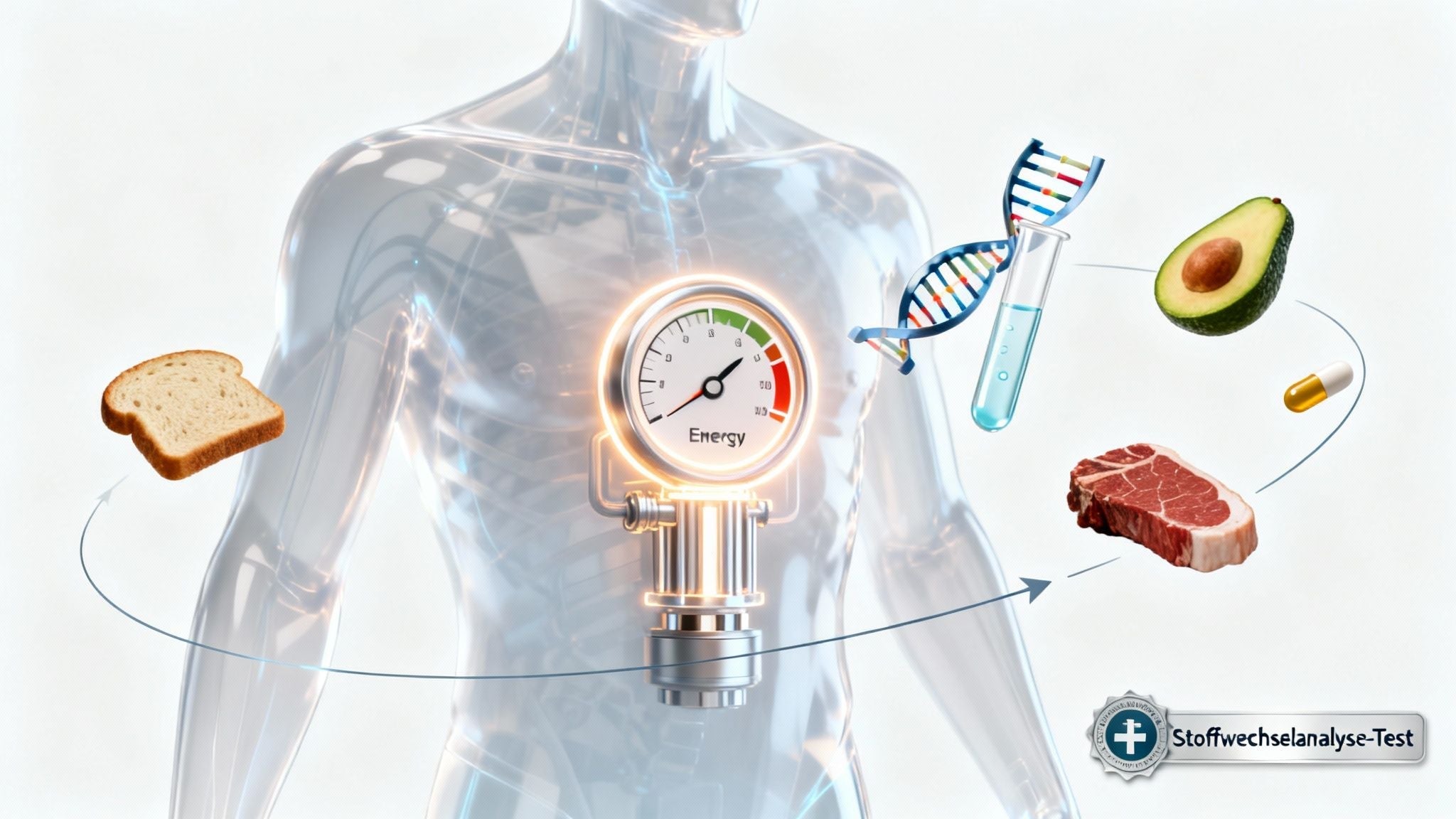
Your metabolic analysis test: Find the nutrition strategy that truly suits you
Imagine your body had its own user manual. The problem? Most of us try to operate it using a standard manual that is the same for everyone. We try diets that work wonders for our friends and then feel frustrated when nothing happens for us. The reason is actually quite simple: Your metabolism is as individual as your fingerprint.
A metabolic analysis test is exactly that: a look into your very own user manual. It is a diagnostic procedure that reveals how your body actually processes nutrients such as fats, carbohydrates, and proteins and converts them into energy. The most precise approach is probably a DNA-based test such as the one from mybody®, which analyzes your genetic predisposition and provides you with a foundation for your nutrition strategy that remains valid for life.
What a metabolic analysis test really reveals about you
Generic nutrition plans ignore your biological uniqueness and often lead to a dead end of restriction and disappointment. A metabolic analysis test breaks this cycle. You can think of it as a precise engine check for your body that finally reveals which “fuel” you really need to perform at your best.
Instead of merely fighting symptoms such as excess weight or constant fatigue, this type of analysis uncovers the underlying causes.
Your body’s genetic blueprint
The decisive factor is your DNA. Your genes determine whether you are sensitive to carbohydrates, how efficiently you burn fat, and how quickly you develop a feeling of fullness. A DNA-based test deciphers precisely this genetic blueprint.
So you learn not only what you should eat, but also understand why your body reacts the way it does. This approach goes far beyond a mere snapshot. While other tests measure only your body’s current state, a genetic analysis provides an unchangeable foundation that remains valid for life. The result is a personalized strategy based on scientific facts, not mere assumptions.
A metabolic analysis test is not a miracle cure, but a scientifically sound guide. It gives you back control and enables you to make decisions that truly suit your body—for sustainable goals such as a healthy weight and more energy in everyday life.
Why an individualized strategy is so important
The figures also show that we need a personalized approach. In Germany, around 54% of adults were overweight in 2023, and the obesity rate has risen sharply over the past 20 years. This development makes it clear that standard solutions often fall short.
After all, being overweight is a major risk factor for metabolic diseases such as type 2 diabetes, which affects at least 8.9 million people in Germany. Learn more about the background to excess weight at marcusknispel.com.
An analysis such as the mybody® DNA metabolism test can help you break out of this cycle. It provides the information you need to make targeted adjustments to your diet and lifestyle—and take charge of your health proactively and on your own terms.
Which method of metabolic analysis is right for you?
Anyone interested in a metabolism analysis test quickly realizes that there is no single test. The market is full of different approaches that vary widely in their depth, significance, and what they actually measure. You could compare it to a car: A quick glance at the speedometer tells you how fast you are driving right now. An in-depth engine analysis, on the other hand, reveals how the engine is built and what potential it holds. Both provide information, but at completely different levels.
Some tests are merely snapshots—influenced by your last meal, your sleep, or the day's stress. Others, such as a DNA analysis, take a look at your personal, unchangeable “operating manual.” Let's take a closer look at the most common methods so you know what makes sense for you.
The following graphic sums up the hierarchy: Your metabolism is a core process in your body. Analysis is the key to finally understanding it.

The graphic shows that targeted analysis gets directly to the heart of the body's core processes, providing genuinely valuable insights.
Snapshots: breath gas analysis and blood tests
A very common method is breath gas analysis, which you may also know as spirometry or calorimetry. You breathe into a device for a few minutes while it measures your oxygen consumption and carbon dioxide output.
This is used to calculate your resting metabolic rate (basal metabolic rate)—the amount of energy your body burns when completely at rest. The test can also tell you whether your body is currently using more fat or carbohydrates as an energy source.
- Benefit: You get a quick, up-to-date figure for your calorie expenditure.
- Disadvantage: The result depends heavily on your condition that day. Slept poorly? Stressed? Ate the wrong foods? All of that distorts the values. It is just a snapshot, nothing more.
Blood tests, in turn, are great for checking specific markers such as blood sugar, cholesterol, hormones, or nutrient deficiencies. They are invaluable for identifying acute problems or assessing your current state of health. But they tell you nothing about how your body fundamentally processes nutrients. That simply is not their purpose.
Remember: Both breath gas and blood tests show you what is happening right now. But they do not explain why it is happening. It is like the difference between today's weather forecast and an analysis of the climate you live in.
The foundation: Your DNA as the key
The situation is completely different with DNA-based metabolic analysis. Your genes have remained unchanged since birth. They are the blueprint according to which all processes in your body operate, and they largely determine how you respond to certain foods.
A DNA analysis deciphers how your body is genetically “wired.” It provides answers to the truly fundamental questions:
- Are you sensitive to carbohydrates or fats? Your genes reveal which nutrient is more likely to end up on your hips.
- How strong are your feelings of hunger and satiety? Certain gene variants, such as those in the well-known FTO gene, have a huge influence on how quickly you feel full or whether you tend to experience cravings.
- What type of athlete are you naturally? Your genetic predisposition provides clear indications of whether you benefit more from endurance or strength training.
A DNA test like mybody®'s therefore gives you a foundation that remains valid for life. Instead of struggling from one diet trend to the next, you receive a personal strategy based on your unique genetic predisposition.
The methods in direct comparison
To make the differences even clearer, a direct comparison is helpful. Each method has its place, but for very different goals.
Comparison of metabolic analysis methods
This table compares different types of metabolic tests in terms of their informative value, measurement method, and suitability for different health goals.
| Test method | What is measured? | Informative value | Ideal for |
|---|---|---|---|
| DNA analysis | Your genetic predisposition for macronutrient metabolism, satiety, and sports type. | Valid for life and fundamental. Shows your innate potentials and tendencies. | A long-term, personalized nutrition and lifestyle strategy to lose weight sustainably or optimize your health. |
| Breath gas analysis | Current resting metabolic rate (calorie expenditure) and current energy source (fat vs. carbohydrates). | Snapshot. The result depends on your condition that day and external factors. | A quick assessment of current calorie requirements, e.g., to adjust an existing nutrition plan. |
| Blood test | Specific biomarkers such as blood sugar, hormones, vitamins, or inflammatory markers in the blood. | Snapshot. Shows the current health and hormonal status. | Diagnosing deficiencies, diseases, or hormonal imbalances, as well as monitoring health status. |
The overview makes it clear: If you want to understand why your body works the way it does and are looking for a lasting solution, a DNA-based analysis is the most precise path. It provides the foundation on which you can build all your future decisions. Would you like to delve even deeper into the subject? In our guide, you will find more information about the types of metabolic analyses.
Why your DNA is the key to your metabolism
Imagine your metabolism as a complex clockwork mechanism. Every small gear—enzymes, hormones, and cells—must mesh perfectly so that your body can produce energy smoothly, utilize nutrients, and regenerate. The blueprint for this entire mechanism is stored in your DNA.
Your DNA is your body's operating system. It establishes the basic rules governing all metabolic processes. While other methods, such as respiratory gas or blood tests, only show you how fast the hands are currently moving, a DNA-based metabolic analysis test goes straight to the root. It analyzes your body's blueprint and reveals how you are “programmed” from the ground up.

Your genes determine your personal fuel
Do you remember the countless diet trends? Low-carb, low-fat, keto, paleo—the list is endless. Do you wonder why your friend is achieving fantastic results with low-carb while it only leaves you feeling tired and drained? The answer lies in your genes.
Your DNA determines how your body responds to the three main nutrients—carbohydrates, fats, and proteins. A genetic analysis like the one from mybody® can tell you precisely which metabolic type you belong to.
- The carbohydrate type: Your body is excellent at converting carbohydrates into quick energy. A diet with a moderate to higher proportion of complex carbohydrates is ideal for you to stay fit and avoid cravings.
- The fat type: Your engine runs best on fat as its primary energy source. A diet rich in healthy fats keeps you satiated for longer and helps you maintain your weight effortlessly.
- The mixed type: You are flexible and can process both carbohydrates and fats quite well. A balanced mixed diet is the perfect way for you to provide your body with everything it needs.
This genetic predisposition is the simple reason why there can be no “one-size-fits-all” diet. What is the perfect fuel for one person leads to inefficient combustion and unwanted pounds for another.
More than just weight: the power of genes
However, your genetic makeup influences far more than just your response to pasta or avocados. It plays a decisive role in countless aspects that are absolutely central to your well-being and health.
Your DNA is an unchanging constant. A single analysis provides you with a lifelong foundation for your health decisions. This is no longer guesswork but a strategy based on your very personal biology.
The science of nutrigenetics, which investigates precisely this connection between genes and nutrition, has made huge strides in recent years. It shows us how tiny genetic variants can massively influence our everyday lives. In our article, you can learn more about what nutrigenetics is and how it determines our lives.
The following factors, for example, are strongly influenced by genetics:
- Hunger and satiety: The FTO gene, often referred to as the “obesity gene,” has a strong influence on how quickly you feel full or whether you tend to experience cravings.
- Predisposition to being overweight: Regardless of eating habits, some people simply have a genetically higher likelihood of gaining weight more easily.
- Muscle building and athletic type: Genes such as ACTN3 determine whether you are more of a born sprinter with fast-twitch muscle fibers or shine as an endurance athlete with slow-twitch fibers.
- Caffeine and alcohol metabolism: How quickly your body breaks down caffeine or how sensitive you are to alcohol is also encoded in your DNA.
Knowing these genetic markers is a tremendous advantage. It finally allows you to work with your nature instead of constantly fighting against it.
Scientifically sound and forward-looking
The idea that our genes control metabolism is not a vague theory but scientifically substantiated. Current research projects repeatedly confirm how fundamental these connections are.
For example, German research projects at the Helmholtz Zentrum München have shown that there are clear links between weight gain and individual changes in fat and amino acid metabolism. Such studies highlight the value of laboratory analyses that use genetic markers to provide truly personalized and effective recommendations.
A DNA-based metabolism analysis test is therefore the most precise and logical way to finally gain clarity. Instead of getting lost in the jungle of nutrition advice, you receive a clear, scientifically sound roadmap. The mybody® DNA metabolism test decodes this information for you and translates it into simple, actionable recommendations for your everyday life. This puts an end to endless trial and error and allows you to truly understand your body—and give it exactly what it needs.
How the at-home metabolism test works so easily
The idea of a medical test initially puts many people off: making appointments, sitting in a waiting room, understanding complicated instructions. But a modern metabolism analysis test for home use has absolutely nothing to do with this outdated image. The mybody® DNA test was designed from the ground up so that you can easily, safely, and conveniently integrate it into your everyday life.
The whole process feels more like placing a regular online order. You select the right test on the website, and a few days later the test kit is in your mailbox. Inside, you will find everything you need for the sample—clearly explained and without any medical jargon.

Your path to collecting a sample in three simple steps
The centerpiece of the test is a simple and completely painless saliva sample. So you do not have to have blood drawn or undergo any other unpleasant procedures. A simple swab of the inside of your cheek is all it takes to collect enough DNA for an in-depth analysis.
The entire process is divided into three really simple steps:
- Activate: First, register your test kit online using a unique code. This step is especially important for your data privacy because it pseudonymizes your sample. This means it can no longer be directly linked to your name in the laboratory.
- Collect: Use the enclosed cotton swab to collect a saliva sample. The detailed instructions guide you through the process step by step, so nothing can really go wrong.
- Shipping: Then pack the sample securely in the prepaid return envelope provided and take it to the post office. From there, it goes directly to our certified specialist laboratory in Germany.
Your data is safe with us. The entire process is subject to the strictest data protection regulations under the GDPR. Your sample is destroyed after analysis, and your personal data is never shared with third parties.
What happens in the laboratory
As soon as your sample arrives at the laboratory, the actual scientific work begins. Specialized laboratory staff extract your DNA from the saliva sample. Using state-of-the-art technologies, they then specifically analyze those gene variations that are relevant to your metabolism.
This is precisely why having a test performed in an ISO-certified laboratory is so crucial for reliable results. Work is carried out under strictly controlled conditions and according to the highest scientific standards. This guarantees the accuracy and significance of your analysis. So you don't receive a vague estimate, but a precise evaluation of your very own genetic predisposition.
After the analysis, the scientific raw data is translated into an easy-to-understand results report. It is delivered to you securely and digitally—and soon you'll be holding your personal “user manual” for your body in your hands. The entire process is designed to provide you with maximum safety, convenience, and, above all, reliable insights. You can also find a detailed description of how the mybody® metabolism test works on our information page. This allows you to get a clear picture of the entire process at your leisure.
Understanding your results and putting them into practice in everyday life
A metabolism analysis test is the first step—but real change only begins when you incorporate the results into your daily life. Think of your mybody® results report as a personal map for your body. It's packed with valuable information, but only when you learn to read it and plan your route will you reach your destination.
Don't worry, it's much easier than it may sound. We deliberately designed the report to combine scientific depth with maximum clarity. You don't have to be a biologist to understand what your genes reveal about you. We translate the complex genetic data into clear, actionable recommendations that you can use right away.

From gene to plate: This is how your recommendations are created
You may be wondering how a dry genetic variant becomes a concrete recommendation such as “Eat more healthy fats.” It is based on a purely scientific process rooted in years of research in nutrigenetics. Your DNA is examined for specific markers known to influence your metabolism.
A well-known example is the FTO gene. Certain variants of this gene have been linked to increased hunger and a tendency toward obesity, particularly with a high-fat diet. If we find such a variant in your DNA, the logical recommendation is to keep an eye on your intake of saturated fats and instead choose filling foods rich in protein and fiber.
This is how a genetic fact becomes a practical everyday strategy.
Your results are not rigid rules, but guardrails. They point you in the right direction for making decisions that align with your biology—without having to turn your entire life upside down.
Concrete examples for your everyday life
The true strength of a metabolic analysis test lies in putting an end to the guesswork. Instead of chasing arbitrary trends, you follow a plan that is genuinely tailored to you. Let us take a look at what this might look like in practice.
Example 1: You are a carbohydrate-oriented type
- Your result: Your genes show that your body can convert carbohydrates into energy very efficiently. A heavily fat-based diet (low-carb/keto) would therefore tend to slow down your engine.
-
Practical implementation in everyday life:
- Shopping list: Choose complex carbohydrates such as whole-grain products, oats, quinoa, sweet potatoes, and legumes.
- Meal planning: Include a moderate portion of these carbohydrate sources with each main meal. Porridge for breakfast, a quinoa salad at lunch, and whole-grain bread for dinner will give you consistent energy.
- What you avoid: You do not have to give up carbohydrates; simply choose the right ones. Reduce simple sugars and white flour products, which cause your blood sugar to spike.
Example 2: You are an endurance-oriented athlete
- Your result: Your gene analysis (e.g., of the ACTN3 gene) suggests that your muscle fibers are geared more toward endurance than explosive strength.
-
Practical implementation in everyday life:
- Training plan: Focus on activities such as running, cycling, swimming, or longer hiking sessions. You will notice that you make faster progress here and feel more comfortable.
- Efficiency: Instead of pushing yourself with heavy weights at the gym, 2–3 endurance sessions per week could be much more effective for you when it comes to burning calories and improving your fitness.
- Motivation: When you do exercise that matches your genetics, it’s not only more enjoyable, but you also see better results—a huge boost to your motivation.
These examples show that it’s not about radical restriction or extreme workout plans. It’s about smart, fact-based adjustments.
Your personal roadmap to greater well-being
Your mybody® results report is more than just a collection of data. It is a tool that empowers you to take responsibility for your health. You’ll learn about the fundamental mechanisms of your body and can finally tailor your diet and lifestyle to them.
The goal is to give you the knowledge you need to make the right decisions independently over the long term. You no longer have to chase every new diet trend because you have your own scientifically sound strategy. Want to explore the topic in even greater depth? In our guide, we show you how to further optimize your diet based on your test results.
Who can really benefit from a DNA-based metabolic test
A metabolic analysis test has long been more than just a tool for biohackers or competitive athletes. Rather, it is intended for anyone who wants to take charge of their health based on facts instead of mere assumptions. Are you wondering whether such an analysis is right for you, too? The chances are quite good.
At certain stages of life or when pursuing specific goals, the insights your DNA provides are especially valuable. If you recognize yourself in one of the following scenarios, a test like the one from mybody® could be exactly the game-changer you’ve been looking for.
When diets only leave you frustrated
Be honest: You’ve already tried countless diets. Low-carb, low-fat, counting calories—the whole range. Every time, you start full of enthusiasm, but the results fail to materialize or the yo-yo effect strikes mercilessly shortly afterward. This frustration isn’t your fault. Often, it is simply the result of a strategy that doesn’t match your genetic predisposition.
A DNA-based metabolic analysis test puts an end to this endless guesswork. It tells you in black and white whether your body reacts more sensitively to carbohydrates or fats. With this knowledge, you can finally find a way of eating that works with your body instead of against it. And that is precisely the key to sustainable success, without constant restriction.
If you want to take your athletic performance to the next level
Whether you are an ambitious amateur athlete or simply want to get more out of your training, your genes have a say in the matter. They determine whether you are naturally more of an endurance type or whether your strengths lie in strength training.
Perhaps you have been torturing yourself with long jogging sessions for ages, even though short, intense strength workouts would be far more effective for your body in building muscle and burning fat. An analysis of your genetic sports type helps you tailor your training to your strengths. The result? Better results, more motivation, and a significantly lower risk of injury.
A DNA test is an investment in prevention. By understanding your metabolism and identifying risk factors at an early stage, you lay the foundation for a long and healthy life.
If you want to start preparing for your future today
Health is about much more than simply the absence of illness. It is about remaining vital and capable in the long term. Many of the diseases of civilization we face today—such as overweight, type 2 diabetes, and cardiovascular problems—are closely linked to our metabolism.
Your DNA can provide valuable insights into genetic predispositions. For example, if you know that you have a tendency toward sensitive fat metabolism, you can proactively adjust your diet long before any problems arise. This preventive approach is precisely one of the greatest benefits of a metabolism analysis.
The societal relevance quickly becomes clear when you look at the figures. The economic costs of obesity and its associated diseases in Germany are estimated to amount to tens of billions of euros. Laboratory-based analyses can make an important contribution by identifying risks at an early stage and enabling personalized countermeasures, which reduces costs and suffering in the long term. You can read more about the impact of metabolic diseases in the HTA report.
A metabolism analysis test is therefore useful for anyone who is finally seeking clarity and ready to take responsibility for their well-being. It is the logical step away from one-size-fits-all advice toward a strategy as unique as you are.
mybody® is your scientifically grounded partner on this journey. Discover how your body really works and start living a healthier life with the mybody® DNA Metabolism Test.



Share now:
Metabolism Type Test: Find out how your body really works
Hair loss due to iron deficiency: Understand and stop the cause