

New Year's Resolutions That Really Work: Your Scientific Path to Success
Good resolutions are quickly made. The desire for change is there, but it often remains at the level of vague goals such as “live a healthier life.” The real key to success lies elsewhere: You have to transform these general wishes into a concrete, personal plan—one based on your body's genuine needs and scientifically sound.
Why Most New Year's Resolutions Fail

January usually begins with a huge surge of motivation. Full of energy and enthusiasm, we throw ourselves into our new goals, but reality quickly catches up with us. After a few weeks, the initial energy has vanished, and old habits quietly creep back in.
Does this sound familiar? Let's be honest: You are not alone. Most of us know the frustrating feeling of ambitious plans being swallowed up by the stresses of everyday life. But what is the real reason?
The Psychological Obstacles Behind Failure
One of the main reasons is the lack of personal relevance. We often adopt resolutions that are currently trending without asking ourselves whether they truly suit us and our lives. A vague goal such as “exercise more” may be well-intentioned, but it lacks the foundation of your very personal “why.”
Another stumbling block is unrealistic expectations. If we want to completely overhaul our lives from one day to the next, feeling overwhelmed is inevitable. Willpower alone is like a muscle—it becomes fatigued when constantly pushed to its limit. Instead of relying solely on willpower, you need a system that supports you even on difficult days.
The strongest motivation does not come from outside, but from a deep understanding of your own body. When you know why you are changing something, the how suddenly becomes much easier.
This is exactly where the same pattern emerges every year. Exercising more is the most popular New Year's resolution among Germans for 2025, at 46 percent. But the initial enthusiasm quickly fades: Gyms experience a real boom at the beginning of the year, but it subsides again after about two months. Surveys confirm that only about one-third of Germans stick to their resolutions for more than a few days. You can find out more about Germans' most popular resolutions at focus.de.
From General Wishes to Concrete Data
The crucial mistake many people make with their New Year's resolutions? They are based on assumptions rather than facts. You often feel tired and resolve to “eat healthier.” But what does that specifically mean for your body?
- Could you be lacking iron, causing this constant exhaustion?
- Do certain foods trigger an intolerance that secretly drains your energy?
- Could your vitamin D levels be completely depleted after the long winter?
Without these answers, you are groping in the dark. You might try a diet that worked for others but is completely unsuitable for your metabolism. The lack of results leads to frustration—and eventually you give up.
Here is the turning point: Instead of guessing, you can measure. A blood test from mybody-x.com provides you with concrete data about your body and transforms a general wish into a scientifically grounded, personalized plan. This turns the vague goal of “living healthier” into a clear, tangible objective such as “correct my iron deficiency” or “adapt my diet to my food intolerances.”
This data-driven approach strengthens your awareness of your body and your motivation in an entirely new way. In our article, we show you how to specifically build body awareness and motivation. With this knowledge, you create the foundation for resolutions that are not just a January impulse, but lead to real, lasting change in your life.
Create Your Foundation for Real Success
Before you dive into your New Year's resolutions full of enthusiasm, let's pause for a moment. The biggest mistake almost everyone makes? Getting started based purely on guesswork. Vague goals like “eat healthier” or “have more energy” may sound great, but they often lead nowhere because they are not tailored to you and your individual needs.
That is why the first and decisive step is an honest assessment of your current situation. It is about going beyond your gut feeling and truly understanding where you currently stand health-wise.
More Than Just a Gut Feeling
Do you often feel tired, struggle with digestive problems, or experience unexplained weight fluctuations? These are important signals from your body. But instead of merely guessing what might be behind them, you can find out precisely today.
Guessing usually only leads to frustration. You might try a gluten-free diet because it worked for a friend, even though an undiagnosed lactose intolerance is actually causing your symptoms. Or you might take high-dose vitamin C, when your body may simply be lacking the iron it needs to produce energy.
You do not build a solid foundation for your health goals on assumptions, but on facts. Your body is unique—and your resolutions should be too.
To finally break this cycle of trial and error, you need clear data. Only when you know the true causes can you take targeted and effective measures.
Your starting point: measurable data
Instead of feeling your way in the dark, a simple at-home test gives you a clear picture. mybody-x.com home tests provide the scientific basis for your goals, directly from your blood.
Imagine holding a detailed report in your hands that shows you, in black and white, the state of your nutrient supply or hormonal balance. These values are your personal starting point, your individual roadmap on the way to greater well-being.
A mybody-x.com test can give you clarity about various areas:
- Nutrient test: Detects deficiencies or excesses of important vitamins and minerals such as vitamin D, iron, magnesium, or zinc. A deficiency may be the reason for persistent fatigue or a weakened immune system.
- Hormone test: Provides insight into the balance of important hormones, such as cortisol (the “stress hormone”) or thyroid hormones. An imbalance can affect your energy, mood, and weight.
- Intolerance test: Shows which foods your body may react to with an immune response, potentially causing digestive problems, skin issues, or inflammation.
With this precise data in hand, your perspective on your New Year’s resolutions changes completely. They become not only measurable but also incredibly motivating, because you are suddenly solving a very specific, personal problem.
From a vague wish to a specific goal
Insights from a test help you completely rephrase your resolutions. They become specific, personal, and above all: achievable. A general wish becomes a clear, tangible goal.
See how your goals can change as a result:
- Vague resolution: “I want to eat healthier.”
- Specific goal based on a test result (e.g., iron deficiency): “I am correcting my iron deficiency by deliberately incorporating iron-rich foods such as lentils and red meat into my diet.”
- Vague resolution: “I finally want to get my digestion under control.”
- Specific goal based on a test result (e.g., lactose intolerance): “I consistently avoid products containing lactose and observe how my symptoms improve over the next four weeks.”
This approach not only gives you clear direction but also the certainty that you are investing your energy in the right measures. A successful change in diet always begins with knowing what your body really needs. You can find more on this topic in our guide to best practices for an optimal dietary change.
By building your goals on a solid foundation of data, you create the best possible conditions for lasting success that extends far beyond January.
Formulate goals your brain understands
A vague intention like “I want to get fitter” is like planning to start a journey without marking a destination on the map. You may set off, but the chance that you will actually arrive where you want to go is vanishingly small. Your brain loves clarity and structure—and that is exactly what most New Year’s resolutions lack.
So that your goals do not remain mere wishes but become a concrete roadmap, we need to formulate them in a way that makes your brain not only cooperate but actively respond to them. The way there leads through a proven method that we fuel with the valuable data from your own body.
The process of turning a vague wish into a tangible goal always follows three basic phases: an honest assessment, precise measurement of your body values, and the clear goal that emerges from them.
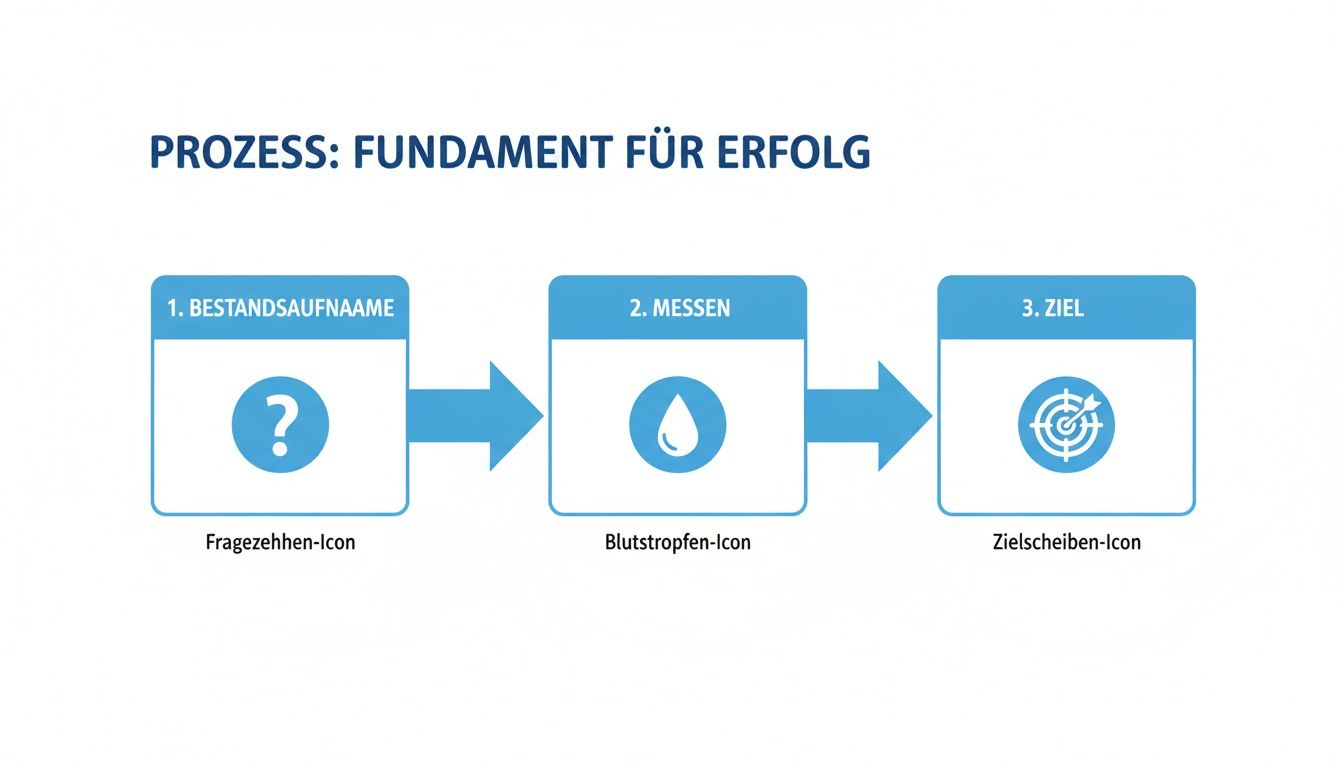
Each of these steps builds on the previous one, creating a stable foundation. That is what supports you when your initial motivation hits a slump.
Bringing the SMART formula to life
The SMART method is a fantastic tool for making goals tangible. Every goal should be Specific, Measurable, Attractive, Realistic, and Time-bound. But the true magic happens when you fuel this formula with your personal health data from mybody-x.com.
Imagine your nutrient test shows a significant iron deficiency—one of the most common causes of persistent fatigue. With this knowledge, we can transform the vague intention “have more energy” into a powerful SMART goal:
- Specific: I will bring my ferritin level (iron stores) into the optimal range.
- Measurable: According to my lab report, my target level is above 50 ng/ml. I will check the level again in three months with a follow-up test.
- Attractive: I will feel more alert, have more energy for my hobbies, and no longer feel constantly exhausted.
- Realistic: I incorporate iron-rich foods (such as lentils, spinach, and red meat) into my diet three times a week and take my iron supplement daily as advised by my doctor.
- Time-bound: I am giving myself three months to achieve this goal.
Do you see the difference? This is no longer a vague hope. It is a specific, understandable plan that addresses the root of your problem directly.
A goal based on your own body data creates an unbeatable connection. You are not working on an abstract resolution; you are solving a very specific, personal health mystery.
To formulate goals that your brain not only understands but also pursues with full commitment, clear planning is essential. You can find many valuable tips on how to create a roadmap for successfully achieving goals in a business context as well in this article about successfully planning goals with a roadmap. The principles can be transferred perfectly.
From vague resolutions to SMART goals with mybody-x.com
This table shows how you can use mybody-x.com test results to turn typical, vague New Year’s resolutions into specific, measurable, and motivating goals.
| Vague resolution | Possible cause (mybody-x.com test) | Specific, SMART goal |
|---|---|---|
| “Sleep better” | Low magnesium level | “I will bring my magnesium level into the healthy range over the next 2 months by taking 300 mg of magnesium daily and avoiding blue light in the evening. Follow-up testing.” |
| “Be less stressed” | Elevated cortisol level (stress hormone) | “I will lower my morning cortisol level to below 500 nmol/l by incorporating a 15-minute meditation into my morning three times a week for the next 6 weeks.” |
| “Finally lose weight” | Food intolerance | “I will reduce my body fat percentage by 3% in 3 months by avoiding the foods I react to according to my intolerance test and adding two additional strength-training sessions per week.” |
This turns a vague wish into a clear mission with an understandable plan.
Break big goals down into small habits
Even the smartest goal can feel overwhelming when the path to it seems long. The trick is to break the big picture down into tiny daily actions—actions so simple that you can hardly refuse them. This is where the ingenious concept of “habit stacking” comes into play.
With habit stacking, you link a new, desired habit to an existing, established routine. Your brain does not have to build a completely new structure; it simply adds a small building block to a familiar pattern.
Let’s stick with our example of iron deficiency. The big goal is to improve the level within three months. The daily habits could look like this:
- Existing habit: I make my coffee every morning.
- New habit: After I turn on the coffee machine, I take my iron supplement with a glass of orange juice (vitamin C improves absorption).
- Existing habit: I write my shopping list every Sunday.
- New habit: Before I finish the list, I add at least three iron-rich foods for the coming week.
This approach has a huge psychological advantage. Every successfully completed “stack” is a small victory. These regular successes release feel-good hormones and motivate your brain to repeat the action.
This way, you gradually build a strong network of positive habits that almost automatically carries you toward your big goal. Instead of relying solely on willpower, you create a system that works for you.
Reduce stress and gain new energy
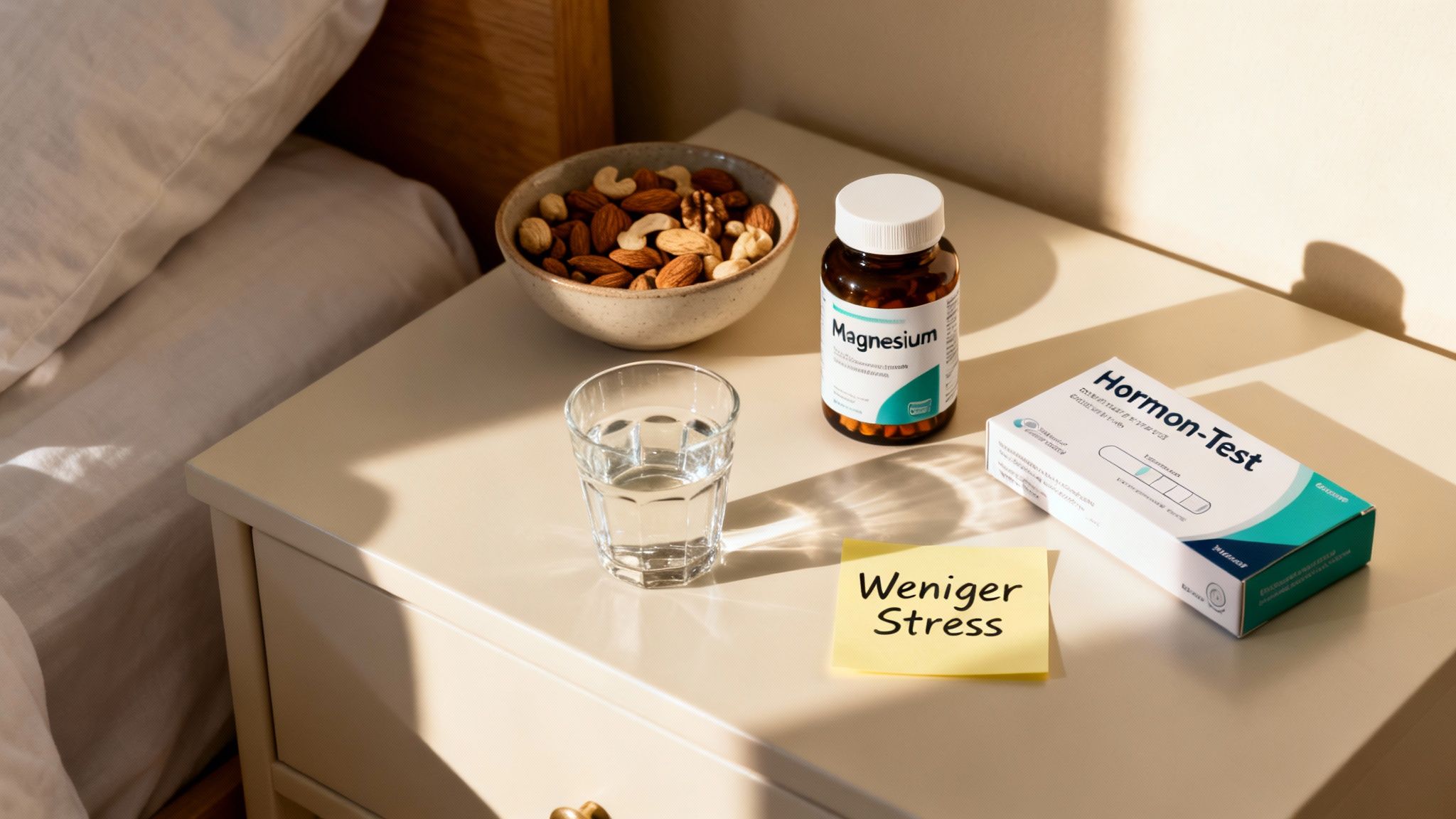
The resolution to “reduce stress” is at the top of many of our lists for the new year. But honestly, it often remains a vague wish because we don’t know where to start. We try taking more breaks or picking up a new hobby, but the feeling of being overwhelmed remains.
The reason is actually quite simple: stress is not just a feeling. It is a measurable biological response in your body, deeply rooted in your hormonal and nutrient balance. So if you really want to change something, you need to start right there—with the cause, not just the symptom.
Understand the biology behind your stress
When you are under constant stress, your body releases more of the hormone cortisol. In the short term, this is an extremely useful response that keeps you performing at your best. But if this state continues, your entire system becomes unbalanced. Chronically elevated cortisol levels can lead to sleep problems, weight gain, cravings, and a weakened immune system.
At the same time, your body uses up huge amounts of important nutrients under stress. Your nervous system primarily needs B vitamins and magnesium to remain stable. When these “stress buffers” are depleted, you become more irritable, tense, and simply feel overwhelmed more quickly.
Stress is not a personal failure but a physiological chain reaction. Instead of asking yourself what’s wrong with you, ask what your body is missing.
This connection also explains why general relaxation tips often fail to have the desired effect. As long as a hormonal imbalance or nutrient deficiency persists, you’re fighting against an invisible biological force.
Your personal tool against stress
This is exactly where the mybody-x.com tests come in. Instead of guessing blindly, they give you targeted insights into your body. They are your personal tools for turning the resolution to “reduce stress” into a concrete, scientifically sound plan.
- The hormone test: A simple saliva test measures your cortisol levels and reveals whether your stress hormone system is in balance. An imbalance here can significantly increase your susceptibility to stress.
- The nutrient test: A few drops of blood from your fingertip are enough to check whether you’re lacking important nutrients such as magnesium, zinc, or vitamin B12—all essential for a resilient nervous system.
With this data in hand, you can finally address the real causes. You can specifically fill nutrient gaps or take measures to naturally regulate your cortisol levels. Learn more about how to lower your cortisol levels in our detailed article about naturally lowering cortisol.
Concrete strategies instead of vague resolutions
Test results enable you to develop scientifically sound strategies. Your resolution becomes tangible, measurable, and finally achievable.
If your hormone test shows elevated cortisol levels:
- Morning routine: Start the day with 10 minutes of gentle stretching instead of reaching for your phone. This way, you won’t immediately activate your stress system.
- Plan recovery: Build fixed, short breaks into your workday—even if it’s just five minutes to consciously take deep breaths.
If your nutrient test reveals a magnesium deficiency:
- Adjust your diet: Consciously incorporate magnesium-rich foods such as nuts, seeds, oats, and leafy green vegetables into your meals.
- \Targeted supplementation:\ Supplement your diet in consultation with an expert to effectively and safely correct the deficiency.
The desire for less stress is widespread, by the way. A DAK-Forsa survey shows that \68 percent\ of Germans want less stress in 2025—the highest figure in 14 years. Women in particular (\71 percent\) and young people see a need for action here.
Good time management is also a crucial lever for reducing stress and sticking to your resolutions. Find out how you can improve your \effective time management with AI\ to gain new energy and pursue your goals with greater focus.
By understanding your body and deliberately giving it what it needs, you can turn one of the most common New Year's resolutions into a lasting improvement in your quality of life.
How to Keep Going Even During Difficult Phases
Anyone who has seriously attempted a New Year's resolution knows this moment: The initial euphoria has faded, everyday life hits with full force, and the couch suddenly seems much more tempting than the gym or the vegetable drawer. This is completely normal and absolutely no reason to throw in the towel.
The crucial difference between those who achieve their goals and those who give up is not endless motivation. Motivation is a feeling—it comes and goes. True, long-term success is based on something much stronger: \discipline, clever systems, and a clear plan for difficult days.\
More Than Just Willpower
Willpower alone is a finite resource. Forcing yourself to exercise or eat a healthy meal every day through sheer mental strength is incredibly exhausting and bound to fail in the long run. It is far more effective to design your environment in a way that almost automatically guides you in the right direction.
You need to make it as easy as possible to do the right thing and as difficult as possible to fall back into old patterns.
This is how you create a supportive environment:
- \Visibility is everything:\ Place healthy options prominently. Put a bowl of nuts and fruit on the living room table and banish the cookie jar to the very back of the top cupboard.
- \Obstacles to bad habits:\ Want to watch less TV in the evening? Take the batteries out of the remote control and put them in another room. This small but deliberate obstacle gives you the crucial moment to reconsider your decision.
- Preparation is your ace: Lay out your workout clothes the evening before. If they’re the first thing you see in the morning, taking the step toward working out becomes much easier.
These small adjustments take the pressure off your willpower. Instead, you build a system that supports you even when your motivation is at rock bottom.
Keep a success journal
Our brains have an built-in tendency to focus more strongly on what didn’t work. We spend days feeling annoyed about the one slip-up, overlooking the nine days when we were fully committed. A success journal deliberately shifts this focus.
Don’t just record the major milestones here, but especially the small, daily victories. Those are exactly what make the difference in the end.
Examples for your success journal:
- “Took the stairs instead of the elevator today.”
- “Ordered a salad for lunch even though I was craving pizza.”
- “Took my vitamin supplements consistently all week.”
Consciously recording these successes trains your brain to recognize and appreciate progress. It is a powerful motivator that shows you in black and white how far you have already come.
Your relapse plan
There will be days when you don’t reach your goal. You eat a slice of cake, skip your workout, or go to bed stressed without doing your evening routine. That isn’t failure—it’s an unavoidable part of the process. What matters is how you respond to it.
The “all-or-nothing” mentality is the biggest enemy of your New Year’s resolutions. A single misstep often leads people to give up completely. Prepare yourself mentally and create a crystal-clear “if-then” plan.
A setback does not define your end result. Your response to it does. Plan for slip-ups, not perfection.
A plan like this could look like:
- If I skip my workout for a day, then I go for a 15-minute walk the next morning right after getting up, so I can immediately get back into my routine.
- If I do reach for sweets, then I make sure my next meal is particularly nutrient-rich and contains plenty of vegetables.
A plan like this takes the emotional force out of a relapse. Instead of letting guilt hold you back, you have a concrete course of action that immediately gets you back on track.
You’re not alone on your journey
Sometimes even the best strategies simply aren’t enough. Perhaps an underlying obstacle is in the way, or you simply need a fresh perspective from the outside. Support can make all the difference during phases like these.
This is exactly where mybody-x.com comes in. We know from experience that test results and recommendations are only the first step. The real challenge lies in putting them into practice over the long term amid the hustle and bustle of everyday life.
That is why we offer you free coaching with our health experts. They will help you interpret your test results correctly, adjust your strategy when you encounter obstacles, and stay on track when things get difficult. If you feel stuck, speaking with a professional is often exactly the boost you need to get moving again.
Frequently asked questions about New Year's resolutions and health tests
Finally, we want to answer the questions about resolutions and health tests that we encounter time and again. This section is intended to dispel your remaining uncertainties and provide clear answers so that you can take the first decisive step with confidence.
Which test is right for me?
This is one of the most important questions of all, and the answer is actually quite simple: it depends entirely on your personal goal. Ask yourself exactly what you want to achieve with your resolution and which symptoms bother you most in everyday life.
Here is a little practical guide:
- Do you often feel tired, unfocused, and simply drained? A nutrient test (e.g., for iron, vitamin D, and vitamin B12) is usually the best starting point here. A deficiency in these essential substances is an extremely common cause of exhaustion.
- Are you struggling with mood swings, sleep problems, or constant stress? A hormone test that measures your cortisol level, for example, can provide valuable insights into whether your stress system is out of balance.
- Are you suffering from digestive problems, bloating, or skin blemishes? An intolerance test can reveal whether your body reacts to certain foods with an immune response that triggers exactly these symptoms.
Your individual symptoms are the best guide to choosing the right test. Choose the test that can reveal the most likely cause of your main concerns.
How reliable are the results of a home test like this?
We hear this question often, and the answer is the most important thing to us at mybody-x.com: the reliability of our tests is our absolute priority. Every single sample you conveniently collect at home is analyzed in our ISO-certified partner laboratories in Germany.
In concrete terms, this means that your sample undergoes exactly the same strict quality and analysis processes as a sample you would submit directly at a doctor's office. We work exclusively with laboratories certified to the highest scientific standards to guarantee you precise and completely reliable results.
What actually happens after the test?
A test result alone won't get you anywhere. It's only as good as the measures that follow. That's why we don't simply provide you with a list of values, but with a comprehensive and, above all, easy-to-understand results report. It explains exactly what your values mean and what specific actions you can take based on them.
These recommendations are essentially your personal roadmap. They include practical tips for everyday life on nutrition and lifestyle and, where appropriate, targeted nutrient supplementation to bring your levels back into the optimal range.
If any questions remain unanswered or you're unsure how best to put everything into practice, we won't leave you on your own. You can take advantage of our free coaching with our health experts at any time. They will provide you with personalized support to help you successfully achieve your New Year's resolutions based on your results.
Is a test enough to help me actually achieve my resolutions?
A test is the perfect starting point. It provides the scientific foundation and clarity that most New Year's resolutions lack. This turns a vague wish into a concrete, data-based goal, and you finally know exactly where to start.
Putting them into practice is, of course, up to you. But with the knowledge from the test, you have an incredible advantage. You no longer have to guess or try different diets on a whim; instead, you can focus your energy on the measures that will truly make a difference for your body.
Remember: A test isn't a miracle cure, but it is the most powerful tool you can have to start a healthier year. It gives you the control and knowledge to take charge of your health and formulate resolutions that finally stick.
Are you ready to put your New Year's resolutions on a solid, scientific foundation? At mybody-x.com, you'll find the right test to give you the clarity you need for real, lasting success.



Share now:
Body awareness & motivation – Your body is your most important compass
What to eat for iron deficiency – Personalized nutrition tips