
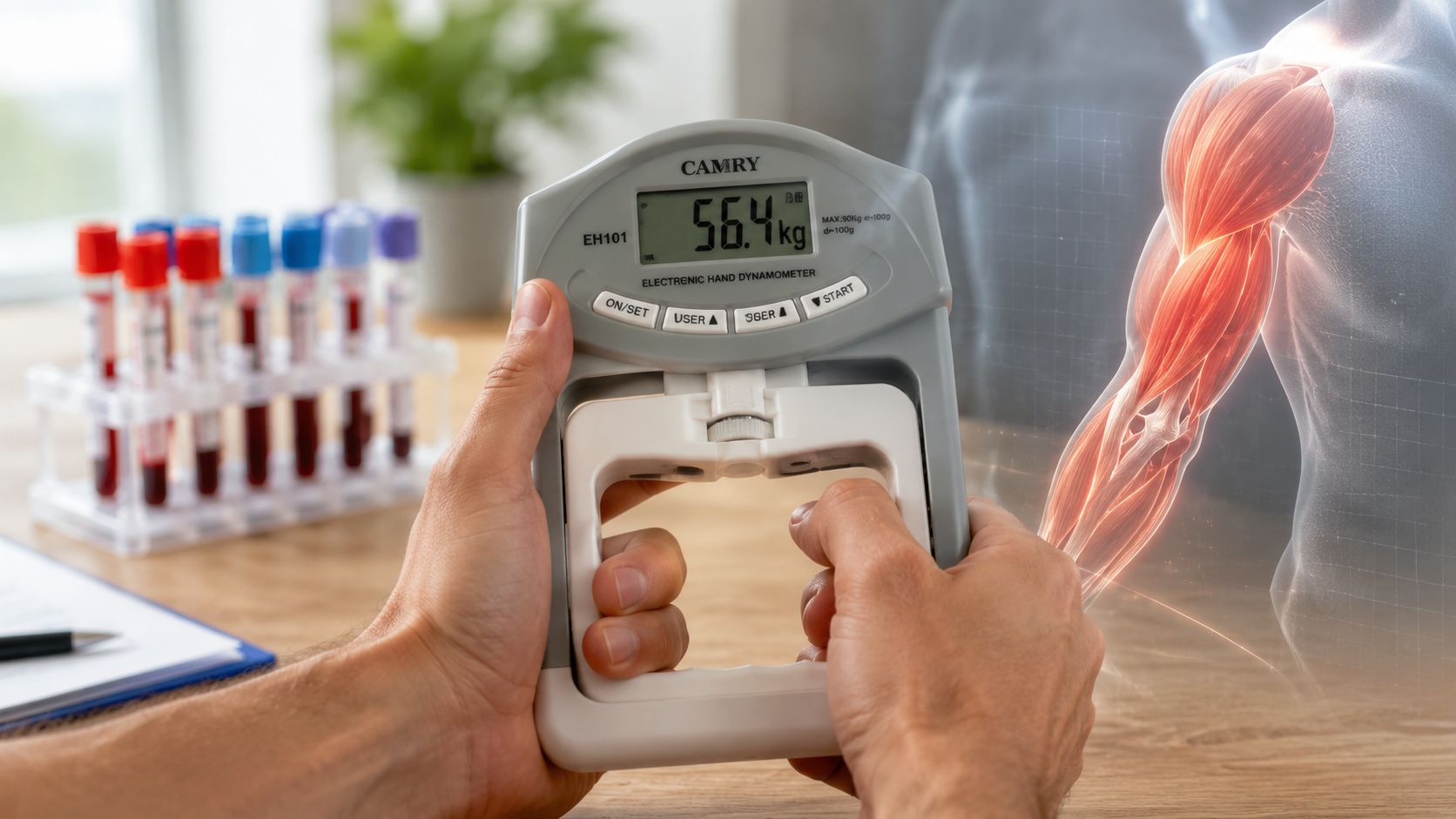
Muscle weakness: causes, symptoms & which tests can help
You lift the grocery bag and briefly think: Why does this feel so heavy today? Or you get up from the couch and notice that your legs do not simply feel “tired” but strangely weak. Many people experience moments like these. The problem is that everyday life quickly attributes everything to stress, poor sleep, or too little exercise.
That is exactly when it is worth taking a closer look. Muscle weakness is not simply another word for tiredness. Sometimes it is just temporary exhaustion. But sometimes your body is sending a signal that you should take seriously. The sooner you can distinguish what seems relatively harmless from what should be checked out, the more purposefully you can respond.
Suddenly weak or simply tired
You may know the feeling: After a long day at work, even small tasks no longer go smoothly. Your arms feel heavy while you dry your hair, climbing the stairs to the third floor takes more effort than usual, and while carrying grocery bags, you wonder whether you are simply exhausted or whether something more is going on.
This uncertainty is understandable. Exhaustion often feels as though your entire body is running low on energy. You feel generally weak, but after sleep, rest, food, or a quieter day, you usually feel better again. True muscle weakness, on the other hand, tends to show up in specific movements or muscle groups. For example, you may notice that it is harder to stand up from a seated position, that you can no longer hold objects securely, or that your arms give out unusually quickly.
What many people get wrong in everyday life
A common misconception is: “I’m probably just stressed.” That may be true. But not always. Medical sources emphasize that recurring weakness should be assessed neurologically, especially if swallowing, speech, or vision problems also occur. Such symptoms are often recognized late, particularly in older people. An estimated around 10% of people over 60 are affected by age-related muscle loss, as described on Biocarn’s page on the symptoms of muscle weakness.
If weakness keeps coming back, persists for a longer period, or clearly changes your daily life, it is not a symptom you should simply ignore.
A good first step is not just to feel your symptoms, but to observe them. Does the weakness always occur in the evening, or does it start in the morning? Does it mainly affect your legs, arms, hands, or your entire body? Are you also experiencing rapid fatigue, shakiness, or unsteadiness when walking?
Your first reality check
Before you search in every direction, ask yourself three simple questions:
- Is it only triggered by exertion? Do you become noticeably stronger again after resting?
- Does it recur? Does it happen not just on one bad day, but repeatedly?
- Is it noticeable in your ability to function? Do you find specific movements difficult that used to be easy?
If you are mainly experiencing diffuse sluggishness, it may also help to look into topics such as persistent fatigue and possible underlying causes. But if you are experiencing genuine loss of strength, you usually need a more thorough evaluation than simply getting more sleep.
What muscle weakness really means

When people talk about muscle weakness, they often mean very different things. Some actually mean a lack of motivation or exhaustion. Others describe their muscles literally failing to do what they are supposed to do during a movement. That is an important distinction.
A simple analogy can help. General fatigue is like an empty tank. Your body needs rest, sleep, food, or relief from strain. Muscle weakness is more like a fault in the transmission of force. You want to move, but the strength does not reliably get through.
Fatigue and weakness are not the same
With fatigue, you often think: “I could do it if I had to, but it takes effort to make myself do it.”
With muscle weakness, it is more like: “I want to, but the muscle is not really cooperating.”
Typical examples:
- When lifting, even a light load may feel unusually heavy.
- When standing up, you suddenly need to use your hands for support.
- Overhead movements such as washing your hair or reaching for something on a shelf quickly become strenuous.
- In the face, drooping eyelids, unclear speech, or rapid fatigue when chewing may be noticeable.
Where the problem may lie in the body
Muscles never work alone. For movement to succeed, several systems must work together:
- The brain and nerves send the signal.
- The connection between the nerve and the muscle transmits it.
- The muscle itself converts it into force.
- Metabolism supplies energy and the necessary minerals.
If something gets out of balance at any of these points, it can manifest as muscle weakness. That is why it is so difficult to assess symptoms based on how they feel alone.
Key point: Not every feeling of weakness is muscle weakness. But any persistent muscle weakness deserves attention.
Why understanding this is so important
Knowing the difference helps you look for causes more specifically. You then no longer ask only, “Why am I so exhausted?” but more precisely: Is this primarily an energy problem, a muscle problem, a nerve problem, or a sign that my body is lacking something?
That is also why persistent symptoms should not be discussed only in terms of sleep, stress, and exercise. Depending on the pattern, laboratory values, functional tests, or neurological examinations may be useful. Clarity almost never comes from guessing, but from systematically ruling things out.
The many causes of your lack of energy
Muscle weakness rarely has just one explanation. Often, several factors interact. That is precisely why it is not very helpful to simply try taking more magnesium, getting more sleep, or exercising more without first taking a closer look.

Common clusters of causes
A helpful approach is to think of the causes in groups.
Nutrients and metabolism
When muscles need to work, they require building blocks, electrolytes, and a functioning energy supply. Expert sources point out that muscle weakness may indicate a vitamin and mineral deficiency, a metabolic disorder, or a neurological muscle disease. In inflammatory muscle diseases such as myositis, blood values such as creatine kinase (CK) play an important role, as described in the article by the Association of German Neurologists on the neurological evaluation of muscle weakness.
Many people first think of iron here. That makes sense, but it is not the whole picture. B vitamins, vitamin D, electrolytes, and other metabolic markers may also be relevant. If you would like to explore a possible B12 issue in more detail, the article on vitamin B12 deficiency and typical signs is a good starting point.
Hormones and internal regulation
Hormones regulate how actively your metabolism functions. When this regulation gets out of balance, it can affect muscle strength, resilience, and recovery. The thyroid in particular is often considered a possible factor in practice.
What is typical is not that you “feel” a particular value. Rather, it is an overall picture: less strength, faster fatigue, diffuse drops in performance, or the feeling that your body is no longer responding properly.
Nerves and muscles themselves
Not every instance of muscle weakness is caused by a lack of nutrients. Sometimes the cause lies in the nerves, signal transmission, or directly in the muscle tissue. This is especially true when symptoms recur, worsen, or are accompanied by other abnormalities such as an unsteady gait, drooping eyelids, or problems speaking.
The more clearly you can describe the pattern of your symptoms, the easier it is to determine the right direction for further tests.
Lifestyle, age, and medications
Daily life also plays a role:
- Lack of exercise can lead to functional loss of strength
- Long periods of illness can cause muscle loss
- Medications can affect muscles or nerves
- An unbalanced diet can promote deficiencies
When it comes to micronutrients, it is important that supplements ideally match a confirmed need. The Vitamin D3 K2 Complex | Shield from mybody®x combines high-dose D3 with K2 for optimal calcium utilization, bone health, and immune function. According to the product information, it is intended primarily for use after a DNA or blood test has confirmed a deficiency.
Recognizing symptoms and initial at-home tests
Not every instance of muscle weakness is immediately obvious. It often first appears in small everyday situations. You carry a bottle of a drink and switch hands earlier than usual. You need momentum to get up from a deep armchair. Or you notice in the evening that your eyelids feel heavy and that chewing tires you more quickly.

Signs to look out for
Pay less attention to the vague feeling of “I feel weak” and more to specific changes in function:
-
Climbing stairs is noticeably difficult
Not out of breath, but weak in the legs. -
Working overhead quickly becomes strenuous
Blow-drying your hair, hanging curtains, or placing something on a shelf becomes tiring sooner than expected. -
Standing up is no longer smooth
You support yourself with your hands even though this was not previously necessary. -
Your gait is becoming less steady
You trip more often or feel unstable on uneven ground. -
Fine motor skills are declining
Opening bottles, writing for longer periods, or holding small objects is becoming more difficult.
Two simple self-checks
These mini-tests do not replace a diagnosis. However, they can give you a clearer sense of whether genuine strength problems are present.
Arm-Holding Test
Sit or stand securely. Extend both arms forward and hold them horizontally for a short time. Notice whether one arm drops significantly faster or whether you tire unusually quickly.
Chair stand test
Sit on a stable chair. Stand up slowly, preferably without pushing yourself up with your hands. Observe whether you can do this smoothly or whether your legs and torso noticeably give way.
Write down when, during what activities, and how often you notice weakness. These notes are often more helpful than a general statement such as “I’m constantly exhausted.”
When an at-home test may also be useful
If your symptoms started gradually and you have no acute warning signs, taking an initial look at possible deficiencies may be useful. This is especially true if you also experience paleness, rapid fatigue, concentration problems, or reduced exercise tolerance. A possible starting point is an at-home iron test, so that a common possibility is not overlooked.
When you need urgent medical help
With muscle weakness, it’s not only the cause that matters, but also the progression. This progression often determines whether you can monitor the situation or need to act immediately.
A sudden-onset, one-sided, or weakness that increases over several weeks requires particular attention, especially when it occurs together with unsteadiness and speech problems. The Leading Medicine Guide’s overview of muscle weakness explicitly points this out.
These warning signs are not something to wait and see about
Seek medical help promptly—or, if in doubt, emergency assistance immediately—if any of the following occurs:
-
Sudden weakness on one side of the body
This could be a neurological emergency. -
Speech disturbances or slurred speech
Especially when combined with weakness, this is a warning sign. -
Unsteady gait or suddenly stumbling
If this is new and getting worse quickly, it needs to be evaluated. -
Swallowing problems
Especially when eating or drinking becomes difficult to control. -
Breathing problems
If you feel you aren’t getting enough air or your breathing muscles seem exhausted, it is urgent.
Why quick action is so important
Many people initially hope that things will “surely be better tomorrow.” That’s human, but risky. Neurological or systemic causes often reveal themselves through patterns like these: sudden onset, asymmetry, progression, or occurrence together with other deficits.
If you’re unsure, one simple rule applies: It’s better to have a doctor check something unnecessarily than to recognize a serious warning sign too late. Self-tests and observation can be useful. But when red flags are present, they do not replace medical help.
Which laboratory values and tests actually provide useful information
When muscle weakness is not acute but recurring or persistent, the real detective work begins. Blood values do not answer everything, but they often answer the first crucial question: Is it more likely to be a deficiency, a hormonal disorder, an indication of muscle damage, or something else?

Which question does each value answer?
The following overview is useful because it not only lists names but also shows the reasoning behind them.
| Laboratory value | Possible relevance to muscle weakness |
|---|---|
| Ferritin / iron status | May provide indications of reduced capacity and fatigue |
| Vitamin B12 | Relevant when nerve function and energy levels also play a role |
| Vitamin D | May be important when considering overall muscle and bone health |
| Magnesium and potassium | Important for muscle and nerve function |
| TSH and other thyroid values | Help determine whether hormonal regulation is impaired |
| CK (creatine kinase) | May indicate muscle damage or inflammatory muscle processes |
Why blood values are often the most useful starting point
Laboratory values are not a substitute for medical diagnosis. However, they are often the quickest way to narrow down likely causes—especially if you are wondering whether the weakness is related to a nutrient deficiency, a hormonal problem, or a sign of muscle strain.
For a structured starting point at home, a nutrient deficiency test may be useful if you first want to determine whether your body needs support in this area.
Where self-tests are useful and where they are not
A home test is a good option if:
- your symptoms have developed gradually
- you have no acute red flags
- you first want to check for deficiencies and basic metabolic indicators
A home test is not appropriate if paralysis, swallowing difficulties, breathing problems, or sudden one-sided weakness occur as well. In that case, you need prompt medical evaluation.
Rule of thumb: Use laboratory tests to test hypotheses. Use a doctor’s visit to put patterns into a medical context.
A look at aging and training
Natural muscle loss also plays a role in assessing muscle weakness. According to Malteser information on sarcopenia and age-related muscle loss, this process often begins as early as the age of 30 to 40 and accelerates significantly after 50. The source recommends strength training 2 to 3 times per week with 3 sets of 10 repetitions, as well as at least 150 minutes of endurance training per week for prevention.
This is important because it changes the way you think about it. Age-related muscle weakness is not a fate that you simply have to accept. It is an area where observation, training, and appropriate diagnostics work together.
In some cases, a genetic perspective may also be interesting if you want to understand in the long term how your body handles aging, inflammation, nutrient utilization, and metabolism. According to the product description, mybody®x's Longevity | ALL IN ONE DNA test analyzes genetic risk factors for aging, inflammation, nutrient utilization, and metabolism and is designed for use at home.
However, I deliberately keep the direct product reference limited when it comes to muscle weakness. The first question is: What pattern do your symptoms show? Then comes the appropriate test. Not the other way around.
If you're looking for a convenient first step, a mybody x blood test may be one way to investigate relevant nutritional or hormonal questions from home and then discuss the results with a doctor.
Your path to greater strength and clarity
Muscle weakness can often be worrying because it is so difficult to assess. The good news is that you don't have to guess. You can proceed systematically. Observe first, then identify patterns, and then arrange targeted testing or medical evaluation.
Above all, making a clear distinction is important. Temporary tiredness is part of life. Recurring or persistent muscle weakness is something else. If specific movements become more difficult, your strength noticeably declines, or additional symptoms occur, it's a signal to take action.
For many people, the best starting point is surprisingly simple:
- Make a note of your symptoms
- Carry out simple self-checks
- Narrow down possible deficiencies through laboratory testing
- Take warning signs seriously and consistently
You don't need a perfect self-diagnosis. You need a clear next step. That's exactly what brings calm to the situation. Instead of jumping back and forth in your mind between stress, age, nutrient deficiency, and worst-case scenarios, you gather real clues.
You don't gain clarity by ignoring symptoms. You gain it by making them understandable.
If you don't want to simply observe your lack of energy any longer but want to assess it systematically, a mybody x blood test may be a sensible first step. It allows you to check potential nutritional or hormonal factors from home and speak with your doctor based on better data.



Share now:
What Is Personalized Medicine? Fundamentals and the Future
Tips for stress-free testing: Get through health tests with ease