

Tips for stress-free testing: Mastering health tests with confidence
Stress-free testing is defined as the targeted combination of preparation, breathing techniques, and mental focus to perform health tests at home efficiently and without errors. People looking for tips for stress-free testing often face a simple challenge: The test itself is straightforward, but the uncertainty beforehand creates unnecessary pressure. Methods such as box breathing, structured checklists, and digital testing procedures, such as those described by medatixx psyx, measurably reduce this pressure. The result: fewer errors during sample collection, more reliable results, and a much more relaxed experience.
How can I prepare optimally for health tests involving sample collection?
Good preparation is the most effective way to reduce stress during at-home tests. Clear advance planning and simulation of sample collection increase the success rate by up to 40%. In practical terms, anyone who knows the procedure before starting makes fewer mistakes and feels more confident.
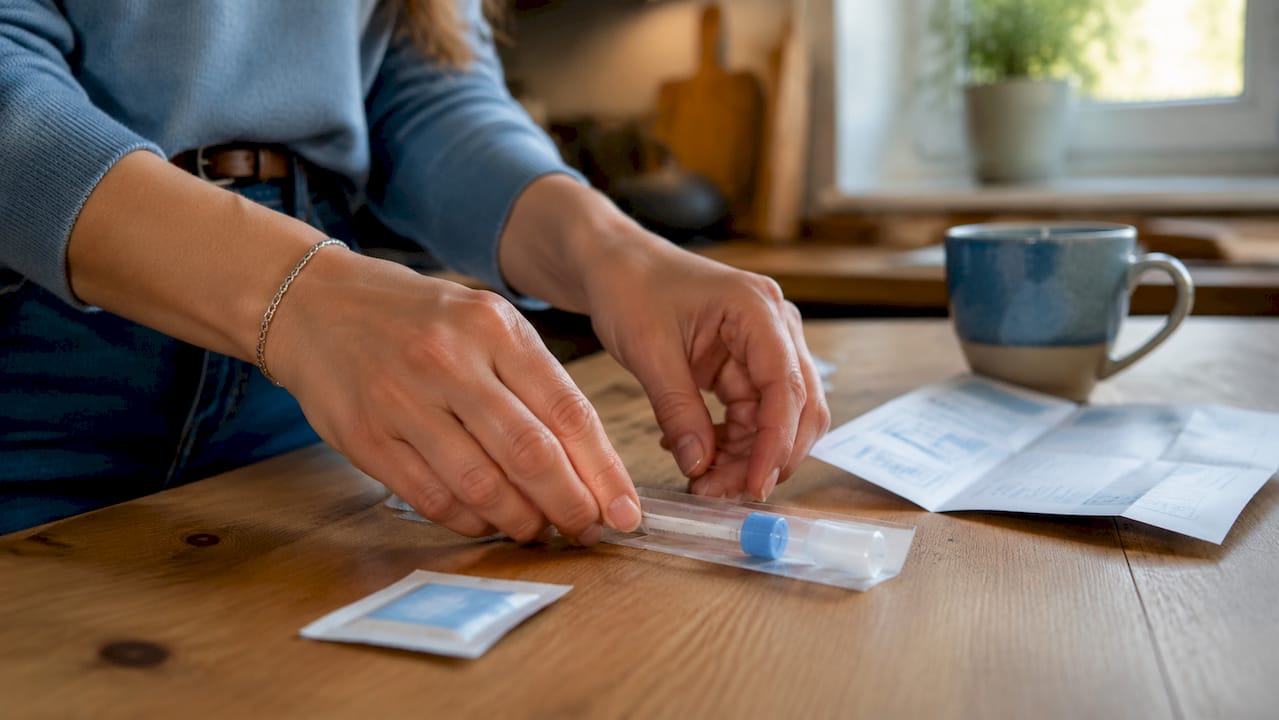
Opening and familiarizing yourself with the test kit early
Unpacking the kit early and mentally rehearsing the procedures is particularly effective at reducing stress and uncertainty during at-home tests. You should open the kit, identify all components, and read the instructions in full at least 24 to 48 hours before the actual test. This may sound trivial, but it is the difference between a smooth process and frantically searching for the right tube under time pressure.
Step by step: Your preparation routine
- Read the instructions: Read the entire instructions 2 to 3 days before the test, not just on the morning of sample collection.
- Create a checklist: Keep all materials ready in a designated place. Tubes, swabs, return envelope, and registration code belong together.
- Secure the documents: Incomplete documentation is the most common source of stress during self-tests. Scan or photograph all accompanying documents as soon as you receive the kit.
- Choose the right time: Schedule the test for a moment when you are rested and do not have other appointments pressing. Timing according to your own biorhythm is crucial: It is best to perform tests at times of day when you feel refreshed.
- Plan buffer time: Including 20 to 30% buffer time in your weekly schedule for possible retakes noticeably reduces stress if something does not work on the first attempt.
- Mentally rehearse the process: Imagine the entire procedure once before you begin. This mental rehearsal measurably reduces tension during the actual process.
Pro tip: Place the opened test kit in a clearly visible spot on your kitchen table the evening before. The visual familiarity the next morning signals to your brain: This is routine, not an exceptional situation.
A common mistake is putting off preparation until the last moment. If you open the kit only five minutes before collecting the sample, you are already starting with an elevated stress level. The solution is simple: Routine is built through familiarity, not willpower.
Which breathing and relaxation techniques help reduce stress?
Breathing techniques are the fastest and most effective way to reduce acute stress before or during a test. Box breathing and the physiological sigh effectively lower the heart rate in under 60 seconds. This is not a relaxation philosophy but physiology: Slow, controlled breathing activates the parasympathetic nervous system and directly slows the stress response.
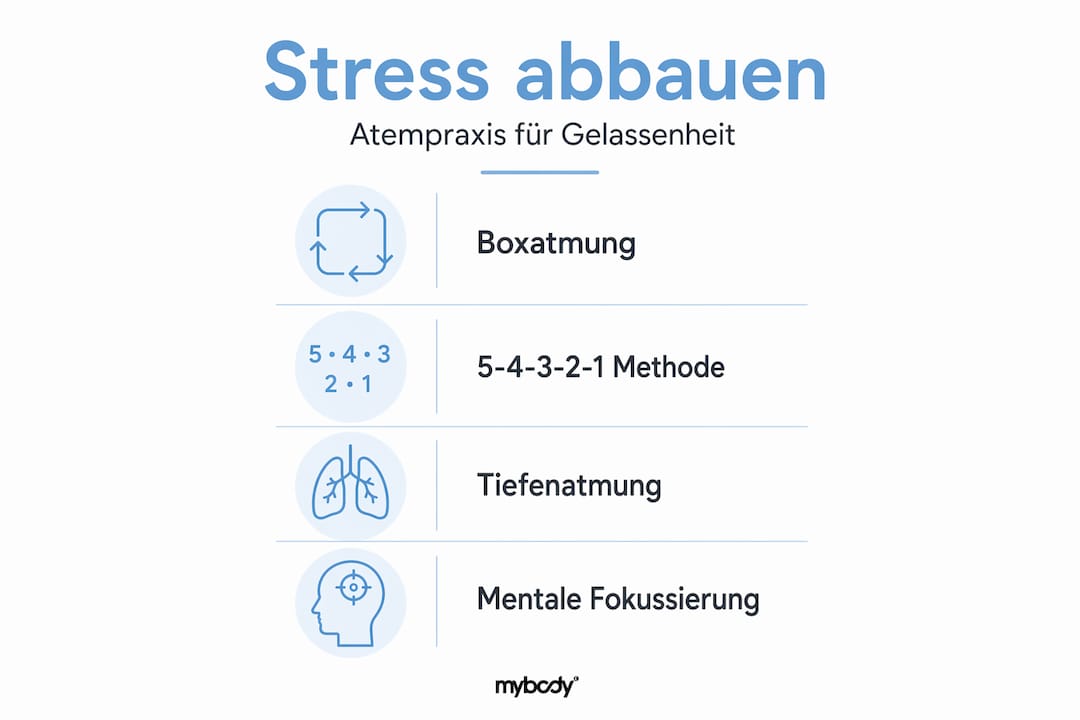
Box breathing: The 4x4 technique
Box breathing follows a simple pattern: inhale for 4 seconds, hold for 4 seconds, exhale for 4 seconds, and hold for 4 seconds. Repeat this cycle three to five times. This technique is used by elite athletes, emergency physicians, and pilots because it works reliably under pressure. For a home test, two minutes of box breathing before starting are enough to sharpen your focus.
Other techniques that work immediately
- Physiological sigh: Inhale through your nose twice in quick succession, then exhale slowly through your mouth. This breath lowers blood CO₂ faster than normal breathing exercises and calms the nervous system within seconds.
- 5-4-3-2-1 method: The 5-4-3-2-1 grounding method significantly reduces the state of alert. Focus on 5 things you can see, then 4 you can feel, 3 you can hear, 2 you can smell, and 1 you can taste. This technique interrupts spiraling thoughts and brings you back to the present moment.
- Shoulder and neck relaxation: Roll your shoulders backward three times and slowly move your head from side to side. Physical tension and mental stress reinforce each other. Relaxing the body also calms the mind.
- Short walking break: Two minutes of slow walking before the test measurably lowers cortisol levels and improves fine motor skills, which is directly relevant for blood or saliva samples.
Pro tip: Combine box breathing with the 5-4-3-2-1 method when you notice your thoughts going in circles. Breathe first, then ground yourself. This sequence is crucial because breath control is the foundation for every other calming technique.
Important: These techniques only work if you have practiced them beforehand. Anyone trying box breathing for the first time in a stressful situation will find it more difficult than someone who has already used it three times in everyday life. So practice the techniques on calm days so they are automatically accessible during the test.
Digital testing procedures and their benefits for relaxed testing
Digital testing procedures eliminate one of the greatest sources of stress in self-testing: uncertainty about whether everything has been documented and transmitted correctly. Digital testing procedures reduce manual errors by nearly 100% through direct digital transmission of results. This means no retyping values, no lost slips of paper, and no illegible handwriting on the return form.
Providers such as mybody x rely on ISO-certified laboratory processes with clear digital feedback channels. After the sample is collected, it is pseudonymized and the result is made directly available in the personal user account. This transparency reduces the pressure because you always know where your sample is and when you can expect a result.
| Aspect | Manual process | Digital process |
|---|---|---|
| Documentation error rate | High (illegible information, missing fields) | Very low (automatic validation) |
| Transparency regarding result status | No tracking possible | Real-time status in the user account |
| Time required for evaluation | Several days due to manual processing | Significantly shorter through direct transmission |
| User control | Low | High (notifications, reminders) |
| User stress level | Increased through uncertainty | Reduced through clear process guidance |
Clear instructions and return systems increase user control and directly reduce uncertainty during testing. This is not a convenience feature but a functional advantage: people who understand and control the process make fewer mistakes and provide better samples. For a blood test at home, this means specifically that the step-by-step instructions in digital format can be paused, revisited, and repeated at any time without a paper booklet becoming crumpled or lost.
Which mental strategies help you test calmly?
The strongest source of stress during health tests is not the sample collection itself, but the thoughts that come beforehand. The focus should shift from the result to the process to reduce stress caused by uncertainty. Those who ask themselves, “What if the result is bad?” create tension. Those who ask themselves, “What is my next step?” remain capable of taking action.
Cognitive reframing: Viewing the test as a routine
Tests should not be viewed as performance situations, but as routine processes, to avoid stress. This reframing is not self-deception, but a conscious reassessment. A health test is not a judgment of you as a person. It is a tool that provides information you can use to take action.
In practice, it helps to set process goals rather than outcome goals. Instead of saying, “I want to have good results,” formulate it as, “I will collect the sample calmly and completely.” This difference may sound minor, but it has a major effect on your stress level because you can fully control the process goal.
Other mental strategies at a glance
- Simulation and active recall: Practice simulation and active recall reduce uncertainty and test anxiety. Go through the process mentally once before you begin. Imagine yourself carrying out each step calmly.
- Vision board or process note: Write down the three most important steps on a piece of paper and place it next to the test kit. Mentally reframing the situation with clear process goals helps reduce stress signals and improve focus.
- Emergency plan for unexpected situations: What will you do if the sample collection does not work? Anyone who has an answer to this question before the problem occurs will respond more calmly. With mybody x, for example, customer service can be reached directly, and a replacement sample is often possible.
- Reflection after the test: Take two minutes to note what went well and what you would do differently next time. This brief reflection builds routine and measurably reduces stress during the next test.
Allowing sufficient buffer time in the test schedule—20 to 30%—noticeably reduces errors and stress. This applies not only to academic exams but directly to home tests as well: If you know you have time for a second attempt if needed, you approach the first one more calmly.
Key findings
Stress-free testing for health tests is achieved through a combination of early preparation, targeted breathing techniques, and a clear focus on the process rather than pressure over the result.
| Point | Details |
|---|---|
| Prepare early | Open the test kit 24 to 48 hours beforehand and mentally walk through the process to reduce apprehension. |
| Use breathing techniques | Box breathing (4x4) or a physiological sigh lowers your heart rate in under 60 seconds. |
| Use digital procedures | Digital submission reduces documentation errors and gives you control over the status of your result. |
| Set process goals | Focusing on the next step instead of the result reduces tension and improves execution. |
| Plan in buffer time | Building 20 to 30% buffer time into your schedule creates confidence and reduces pressure on the first attempt. |
What I learned from hundreds of tests
Most people underestimate how much stress comes from unfamiliarity rather than from the test itself. I have observed this again and again: Someone opens the kit for the first time right before collecting the sample, reads the instructions under time pressure, and then makes exactly the mistake that could have been avoided. A tube filled incorrectly, a forgotten registration code, or a sample that arrives at the lab too late.
What really helps is not courage or discipline. It is familiarity. If you know the kit before using it, have practiced the breathing technique before you need it, and have a plan for the unexpected, you can test calmly. This is not a matter of personality, but of preparation.
One point I especially want to emphasize: Reflection after the test is almost always skipped. Yet it is the easiest way to improve next time. Taking two minutes to note what went well and what did not gradually builds a routine that structurally reduces stress. Anyone who regularly performs health tests—whether blood, saliva, or stool tests—benefits enormously from this small habit.
My honest advice: Treat the first test as a practice run. Not as an exam, but as a way to familiarize yourself with a process. The second test is almost always much calmer because you know what to expect.
— MYBODY X
Perform health tests stress-free with mybody x
mybody x offers ISO-certified at-home tests for DNA, the microbiome, nutrients, hormones, and more, all with clear digital instructions and personal customer service. More than 11,300 customers with an average rating of 4.77 stars show that the process works when it is well supported.
Whether you want to carry out your first at-home medical test or already have experience and want to systematically monitor your health data: mybody x supports you with easy-to-understand instructions, fast results, and GDPR-compliant data security. All samples are pseudonymized and destroyed after analysis. Visit mybody-x.com and find the test that matches your health goals.
FAQ
What does stress-free testing mean for health tests?
Stress-free testing means carrying out at-home tests without errors or unnecessary tension through targeted preparation, breathing techniques, and clear process management. The focus is on the procedure, not the result.
How long before the test should I prepare?
Open the test kit at least 24 to 48 hours beforehand and read the instructions in full. Checklists and a mental practice run 2 to 3 days before the test have been shown to increase the success rate.
Which breathing technique relieves stress the fastest?
Box breathing (inhale for 4 seconds, hold for 4 seconds, exhale for 4 seconds, hold for 4 seconds) lowers your heart rate in under 60 seconds. Alternatively, the physiological sigh works even faster during acute tension.
Why are digital testing procedures less stressful
Digital procedures eliminate documentation errors through automatic transmission and give you real-time insight into the status of your sample. This transparency and control reduce the uncertainty that accounts for most of the stress associated with testing.
What should I do if sample collection doesn’t work on the first attempt?
Plan for 20 to 30% extra time from the outset and check in advance whether your provider supplies replacement samples. At mybody x, customer service is readily available and can provide straightforward assistance if you encounter problems collecting your sample.

Share now:
Muscle weakness: causes, symptoms & which tests can help
Latest information on vitamin B12 deficiency and joint pain in 2026