

Genetic test for weight loss: Your personal code to your ideal weight?
Have you tried countless diets, but nothing seems to really work for you? While your friend is losing weight with intermittent fasting and your colleague swears by low-carb, you often just feel frustrated. If you're wondering why your body works differently, a genetic weight-loss test could finally provide the answers you're looking for. It analyzes your unique genetic predisposition and gives you a personalized user manual for your metabolism – without any one-size-fits-all solutions.
Why standard diets don't work for you
Low-carb diets, intermittent fasting, expensive juice cleanses – the list of attempts is long. The result? Minimal success with maximum frustration. If this sounds familiar: you're definitely not alone.
The desire to lose weight is widespread. A YouGov survey from 2022 shows that around 57 percent of Germans want to lose weight because they are unhappy with their bodies. A full 49 percent have already tried diets. You can find out more about the fascinating background at ZavaMed.
Your DNA as a personal instruction manual
The main reason why the "one-size-fits-all" approach so often fails is actually quite simple: your biology is unique. Your genes are, so to speak, the individual instruction manual for your metabolism. They determine how your body reacts to certain nutrients.
Imagine your body has a preference for a certain "fuel." While one body runs at full throttle on a low-fat diet, another might need more carbohydrates to function efficiently. This is precisely where a genetic test for weight loss comes in.
I was amazed when my own test revealed that my body can process carbohydrates much better than I had thought for years. This single realization changed my entire nutritional strategy and was the crucial key to finally seeing lasting progress.
What your genes really control
Your genetic predisposition directly influences various processes in your body that are crucial for weight loss. These include, above all:
- Your metabolic type: Does your body preferentially use fats, carbohydrates, or proteins for energy?
- Your satiety level: How quickly do you feel full and how pronounced is your hunger?
- Your reaction to exercise: What type of training boosts your fat burning the most?
If you ignore these genetic factors, you're essentially working against your own body. You're forcing it into a pattern that might work for millions of others, but not for you. Once you understand how healthy weight loss can truly work , it quickly becomes clear why a personalized approach is so important.
Ultimately, it's not about a lack of discipline, but about finding the right strategy for your individual biology. A genetic test isn't a magic bullet, but it's an incredibly powerful tool to finally gain clarity.
What your DNA reveals about your metabolism

A genetic test for weight loss isn't magic, but applied science. Think of it this way: you finally get a glimpse behind the scenes of your body and learn the very personal rules by which your metabolism truly operates. But what exactly is examined?
Don't worry, the goal isn't to overwhelm you with technical jargon. Rather, I want to explain in an understandable way which genetic markers are truly relevant to your physique and how you can use this knowledge to your advantage.
Your most important genes checked
Your individual genetic code is determined by thousands of genes. However, only a handful of these are particularly revealing when it comes to weight loss. They act almost like the personal directors of your metabolism, your hunger, and even your motivation to exercise.
The most important players in this game include:
- The FTO gene: It is often referred to as the "obesity gene." Certain variants of this gene can reduce your feeling of satiety and lead to increased hunger. Knowing this predisposition allows you to counteract it with targeted meals rich in protein and fiber.
- The APOA2 gene: This gene reveals how your body reacts to saturated fats. In a specific variant, a high-fat diet can lead to significantly faster weight gain than in other people.
- The ADRB2 gene: This gene is particularly interesting for your exercise program. It can indicate whether you benefit more from moderate endurance exercise or from short, intense training sessions (like HIIT) to maximize your fat burning.
A genetic test is like a compass. It shows you the direction, but you have to walk the path yourself. The results are a personalized recommendation based on probabilities – not a medical diagnosis.
This information is invaluable. It allows you to finally tailor your diet and training to your unique biology. You'll find out whether you're genetically predisposed to be a "low-carb type" or a "low-fat type." I was surprised when my test showed that my body doesn't process saturated fats as efficiently. Since then, I've been more mindful of healthy fats and have noticed how much better I feel.
These genes are analyzed by a metabolic test.
A good genetic test looks at a whole range of markers. The following table gives you a brief overview of which genes are often analyzed and what they can mean for your metabolism and eating habits.
| gene | Function in the body | What a variant can mean for you |
|---|---|---|
| FTO | Controls appetite and satiety | Increased hunger, tendency to eat larger portions |
| APOA2 | Regulates the metabolism of saturated fats | Greater weight gain with a high-fat diet |
| ADRB2 | Does exercise affect fat burning? | Improved response to endurance or interval training |
| PPARG | It plays a role in fat storage. | Sensitivity to monounsaturated fats |
| TCF7L2 | It affects blood sugar levels and the insulin response. | Increased sensitivity to carbohydrates |
| CLOCK | Regulates the circadian rhythm (internal clock) | Influence on mealtimes and nighttime hunger pangs |
These genes are just a sample, but they show how deep the analysis can go. The goal is to get a complete picture, rather than focusing on just one aspect.
From gene analysis to practical application
The raw insights from your DNA are one thing. But the real value only arises when this information is translated into your everyday life. A reputable provider will therefore deliver not just raw data, but clear and actionable recommendations.
This is what an evaluation could look like for you, and what you can do with it:
-
Gene marker FTO: Your test shows a variant that increases the feeling of hunger.
- Your strategy: Focus on meals high in protein and fiber. A protein-rich breakfast (e.g., quark with berries) will keep you full longer than a jam sandwich.
-
Gene marker APOA2: You are more sensitive to saturated fats.
- Your strategy: Consciously reduce your intake of red meat and butter. Replace them more often with avocados, nuts, and good olive oil.
-
Gene marker ADRB2: Your body responds well to endurance training.
- Your strategy: Integrate regular, moderate cardio sessions such as jogging, swimming or cycling (e.g. 3 times a week for 45 minutes ) into your daily routine.
These personalized tips are precisely what sets you apart from generic, off-the-shelf diet rules. They show you exactly which personal adjustments you need to make to achieve the best results. If you'd like to delve even deeper to understand how a DNA test can improve your diet , you'll find further fascinating insights here.
Here's how to get your personal DNA analysis
You're curious and considering a genetic test for weight loss , but you're wondering exactly how it works? Don't worry, getting your personal DNA analysis is much simpler than most people think. I'll guide you through the process and show you what to expect – from ordering to receiving your results.
The best part: It all starts conveniently at your home. You don't need a doctor's appointment or a trip to a lab. The entire process is designed so that you can handle it easily and discreetly yourself.
Your path to the genetic blueprint
The first and most important step is choosing a reputable provider. My tip: Pay close attention to transparent data protection and scientifically sound evaluation. A good partner, such as mybody®x , will send you a test kit directly to your home by mail after you place your order.
This kit contains everything you need for the rehearsal:
- A sterile cotton swab to take a saliva sample.
- A small tube in which the sample is safely stored.
- A very easy-to-follow guide that explains everything in detail.
- A pre-paid return envelope.
Taking the sample itself only takes a few minutes. You simply rub the swab against the inside of your cheek for about a minute, insert it into the tube, and drop the envelope in the nearest mailbox. It really couldn't be easier.
To be honest, I was surprised myself at how straightforward this part was. The instructions were absolutely foolproof, and just the feeling of actively taking the first step towards finally getting answers motivated me enormously.
From the lab directly to you: What happens to your sample
Once your sample arrives at the certified laboratory, the real work begins. Experts isolate your DNA from the cells in your saliva sample and then decode the gene segments relevant to your diet. This process usually takes a few weeks – good quality takes time.
This process shows you at a glance how simple the path from sample to result is.
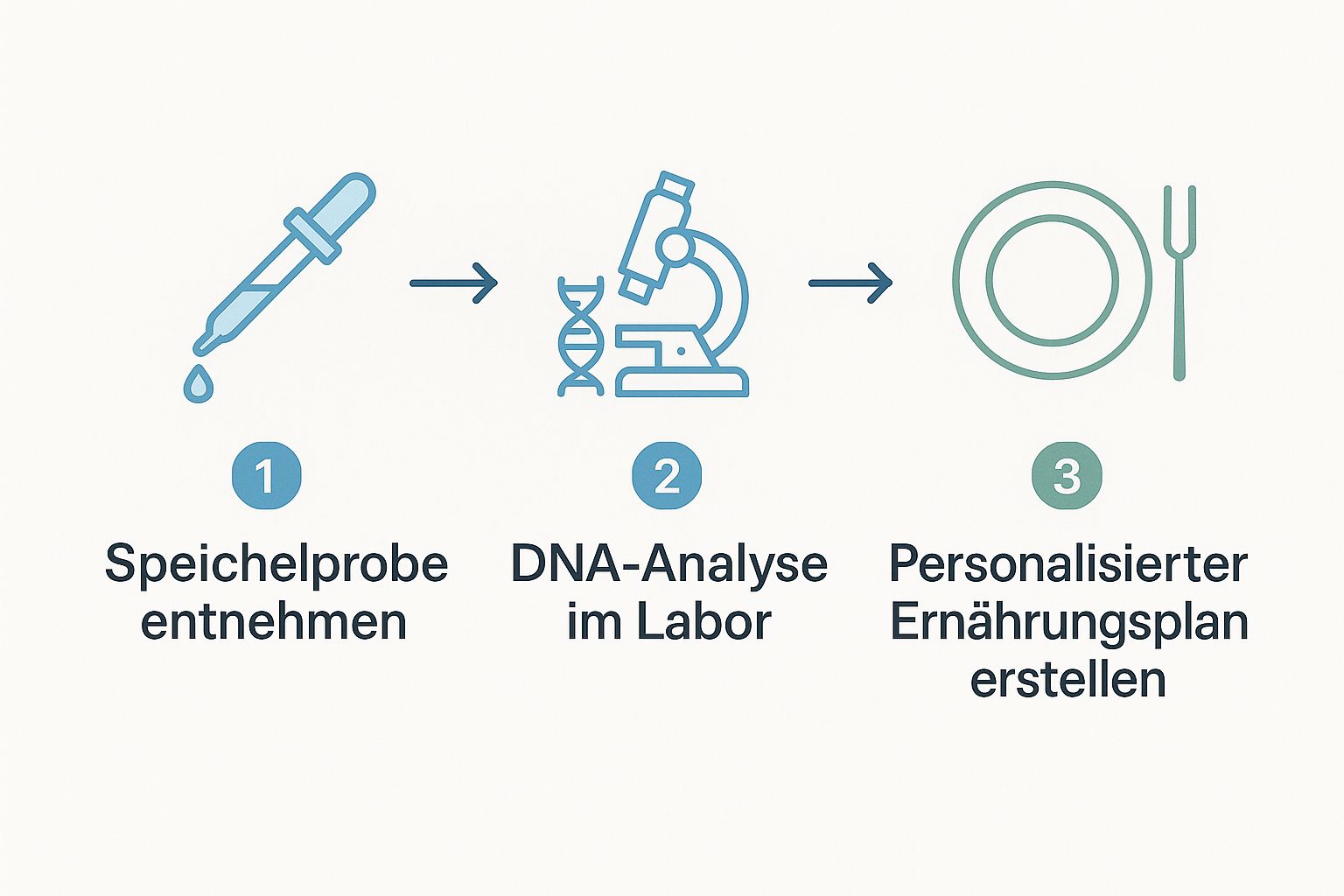
The graphic makes it clear: You are only responsible for the first, very simple step. The experts will take care of the rest for you.
You'll receive your final results presented in a clear and engaging way. This usually takes the form of a detailed report as a PDF and access to an interactive app or online portal. And here you won't just find random data, but clear, actionable recommendations for your diet and lifestyle. Everything is precisely tailored to your genetic predisposition – so you can finally find the strategy that truly suits you.
Finally, you're holding your results in your hands. In black and white, you now see how your body truly functions. This is a powerful moment. But what do you do with all this valuable information in your daily life? That's precisely where we come in: This section is your practical guide, showing you how to transform the scientific data into a functional routine – one that feels good and delivers real results.
The best news first: You don't have to completely turn your life upside down overnight. It's about smart, small adjustments tailored precisely to your genes. See the test as your personal tool, not a strict supervisor.
From knowledge to action: Your personal roadmap
Your results report is the starting point. You'll usually receive a clear classification of your metabolic type – for example, protein, carbohydrate, or mixed. This single piece of information is your compass for everything that follows.
Let's play this out in concrete terms:
-
Scenario 1: You're a "carbohydrate type." Your body is excellent at converting carbohydrates into energy. That's fantastic, because you don't have to give up bread, pasta, or potatoes! The trick lies in the quality: Focus on complex carbohydrates like whole-grain products, oatmeal, and legumes. These will keep you feeling full longer and your blood sugar levels stable.
- Your new shopping list: wholemeal bread instead of white bread, quinoa instead of white rice, lentils and chickpeas.
- Your breakfast upgrade: Instead of jam on toast, now it's porridge with fresh berries. A small swap with a big impact.
-
Scenario 2: You are a "protein type." Your metabolism runs at full speed when it receives enough protein. Perhaps your test showed that proteins keep you feeling full particularly well and for a long time.
- Your new shopping list: Lean meat, fish, eggs, Greek yogurt, tofu and cottage cheese.
- Your lunch strategy: A large salad with chicken breast strips or tofu will make you more satisfied and last longer through the afternoon than a plate of pasta.
Your genetic test for weight loss gives you the answer to the "what," but you determine the "how" yourself. It's not about perfection, but about conscious decisions that feel more natural and better with each passing day.
More than just food: Optimize your training
You can also use the results to perfect your exercise program. Did your test show that you respond particularly well to endurance sports (for example, due to a variant in the ADRB2 gene )? Then consciously plan two to three moderate cardio sessions per week. This could be a jog in the park or a longer bike ride on the weekend.
However, if your genetics indicate that short, intense bursts of activity like HIIT (High-Intensity Interval Training) maximize your fat burning, then 20-minute workouts might be enough to achieve visible results.
Implementation is actually easier than you might think. It's about making your training not harder, but finally smarter .
The power of the mind: Don't underestimate the mental aspect.
A genetic test for weight loss provides you with the biological blueprint. However, your success depends crucially on your mental attitude. The journey to your ideal weight is a marathon, not a sprint.
Statistics show that only 20 to 30 percent of those who lose weight are able to maintain their goal in the long term. The reason often lies not in the diet plan, but in one's mindset and how one deals with setbacks. If you want to delve deeper into how to program your mind for success, you'll find valuable tips in this insightful article on Focus Online .
View your genetic analysis as a boost to your self-confidence. You now know that past failures weren't due to a lack of discipline, but probably simply to the wrong strategy. With this new knowledge and a positive, patient attitude, you have the best chance of finally creating the change you desire – and making it last.
The honest limits of a genetic test

A genetic test for weight loss provides you with valuable, personal insights. But despite my enthusiasm for this modern method, it's important for me to make one thing perfectly clear: A genetic test is not a miracle cure. It's not the magic switch that makes the pounds melt away while you lie on the couch.
Rather, it's an incredibly detailed map. It shows you the most efficient path, but you have to walk it yourself. Your DNA only tells one part of the story, albeit an important one.
Your genes are only one piece of the puzzle.
Your success in losing weight is never solely determined by your genetic predisposition. Factors related to your daily life and your mindset are at least as crucial.
This includes, above all:
- Your lifestyle: Do you get enough sleep? What is your stress level? Do you smoke or drink alcohol regularly? All of this massively influences your metabolism and hormones.
- Your habits: Emotional eating, irregular meals, or nighttime snacks often have little to do with genetics, but a lot to do with patterns learned over years.
- Your mental health: Your mindset, your patience, and how you deal with setbacks are often the real game-changers on the way to your ideal weight.
A good example of this is smoking behavior. Current data for 2022/2023 shows that 32.7% of men and 24.8% of women in Germany smoke. This vividly underscores how strongly external factors, in addition to genetics, shape our overall health. You can find more information in the RKI's insights on obesity and smoking.
How to recognize unrealistic promises
The market for genetic tests is growing, and unfortunately, there are also providers who promise you the moon. Be skeptical if you come across the following statements:
"Lose 10 kilos in 4 weeks – guaranteed by your DNA!"
Such promises are not only unrealistic but also unethical. A genetic test can guide you toward a healthier weight, but it never replaces the fundamentals: a calorie deficit, a balanced diet, and regular exercise. It's a valuable tool, but certainly not a shortcut. You can find out more about how a DNA test can truly help with weight loss in our related article.
So be aware: your genes are a fixed factor, but your lifestyle is the variable you control every day. A genetic test gives you the best possible tools, but the responsibility for implementing and developing a healthy, mindful relationship with your body remains with you.
But that is precisely where your greatest strength lies.
Your most important questions about genetic testing
To conclude our journey into the world of nutrigenetics, I'd like to answer the most frequently asked questions I encounter regarding genetic testing for weight loss . Here you'll find clear and honest answers that will help you clear up any remaining uncertainties and make the right decision for yourself.
Is a genetic test for weight loss scientifically sound?
Yes, absolutely. The science behind it is called nutrigenetics and is a well-established field of research. Many connections, such as the influence of the FTO gene on our feeling of hunger, are very well documented by numerous studies.
Reputable providers therefore always base their analyses on published scientific findings. This is precisely the crucial difference to the sweeping diet myths that one reads everywhere.
It's important to interpret the results correctly: they are personalized recommendations based on probabilities – not a medical diagnosis. A genetic test is not an oracle that predicts your future, but a tool that helps you finally understand your body better.
How much does such a test cost, and does health insurance cover it?
The cost of a genetic test for weight loss can vary depending on the provider and the scope of the analysis, but usually ranges between 200 and 500 euros . That might sound like a lot at first, but think about it: your genes don't change. So it's a one-time investment in your health that you can benefit from for the rest of your life.
Currently, statutory health insurance companies in Germany do not cover the costs of such lifestyle genetic tests, as they are not considered medically necessary. Therefore, you are making a private investment in yourself and your well-being.
What happens to my sensitive genetic data?
This is one of the most important questions of all – and data protection has absolute priority here. Reputable providers, especially those based in the EU, are subject to the strict General Data Protection Regulation (GDPR).
Pay close attention to these points:
- Pseudonymization: Your sample should be analyzed in the laboratory without your name, i.e., only with a code.
- Certified laboratory: The laboratory must be certified according to recognized standards (e.g. ISO).
- Transparent privacy policy: The provider must clearly explain how your data is stored, processed and protected.
- Right to erasure: You must have the option at any time to request the deletion of your data and the destruction of your sample.
Always read the privacy policy carefully before making a purchase. Your genetic data is your property and must be secure.
For whom is a DNA test truly useful?
A genetic test is ideal for you if you recognize yourself in any of these points:
- You've already tried a lot of things, but you're frustrated because standard diets just don't work for you.
- You are looking for a highly personalized, scientifically sound strategy for your diet and training.
- You are curious, eager to learn, and ready to actually implement the new insights in your everyday life.
However, if you're expecting a quick fix without any effort on your part, this test probably isn't for you. It's a fantastic guide, but you're the one who ultimately walks the path to your goal. Our comprehensive guide to genetic nutrition testing and weight loss based on DNA provides even more details that can help you make your decision.
Are you ready to finally discover the nutrition strategy that truly suits you? With the scientifically based analyses from MYBODY Lab GmbH, you'll receive your personal roadmap to greater well-being and lasting success.


Share:
Boost your metabolism naturally – 8 simple tips for more energy and a better body image
8 common vitamin deficiency symptoms you should know