

Nutritional analysis: Your personal guide to better health
Imagine having a personal user manual for your body—one that tells you exactly which nutrients you really need and which diet will best help you achieve your goals. That is precisely the essence of a modern nutritional analysis: It translates your body's signals into a clear, actionable plan for your health.
What a nutritional analysis can do for you
Do you often feel tired even though you actually get enough sleep? Have you tried countless diets, but the number on the scale simply will not budge? Or do you just want to make sure that your body is optimally nourished and that you are taking proactive steps for your health? If you answer yes to even one of these questions, a nutritional analysis is an extremely powerful tool for you.
This is about much more than simply counting calories or following general nutrition tips from the internet. A scientifically grounded analysis goes deeper and reveals your own personal, unique needs. It is like an exclusive look behind the scenes of your metabolism.
Finally understand your body
Each of us is unique. Your genes, your lifestyle, and even the tiny bacteria in your gut determine how you respond to certain foods. That is why there is simply no one-size-fits-all “healthy diet.” What works wonderfully for one person may be ineffective or even counterproductive for another. A nutritional analysis helps you identify these individual differences.
It can provide answers to crucial questions:
- Weight issues: Why am I not losing weight even though I eat healthily? Could I be particularly efficient at processing fats or carbohydrates?
- Energy & performance: Am I lacking essential vitamins or minerals that are leaving me low on energy?
- Digestive issues: Could my bloating or discomfort be related to my gut flora?
- Prevention: How can I optimize my diet to stay healthy, fit, and capable in the long term?
A turning point for your health
The insights from a nutritional analysis can be a real turning point. Instead of stumbling around in the dark and trying every new trend, you get a clear, data-based foundation for your decisions. You learn which foods are genuinely good for you and which you may need to adjust to achieve your goals—whether that involves weight, energy, or well-being.
Personalized nutritional analysis replaces guesswork with knowledge. It gives you back control and enables you to shape your health independently and intentionally, based on facts about your own body.
The areas of application are extremely diverse. Nutritional analysis can help you not only optimize your weight, but also address highly specific concerns, such as the desire for healthier and faster hair growth. Nutrient deficiencies that often go unnoticed can significantly affect hair quality, and an analysis exposes such deficiencies unequivocally. There are even helpful tips for faster hair growth that go hand in hand with optimized nutrient intake.
Ultimately, the analysis enables you to adjust your diet so that you feel more comfortable in every area of life. If you're curious about exactly how such an examination works, you can find detailed information in our comprehensive article on DNA analysis.
Which nutritional analysis method is right for you
The path to your ideal diet is as personal as your fingerprint. That is precisely why there is no one perfect method of nutritional analysis. Instead, there are various approaches, each offering a different perspective on your body. Think of it as a toolbox: some tools analyze your body's basic blueprint, while others check its current operating condition.
To make the right choice here, you should know your goal. Do you finally want to understand why your body processes fats and carbohydrates in such a unique way? Are you looking for the cause of your constant fatigue? Or do you simply want to get your digestion back on track?
The most common goals people pursue with nutritional analysis can be summarized well.
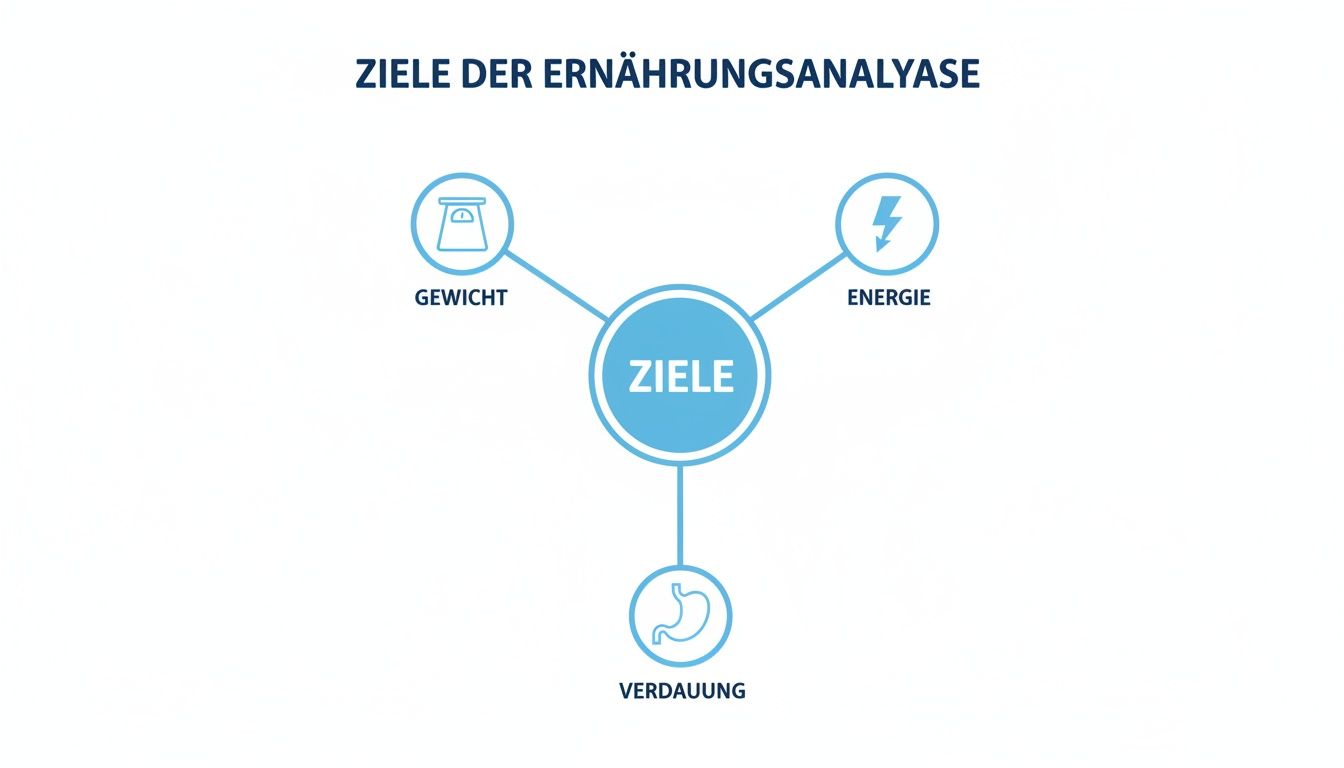
As you can see, almost everything revolves around weight, energy, and digestion—the three major pillars of a fit and high-performing life. Depending on where you need support, a different analysis method may be right for you.
DNA Analysis: Your Genetic Blueprint
Imagine your DNA as your body's definitive cookbook. A DNA metabolism analysis reads this book and reveals which “recipes” you are naturally predisposed to. It gives you fundamental insights into how your body basically processes the major nutrient groups—fats, carbohydrates, and proteins.
This analysis is a match for you if you:
- Want to manage your weight over the long term: You find out whether you are genetically more of a carbohydrate, fat, or mixed type.
- Want to take your training to the next level: The analysis can provide insights into your muscle fiber type or your ability to recover.
- Want to understand your basic predispositions: Why do I react so strongly to caffeine, or have a higher risk of certain nutrient deficiencies?
The biggest advantage of DNA analysis is its lifelong validity. Your genes do not change. The result is therefore a one-time investment in understanding the fundamentals of your body and serves as a foundation for all future nutrition decisions.
This type of personalized nutrition is becoming increasingly important. Moving away from rigid diet rules toward individual solutions—that is the clear trend also confirmed by the 2025 Nutrition Report. In it, 82 % of the experts surveyed named a plant-focused diet as the most important trend. In particular, people who eat flexibly and consciously want to understand how their genetics affect nutrient absorption and weight management.
Blood analysis: Your current nutrient tank level
While DNA describes your potential, blood analysis provides a snapshot of your current nutritional status. It measures what is actually circulating in your body and uncompromisingly reveals deficiencies or excesses in vitamins, minerals, and other important biomarkers.
A blood test is especially valuable when you:
- You suffer from nonspecific symptoms such as fatigue, difficulty concentrating, or hair loss.
- You want to make sure you are getting all the essential micronutrients, for example on a vegan or vegetarian diet.
- You want to improve your athletic performance and make sure that no deficiency is holding you back.
Typical candidates for a check include vitamin D, iron (ferritin), vitamin B12, magnesium, and zinc. Such a test gives you immediately actionable insights into where you need to make changes—whether in your diet or through targeted supplements.
Microbiome analysis: A look into your gut
Trillions of bacteria live in your gut and together form your microbiome. These tiny helpers influence far more than just your digestion. They play a role in your immune system, mood, and even body weight. A microbiome analysis, usually performed using a stool sample, provides deep insight into the composition and diversity of your gut flora.
This test is the right choice if you:
- You often struggle with digestive issues such as bloating, constipation, or irritable bowel syndrome.
- You want to strengthen your immune system – after all, around 70 % of the immune cells in the gut.
- You want to understand how your gut feeling influences your overall health and well-being.
The analysis shows whether your gut bacteria are in balance, whether beneficial strains are missing, or whether unwanted ones have spread. Based on this, you receive targeted recommendations, such as probiotic foods or fiber, to get your gut health back on track.
If you want to dive even deeper into the world of genetics and its influence on your metabolism, our article tells you everything about the mybody-x metabolism test.
Comparison of analysis methods: DNA vs. blood vs. microbiome
To make your decision easier, we have summarized the key differences, benefits, and ideal applications of the three most important methods for you in a table.
| Characteristic | DNA analysis (metabolism) | Blood analysis (nutrients) | Microbiome analysis (gut flora) |
|---|---|---|---|
| What is measured? | Your genetic predisposition for metabolism & nutrient requirements | Current concentration of vitamins, minerals, etc. in the blood | Composition and diversity of bacteria in the gut |
| Validity | Lifelong, since genes do not change | Snapshot (approx. 3–6 months) | Snapshot (can be changed by lifestyle) |
| Goal | Developing a long-term, fundamental nutritional strategy | Identifying and addressing short- to medium-term deficiencies | Improving gut health, alleviating digestive issues |
| Ideal for... | Weight management, training optimization, basic understanding | Fatigue, performance slumps, specific diets (e.g., vegan) | Digestive problems, a weakened immune system, general well-being |
| Sample | Saliva | Blood | Stool |
Each method has its strengths. DNA analysis provides the foundation, blood analysis shows your current status, and microbiome analysis offers insight into your inner ecosystem. Often, combining these approaches is the smartest way to achieve a thoroughly healthy lifestyle.
This is how you can easily start your nutritional analysis from home
Does a professional laboratory analysis make you think of doctor visits, long waiting times, and complicated forms? Fortunately, those days are over. Today, you can conduct a detailed nutritional analysis conveniently and discreetly in your own home. At mybody-x, we have designed the process to fit seamlessly into your daily routine—straightforward, yet with maximum scientific precision.
The path to your personal health data is remarkably simple and completely transparent. So you know exactly what to expect, we'll now guide you step by step through the entire process.

Your analysis starts in just 3 steps
It all starts with your decision to finally understand your body properly. From that point on, we take over and make everything as easy as possible for you.
- Choose & order your test kit: Browse our website and choose the analysis that best suits your goals. Whether it's a DNA metabolism test, microbiome analysis, or specific nutrient check, your personal test kit will be on its way to you in just a few clicks.
- Collect your sample conveniently at home: Your kit contains everything you need, including an easy-to-follow, illustrated guide. Depending on the test, this may be a simple saliva sample, a small, virtually painless finger prick, or a stool sample. The entire process takes only a few minutes and requires no prior knowledge.
- Return your sample free of charge: Once you have collected your sample, place it in the enclosed, prepaid return envelope. Simply drop it in the nearest mailbox or hand it in at the post office—we'll take care of the rest.
This straightforward process removes every obstacle. You don't need to make appointments or rearrange your daily routine. Everything adapts to your schedule, not the other way around.
What happens to your sample in the laboratory
As soon as your sample arrives at our facility, the actual scientific work begins. It is analyzed by experts in a specialist laboratory in Germany certified to ISO standards. State-of-the-art technologies are used to obtain precise and reliable data about your body.
Privacy and anonymity are our top priority. Your sample is immediately pseudonymized, meaning it can only be identified using a random code. Your name and personal data are completely separated from the sample. This ensures that your sensitive health data is protected at all times in accordance with the strictest GDPR guidelines.
After the analysis is complete, your biological sample is professionally and permanently destroyed. You retain full control over your data, which will never be shared with third parties without your explicit consent.
Your results report: presented clearly
Once the laboratory analysis is complete—which usually takes just a few weeks, depending on the type of test—we’ll notify you by email. Your detailed results report will then be waiting in your personal, secure customer account on our website.
We place the highest value on ensuring that you not only see your results, but truly understand them. We translate complex scientific data into clear charts, easy-to-understand text, and, above all, concrete, actionable recommendations. So you don’t receive an incomprehensible lab report, but a personal guide to your health.
The entire process, from taking a DNA test to receiving your completed report, is designed to give you clarity. You’ll find more details in our guide on how to easily obtain your personal genetic analysis.
How to read your results report correctly
At last, you’re holding it in your hands: your personal results report. A document full of data, charts, and scientific insights into your body. But what now? Don’t view this report as a rigid document, but as your very own treasure map to better health. Let’s translate the science into your everyday life together and see what this data really means for you.

Our goal is to give you the tools you need not only to read what your report says, but also to understand why it matters for you and your goals. Think of the results as your personal guide—they’ll help you make informed, thoughtful decisions for your well-being.
The key findings—what’s behind them?
A mybody-x results report is structured to distill complex information into clear, concise insights. You’ll find clear categories focused on the most important aspects of your health. Let’s take a look at how you can interpret typical findings from a DNA or nutrient analysis for yourself.
Example 1: Your DNA Metabolic Type
A key result of your DNA analysis is often the determination of your metabolic type. Perhaps the report classifies you as a “carbohydrate type.” This does not mean that fats or proteins are off-limits for you.
Rather, it means that your body is genetically wired to obtain energy from carbohydrates particularly efficiently. For you, this could mean the following in everyday life:
- Your energy level: Complex carbohydrates from whole-grain products, legumes, or vegetables will probably give you a steadier and longer-lasting energy boost than a very high-fat meal.
- Your weight management: If you want to lose weight, you may benefit more from moderately reducing your fat intake than from following a strict low-carb diet that may work perfectly for others.
- Your well-being: Your body will probably signal a pleasant feeling of fullness sooner when your meals contain a balanced proportion of healthy carbohydrates.
The classification into metabolic types is not a rigid rule, but a strong tendency. It helps you sharpen your nutritional focus and understand which “fuel” your engine runs best on.
Example 2: Your Nutrient Status
Let’s imagine that your nutrient check shows a low vitamin D level. This is far more than just a number on paper; this value has a direct impact on your everyday life.
A deficiency in vitamin D, the famous “sunshine vitamin,” can manifest in many different ways:
- Fatigue and lack of motivation: Do you often feel exhausted for no apparent reason? A low vitamin D level can noticeably deplete your energy reserves.
- Mood swings: Vitamin D is involved in the production of serotonin, our “happiness hormone.” If you lack it, it can affect your mood.
- Weakened immune system: Do you get sick more often than others? Vitamin D is a key player in strong immune defenses.
This information is essentially a direct call to action. It shows you a specific area where you can make a difference—whether through more sunlight, vitamin D-rich foods such as fatty fish, or targeted supplementation.
From Insight to Action
The true value of your nutrition analysis only unfolds when you connect the individual points. It is about recognizing patterns and establishing connections between the data and how you feel in your daily life.
Ask yourself questions like these:
- Does my genetic predisposition to caffeine sensitivity explain why I sleep so poorly after my afternoon coffee?
- Could my slow recovery after exercise be related to the magnesium deficiency identified in my blood test?
- Could my tendency to experience cravings be related to my metabolic type needing more protein to feel satiated?
These connections are precisely the key to taking responsibility for your health. You begin to stop dismissing your body's signals as coincidences and instead understand them as the logical result of your unique biology.
Your report provides the scientific foundation, but you are the expert on your everyday life. To put the results into practice as effectively as possible, it is worth going one step further. In our guide, you can learn more about how to optimize your diet based on your test results. With this knowledge, you will be able to use your report for what it is: a personal guide to a healthier, higher-performing life.
How to implement your insights in everyday life
Knowledge is the first step, but implementation determines success. Your results report is not a document to be filed away, but your personal roadmap to greater well-being. It is not about completely turning your life upside down overnight. Rather, it is the smart, targeted adjustments that truly fit you and your everyday life—and that is exactly where we come in.
The biggest hurdle is often the gap between knowing what would be healthy and what actually ends up on your plate in stressful everyday life. A scientific analysis of the health situation in Germany puts it plainly: Although around 34 percent of Germans are familiar with common dietary recommendations, a shockingly small two percent manage to maintain a consistently healthy lifestyle.
This figure has even fallen significantly since 2010; back then, it was still eleven percent. A major problem is how stress is handled, with only 20 percent of respondents managing it in a healthy way. This is where a personalized nutrition analysis closes the crucial gap: It provides you with a scientifically sound, individualized roadmap that puts an end to guesswork.
Your nutrition plan based on your metabolic type
One of the most valuable insights from your analysis is understanding your personal metabolic type. Instead of following one-size-fits-all diet rules, you can now put together your meals in a way that optimally nourishes your body.
- Focus on macronutrients: Are you a “carbohydrate type”? Then consciously include complex carbohydrates such as oats, quinoa, or sweet potatoes in your meals. They provide stable energy and keep you feeling full for much longer.
- Smart snacks: As a “fat type,” you benefit from healthy fats. A handful of nuts, an avocado, or a few olives are often better snacks for you than a sweet bar, as they keep your blood sugar levels stable.
- Protein for satiety: If your body needs more protein, make sure every meal contains a good source of protein. This could be low-fat quark for breakfast, lentils at lunch, or fish in the evening. This is a smart way to prevent cravings.
Targeted nutrient supplementation—when does it make sense?
Your results report can identify specific nutrient deficiencies, such as vitamin D or iron. Before you reach straight for dietary supplements, however, the first and most important step is always to adjust your diet.
Dietary supplements are not a substitute for a balanced diet. They provide targeted support to fill gaps that are difficult to cover through food alone. They work best when the foundation is right.
So when is supplementation really useful?
- For diagnosed deficiencies: If your report shows a clear deficiency (e.g., vitamin D in winter), targeted supplementation is often the quickest way to replenish your stores.
- When requirements are higher: Athletes, pregnant women, or people going through particularly stressful phases of life often have a higher need for certain nutrients such as magnesium or B vitamins.
- For special diets: Anyone following a purely plant-based diet should definitely take vitamin B12 supplements, as it is found almost exclusively in animal products.
At mybody-x, you will find not only analyses to determine your needs, but also high-quality supplements tailored precisely to these common deficiencies. This way, you can be sure that you are giving your body exactly what it really needs.
Your lifestyle as a success factor
Your diet is only one piece of the puzzle. You will achieve the best results if you also align other areas of your life with your new insights. Your nutrition analysis also provides valuable guidance for this.
Sports and exercise Your genetic muscle fiber type reveals whether you are more likely to benefit from strength training or endurance sports. Use this knowledge to make your training more effective and reach your goals faster. Perhaps the intense HIIT session is exactly your thing, or maybe you truly thrive on long, moderate runs.
Stress management and sleep High cortisol levels or a genetic predisposition to stress can directly sabotage your metabolism and nutrient absorption. Techniques such as meditation, breathing exercises, or regular walks in nature can help you lower your stress levels. Good sleep is also essential for recovery and hormonal balance—both crucial factors for maintaining a healthy weight.
Holistic health You can apply the insights from your analysis to many areas of life. For example, a better understanding of sugar and carbohydrates can also help you develop targeted strategies for a tooth-friendly diet. In this way, your knowledge becomes a powerful tool for comprehensive well-being that extends far beyond nutrition alone.
Frequently asked questions about nutritional analysis
By now, you have read a lot about how a nutritional analysis can help you gain more clarity about your health. Nevertheless, a few questions often remain before embarking on this exciting, deeply personal journey. That is perfectly normal—after all, it is about you and your body.
To dispel your remaining uncertainties, we have collected the answers to the questions we are asked most frequently here.
How secure is my data in a DNA analysis?
Absolutely secure. Data security is mybody-x’s top priority, and we strictly comply with the General Data Protection Regulation (GDPR). As soon as your sample arrives at the laboratory, it is immediately pseudonymized. This means it is assigned a random code and is no longer linked to your name.
After the analysis, the biological sample is destroyed safely and in accordance with regulations. We never share your genetic data with third parties without your explicit consent. You always retain full control, and your privacy is maximally protected.
Do I have to completely change my diet after the test?
No, absolutely not! A nutritional analysis does not give you radical prohibitions, but smart, personalized recommendations that are truly right for you. It is about targeted optimization, not a revolution on your plate.
Often, it is the small, conscious adjustments that make the biggest difference. Perhaps you notice that a little more protein at breakfast does you good or that certain carbohydrates simply give you more energy. The results are your personal compass, helping you make better decisions—without deprivation or frustration.
A nutritional analysis is designed to make your life easier, not more complicated. It gives you the freedom to let go of general diet myths and instead listen to the clear signals from your own body.
Who can really benefit from a nutritional analysis?
A nutritional analysis is valuable for anyone who wants to take control of their health and better understand their body. However, you benefit especially if you have specific goals:
- Lose weight sustainably: You finally want to understand why diets have failed for you in the past and which strategy truly suits your metabolism.
- Improve athletic performance: You want to ensure that your body is optimally supplied with nutrients to achieve your training goals and speed up recovery.
- Get digestive problems under control: You are looking for the cause of constant discomfort and want to support your gut health in a targeted way.
- Have more energy in everyday life: You often feel tired and sluggish and want to know whether a nutrient deficiency could be behind it.
In short: It is the perfect tool for anyone who is tired of general advice and is looking for individualized, scientifically grounded solutions. If you feel like you're doing everything “right” but aren't seeing results, the analysis often provides the crucial insight.
How long does it take to receive my results?
Once your sample has arrived at our laboratory, the analysis usually takes between 2 and 4 weeks. The exact timeframe depends on the type of test—a complex DNA analysis naturally takes a little longer than a simple nutrient check.
We know you're eagerly awaiting your results and will keep you updated. As soon as your analysis is complete, we'll notify you immediately by email. You can then access your detailed, easy-to-understand results report directly in your secure online customer account.
Are you ready to put an end to guesswork and finally gain clarity about your body's needs? At mybody-x, you'll find the scientifically grounded nutritional analysis that is perfectly suited to you and your goals. Discover your individual path to greater health and well-being now at https://mybody-x.com.



Share now:
Genetic testing experiences: what the test shows and what it doesn’t
Genetic analysis step by step: optimize your health strategically