
Hair loss due to iron deficiency: Understanding & stopping the cause
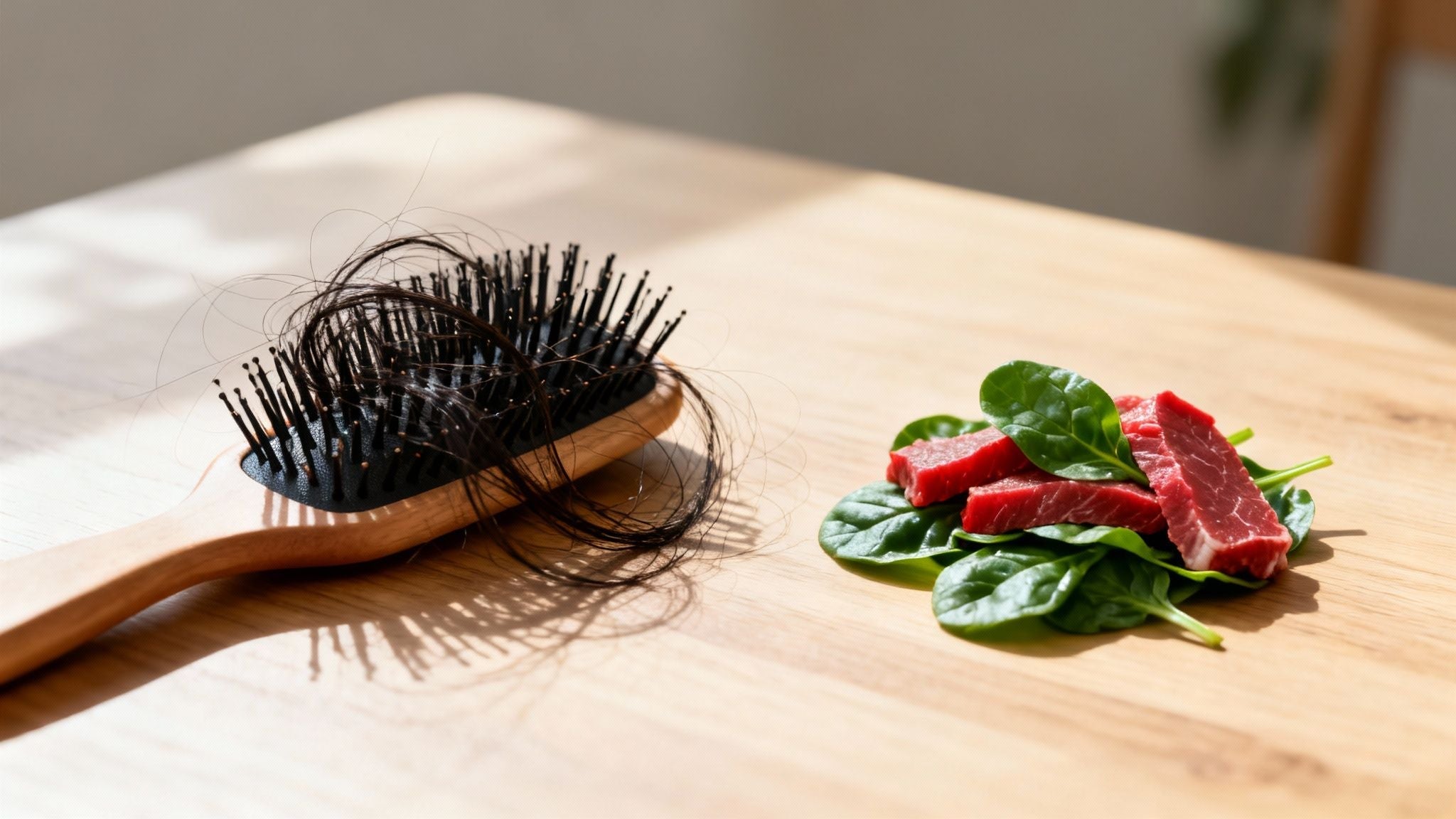
Have you also been finding more and more hair in your brush lately? If you are looking for a cause, you have come to the right place. Because yes, hair loss due to iron deficiency is indeed one of the most common causes, especially among women. Think of your body as a clever manager that has to distribute scarce resources. Vital organs naturally get everything they need. Less critical areas, such as hair production, are quickly put on the back burner.
Why your hair is affected first by iron deficiency
When you notice that your hair is thinning or that you are losing more hair than usual, it is understandable to feel concerned. You often look for the cause in stress or the wrong hair-care products. But the problem frequently lies much deeper—in your nutrient balance. And iron is a crucial factor here.
Your hair roots are among the most active cells in your entire body. They divide tirelessly to continually produce new hair. This energy-intensive process requires a constant supply of oxygen and nutrients. This is exactly where iron comes in. It is the central component of hemoglobin in red blood cells, which transports vital oxygen to every single cell—including your hair follicles.

When the fuel for hair production is missing
When your body lacks iron, it immediately switches into survival mode. Supplying the heart and brain has absolute priority. Areas that are not immediately necessary for mere survival—such as strong hair growth or healthy fingernails—are the first to receive insufficient supplies.
The result? Cell division in the hair roots slows down, the hair’s growth phase (anagen phase) is shortened, and more hairs prematurely enter the shedding phase (telogen phase). The result is the typical diffuse hair loss: Overall, your hair simply looks thinner and more lifeless.
This connection is well documented scientifically. A French study showed that just under 60 percent of the women studied with severe hair loss had extremely low iron levels. This underscores how directly hair health depends on an adequate iron supply. Since your body cannot produce iron itself, you need to get it from your diet every day. You can find more fascinating details about this study in this article on n-tv.de.
The iron store is the true indicator
What is often crucial is not just the iron currently circulating in the blood (serum iron), but above all your iron stores, known as ferritin. You can think of it as your body’s iron warehouse.
If this storage is empty, your body can no longer compensate for short-term shortages, and hair production is among the first processes to suffer. A low ferritin level is therefore an important early warning sign, often appearing long before other symptoms or full-blown anemia develop.
Important note: For optimal hair growth, experts often recommend a ferritin level of over 50–70 µg/l, even though medical reference ranges often start as low as 15–30 µg/l. A level in the lower “normal range” may therefore already be far too low for your hair.
To give you a quick overview, we have summarized the most important facts here in a table.
Iron deficiency and hair loss at a glance
This table summarizes the most important facts about the connection between iron deficiency and hair loss.
| Aspect | Description |
|---|---|
| Cause | Your body prioritizes vital organs and reduces the supply of nutrients to the hair roots. |
| Mechanism | Oxygen deficiency in the hair follicles leads to a shortened growth phase (anagen phase) and increased hair loss. |
| Symptom | Diffuse hair loss: The hair becomes thinner and weaker overall, not just in individual areas. |
| Key value | The storage iron ferritin is often more informative than the current serum iron level. |
| Optimal level | For healthy hair growth, a ferritin level of over 50–70 µg/l is recommended. |
This overview gives you a clear initial summary before we explore the connections in greater depth in the following sections.
What iron deficiency really does to your hair roots
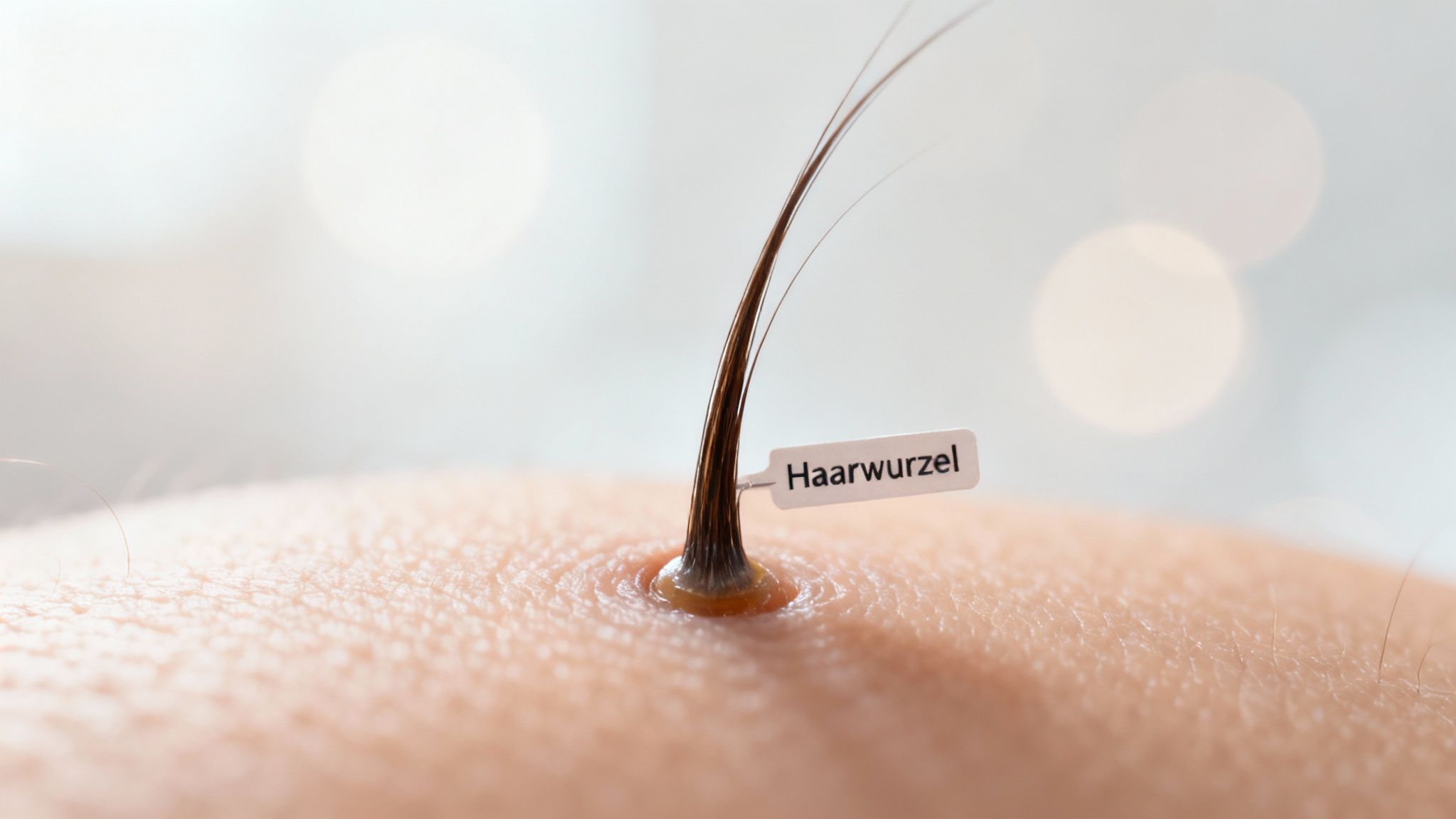
To understand why iron deficiency causes hair loss, we need to take a closer look at the issue—right at the root of the problem. Imagine your hair roots, known as hair follicles, as tiny, highly specialized factories. Their only job: to produce new hair around the clock, one cell at a time.
These small production sites are among the most metabolically active areas in the entire body. This uninterrupted process requires an enormous amount of energy and, above all, oxygen. And this is exactly where iron comes into play. It is the crucial fuel, because iron is the core of hemoglobin, which transports oxygen through the blood to every single cell.
When the hair factory runs on low power
If your body is now lacking iron, not enough oxygen can reach the hair roots. The result is a full-blown energy crisis in your hair factory. The machines run more slowly, cell division stalls, and the entire production process is scaled back. Your body is clever and has to set priorities: It reduces nonessential hair production to supply vital organs.
This has direct and noticeable effects on the natural hair cycle.
The hair cycle falls out of sync
Every hair’s life cycle follows a clear rhythm. Iron deficiency completely disrupts this finely tuned rhythm, triggering visible hair loss.
-
1. The growth phase (anagen phase): Normally, about 85–90% of your hair is in this active phase, which lasts several years. This is where intensive cell division takes place, consuming a significant amount of iron. With iron deficiency, this phase becomes drastically shorter because the hair root simply no longer has enough energy for growth.
-
2. The transition phase (catagen phase): A short phase lasting a few weeks, during which hair growth stops and the follicle regresses.
-
3. The shedding phase (telogen phase): After a resting period, the hair eventually falls out to make room for a new one. In a healthy cycle, this affects only about 10–15% of the hair.
When you have an iron deficiency, your body sends a disproportionately large number of hairs prematurely from the growth phase directly into the shedding phase. This condition is known in medicine as telogen effluvium. As a result, significantly fewer new hairs grow back, while many more old hairs fall out at the same time.
The result is diffuse hair loss: Your hair doesn’t become bald in isolated areas; instead, it becomes thinner, sparser, and weaker overall. You notice it as more hair in your brush, the drain, or on your pillow.
Why a healthy iron status is so crucial
This invisible connection makes it clear why a stable iron status is the absolute foundation for full, healthy hair. Without enough iron, your hair roots simply cannot do their job properly. They depend on a constant supply to produce strong, resilient hair fibers.
So, as you can see: Hair loss is often a very direct and visible symptom of a deficiency occurring inside your body. That's why it's so important to take the warning signs seriously. Instead of treating only the symptom on the surface, you need to address the root cause. The first step is to gain clarity about your own iron status—and that's where we can help.
How to correctly interpret your body's warning signs
If you suddenly lose more hair than usual, it's rarely just a cosmetic issue. Think of it more like a warning light in a car: It lights up to alert you to an underlying problem. Hair loss is often just the most visible sign—the tip of the iceberg. Your body is trying to tell you that an important resource is running low—in many cases, iron.
Iron deficiency often creeps into everyday life unnoticed. The first symptoms are usually so nonspecific that you quickly attribute them to stress or a hectic lifestyle. But when you learn to piece the individual clues together, they often reveal a surprisingly clear picture.
More Than Just Fatigue
The most well-known and common accompanying symptom of iron deficiency is this leaden, unexplained fatigue. Even after eight hours of sleep, you feel exhausted and go through the day as if you were constantly driving with the handbrake on. That's no wonder, because without enough iron, oxygen transport in the blood doesn't function properly. Your cells simply lack the fuel they need.
But your body often sends many more signals. Pay attention to whether any of the following sounds familiar:
- Pale skin and mucous membranes: Does your skin look somewhat duller than usual? A quick self-check: Gently pull your lower eyelid down. If the inside looks pale pink rather than vivid red, that could be a classic indication.
- Brittle fingernails and cracked corners of the mouth: Do your nails split, develop ridges, or keep breaking? Small, painful cracks at the corners of your mouth (known as angular cheilitis) are also a typical sign.
- Difficulty concentrating and headaches: Are you finding it increasingly difficult to focus? Do you suffer from headaches or dizziness more often? Your brain also needs sufficient oxygen to perform at its best.
- Increased susceptibility to infections: Do you catch every cold that's going around? Iron is also a crucial player in supporting a strong immune system.
These signs make it clear: hair loss caused by iron deficiency rarely occurs on its own. It is usually part of a broader set of symptoms that affects your entire body. Many of these symptoms also overlap with those of vitamin B12 deficiency, so it is wise to keep an eye on both levels. You can find out more in our article about symptoms of iron and vitamin B12 deficiency.
To help you better interpret your body's signals, we have put together a checklist. Go through it point by point and see what applies to you.
Checklist of symptoms and risk factors A clear overview of the most common signs and groups of people who should pay particular attention to their iron status.
| Symptom/Risk factor | Description | Applies to me (Yes/No) |
|---|---|---|
| Hair loss | Increased, diffuse hair loss (more than 100 hairs per day) over an extended period. | |
| Chronic fatigue | Unexplained exhaustion and lack of energy despite getting enough sleep. | |
| Paleness | Pale skin and pale mucous membranes (e.g., inside the eyelids). | |
| Brittle nails | Fingernails split, develop ridges, or break easily. | |
| Poor concentration | Difficulty focusing, "brain fog." | |
| Heavy periods | Regularly heavy blood loss during your period. | |
| Vegan/Vegetarian diet | Avoiding animal sources of iron, which the body absorbs best. | |
| Intensive exercise | Regular endurance training increases the need for iron. | |
| Pregnancy/Breastfeeding | Significantly increased iron requirements to support mother and child. |
If you answered "Yes" to several points, this is a strong indication that you should investigate the matter further.
Who is particularly at risk?
Certain phases of life and habits make iron deficiency significantly more likely. If you identify with any of the following groups, you should be particularly vigilant.
If you pull more than 10 hairs from your brush or head with a single stroke, this could indicate diffuse hair loss. Iron deficiency is one of the main causes of this in Germany, especially among women. Those affected often have fewer than 170 hairs per cm², resulting in a noticeably thinner ponytail.
Women between 30 and 65 years in particular are in the absolute top risk group. This is often due to a combination of hormonal factors and certain circumstances in life. These include:
- Women with heavy periods: Every month means a loss of valuable iron through bleeding.
- Pregnant and breastfeeding women: During this time, your body is working at full capacity. The need for iron increases enormously because not only you but also your child needs to be supplied.
- Vegetarians and vegans: Plant-based iron is significantly harder for our bodies to use than iron from animal sources. A very mindful diet is essential here.
- Endurance athletes: Anyone who sweats a lot and puts their body under strain also uses up and loses more iron.
Especially in Germany, women with heavy periods, those who follow a vegan diet, and people who do a lot of sports often slip into a deficiency unnoticed. We need around 15 mg of iron every day, but can absorb only a small portion of it. The reservoir can therefore run empty quickly.
When you stop dismissing these warning signs as isolated minor complaints and understand them as part of a connected picture, you can finally take proactive action.
Gain certainty: Your at-home nutrient test
Guesswork and worry will not get you anywhere. If you suspect that your hair loss is related to your iron balance, you need clear facts. The only reliable way to check your iron status and uncover the cause of your hair loss is a blood test. This is the only way to obtain objective data instead of mere speculation.
But such a test does not only measure the iron currently circulating in your blood. Much more important are the values that provide deeper insight into how well stocked your reserves really are. Three laboratory values are crucial for understanding the full picture.
The three key values that reveal your iron status
To truly assess your iron balance, experts always look at a trio of values. Each one tells an important part of the story about your health.
- Ferritin: This is the most important value of all when it comes to hair loss. Think of ferritin as your body’s iron warehouse—your stored iron. A low level is a critical early warning system that often sounds the alarm long before you develop full-blown anemia.
- Serum iron: This value shows how much iron is currently being transported in your blood. It can fluctuate throughout the day and is therefore often not meaningful enough on its own.
- Transferrin saturation: This value indicates how fully the “iron taxis” in your blood are occupied. Low saturation means that little iron is available for transport to your cells—such as your hair roots.
This infographic helps you quickly assess your personal risk of iron deficiency and decide when testing makes sense.
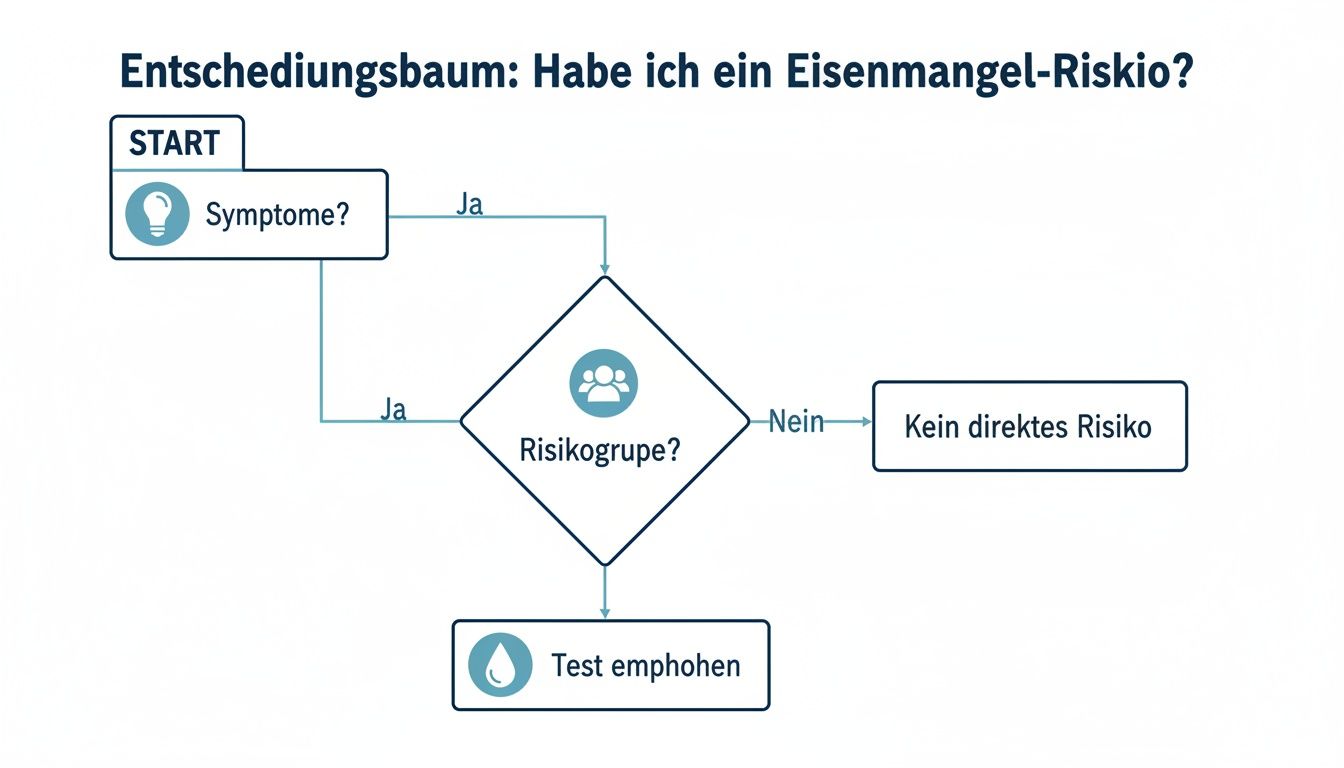
The decision tree makes it clear: If you notice symptoms and belong to a risk group, taking a test is the logical next step toward greater clarity.
Did you know? Iron deficiency is the most common nutrient deficiency worldwide and one of the leading causes of hair loss in women. One study showed that 59 percent of women with excessive hair loss also had an iron deficiency. Dermatologists on their website provide more detailed information on this.
Your path to clarity—right from home
Instead of waiting weeks for a doctor's appointment, you can take control yourself. A mybody-x nutrient test makes it possible to check your iron levels easily, quickly, and discreetly from home. This allows you to avoid waiting times and receive precise results directly on your smartphone.
The process is really straightforward and takes away the uncertainty:
- Order the test kit: You conveniently order the nutrient test online and have it delivered to your home.
- Collect your sample: Using a small lancet, you take a few drops of blood from your fingertip yourself—it is quick and barely hurts.
- Return it free of charge: You send your sample in the enclosed return envelope to our certified partner laboratory in Germany.
- Receive your results: After a few days, you will receive a detailed, easy-to-understand results report in your personal online area.
This report not only shows you your exact results, but also provides concrete, personalized recommendations for action. That way, you know exactly what to do to replenish your stores. If you would like to learn more about how it all works, take a closer look at our at-home iron test. This finally gives you certainty and allows you to take targeted action against hair loss caused by iron deficiency.
Your roadmap to full, healthy hair
A confirmed iron deficiency is not the end point, but the decisive starting point for your solution. You now have certainty and can finally take targeted action. This section is your personal roadmap, showing you in practical terms how to systematically replenish your iron stores to stop hair loss caused by iron deficiency. We focus on the two most important pillars: smart nutrition and targeted supplements.
This allows you to take active control and create the best conditions for your hair to grow back strong. It’s not about completely turning your life upside down, but about adjusting the right levers.
Pillar 1: The right diet as a foundation
Your diet is the foundation for everything. To replenish your iron stores, you need to regularly provide your body with iron-rich foods. However, there is a crucial difference between animal-based and plant-based sources of iron that you should know.
-
Animal-based iron (heme iron): Your body can absorb this form best of all. You’ll find it primarily in red meat such as beef or lamb, but also in liver and egg yolks. You could say it’s the “express route” to getting enough iron.
-
Plant-based iron (non-heme iron): This iron is somewhat trickier for your body to use. Top sources include lentils, chickpeas, quinoa, pumpkin seeds, oats, and green leafy vegetables such as spinach. Even though absorption is somewhat lower, these foods are extremely important, especially if you follow a vegetarian or vegan diet.
The real trick, however, lies in the right combination. You can cleverly increase the absorption of plant-based iron.
Vitamin C is iron’s best friend. It converts plant-based iron into a form that your body can absorb much more easily. Adding a bell pepper to a lentil salad or drinking a glass of orange juice with your oatmeal can increase iron absorption many times over.
Just as there are helpers, unfortunately there are also so-called “iron thieves.” These are substances that block the absorption of iron in the intestines. If you’re currently working to replenish your stores, you should consciously avoid them or eat or drink them some time apart from your iron-rich meals.
These foods inhibit iron absorption:
- Coffee and black tea: The tannins they contain bind iron and make it unusable by the body. Wait at least two hours after an iron-rich meal before enjoying your coffee.
- Dairy products: The calcium in milk, yogurt, or cheese competes with iron for absorption in the intestines.
- Whole-grain products: Although they contain iron themselves, the phytates they contain can unfortunately inhibit absorption somewhat.
If you want to delve deeper into the topic, you’ll find many more tips and delicious recipe ideas for the optimal diet for iron deficiency in our guide.
Pillar 2: Targeted supplementation for fast results
Changing your diet is essential, but when a significant deficiency has been confirmed, it is often not enough to replenish depleted stores quickly and effectively. Imagine your iron stores as a large barrel that is almost empty. With diet alone, you would fill it only drop by drop—which could take months or even years.
This is where targeted dietary supplements come into play. They are the fastest way to correct the deficiency and give your body the foundation it needs to finally focus on hair growth again.
When is supplementation advisable? Quite simply: Whenever a blood test, such as the mybody-x nutrient test, reveals a deficiency, particularly a low ferritin level. Taking iron purely on suspicion is not a good idea, as too much iron can also be harmful.
The major advantage of your mybody-x test result lies in its personalized recommendations for action. You learn not only that a deficiency exists, but also receive specific suggestions on how best to correct it.
Instead of choosing just any supplement from the drugstore, your individual test results help you find the right dosage for your personal needs. This not only makes the treatment safer but also significantly more effective.
So your roadmap is clear: Use your blood test results as a foundation, optimize your diet with iron-rich foods and smart combinations, and replenish your stores strategically with the supplements that suit you. This creates the perfect foundation to stop hair loss and pave the way for new, healthy hair growth.
When you can expect the first results
You’ve changed your diet, may be taking targeted iron supplements, and are now wondering hopefully: When will I finally see signs that something is happening? This question is more than understandable, because the desire for full, healthy hair is strong. But it’s important to remain realistic. Replenishing your iron stores is a marathon, not a sprint.
Your body is very pragmatic about this: It has clear priorities. Only when your iron stores—that is, your ferritin level—are back at a healthy level and all vital functions are adequately supplied does it direct excess iron to less critical areas. Hair growth is one of them. This replenishment process often takes several months.
The hair cycle determines the timeline
Patience is your most important ally right now, and there is a simple biological reason for this: the hair cycle. Even if your hair roots are optimally supplied with nutrients again from today onward, they will not respond overnight. The hairs that were already in the shedding phase (telogen phase) will fall out normally over the coming weeks and months. This is a natural process that you cannot stop immediately.
Only once the cycle has normalized will more hairs remain in the long growth phase (anagen phase). And this transition simply takes time.
A realistic timeline: As a rule, you can expect the first visible results after about three to six months of consistent treatment. This does not mean your hair will already be full again, but you will probably notice two very important things.
The first signs of improvement
The positive changes happen gradually and may be very subtle at first. Look out for these two important signs that show you are absolutely on the right track:
- Hair loss decreases: You notice noticeably less hair in your brush, the shower drain, or on your pillow. This is the first and most important sign that the treatment is working and your hair cycle is slowly stabilizing again.
- New “baby hairs” start to grow: After a few months, you will probably notice fine, new hairs sprouting along your hairline. These new, stronger hairs are visible proof that your follicles are active and healthy again.
This information is intended to motivate you to stay consistent, even if the first few weeks feel frustrating. Every day that you nourish your body well is an investment in your future hair. Consistency is the true key to success here.
Your questions about hair loss and iron deficiency—answered briefly and clearly
Here, I have gathered the most important questions that keep coming up in connection with hair loss due to iron deficiency. This way, you can quickly and clearly get an answer to what concerns you most right now.
Can hair loss caused by iron deficiency go away?
Yes, and that is the really good news: In the vast majority of cases, hair loss caused solely by iron deficiency is completely reversible. Once you replenish your iron stores—whether through a conscious change in diet or targeted supplements—the hair growth cycle can return to normal.
Your hair roots finally receive the nutrients they need to produce healthy, strong hair again. However, a little patience is required. It usually takes three to six months before you see a noticeable improvement and new hair starts to grow.
Which ferritin level is crucial for healthy hair growth?
Medical reference ranges often start at just 15–30 µg/l to rule out actual anemia. But that is far too low for optimal hair growth. Hair experts agree: Your ferritin level should be at least 50 µg/l, and ideally above 70 µg/l.
A level that is still within the lower “normal range” may already constitute a deficiency for your hair. The reason is that your body supplies the vital organs first. That simply leaves too little for your hair. A mybody-x nutrient test gives you precise information about where you stand.
Is an iron-rich diet enough to correct the deficiency?
For a mild deficiency or to keep your stores topped up, a conscious diet can already make a big difference. But if your stores are truly depleted, meaning your ferritin level is very low, it becomes difficult and, above all, very time-consuming to correct the deficiency through food alone.
In such cases, high-quality iron supplements—based on a specific test result—are the faster and more effective option. They help replenish your stores and sustainably stimulate hair growth.
Should I just take iron supplements as a precaution?
No, absolutely not. This is a really important point. You should never take iron supplements without a confirmed deficiency. Too much iron can cause oxidative stress in the body and may potentially harm your organs.
That is why it is so crucial to check your iron status with a blood test beforehand. This ensures that you give your body exactly what it really needs—not too much and not too little.
Do you finally want clarity about your iron status and the cause of your hair loss? With mybody-x, you can easily check your nutrient levels from home and receive clear, understandable results with personalized recommendations. Take control of your health now. Learn more about mybody-x health tests



Share now:
Your Metabolism Analysis Test: Find the nutrition strategy that truly suits you
Speed up your metabolism: 8 home remedies that really work